Kirjojen hintavertailu. Mukana 12 093 950 kirjaa ja 12 kauppaa.

Kirjahaku

Etsi kirjoja tekijän nimen, kirjan nimen tai ISBN:n perusteella.

1000 tulosta hakusanalla Alfred N. Meiss

Biomedical Engineering Principles

Biomedical Engineering Principles

Arthur B. Ritter; Vikki Hazelwood; Antonio Valdevit; Alfred N. Ascione

CRC Press
2018
nidottu
Current demand in biomedical sciences emphasizes the understanding of basic mechanisms and problem solving rather than rigid empiricism and factual recall. Knowledge of the basic laws of mass and momentum transport as well as model development and validation, biomedical signal processing, biomechanics, and capstone design have indispensable roles in the engineering analysis of physiological processes. To this end, an introductory, multidisciplinary text is a must to provide the necessary foundation for beginning biomedical students.Assuming no more than a passing acquaintance with molecular biology, physiology, biochemistry, and signal processing, Biomedical Engineering Principles, Second Edition provides just such a solid, accessible grounding to this rapidly advancing field. Acknowledging the vast range of backgrounds and prior education from which the biomedical field draws, the organization of this book lends itself to a tailored course specific to the experience and interests of the student.Divided into four sections, the book begins with systems physiology, transport processes, cell physiology, and the cardiovascular system. Part I covers systems analysis, biological data, and modeling and simulation in experimental design, applying concepts of diffusion, and facilitated and active transport. Part II presents biomedical signal processing, reviewing frequency, periodic functions, and Fourier series as well as signal acquisition and processing techniques.Part III presents the practical applications of biomechanics, focusing on the mechanical and structural properties of bone, musculoskeletal, and connective tissue with respect to joint range, load bearing capacity, and electrical stimulation. The final part highlights capstone design, discussing design perspectives for living and nonliving systems, the role of the FDA, and the project timeline from inception to proof of concept.Cutting across many disciplines, Biomedical Engineering Principles, Second Edition offers illustrative examples as well as problems and discussion questions designed specifically for this book to provide a readily accessible, widely applicable introductory text.
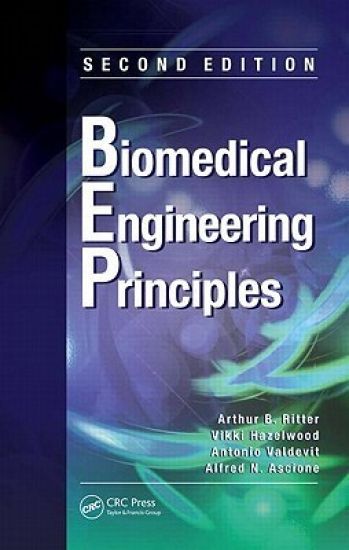
Biomedical Engineering Principles

Biomedical Engineering Principles

Arthur B. Ritter; Vikki Hazelwood; Antonio Valdevit; Alfred N. Ascione

CRC Press Inc
2011
sidottu
Current demand in biomedical sciences emphasizes the understanding of basic mechanisms and problem solving rather than rigid empiricism and factual recall. Knowledge of the basic laws of mass and momentum transport as well as model development and validation, biomedical signal processing, biomechanics, and capstone design have indispensable roles in the engineering analysis of physiological processes. To this end, an introductory, multidisciplinary text is a must to provide the necessary foundation for beginning biomedical students.Assuming no more than a passing acquaintance with molecular biology, physiology, biochemistry, and signal processing, Biomedical Engineering Principles, Second Edition provides just such a solid, accessible grounding to this rapidly advancing field. Acknowledging the vast range of backgrounds and prior education from which the biomedical field draws, the organization of this book lends itself to a tailored course specific to the experience and interests of the student.Divided into four sections, the book begins with systems physiology, transport processes, cell physiology, and the cardiovascular system. Part I covers systems analysis, biological data, and modeling and simulation in experimental design, applying concepts of diffusion, and facilitated and active transport. Part II presents biomedical signal processing, reviewing frequency, periodic functions, and Fourier series as well as signal acquisition and processing techniques.Part III presents the practical applications of biomechanics, focusing on the mechanical and structural properties of bone, musculoskeletal, and connective tissue with respect to joint range, load bearing capacity, and electrical stimulation. The final part highlights capstone design, discussing design perspectives for living and nonliving systems, the role of the FDA, and the project timeline from inception to proof of concept.Cutting across many disciplines, Biomedical Engineering Principles, Second Edition offers illustrative examples as well as problems and discussion questions designed specifically for this book to provide a readily accessible, widely applicable introductory text.
Antiques, Their Restoration and Preservation

Antiques, Their Restoration and Preservation

A. (Alfred) 1867-1945 N. 9107 Lucas

Hassell Street Press
2021
nidottu
This work has been selected by scholars as being culturally important and is part of the knowledge base of civilization as we know it.This work is in the public domain in the United States of America, and possibly other nations. Within the United States, you may freely copy and distribute this work, as no entity (individual or corporate) has a copyright on the body of the work.Scholars believe, and we concur, that this work is important enough to be preserved, reproduced, and made generally available to the public. To ensure a quality reading experience, this work has been proofread and republished using a format that seamlessly blends the original graphical elements with text in an easy-to-read typeface.We appreciate your support of the preservation process, and thank you for being an important part of keeping this knowledge alive and relevant.
The boy knight; a tale of the crusade, By G. A. Henty (illustrated): George Alfred Henty (8 December 1832 - 16 November 1902) was a prolific English n
George Alfred Henty (8 December 1832 - 16 November 1902) was a prolific English novelist and war correspondent.He is best known for his historical adventure stories that were popular in the late 19th century. His works include The Dragon & The Raven (1886), For The Temple (1888), Under Drake's Flag (1883) and In Freedom's Cause (1885).G. A. Henty was born in Trumpington, near Cambridge. He was a sickly child who had to spend long periods in bed. During his frequent illnesses he became an avid reader and developed a wide range of interests which he carried into adulthood. He attended Westminster School, London, and later Gonville and Caius College, Cambridge, where he was a keen sportsman. He left the university early without completing his degree to volunteer for the Army Hospital Commissariat when the Crimean War began. He was sent to the Crimea and while there he witnessed the appalling conditions under which the British soldier had to fight. His letters home were filled with vivid descriptions of what he saw. His father was impressed by his letters and sent them to The Morning Advertiser newspaper which printed them. This initial writing success was a factor in Henty's later decision to accept the offer to become a special correspondent, the early name for journalists now better known as war correspondents.Shortly before resigning from the army as a captain in 1859 he married Elizabeth Finucane. The couple had four children. Elizabeth died in 1865 after a long illness and shortly after her death Henty began writing articles for the Standard newspaper. In 1866 the newspaper sent him as their special correspondent to report on the Austro-Italian War where he met Giuseppe Garibaldi. He went on to cover the 1868 British punitive expedition to Abyssinia, the Franco-Prussian War, the Ashanti War, the Carlist Rebellion in Spain ..........
Alfred Marshall and Modern Economics

Alfred Marshall and Modern Economics

N. Hart

Palgrave Macmillan
2013
sidottu
Alfred Marshall and Modern Economics re-examines Marshall's legacy and relevance to modern economic analysis with the more settled conventional wisdom concerning evolutionary processes allowing advances in economic theorising which were not possible in Marshall's life time.
Alfred Marshall and Modern Economics

Alfred Marshall and Modern Economics

N. Hart

Palgrave Macmillan
2013
nidottu
Alfred Marshall and Modern Economics re-examines Marshall's legacy and relevance to modern economic analysis with the more settled conventional wisdom concerning evolutionary processes allowing advances in economic theorising which were not possible in Marshall's life time.