

Kirjahaku
Etsi kirjoja tekijän nimen, kirjan nimen tai ISBN:n perusteella.
164 tulosta hakusanalla Anat Umansky

Paulicki, A: Beiträge zur vergleichenden pathologischen Anat
August Paulicki
Antigonos Verlag
2024
nidottu
Carcenac, M: Sciences chirurgicales, sciences médicale, anat
Antigonos Verlag
2025
nidottu
Carcenac, M: Sciences chirurgicales, sciences médicale, anat
Antigonos Verlag
2025
sidottu
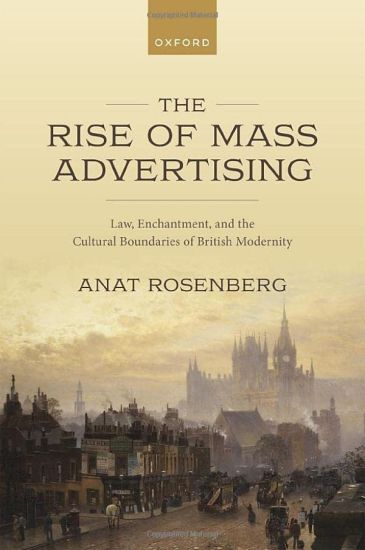
This is an open access title available under the terms of a CC BY-NC-ND 4.0 International licence. It is free to read at Oxford Scholarship Online and offered as a free PDF download from OUP and selected open access locations. The Rise of Mass Advertising is a first cultural legal history of advertising in Britain, tracing the rise of mass advertising c.1840-1914 and its legal shaping. The emergence of this new system disrupted the perceived foundations of modernity. The idea that culture was organized by identifiable fields of knowledge, experience, and authority came under strain as advertisers claimed to share values with the era's most prominent fields, including news, art, science, and religiously inflected morality. While cultural boundaries grew blurry, the assumption that the world was becoming progressively disenchanted was undermined, as enchanted experiences multiplied with the transformation of everyday environments by advertising. Magical thinking, a dwelling in mysteries, searches for transfiguration, affective connection between humans and things, and powerful fantasy disrupted assumptions that the capitalist economy was a victory of reason. The Rise of Mass Advertising examines how contemporaries came to terms with the disruptive impact by mobilizing legal processes, powers, and concepts. Law was implicated in performing boundary work that preserved the modern sense of field distinctions. Advertising's cultural meanings and its organization were shaped dialectically vis-à-vis other fields in a process that mainstreamed and legitimized it with legal means, but also construed it as an inferior simulation of the values of a progressive modernity, exhibiting epistemological shortfalls and aesthetic compromises that marked it apart from adjacent fields. The dual treatment meanwhile disavowed the central role of enchantment, in what amounted to a normative enterprise of disenchantment. One of the ironies of this enterprise was that it ultimately drove professional advertisers to embrace enchantment as their peculiar expertise. The analysis draws on an extensive archive that bridges disciplinary divides. It offers a novel methodological approach to the study of advertising, which brings together the history of capitalism, the history of knowledge, and the history of modern disenchantment, and yields a new account of advertising's significance for modernity.

Developmental research is abandoning formal syntax, probably because Chomskyan generative syntax lacks psychological reality. Some studies opt for pure statistics-based definitions of syntactic knowledge, as if humans were similar to Large Language Models of AI and had no structurally meaningful concepts of syntactic relations. Others tend to Constructivist syntax, where patterns of elements are said to possess associated semantic meaning. The problem is that the core syntactic relations that young children acquire, such as verb-object and verb-subject combinations, do not possess particular associated semantics, meaning that the Constructivist approach is not a helpful vehicle for understanding syntactic acquisition. In this book, Anat Ninio approaches syntactic development from a novel point of view, within the framework of Relevance Theory, a theory of pragmatics with a strong commitment to a cognitive conceptualization of linguistic competence. This theory's architecture of linguistic information acknowledges the existence of procedural instructions as part of the content of words, covering various processing acts, including syntactic combination. Methodologically, the study employs computer programming algorithms as heuristic models for the cognitive combinatory processes of syntax, computer programs being a close analogue to mental plans for solving computational problems. The unusual framework and methodology adopted in the book represent a break with current approaches in developmental psycholinguistics and perhaps even with the teachings of mainstream linguistics. The first part of the book proposes a procedural syntax of the central patterns of English, covering argument-structure constructions, phrasal and clausal combinations of function words and content words, wh-questions, relative clauses, and coordination and gapping. This modelling resolves significant issues that have been eluding linguistic theory for decades. The second part of the book describes the development of certain syntactic procedures in English-speaking children, employing a microgenetic analysis to demonstrate that syntactic learning is guesswork by trial and error. Despite the apparent chaos, the many different attempts that children make to arrive at some syntactic construct belong to a single learning process, and gradually converge on the adult algorithm. Defining syntax in terms of combinatory procedures provides a novel perspective on our 'predictive brain', on language structure, and on cross-linguistic variation.

Language development remains one of the most hotly debated topics in the cognitive sciences. In recent years we have seen contributions to the debate from researchers in psychology, linguistics, artificial intelligence, and philosophy, though there have been surprisingly few interdisciplinary attempts at unifying the various theories. In Language and the Learning Curve, a leading researcher in the field offers a radical new view of language development. Drawing on formal linguistic theory (the Minimalist Program, Dependency Grammars), cognitive psychology (skill learning) computational linguistics (Zipf curves), and Complexity Theory (networks), it takes the view that syntactic development is a simple process and that syntax can be learned just like any other cognitive or motor skill. In a thought provoking and accessible style, it develops a learning theory of the acquisition of syntax that builds on the contribution of the different source theories in a detailed and explicit manner. Each chapter starts by laying the relevant theoretical background, before examining empirical data on child language acquisition. The result is a bold new theory of the acquisition of syntax, unusual in its combination of Chomskian linguistics and learning theory. Language and the Learning Curve is an important new work that challenges many of our usual assumptions about syntactic development.

Language development remains one of the most hotly debated topics in the cognitive sciences. In recent years we have seen contributions to the debate from researchers in psychology, linguistics, artificial intelligence, and philosophy, though there have been surprisingly few interdisciplinary attempts at unifying the various theories. In Language and the Learning Curve, a leading researcher in the field offers a radical new view of language development. Drawing on formal linguistic theory (the Minimalist Program, Dependency Grammars), cognitive psychology (Skill Learning) computational linguistics (Zipf curves), and Complexity Theory (networks), it takes the view that syntactic development is a simple process and that syntax can be learned just like any other cognitive or motor skill. In a thought provoking and accessible style, it develops a learning theory of the acquisition of syntax that builds on the contribution of the different source theories in a detailed and explicit manner. Each chapter starts by laying the relevant theoretical background, before examining empirical data on child language acquisition. The result is a bold new theory of the acquisition of syntax, unusual in its combination of Chomskian linguistics and learning theory. Language and the Learning Curve is an important new work that challenges many of our usual assumptions about syntactic development.
Simone Weil once wrote that "the vulnerability of precious things is beautiful because vulnerability is a mark of existence," establishing a relationship between vulnerability, beauty, and existence transcending the separation of species. Her conception of a radical ethics and aesthetics could be characterized as a new poetics of species, forcing a rethinking of the body's significance, both human and animal. Exploring the "logic of flesh" and the use of the body to mark species identity, Anat Pick reimagines a poetics that begins with the vulnerability of bodies, not the omnipotence of thought. Pick proposes a "creaturely" approach based on the shared embodiedness of humans and animals and a postsecular perspective on human-animal relations. She turns to literature, film, and other cultural texts, challenging the familiar inventory of the human: consciousness, language, morality, and dignity. Reintroducing Weil's elaboration of such themes as witnessing, commemoration, and collective memory, Pick identifies the animal within all humans, emphasizing the corporeal and its issues of power and freedom. In her poetics of the creaturely, powerlessness is the point at which aesthetic and ethical thinking must begin.
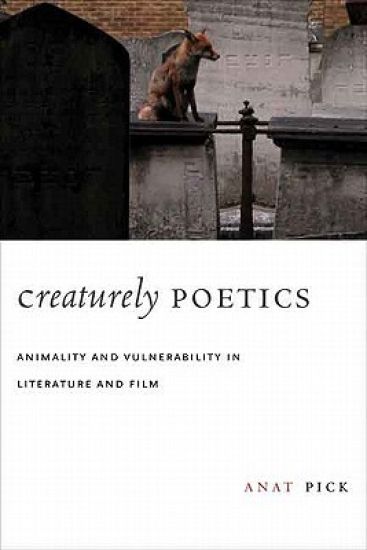
Simone Weil once wrote that "the vulnerability of precious things is beautiful because vulnerability is a mark of existence," establishing a relationship between vulnerability, beauty, and existence transcending the separation of species. Her conception of a radical ethics and aesthetics could be characterized as a new poetics of species, forcing a rethinking of the body's significance, both human and animal. Exploring the "logic of flesh" and the use of the body to mark species identity, Anat Pick reimagines a poetics that begins with the vulnerability of bodies, not the omnipotence of thought. Pick proposes a "creaturely" approach based on the shared embodiedness of humans and animals and a postsecular perspective on human-animal relations. She turns to literature, film, and other cultural texts, challenging the familiar inventory of the human: consciousness, language, morality, and dignity. Reintroducing Weil's elaboration of such themes as witnessing, commemoration, and collective memory, Pick identifies the animal within all humans, emphasizing the corporeal and its issues of power and freedom. In her poetics of the creaturely, powerlessness is the point at which aesthetic and ethical thinking must begin.

In March 1968, against the background of the Six-Day War, a campaign of antisemitism and anti-Zionism swept through Poland. The Expulsion of Jews from Communist Poland is the first full-length study of the events, their precursors, and the aftermath of this turbulent period. Plocker offers a new framework for understanding how this antisemitic campaign was motivated by a genuine fear of Jewish influence and international power. She sheds new light on the internal dynamics of the communist regime in Poland, stressing the importance of middle-level functionaries, whose dislike and fear of Jews had an unmistakable impact on the evolution of party policy. The Expulsion of Jews from Communist Poland examines how Communist Party leader Wladyslaw Gomulka's anti-Zionist rhetoric spiraled out of hand and opened up a fraught Pandora's box of old assertions that Jews controlled the Communist Party, the revival of nationalist chauvinism, and a witch hunt in universities and workplaces that conjured up ugly memories of Nazi Germany.

In March 1968, against the background of the Six-Day War, a campaign of antisemitism and anti-Zionism swept through Poland. The Expulsion of Jews from Communist Poland is the first full-length study of the events, their precursors, and the aftermath of this turbulent period. Plocker offers a new framework for understanding how this antisemitic campaign was motivated by a genuine fear of Jewish influence and international power. She sheds new light on the internal dynamics of the communist regime in Poland, stressing the importance of middle-level functionaries, whose dislike and fear of Jews had an unmistakable impact on the evolution of party policy. The Expulsion of Jews from Communist Poland examines how Communist Party leader Wladyslaw Gomulka's anti-Zionist rhetoric spiraled out of hand and opened up a fraught Pandora's box of old assertions that Jews controlled the Communist Party, the revival of nationalist chauvinism, and a witch hunt in universities and workplaces that conjured up ugly memories of Nazi Germany.

Suicide bombers are often compared to smart bombs. From the point of view of their dispatchers, they are highly effective, inexpensive forms of weaponry, and there is no need to invest in their technological development. Suicide bombers are in fact smarter than smart bombs because they can choose their own target—and they can react to circumstances on the ground, changing their target, or their timing, in an instant, to ensure the maximum damage, destruction, and death. Of course, unlike smart bombs, suicide bombers think and feel, they have histories, stories, beliefs, desires—in short, they have an inner world. Exploring the inner world of suicide bombers has been the focus of Anat Berko's research for years. She has worked to understand the thought processes of a people who can choose to place explosives on their bodies and kill themselves, taking as many other people with them as they can.Do male bombers really believe that death will transport them to a paradise where they will be greeted by virgins? Are they victims of unbearable pressure to commit this act of terror? What are female bombers promised in the hereafter? Is there something that links all suicide bombers? Berko also explores the world of those who drop the smart bomb—the dispatchers: who are these people who persuade others to go calmly to their horrific deaths?

Pituitary Disorders, An Issue of Endocrinology and Metabolism Clinics of North America
Anat Ben-Shlomo
Elsevier - Health Sciences Division
2015
sidottu
This issue of Endocrinology and Metabolism Clinics, edited by Drs. Anat Ben-Shlomo and Maria Fleseriu, is devoted to Pituitary Disorders. Articles in this issue include: Pathogenesis of Pituitary Tumors; Prognostic Clinicopathological Classification of Pituitary Adenomas; Familial Isolated Pituitary Adenomas (FIPA) and Mutations in the Aryl Hydrocarbon Receptor Interacting Protein (AIP) Gene; Pitfalls of IGF1 and GH Assays; Acromegaly: Pharmacotherapy; Hypothalamo-pituitary-adrenal Axis Testing; Pharmacotherapy of Cushing Disease: New Targets; Prolactinomas; Non-functioning Pituitary Tumors; Cabergoline Use for Pituitary Tumors and Valvular Disorders; Aggressive Atypical Pituitary Tumors and Carcinoma; Outcomes of Endoscopic Transsphenoidal Pituitary Surgery; Efficacy and Complications of Pituitary Irradiation; Hypopituitarism: GH and ACTH Deficiency; Hypophysitis; Hypopituitarism After Traumatic Brain Injury; Quality of Life in Pituitary Diseases; Pituitary and Bone Disease; Pituitary Tumor Management in Pregnancy; and Pituitary Apoplexy.

This report surveys international terrorism in 1988. It is the fifth annual survey of its kind published by the Jaffee Center for Strategic Studies' Project on Low intensity Varfare. As in previous years' reports, the current survey contains statistical data that delineate various aspects of international terrorism, as well as brief articles that

This survey delineates various aspects of and major issues in international terrorism in 1986, focusing on western states' policies on terrorism and the use of and support for terrorism by Middle Eastern states. It also presents an analysis of trends in Palestinian terrorism.

This annual publication contains statistical data on international terrorism in 1989, as well as brief analyses of key terrorism-related issues. Extensive tables are accompanied by a chronology of significant international terrorist events in 1989 and a glossary of terrorist organizations.

Winner of the 2021 ABAPsa Book Prize Award!What would the story of analysis look like if it were told through the eyes of the analysand? How would the patient write and present the analytic experience? How would the narrative as written by the analysand differ from the analytic narrative commonly offered by the analyst? What do the actual analytic narratives written by Freud’s patients look like?This book aims to confront these intriguing questions with an innovative reading of memoirs by Freud’s patients. These patients—including Sergei Pankejeff, known as the Wolf Man; the poet H. D.; and the American psychoanalyst Abram Kardiner—all came to Vienna specially to meet Freud and embark with him on the intimate and thrilling journey of deciphering the unconscious and unravelling the secrets of the psyche. A broad psychoanalytic and literary-historical reading of their memoirs is offered in this new entry to the popular Routledge History of Psychoanalysis Series, with the purpose of presenting the analysands' narratives as they themselves recounted them. This makes it possible to re-examine the links among psychoanalysis, literature, and translation and sheds new light on the complex challenge of coming to know oneself through the encounter with otherness. This book is unique in its focus on multiple memoirs by patients of Freud and presents a fresh, even startling, close-up look at psychoanalysis as a clinical practice and as a rigorous discourse and offers a new vision of Freud’s strengths and, at times, defects. It will be of considerable interest to scholars of psychoanalysis and intellectual history, as well as those with a wider interest in literature and memoir.

Winner of the 2021 ABAPsa Book Prize Award!What would the story of analysis look like if it were told through the eyes of the analysand? How would the patient write and present the analytic experience? How would the narrative as written by the analysand differ from the analytic narrative commonly offered by the analyst? What do the actual analytic narratives written by Freud’s patients look like?This book aims to confront these intriguing questions with an innovative reading of memoirs by Freud’s patients. These patients—including Sergei Pankejeff, known as the Wolf Man; the poet H. D.; and the American psychoanalyst Abram Kardiner—all came to Vienna specially to meet Freud and embark with him on the intimate and thrilling journey of deciphering the unconscious and unravelling the secrets of the psyche. A broad psychoanalytic and literary-historical reading of their memoirs is offered in this new entry to the popular Routledge History of Psychoanalysis Series, with the purpose of presenting the analysands' narratives as they themselves recounted them. This makes it possible to re-examine the links among psychoanalysis, literature, and translation and sheds new light on the complex challenge of coming to know oneself through the encounter with otherness. This book is unique in its focus on multiple memoirs by patients of Freud and presents a fresh, even startling, close-up look at psychoanalysis as a clinical practice and as a rigorous discourse and offers a new vision of Freud’s strengths and, at times, defects. It will be of considerable interest to scholars of psychoanalysis and intellectual history, as well as those with a wider interest in literature and memoir.