
Kirjahaku
Etsi kirjoja tekijän nimen, kirjan nimen tai ISBN:n perusteella.
1000 tulosta hakusanalla Andrew Thomson


John Owen (1616–1683) was one of the defining theologians in the Christian era. His books have been continually in print and are still influential today. Educated at Queen’s College, Oxford, he was a moderate Presbyterian who became a Congregationalist after reading a book by John Cotton. He later helped draw up the Savoy Declaration, the Congregational Basis of Faith. During the English Civil War Owen was wholly on the side of the Parliamentarians, accompanying Cromwell on expeditions to Scotland and Ireland as Chaplain. Owen was influential in national life and was made Vice–Chancellor of Christ Church Oxford. After the Restoration of the Monarchy he was ejected from this position and devoted his energies to developing ‘godly and learned men’, in writing commentaries and devotional books, and in defending nonconformists from state persecution. Andrew Thomson uses various sources for this biography including Owen’s adversaries ‘who could not be silent on so great a name or withhold reluctant praise.’

Few British pastors can claim to have written a book that is amongst the 'life-books of their generation', yet Boston is one. His Fourfold State of Man has been the instrument of countless conversions and could be said to have changed the zeitgeist of his era as effectively as Luther's Commentary on Galations, Alleine's Alarm to the Unconverted, Bunyan's Pilgrim's Progress, Edwards' Sinners in the Hands of an Angry God, Wilberforce's True Christianity or Lewis' Mere Christianity.



Reprint of the original, first published in 1882.

Reprint of the original, first published in 1882.



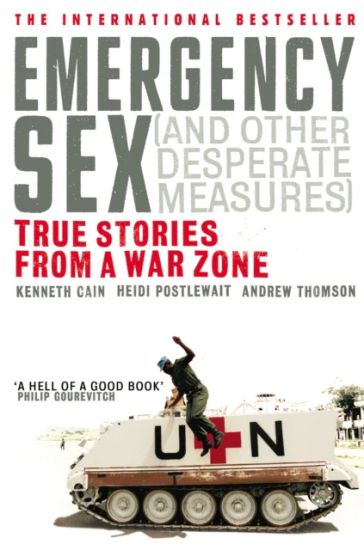
Emergency Sex (And Other Desperate Measures)
Andrew Thomson; Heidi Postlewait; Kenneth Cain
Ebury Press
2006
pokkari
Deeply critical of the West's indifference to developing countries and the UN's repeated failure to intervene decisively, the book provoked massive controversy on its initial publication.

Changing Patterns of Management Development
Andrew Thomson; Christopher Mabey; John Storey; Colin S. Gray; Paul Iles
Blackwell Publishers
2001
nidottu
Written in a highly accessible style by a small distinguished team, this is a wide-ranging account of the whole subject of management development, underpinned by the most extensive data set ever made available.

Four Lectures To Young Men
Andrew Thomson; Alexander Fraser; William Cunningham
KESSINGER PUBLISHING CO
2009
pokkari

The Precentor's Guide To The Selection Of Tunes Suited To The Character And Metres Of The Psalms, Paraphrases, And Hymns Adopted By The United Presbyterian Church (1853)
Andrew Thomson; Matthew McGavin
KESSINGER PUBLISHING, LLC
2010
sidottu

Four Lectures To Young Men
Andrew Thomson; Alexander Fraser; William Cunningham
KESSINGER PUBLISHING, LLC
2010
sidottu

The Precentor's Guide To The Selection Of Tunes Suited To The Character And Metres Of The Psalms, Paraphrases, And Hymns Adopted By The United Presbyterian Church (1853)
Andrew Thomson; Matthew McGavin
KESSINGER PUBLISHING, LLC
2008
nidottu
The War on Terror has remained an enduring feature of American foreign policy for over two decades. This short history positions the War on Terror within the broader context of Cold War interventionism and the rise of various transnational threats to American (and global) security during the late twentieth century. It introduces readers to the main concepts, debates and theories which have been used to understand and make sense of the War on Terror. These include approaches that frame it as a disparate set of policies aimed at reducing the risk of terrorist attacks against American citizens at both home and aboard; as part of a project aimed at helping maintain the United States’ dominant position within international politics; and as an idea intimately bound up with perceptions of American national identity and America’s place in the world. In this way, the book aims to show how the War on Terror has changed global politics, as well as why it has been fought and proven so difficult to end despite multiple failed attempts at course correction. The book is ideally suited for courses on international security, American foreign policy and contemporary world politics.

The War on Terror has remained an enduring feature of American foreign policy for over two decades. This short history positions the War on Terror within the broader context of Cold War interventionism and the rise of various transnational threats to American (and global) security during the late twentieth century. It introduces readers to the main concepts, debates and theories which have been used to understand and make sense of the War on Terror. These include approaches that frame it as a disparate set of policies aimed at reducing the risk of terrorist attacks against American citizens at both home and aboard; as part of a project aimed at helping maintain the United States’ dominant position within international politics; and as an idea intimately bound up with perceptions of American national identity and America’s place in the world. In this way, the book aims to show how the War on Terror has changed global politics, as well as why it has been fought and proven so difficult to end despite multiple failed attempts at course correction. The book is ideally suited for courses on international security, American foreign policy and contemporary world politics.