
Kirjahaku
Etsi kirjoja tekijän nimen, kirjan nimen tai ISBN:n perusteella.
540 tulosta hakusanalla Aparna Gupta

Microwaves in Chemistry Applications
Aparna Das; Bimal Banik
Elsevier Science Publishing Co Inc
2021
nidottu
Microwaves in Chemistry Applications: Fundamentals, Methods and Future Trends offers a number of benefits over conventional heating technologies, including acceleration of reaction rates, milder reaction conditions, higher chemical yields, lower energy usage and different reaction selectivity, all of which can improve the sustainability of processes. The book provides valuable insights into the underlying chemistry at play in microwave-assisted processes, introducing fundamental concepts, discussing the modeling of reactions in such processes, and also highlighting a range of key methods and applications of microwaves in chemistry for improved sustainability. Beginning with an introduction to microwave chemistry, Part One discusses foundational principles, equipment and approaches for modeling reactions and assessing the outputs of those models. Methods in microwave chemistry are then the focus of Part Two, with microwave-assisted synthesis, catalysis, reduction and reactions all explored in detail. Part Three reflects on the practical usage of these methods to address specific issues, covering a number of interesting applications.

In Divya’s hair, you will find pencils, peanuts and paintbrushes! All because Divya refuses to wash her hair.
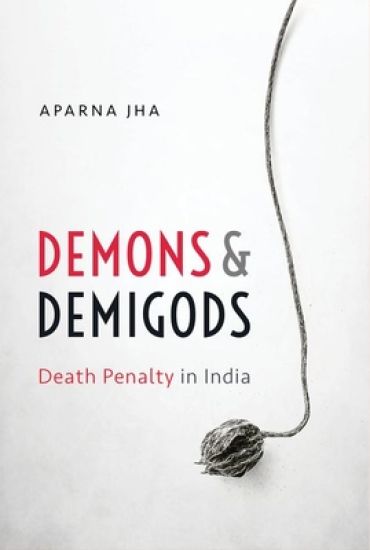
The capital punishment is a subject of great debate not only in India, but also across the world. While some countries have abolished this practice terming it inhuman and degrading, others have retained it as a means of deterrence. In India, the death penalty continues to be in practice. The author in this book argues that the death penalty be abolished in India. She strengthens her argument with the help of a personal narrative recounting her experience as a lawyer in arguing a case in the Supreme Court, in which four young men had been sentenced to death by the trial court. The sentence of death delivered by the trial court was upheld by the Bombay High Court. The author, however, along with her senior successfully defended the accused in the Supreme Court, and got their death penalty converted to life imprisonment. To further supplement her position against the death penalty, the author critically analyses the landmark cases, which have shaped the law on the capital punishment in India, and interprets the views of experts on the subject. She also examines a few foreign jurisdictions, and provides a comparative perspective on the issue of the death penalty.
Cosmo-Modernism and Theater in India
Aparna Bhargava Dharwadker
Columbia University Press
2025
sidottu
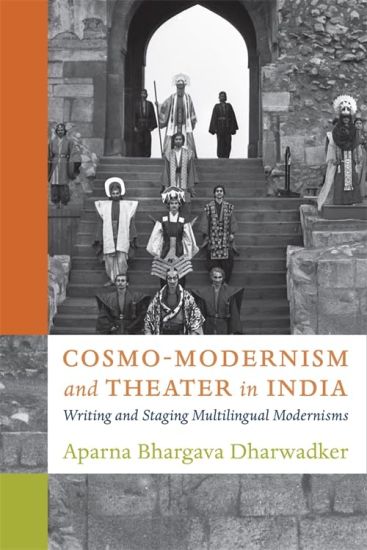
Urban theater took shape in postindependence India as a large and complex field produced in more than sixteen major languages, including Bengali, Marathi, Hindi, Gujarati, and Kannada. The cosmopolitan engagement of leading playwrights with modernist and postcolonial literary movements around the world created distinctly new aesthetic and political approaches to Indian myth, history, and sociocultural experience, which had become the most prominent subjects in modern Indian drama. Yet even as critics and scholars of global modernism have increasingly turned their attention beyond North America and Europe, they continue to focus on dominant world languages at the expense of multilingual cultures such as India’s. Despite their originality and significance, modernist works written in Indian languages other than English remain neglected.In Cosmo-Modernism and Theater in India, Aparna Bhargava Dharwadker develops a new framework for understanding non-Anglophone Indian modernisms by recovering crucial theoretical concepts and using them to analyze the writing, staging, and reception of major plays in multiple languages. She argues that the output of prominent mid- to late-twentieth-century playwrights such as Dharamvir Bharati, Mohan Rakesh, Badal Sircar, Vijay Tendulkar, Girish Karnad, and Habib Tanvir registers a decisive rupture from nineteenth-century forms of colonial modernity. In representing the ancient Indian past, the postcolonial urban present, and the rich repertoire of precolonial performance traditions, these authors’ works became highly inventive expressions of modernist classicism, realism, and traditionalism. Dharwadker shows how a decommercialized performance economy and the incessant activity of translation further enhanced modernist production, and she connects Indian modernisms to regional, national, and transnational networks. Offering bold new insights into the theory and practice of modernist drama, this book delivers a radical remapping of global modernisms.

Cosmo-Modernism and Theater in India
Aparna Bhargava Dharwadker
Columbia University Press
2025
pokkari
Urban theater took shape in postindependence India as a large and complex field produced in more than sixteen major languages, including Bengali, Marathi, Hindi, Gujarati, and Kannada. The cosmopolitan engagement of leading playwrights with modernist and postcolonial literary movements around the world created distinctly new aesthetic and political approaches to Indian myth, history, and sociocultural experience, which had become the most prominent subjects in modern Indian drama. Yet even as critics and scholars of global modernism have increasingly turned their attention beyond North America and Europe, they continue to focus on dominant world languages at the expense of multilingual cultures such as India’s. Despite their originality and significance, modernist works written in Indian languages other than English remain neglected.In Cosmo-Modernism and Theater in India, Aparna Bhargava Dharwadker develops a new framework for understanding non-Anglophone Indian modernisms by recovering crucial theoretical concepts and using them to analyze the writing, staging, and reception of major plays in multiple languages. She argues that the output of prominent mid- to late-twentieth-century playwrights such as Dharamvir Bharati, Mohan Rakesh, Badal Sircar, Vijay Tendulkar, Girish Karnad, and Habib Tanvir registers a decisive rupture from nineteenth-century forms of colonial modernity. In representing the ancient Indian past, the postcolonial urban present, and the rich repertoire of precolonial performance traditions, these authors’ works became highly inventive expressions of modernist classicism, realism, and traditionalism. Dharwadker shows how a decommercialized performance economy and the incessant activity of translation further enhanced modernist production, and she connects Indian modernisms to regional, national, and transnational networks. Offering bold new insights into the theory and practice of modernist drama, this book delivers a radical remapping of global modernisms.
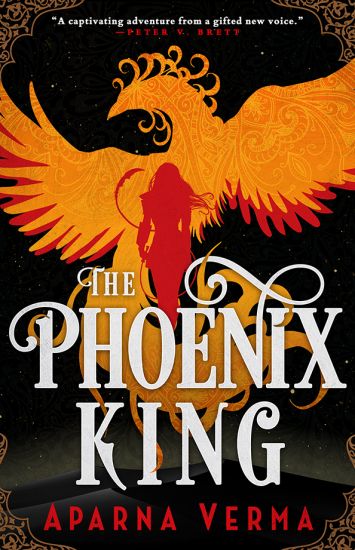
From a stunning new voice in science fantasy comes an action-packed debut of fire magic and ancient prophecy, in which the fate of a futuristic desert kingdom rests in the hands of a princess desperate for power and an assassin with a dark secret. "A CAPTIVATING ADVENTURE." --Peter V. Brett The Ravani kingdom was born of a prophecy, carved from unforgiving desert sands and ruled by the Ravence bloodline: those with the power to command the Eternal Fire. Elena Aadya is the heir to the throne--and the only Ravence who cannot wield her family's legendary magic. As her coronation approaches, she will do whatever it takes to prove herself a worthy successor to her revered father. But she doesn't anticipate the arrival of Yassen Knight, the notorious assassin who now claims fealty to the throne. Elena's father might trust Yassen to be a member of her royal guard, but she is certain he is hiding something. As the threat of war looms like a storm on the horizon, the two begin a dangerous dance of intrigue and betrayal. And the choices they make could burn down the world. "Come for the science fantasy worldbuilding and stay for the characters you just can't get out of your head." --Vaishnavi Patel, NYT bestselling author of Kaikeyi "Elegant and intelligent storytelling...an exhilarating adventure perfect for fans of S.A. Chakraborty." --Library Journal "A riveting page turner." --Booklist "This exciting fantasy promises good things from the series to come." --Publishers Weekly
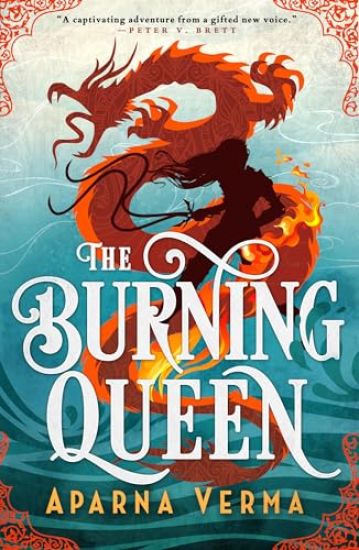
In the thrilling sequel to The Phoenix King, deadly secrets are uncovered, new alliances are forged, and an exiled princess will rise from the ashes of the old world as the burning queen. "So what will you become, Elena? Villain, hero, or conqueror?" Ravence has fallen. Her enemies have ravaged her people. And now Elena Aadya Ravence must decide how far she will go to reap her revenge. As she is pulled into a bitter war that will decide the fate of her kingdom, a new tyrant rises to reclaim his home, and Elena finds that perhaps her hunger isn't enough. And his knows no bounds. Praise for The Phoenix King: "A captivating adventure from a gifted new voice." --Peter V. Brett "Come for the science fantasy worldbuilding and stay for the characters you just can't get out of your head." --Vaishnavi Patel "A heady and seamless blend of sci fi and fantasy infused with Indian inspiration. An engrossing read that will have you quickly turning through the chapters." --R. R. Virdi
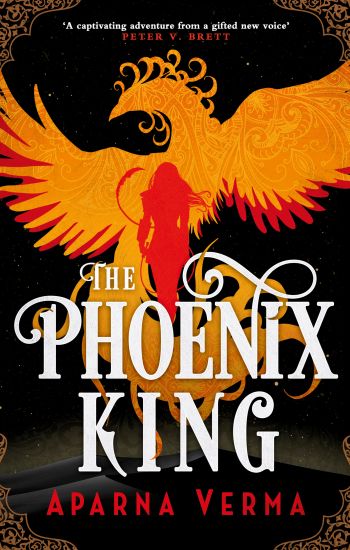
In a kingdom where flames hold magic and the desert hides secrets, an ancient prophecy comes for an assassin, a princess, and a king. But none are ready to face destiny-and the choices they make could burn the world."If we carry the burdens of our fathers, we'll never know what it means to be free."For Elena Aadya Ravence, fire is yearning. She longs to feel worthy of her Phoenix god, of her ancestors who transformed the barren dunes of Sayon into a thriving kingdom. But though she knows the ways and wiles of the desert better than she knows her own skin, the secrets of the Eternal Flame elude her. And without them, she'll never be accepted as queen.For Leo Malhari Ravence, fire is control. He is not ready to give up his crown-there's still too much work to be done to ensure his legacy remains untarnished, his family protected. But power comes with a price, and he'll wage war with the heavens themselves to keep from paying it.For Yassen Knight, fire is redemption. He dreams of shedding his past as one of Sayon's most deadly assassins, of laying to rest the ghosts of those he has lost. If joining the court of flame and serving the royal Ravence family-the very people he once swore to eliminate-will earn him that, he'll do it no matter what they ask of him.But the Phoenix watches over all and the fire has a will of its own. It will come for all three, will come for Sayon itself....and they must either find a way to withstand the blaze or burn to ash.The first in an action-packed debut epic fantasy trilogy, The Phoenix King is "a captivating adventure from a gifted new voice" (Peter V. Brett).'The kind of book you sit down with to read one chapter and end up spending the whole day on. Come for the science fantasy worldbuilding and stay for the characters you just can't get out of your head'Vaishnavi Patel, New York Times bestselling author of Kaikeyi'Vast and fascinating . . . A satisfying slow-burn romance only enhances the political machinations. This exciting fantasy promises good things from the series to come'Publishers Weekly'Verma seamlessly blends fantasy with sci-fi . . . A highly recommended read'Fantasy Hive
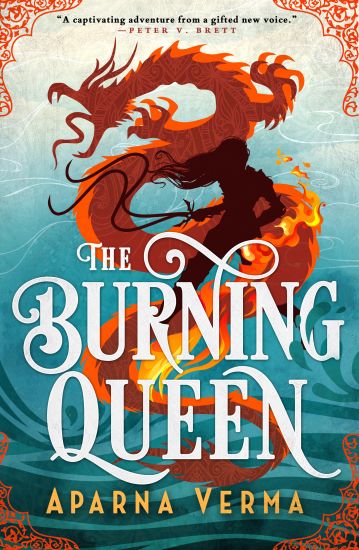
"So what will you become, Elena? Villain, hero, or conqueror?"Ravence has fallen. Her enemies have ravaged her people. And now Elena Aadya Ravence must decide how far she will go to reap her revenge. As she is pulled into a bitter war that will decide the fate of her kingdom, a new tyrant rises to reclaim his home, and Elena finds that perhaps her hunger isn't enough.And his knows no bounds.In the thrilling sequel to The Phoenix King, deadly secrets are uncovered, new alliances are forged, and an exiled princess will rise from the ashes of the old world as the burning queen.
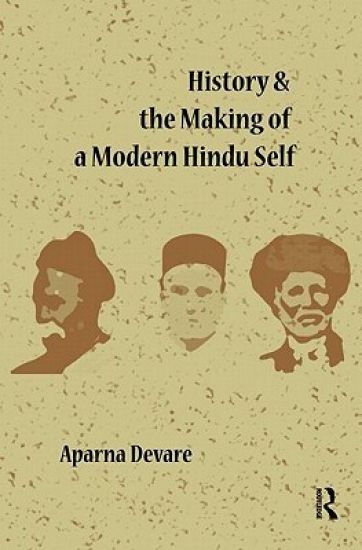
Taking the contentious debates surrounding historical evidence and history writing between secularists and Hindu nationalists as a starting point, this book seeks to understand the origins of a growing historical consciousness in contemporary India, especially amongst Hindus. The broad question it poses is: Why has ‘history’ become such an important site of identity, conflict and self-definition amongst modern Hindus, especially when Hinduism is known to have been notoriously impervious to history? As modern ideas regarding notions of history came to India with colonialism, it turns to the colonial period as the ‘moment of encounter’ with such ideas. The book examines three distinct moments in the Hindu self through the lives and writings of lower-caste public figure Jotiba Phule, ‘moderate’ nationalist M. G. Ranade and Hindu nationalist V. D. Savarkar. Through a close reading of original writings, speeches and biographical material, it is demonstrated that these three individuals were engaged with a modern historical and rationalist approach. However, the same material is also used to argue that Phule and Ranade viewed religion as living, contemporaneous and capable of informing both their personal and political lives. Savarkar, the ‘explicitly Hindu’ leader, on the contrary, held Hindu practices and traditions in contempt, confining them to historical analysis while denying any role for religion as spirituality or morality in contemporary political life.While providing some historical context, this volume highlights the philosophical/ political ideas and actions of the three individuals discussed. It integrates aspects of their lives as central to understanding their politics.

Pakistan has over the decades become a hotbed for the terrorist ideology often referred to as Jihadism. This book investigates the underlying principles of Pakistan’s foreign policy from 1947 until the present day, and explains the rise of Jihadism as an offshoot of Pakistan’s security concerns.The book goes on to discuss that from its inception as a separate state, Pakistan’s foreign policy focused on ‘seeking parity’ with India and ‘escaping’ from an Indian South Asian identity. The desire to achieve parity with its much larger neighbour led Pakistan to seek the assistance and support of allies. The author analyses the relationship Pakistan has with Afghanistan, United States, China and the Muslim world, and looks at how these relationships are based on the desire that military, economic and diplomatic aid from these countries would bolster Pakistan’s meagre resources in countering Indian economic and military strength. The book presents an interesting contribution to South Asian Studies, as well as studies on International Relations and Foreign Policy.

Taking the contentious debates surrounding historical evidence and history writing between secularists and Hindu nationalists as a starting point, this book seeks to understand the origins of a growing historical consciousness in contemporary India, especially amongst Hindus. The broad question it poses is: Why has ‘history’ become such an important site of identity, conflict and self-definition amongst modern Hindus, especially when Hinduism is known to have been notoriously impervious to history? As modern ideas regarding notions of history came to India with colonialism, it turns to the colonial period as the ‘moment of encounter’ with such ideas. The book examines three distinct moments in the Hindu self through the lives and writings of lower-caste public figure Jotiba Phule, ‘moderate’ nationalist M. G. Ranade and Hindu nationalist V. D. Savarkar. Through a close reading of original writings, speeches and biographical material, it is demonstrated that these three individuals were engaged with a modern historical and rationalist approach. However, the same material is also used to argue that Phule and Ranade viewed religion as living, contemporaneous and capable of informing both their personal and political lives. Savarkar, the ‘explicitly Hindu’ leader, on the contrary, held Hindu practices and traditions in contempt, confining them to historical analysis while denying any role for religion as spirituality or morality in contemporary political life.While providing some historical context, this volume highlights the philosophical/ political ideas and actions of the three individuals discussed. It integrates aspects of their lives as central to understanding their politics.
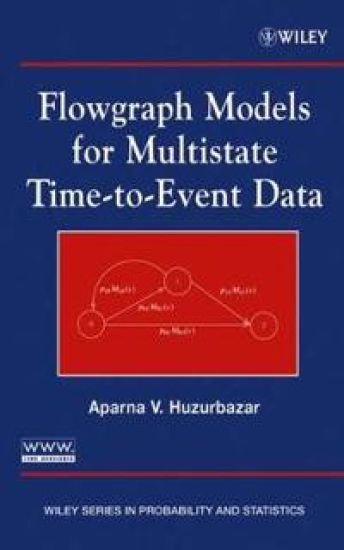
Flowgraph Models for Multistate Time-to-Event Data
Aparna V. Huzurbazar
John Wiley Sons Inc
2004
sidottu
A unique introduction to the innovative methodology of statistical flowgraphs This book offers a practical, application-based approach to flowgraph models for time-to-event data. It clearly shows how this innovative new methodology can be used to analyze data from semi-Markov processes without prior knowledge of stochastic processes--opening the door to interesting applications in survival analysis and reliability as well as stochastic processes. Unlike other books on multistate time-to-event data, this work emphasizes reliability and not just biostatistics, illustrating each method with medical and engineering examples. It demonstrates how flowgraphs bring together applied probability techniques and combine them with data analysis and statistical methods to answer questions of practical interest. Bayesian methods of data analysis are emphasized. Coverage includes: * Clear instructions on how to model multistate time-to-event data using flowgraph models * An emphasis on computation, real data, and Bayesian methods for problem solving * Real-world examples for analyzing data from stochastic processes * The use of flowgraph models to analyze complex stochastic networks * Exercise sets to reinforce the practical approach of this volume Flowgraph Models for Multistate Time-to-Event Data is an invaluable resource/reference for researchers in biostatistics/survival analysis, systems engineering, and in fields that use stochastic processes, including anthropology, biology, psychology, computer science, and engineering.

"Talking of Silence is about a young woman named Ananya, and her struggle to make peace with the inner voice that threatens to destroy the only thing she ever wanted--Love. She makes the boldest decision of her life when she goes to live with Marc, an Indian-American doctor based in Philadelphia. She leaves behind the comfort of culture, family, and a successful career as a tour guide in Southern India. And in doing so, parts ways with herself. Thus, the voice is born.Soon, she is left fearing for her life, sanity, and her relationship with Marc. All seems lost when she runs into Bob, an elderly man who saves her from death. He is not new to the world of pain and helps her deal with hers. One day, he disappears just as suddenly as he entered her life, but not before he has taught her to talk. To herself. Slowly and painfully, she revisits the past to look for it--silence.

Forget Me Not is a deeply emotional collection of short stories, which strive to bring a soulful connection between all that read it. Stories of risk, triumph, love and loss are collated in this stunning admiration of human connection, spanning across the globe from India, to the UK and all the way to Australia. This book emulates the feel-good factor, providing a space of love, kindness, compassion and simplicity, the perfect collection of stories based on the author's real life and those of her family and friends.Dr Aparna Baruah is a consultant radiologist currently residing in Perth, Western Australia. As a doctor during the pandemic, the feeling of loss was monumental, which guided her intuitively and spiritually to gather memories and stories of love and gratitude, to help bring back some of the positivity and compassion that was lost to our world after 2020.
Critically analyzing the representation of pedagogy in the novels of J.M. Coetzee, this insightful text illustrates the author’s profound conception of learning and personal development as something which takes place well beyond formal education.Bringing together critical and educational theory, Pedagogy in the Novels of J.M. Coetzee examines depictions of pedagogy in novels including Age of Iron, Elizabeth Costello, Disgrace, and Childhood of Jesus. Engaging with Coetzee’s varied literary use of pedagogical themes such as motherhood, maternal love, and the importance of childhood interactions, reading, and experiences, chapters demonstrate how Coetzee foregrounds pedagogy as intrinsic to the formation of human actors, society, and civilization. The text thereby aptly explores and broadens our understanding of education - what it is, what it achieves, and how it can affect and shape human existence. This text will be of great interest to graduate and postgraduate students, academics, researchers and professionals in the fields of pedagogy, postcolonial studies, educational theory and philosophy, and English literature.

Combining theoretical and practical information, this book presents a holistic overview of refugee settlement in Australia. It focuses on numerous critical aspects of refugee settlement which play a vital role in refugee integration into Australia. Starting with an overview of immigration history in Australia, the book then places an emphasis on 21st-century settlement of refugees.The chapters explore a gamut of topics including how culture is transmitted in refugee families, how media portrays refugees, and how to work with refugee communities in various contexts, without focusing on one specific refugee cohort/country group. This interdisciplinary angle is presented via the inclusion of voices from interviews with key refugee settlement providers, educators, former refugees, researchers, and second-generation youth from refugee backgrounds. It covers current Australia political debate and politicisation of refugees, digital technologies, the role of language in enabling successful settlement, education trajectories, social cohesion, the fractured diasporic family, and the impact of media coverage, which underpin the settlement of refugees in Australia.This is an ideal resource for advanced undergraduates, postgraduates, and scholars of refugee settlement in the disciplines of communication, media, politics and international relations, social work, education, and demographic studies, as well as government entities, policy makers, service providers, and NGOs looking to gain an understanding of the factors impacting refugee settlement in Australia.
Combining theoretical and practical information, this book presents a holistic overview of refugee settlement in Australia. It focuses on numerous critical aspects of refugee settlement which play a vital role in refugee integration into Australia. Starting with an overview of immigration history in Australia, the book then places an emphasis on 21st-century settlement of refugees. The chapters explore a gamut of topics including how culture is transmitted in refugee families, how media portrays refugees, and how to work with refugee communities in various contexts, without focusing on one specific refugee cohort/country group. This interdisciplinary angle is presented via the inclusion of voices from interviews with key refugee settlement providers, educators, former refugees, researchers, and second-generation youth from refugee backgrounds. It covers current Australia political debate and politicisation of refugees, digital technologies, the role of language in enabling successful settlement, education trajectories, social cohesion, the fractured diasporic family, and the impact of media coverage, which underpin the settlement of refugees in Australia. This is an ideal resource for advanced undergraduates, postgraduates, and scholars of refugee settlement in the disciplines of communication, media, politics and international relations, social work, education, and demographic studies, as well as government entities, policy makers, service providers, and NGOs looking to gain an understanding of the factors impacting refugee settlement in Australia.
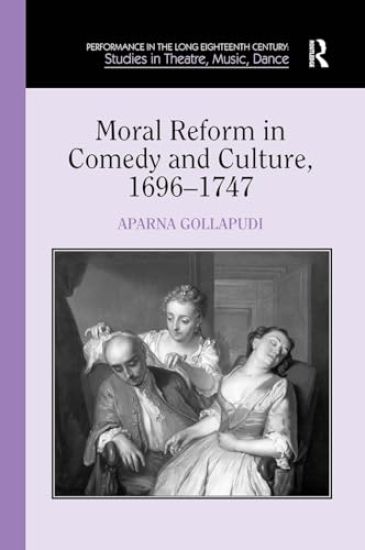
In the first half of the eighteenth century, a new comic plot formula dramatizing the moral reform of a flawed protagonist emerged on the English stage. The comic reform plot was not merely a generic turn towards morality or sentimentality, Aparna Gollapudi argues, but an important social mechanism for controlling and challenging political and economic changes. Gollapudi looks at reform comedies by dramatists such as Colley Cibber, Susanna Centlivre, Richard Steele, Charles Johnson, and Benjamin Hoadly in relation to emergent trends in finance capitalism, imperial nationalism, political factionalism, domestic ideology, and middling class-consciousness. Within the context of the cultural anxieties engendered by these developments, Gollapudi suggests, the reform comedies must be seen not as clichéd and moralistic productions but as responses to vital ideological shifts and cultural transvaluations that impose a reassuring moral schema on everyday conduct. Thoroughly researched and elegantly written, Gollapudi's study shows that reform comedies covered a range of contemporary concerns from party politics to domestic harmony and are crucial for understanding eighteenth-century literature and culture.