Kirjojen hintavertailu. Mukana 11 699 587 kirjaa ja 12 kauppaa.

Kirjahaku

Etsi kirjoja tekijän nimen, kirjan nimen tai ISBN:n perusteella.

1000 tulosta hakusanalla Barbara J. Brooks

Personalities on the Plate

Personalities on the Plate

Barbara J. King

University of Chicago Press
2017
sidottu
In recent years, scientific advances in our understanding of animal minds have led to major changes in how we think about, and treat, animals in zoos and aquariums. The general public, it seems, is slowly coming to understand that animals like apes, elephants, and dolphins have not just brains, but complicated inner and social lives, and that we need to act accordingly. Yet that realization hasn't yet made its presence felt to any great degree in our most intimate relationship with animals: at the dinner table. Sure, there are vegetarians and vegans all over, but at the same time, meat consumption is up, and meat remains a central part of the culinary and dining experience for the majority of people in the developed world. With Personalities on the Plate, Barbara King asks us to think hard about our meat eating though this isn't a polemic intended to convert readers to veganism. What she is interested in is why we've not drawn food animals into our concern, and, as part of that, just what we do know about the minds and lives of chickens, cows, octopuses, fish, and more. Rooted in the latest science, and built on a mix of firsthand experience (including entomophagy, which, yes, is what you think it is) and close engagement with the work of scientists, farmers, vets, and chefs, Personalities on the Plate is an unforgettable journey through the world of animals we eat. Knowing what we know and what we may yet learn what is the proper ethical stance toward eating meat? What are the consequences for the planet? How can we life an ethically and ecologically sound life through our food choices? We could have no better guide to these fascinatingly thorny questions than King, whose deep empathy embraces human and animal alike. Readers will be moved, provoked, and changed by this powerful book.
Evolving God

Evolving God

Barbara J. King

University of Chicago Press
2017
nidottu
Religion has been a central part of human experience since at least the dawn of recorded history. The gods change, as do the rituals, but the underlying desire remains a desire to belong to something larger, greater, most lasting than our mortal, finite selves. But where did that desire come from? Can we explain its emergence through evolution? Yes, says biological anthropologist Barbara J. King and doing so not only helps us to understand the religious imagination, but also reveals fascinating links to the lives and minds of our primate cousins. Evolving God draws on King's own fieldwork among primates in Africa and paleoanthropology of our extinct ancestors to offer a new way of thinking about the origins of religion, one that situates it in a deep need for emotional connection with others, a need we share with apes and monkeys. Though her thesis is provocative, and she's not above thoughtful speculation, King's argument is strongly rooted in close observation and analysis. She traces an evolutionary path that connects us to other primates, who, like us, display empathy, make meanings through interaction, create social rules, and display imagination the basic building blocks of the religious imagination. With fresh insights, she responds to recent suggestions that chimpanzees are spiritual or even religious beings, and that our ancient humanlike cousins carefully disposed of their dead well before the time of Neandertals. King writes with a scientist's appreciation for evidence and argument, leavened with a deep empathy and admiration for the powerful desire to belong, a desire that not only brings us together with other humans, but with our closest animal relations as well.
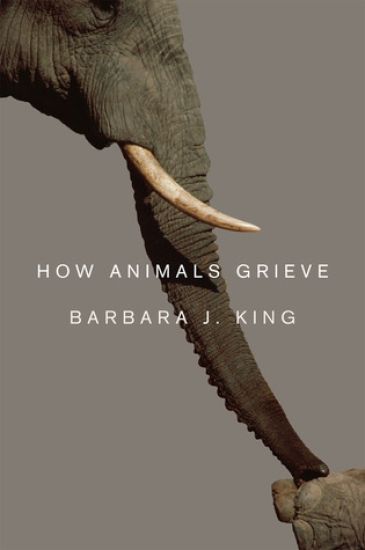
How Animals Grieve

How Animals Grieve

Barbara J. King

University of Chicago Press
2013
sidottu
From the time of our earliest childhood encounters with animals, we casually ascribe familiar emotions to them. But scientists have long cautioned against such anthropomorphizing, arguing that it limits our ability to truly comprehend the lives of other creatures. Recently, however, things have begun to shift in the other direction, and anthropologist Barbara J. King is at the forefront of that movement, arguing strenuously that we can - and should - attend to animal emotions. With "How Animals Grieve", she draws our attention to the specific case of grief, and relates story after story - from fieldsites, farms, homes, and more - of animals mourning lost companions, mates, or friends. King tells of elephants surrounding their matriarch as she weakens and dies, and, in the following days, attending to her corpse as if holding a vigil. A housecat loses her sister, from whom she's never before been parted, and spends weeks pacing the apartment, wailing plaintively. A baboon loses her daughter to a predator and sinks into grief. In each case, King uses her anthropological training to interpret and try to explain what we see-to help us understand this animal grief properly, as something neither the same as nor wholly different from the human experience of loss. The resulting book is both daring and down to earth, strikingly ambitious even as it's careful to acknowledge the limits of our understanding. Through the moving stories she chronicles and analyzes so beautifully, King brings us closer to the animals with whom we share a planet and helps us see our own experiences, attachments, and emotions as part of a larger web of life, death, love, and loss.
Making an Issue of Child Abuse

Making an Issue of Child Abuse

Barbara J. Nelson

University of Chicago Press
1986
nidottu
In this absorbing story of how child abuse grew from a small, private-sector charity concern into a multimillion-dollar social welfare issue, Barbara Nelson provides important new perspectives on the process of public agenda setting. Using extensive personal interviews and detailed archival research, she reconstructs an invaluable history of child abuse policy in America. She shows how the mass media presented child abuse to the public, how government agencies acted and interacted, and how state and national legislatures were spurred to strong action on this issue. Nelson examines prevailing theories about agenda setting and introduces a new conceptual framework for understanding how a social issue becomes part of the public agenda. This issue of child abuse, she argues, clearly reveals the scope and limitations of social change initiated through interest-group politics. Unfortunately, the process that transforms an issue into a popular cause, Nelson concludes, brings about programs that ultimately address only the symptoms and not the roots of such social problems.
Animals' Best Friends

Animals' Best Friends

Barbara J King

University of Chicago Press
2021
sidottu
As people come to understand more about animals’ inner lives—the intricacies of their thoughts and the emotions that are expressed every day by whales and cows, octopus and mice, even bees—we feel a growing compassion, a desire to better their lives. But how do we translate this compassion into helping other creatures, both those that are and are not our pets? Bringing together the latest science with heartfelt storytelling, Animals’ Best Friends reveals the opportunities we have in everyday life to help animals in our homes, in the wild, in zoos, and in science labs, as well as those considered to be food. Barbara J. King, an expert on animal cognition and emotion, guides us on a journey both animal and deeply human. We meet cows living relaxed lives in an animal sanctuary—and cows with plastic portals in their sides at a university research station. We observe bison free-roaming at Yellowstone National Park and chimpanzees confined to zoos. We learn with King how to negotiate vegetarian preferences in omnivore restaurants. We experience the touch of a giant Pacific octopus tasting King’s skin with one of his long, neuron-rich arms. We reflect on animal testing as King shares her own experience as the survivor of a particularly nasty cancer. And in a moment all too familiar to many of us, we recover from a close encounter with two spiders in the home. This is a book not of shaming and limitation, but of uplift and expansion. Throughout this journey, King makes no claims of personal perfection. Though an animal expert, she is just like the rest of us: on a journey still, learning each day how to be better, and do better, for animals. But as Animals’ Best Friends makes clear, challenging choices can bring deep rewards. By turning compassion into action on behalf of animals, we not only improve animals’ lives—we also immeasurably enrich our own.
A Call to Be Whole

A Call to Be Whole

Barbara J. Sowada

Praeger Publishers Inc
2003
sidottu
Examines the complex interrelationships that inform the health care system. Health care, like all social systems, is a product of thought. Up to now, our collective thinking has been based on trying to manage parts, not the whole. This book inquires into four age-old questions that shape all health care systems: What is health? What is care? Who is responsible? How much is enough?Americans have the wealthiest health care system in the world, yet the health status of Americans ranks in the lowest quartile among the world's 25 industrialized nations and 45 million Americans are without health insurance. Today's cost, quality, and access problems are inter-related and can be traced to taken-for-granted assumptions and health care's outmoded organizing concepts: reductionism and materialism. Greater fragmentation of care, an over-dependence on technology, inattention to social and environmental determinants of health, and serious economic and moral dilemmas are some of the results of the last 40 years of piecemeal political and economic reform.This book has three purposes. The first is to help the reader see healthcare as a complex system—a part in a larger whole—and to show how answers to the questions, What is health? What is care? Who is responsible? How much is enough? implicitly define the purpose, effectiveness, efficiency, and fairness of a health care system. The second is to show that today's access, cost, and quality problems are interrelated, and arise from outmoded concepts, unquestioned assumptions, and a long trail of inconsistent and contradictory answers to the four questions. The third purpose is to acquaint readers with both the personal and societal challenges of finding coherent answers to the four questions raised above and to describe some of the budding experimental solutions that challenge traditional conventions and assumptions.
The Secret Life of the Lawman's Wife

The Secret Life of the Lawman's Wife

Barbara J. Alderman

Praeger Publishers Inc
2006
sidottu
During an era when many women concentrated on hearth and home, thousands of women quietly and without pay served in law enforcement. They organized, administered, presented reports to county commissioners, prepared for inspections, comforted victims, disciplined unruly inmates, fought with escapees, rode shotgun with their husbands as backup, and raised children, tended gardens, and kept house. They risked their lives every day and some paid the ultimate price. This is their story.The office of county sheriff has existed in America since 1634. Between 1800 and 1960, families of the sheriff lived in or near the jail. All family members, young and old, worked alongside the lawman to fulfill the required duties, without additional pay. The mom and pop jail was truly a family business. After the middle of the 20th century, fewer families carried on this tradition as counties modernized and jails became professionalized.
Rewriting Russia

Rewriting Russia

Barbara J. Henry

University of Washington Press
2011
sidottu
Jacob Gordin was the first major playwright of the "Golden Age" of New York's Yiddish theater, which was not just entertainment but also a public forum, a force for education and acculturation, and a battleground for ideologies and artistic credos. Gordin, like his audience, was a Russian émigré. His most successful and scandalous dramas--The Jewish King Lear, The Kreutzer Sonata, and Khasye the Orphan--were based on works by Lev Tolstoy and Ivan Turgenev, and reflected a profoundly Jewish means of using literature to salvage a lost land.Gordin's life and his plays held out the tantalizing possibility that by changing the story of one's past, one could write one's own future. Through a detailed examination of Gordin's career in Russia, Barbara Henry dismantles the fictive radical background he invented for himself. In doing so, she illuminates the continuities among his Russian fiction and journalism, his work as a controversial Jewish religious reformer, and his Yiddish plays.
Rewriting Russia

Rewriting Russia

Barbara J. Henry

University of Washington Press
2011
pokkari
Jacob Gordin was the first major playwright of the "Golden Age" of New York's Yiddish theater, which was not just entertainment but also a public forum, a force for education and acculturation, and a battleground for ideologies and artistic credos. Gordin, like his audience, was a Russian émigré. His most successful and scandalous dramas--The Jewish King Lear, The Kreutzer Sonata, and Khasye the Orphan--were based on works by Lev Tolstoy and Ivan Turgenev, and reflected a profoundly Jewish means of using literature to salvage a lost land.Gordin's life and his plays held out the tantalizing possibility that by changing the story of one's past, one could write one's own future. Through a detailed examination of Gordin's career in Russia, Barbara Henry dismantles the fictive radical background he invented for himself. In doing so, she illuminates the continuities among his Russian fiction and journalism, his work as a controversial Jewish religious reformer, and his Yiddish plays.
Gender Vertigo

Gender Vertigo

Barbara J. Risman

Yale University Press
1999
pokkari
Just as every society has an economic and political structure, so too every society has a gender structure. Barbara Risman’s original research on single fathers, married baby boom mothers, and heterosexual egalitarian couples and their children, reported in this intriguing book, weaves together qualitative and quantitative data from surveys, interviews, and observation. Risman shows how gender as a social structure affects individuals, organizes expectations attached to social positions, and becomes an integral part of social institutions. She provides empirical evidence that human beings are capable of enduring and affective intimate relationships without gender as the central organizing mechanism. The data also strongly indicate that men and women are capable of changing gendered ways of being throughout their lives.In her analysis of nontraditional families, Risman finds that gender expectations can be overcome if couples are willing to flout society and risk "gender vertigo." Most children of such families adopt their parents’ beliefs about gender, but they do struggle with the contradictions between parental ideology and folk knowledge and expectations in peer relationships. The author argues that we can create a just society only by creating a society in which gender is an irrelevant category for social life—a post-gender society.
The Matriarchs of England's Cooperative Movement

The Matriarchs of England's Cooperative Movement

Barbara J. Blaszak

Praeger Publishers Inc
1999
sidottu
Current thinking considers the Women's Cooperative Guild within the English Cooperative Movement to have been an independent and democratically run organization whose leaders built sisterhood across class lines and achieved many benefits for married working-class women. This study of the dynamics of gender within the movement between 1883 and 1921 arrives at different conclusions. Blaszak examines what freedoms of speech and activity women were permitted within the movement, as well as what resources they were given to accomplish their tasks. Ultimately, the parameters set by the men would determine the type of female leadership that emerged and whether it was able to realize its feminist and utopian agendas. Setting the organization's activities within the context of gender relations in the Cooperative Movement, Blaszak finds that the Guild was much more dependent and much less democratically directed than has usually been supposed. Restrictions established by male cooperators and enhanced by the realities of working-class life turned the Guild into a clique dominated by a few. Even the Guild's most revered leader, Margaret Llewelyn Davies, found it impossible to escape the gendered socio-economic circumstances in which she labored at her ministry to improve the lives of working-class women. Consequently, her leadership inadvertently assisted male cooperators in their attempts to limit possibilities for women.
RAPID ACLS - Revised Reprint

RAPID ACLS - Revised Reprint

Barbara J Aehlert

Mosby/JEMS
2011
nidottu
Designed to offer essential information on-the-spot, where it's needed most! RAPID ACLS, 2nd Edition, Revised Reprint is now updated to reflect the 2010 emergency cardiovascular care guidelines. It contains a broad range of topics pertaining to advanced cardiac life support including information on airway management, pharmacology, vascular access, ECGs, electrical therapy, acute coronary syndromes, and special resuscitation situations. Loaded with tables, mnemonics, and algorithms throughout, RAPID ACLS, 2nd Edition, Revised Reprint is ideal for use in clinical practice or during an ACLS course. Compact 3 x 5 ½-inch size presents essential information in a quick-reference format. Fluid-resistant paper is durable for rugged clinical use. Full-color illustrations show clear, vivid presentations of essential concepts and common cardiac rhythms for clear and easy interpretation. Concise, accessible bullet points and numbered lists make key information easy to find, read, and understand. Convenient format uses spiral binding and color tabs as section dividers allow you to quickly locate important information in an emergency. Over 70 tables throughout the text including dysrhythmias and cardiac medications provide the basics of dysrhythmias and medications at a glance. Commonly used but rarely memorized information broken down into tables, algorithms, and acronyms help in locating essential information. Reflects the 2010 emergency cardiovascular care guidelines.
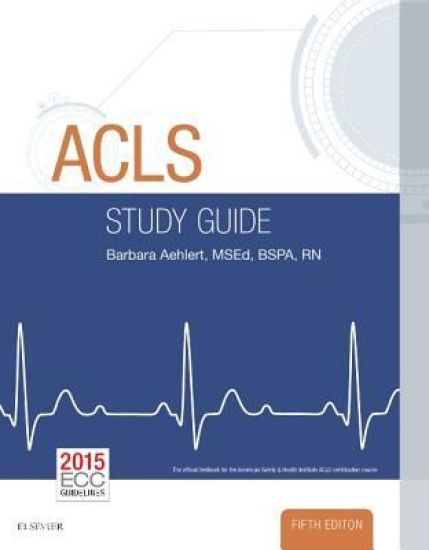
ACLS Study Guide

ACLS Study Guide

Barbara J Aehlert

Mosby
2016
nidottu
Provide the best possible emergency cardiovascular care - using the newest ECC guidelines! ACLS Study Guide, 5th Edition offers a complete, full-color overview of advanced cardiovascular life support. An easy-to-read approach covers everything from airway management to cardiac arrest rhythms and their management, electrical therapy, acute coronary syndromes, and acute stroke. In addition to the latest ACLS treatment algorithms, this edition includes case studies and hundreds of full-color photos and illustrations. Case studies present common, realistic clinical situations, helping you learn and apply skills in cardiac rhythm interpretation, medication administration, and other essential interventions. ACLS Pearls boxes offer brief explanations of complex topics and useful tips for clinical practice. End-of-chapter quizzes include answers and rationales, helping you learn and remember the most important information. Easy-to-understand approach simplifies your study of advanced cardiac life support, thanks to Barbara Aehlert's unique, conversational writing style. NEW! UPDATED content centers on evidence-based practice recommendations, including the 2015 American Heart Association Guidelines for Cardiopulmonary Resuscitation and Emergency Cardiovascular Care and the 2015 International Consensus on Cardiopulmonary Resuscitation and Emergency Cardiovascular Care Science With Treatment Recommendations. NEW! Improved format integrates all case studies into the appropriate chapters, so that you can apply concepts immediately to real-world situations.
ACLS Study Guide

ACLS Study Guide

Barbara J Aehlert

Mosby
2021
nidottu
Build the knowledge and skills you need to provide emergency cardiovascular care! ACLS Study Guide, 6th Edition provides a comprehensive, easy-to-understand overview of advanced cardiovascular life support. With case studies and hundreds of full-color photos and illustrations, this guide covers everything from airway management to cardiac arrest rhythms and electrophysiology, tachycardias and bradycardias, acute coronary syndromes, and acute ischemic stroke. Discussions of the newest ECC guidelines and ACLS treatment algorithms help you manage common cardiac conditions. Written by noted EMS educator Barbara Aehlert, ACLS Study Guide is ideal for use with the American Safety & Health Institute ACLS certification course. Easy-to-understand approach simplifies your study of advanced cardiac life support, thanks to Barbara Aehlert's unique, conversational writing style. Case studies describe real-world examples of common clinical situations, helping you master skills in cardiac rhythm interpretation, medication administration, and other essential interventions. Evidence-based practice recommendations are provided for emergency medical treatment. ACLS Pearl boxes offer brief explanations of complex topics and useful tips for clinical practice. Keeping It Simple boxes provide clear and concise summaries of key points along with memory aids. End-of-chapter quizzes include answers and rationales, helping you remember the most important information. NEW! Updated content includes the latest guidelines from the American Heart Association Guidelines for Cardiopulmonary Resuscitation and Emergency Cardiovascular Care and the International Consensus on Cardiopulmonary Resuscitation and Emergency Cardiovascular Care Science with Treatment Recommendations. NEW! 20 new illustrations are added to the book's hundreds of illustrations.
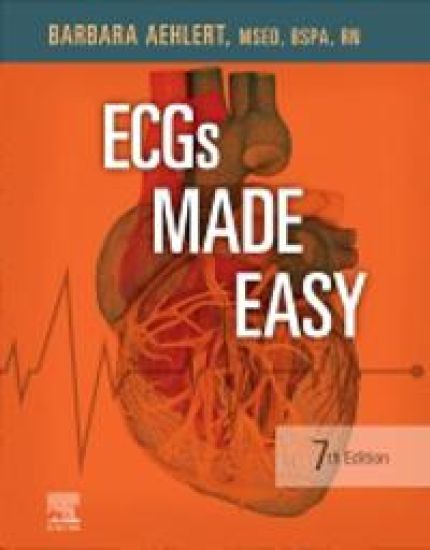
ECGs Made Easy

ECGs Made Easy

Barbara J Aehlert

Elsevier - Health Sciences Division
2022
nidottu
Learning ECG interpretation has never been easier! A practical guide to heart rhythm recognition, ECGs Made Easy, 7th Edition offers a more visual, less intimidating way to identify and interpret basic heart dysrhythmias. Each ECG rhythm includes a clear description, a sample ECG rhythm strip, possible signs and symptoms related to each rhythm, and recommended treatment. For more practice, additional rhythm strips and review exercises are provided at the end of each chapter. Written by noted EMS educator Barbara Aehlert, this guide has everything you need to master skills in ECG interpretation. Easy-to-read style and conversational tone help you to recall and apply ECG information. Brief description of each dysrhythmia is accompanied by a summary of rhythm characteristics and a sample ECG rhythm strip. Clear ECG discussions highlight what you need to know about dysrhythmia recognition, such as: How Do I Recognize It? What Causes It? What Do I Do About It? Introduction to the 12-Lead ECG chapter provides the basics for this advanced skill, including determining electrical axis, and recognizing ECG changes associated with myocardial ischemia and infarction, bundle branch block, and other conditions. ECG Pearl boxes cover ECG principles, practical applications, indications, and techniques, and offer useful hints for interpreting ECGs. Drug Pearls highlight select medications used to treat dysrhythmias. Key terms open each chapter by introducing and defining essential terminology. Summary tables review the key characteristics of dysrhythmias discussed in the chapter. Stop & Review exercises at the end of each chapter allow you to assess your understanding. Comprehensive posttest with answers at the end of the book allows you to check your understanding. NEW! Content updates reflect current science and clinical practice guidelines, including the American Heart Association's 2020 ECC resuscitation guidelines where applicable. NEW! Updates to selected rhythm strips allow for additional practice.
Pocket Guide for ECGs Made Easy

Pocket Guide for ECGs Made Easy

Barbara J Aehlert

Elsevier - Health Sciences Division
2022
nidottu
Put essential ECG information at your fingertips! Based on Barbara Aehlert's popular ECGs Made Easy, 7th Edition, this full-color pocket guide makes it quick and easy to identify and interpret basic heart rhythms. Each dysrhythmia includes a sample rhythm strip, a brief description, a discussion of possible patient symptoms, and general treatment guidelines. Ideal for use in classroom and practice settings, this handy, compact reference makes heart dysrhythmia information easy to find and easy to understand. Easy-to-read style and conversational tone make understanding ECG information quick and easy. Brief description of each dysrhythmia is accompanied by a concise summary of rhythm characteristics and a sample ECG rhythm strip. More than 70 full-color illustrations plus numerous tables and boxes highlight and summarize key information. NEW! Content updates mirror the changes to Aehlert's core text, ECGs Made Easy, 7th Edition. NEW! Current science and clinical practice guidelines are reflected, including the American Heart Association's 2020 ECC resuscitation guidelines where applicable.
Ecgs Made Easy - Elsevier eBook on Vitalsource (Retail Access Card)
Learning ECG interpretation has never been easier A practical guide to heart rhythm recognition, ECGs Made Easy, 7th Edition offers a more visual, less intimidating way to identify and interpret basic heart dysrhythmias. Each ECG rhythm includes a clear description, a sample ECG rhythm strip, possible signs and symptoms related to each rhythm, and recommended treatment. For more practice, additional rhythm strips and review exercises are provided at the end of each chapter. Written by noted EMS educator Barbara Aehlert, this guide has everything you need to master skills in ECG interpretation. Easy-to-read style and conversational tone help you to recall and apply ECG information. Brief description of each dysrhythmia is accompanied by a summary of rhythm characteristics and a sample ECG rhythm strip. Clear ECG discussions highlight what you need to know about dysrhythmia recognition, such as: How Do I Recognize It? What Causes It? What Do I Do About It? Introduction to the 12-Lead ECG chapter provides the basics for this advanced skill, including determining electrical axis, and recognizing ECG changes associated with myocardial ischemia and infarction, bundle branch block, and other conditions. ECG Pearl boxes cover ECG principles, practical applications, indications, and techniques, and offer useful hints for interpreting ECGs. Drug Pearls highlight select medications used to treat dysrhythmias. Key terms open each chapter by introducing and defining essential terminology. Summary tables review the key characteristics of dysrhythmias discussed in the chapter. Stop & Review exercises at the end of each chapter allow you to assess your understanding. Comprehensive posttest with answers at the end of the book allows you to check your understanding. NEW Content updates reflect current science and clinical practice guidelines, including the American Heart Association's 2020 ECC resuscitation guidelines where applicable. NEW Updates to selected rhythm strips allow for additional practice.
Don't Be A Victim Of Alcoholism

Don't Be A Victim Of Alcoholism

Barbara J Wright

Lulu.com
2018
pokkari
This pamphlet contains information on the effects of alcoholism and how you can seek help. I wrote this to inspire others who may be dealing with alcoholic issues. If you or anyone you know suffer from alcoholism, seek help immediately. Inside, you'll find valuable information and guidance.