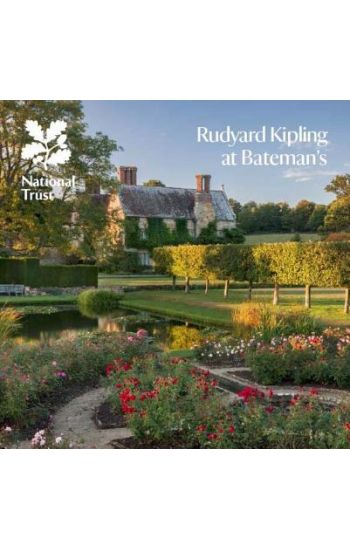
Rudyard Kipling loved Batemans. It was his personal paradise, where he wrote some of his most famous works and enjoyed quiet family life free from the demands of fame. The atmospheric 17th-century house has changed little since his time and nestles modestly in the wooded landscape of the Sussex Weald. Rudyard Kipling loved Batemans. It was his personal paradise, where he wrote some of his most famous works and enjoyed quiet family life free from the demands of fame. The atmospheric 17th-century house has changed little since his time and nestles modestly in the wooded landscape of the Sussex Weald. This guidebook uncovers the lives of the Kiplings and their staff at Bateman's.
Le r le du pathologiste est primordial dans la prise en charge des cancers du rectum (CR) localement avanc s dont le pronostic reste relativement sombre. Ces tumeurs sont soumises une radio-chimioth rapie suivie d'une ex r se chirurgicale. Le pathologiste d termine les facteurs histopronostiques, dont la r ponse au traitement n o-adjuvant, contribuant la d cision th rapeutique.Plusieurs classifications visent valuer cette r ponse avec des avantages et des inconv nients pour chacune d'elles.Le but de ce travail tait: - D'appliquer le score de Bateman pour l' valuation de la r ponse histologique la radio-chimioth rapie n o-adjuvante sur une s rie de 44 ad nocarcinomes du rectum localement avanc s - D' valuer la valeur pronostique de la r gression tumorale histologique - De rechercher une corr lation entre cette RH et 6 param tres clinico-pathologiques, consid r s comme de mauvais pronostic dans les CR.
The Road to Batemans Bay is the story of competing ventures to create 'the Great Southern Township' on the South Coast of New South Wales in the early 1840s. The idea of developing the furthest reaches of settlement was linked to the hopes of southern woolgrowers for a road from their properties to the coast, over the Great Dividing Range. The township proponents dreamed that having a quicker and cheaper connection to Sydney would allow them to open a port second only to Port Jackson.The scene begins with the proposed coastal township of St Vincent, in an age of optimism: settlement is expanding, exports are growing and land prices are soaring, generating Australia's first land boom. Before long, however, the colony experiences a catastrophic economic depression whose 'pestilential breath' infects those with a stake in the coastal townships. Alastair Greig follows the fate of these individuals, while also speculating on the broader fate of South Coast development during the mid-nineteenth century.Greig gives a unique insight into many aspects of colonial life-including the worlds of Sydney's merchants, auctioneers, land speculators, surveyors, map-makers and lawyers-as well as its maritime challenges. The Road to Batemans Bay is a chronicle of how Australia first developed its land-gambling habit and how land speculation led to the road to ruin.
This is the first of three volumes that form the Encyclopedia of Special Functions, an extensive update of the Bateman Manuscript Project. Volume 1 contains most of the material on orthogonal polynomials, from the classical orthogonal polynomials of Hermite, Laguerre and Jacobi to the Askey–Wilson polynomials, which are the most general basic hypergeometric orthogonal polynomials. Separate chapters cover orthogonal polynomials on the unit circle, zeros of orthogonal polynomials and matrix orthogonal polynomials, with detailed results about matrix-valued Jacobi polynomials. A chapter on moment problems provides many examples of indeterminate moment problems. A thorough bibliography rounds off what will be an essential reference.
"The Loving Ballad of Lord Bateman" is a delightful piece of English poetry, a classic example of humorous verse and narrative storytelling from literary giants Charles Dickens and William Makepeace Thackeray. This engaging ballad, presented here in a meticulously prepared print edition, showcases the authors' wit and skill in crafting memorable characters and a lively story. A testament to the enduring appeal of traditional ballad form, this volume offers a glimpse into the rich landscape of 19th-century English poetry. Perfect for enthusiasts of poetry, humor, and classic literature, "The Loving Ballad of Lord Bateman" is a timeless addition to any collection. Rediscover this charming and often-overlooked gem of poetic storytelling.This work has been selected by scholars as being culturally important, and is part of the knowledge base of civilization as we know it.This work is in the public domain in the United States of America, and possibly other nations. Within the United States, you may freely copy and distribute this work, as no entity (individual or corporate) has a copyright on the body of the work.Scholars believe, and we concur, that this work is important enough to be preserved, reproduced, and made generally available to the public. We appreciate your support of the preservation process, and thank you for being an important part of keeping this knowledge alive and relevant.
This is the second of three volumes that form the Encyclopedia of Special Functions, an extensive update of the Bateman Manuscript Project. Volume 2 covers multivariable special functions. When the Bateman project appeared, study of these was in an early stage, but revolutionary developments began to be made in the 1980s and have continued ever since. World-renowned experts survey these over the course of 12 chapters, each containing an extensive bibliography. The reader encounters different perspectives on a wide range of topics, from Dunkl theory, to Macdonald theory, to the various deep generalizations of classical hypergeometric functions to the several variables case, including the elliptic level. Particular attention is paid to the close relation of the subject with Lie theory, geometry, mathematical physics and combinatorics.
The Loving Ballad of Lord Bateman is a classic English poem by the great English writers, Charles Dickens and William Makepeace Thackeray. In some collection of old English Ballads there is an ancient ditty which I am told bears some remote and distant resemblance to the following Epic Poem. I beg to quote the emphatic language of my estimable friend (if he will allow me to call him so), the Black Bear in Piccadilly, and to assure all to whom these presents may come, that "_I_ am the original." This affecting legend is given in the following pages precisely as I have frequently heard it sung on Saturday nights, outside a house of general refreshment (familiarly termed a wine vaults) at Battle-bridge.
This special edition of 'Extraordinary Life and Character of Mary Bateman, The Yorkshire Witch' was written by Davies and Company, and first published in 1811, making it well over 200 years old. Although the quality of the text rendering in this book is not up to the usual standard that we would publish and is a little hard to read at times, this is a very important antiquarian text. It should be noted that the text features the Old English style of "s" which looks like a tall "f" and can make reading a tad confusing at times It was written just two years after the execution of Mary Bateman, and as such is an absolute essential addition to the libraries of all who are interested in The Yorkshire Witch story. This super-short, fast read, is a rare old find, and will be a welcome addition to your collection of Occult and Witchcraft book collection and is a must read for all researchers and enthusiasts of the Black Arts, and those with a penchant for old murder cases. IMPORTANT NOTE - Please read BEFORE buying THIS BOOK IS A REPRINT. IT IS NOT AN ORIGINAL COPY. This book is a reprint edition and is a perfect facsimile of the original book. It is not set in a modern typeface and has not been digitally enhanced. As a result, some characters and images might suffer from slight imperfections, blurring, or minor shadows in the page background. This book appears exactly as it did when it was first printed. At 'Black Books' we do not use OCR (Optical Character Recognition) technology to transcribe books from scanned images or other forms of text - this usually results in everything from strange characters to gibberish. We believe that reading an old book, exactly as it was, is the most satisfying way to read it. DISCLAIMER: Due to the age of this book, some methods, beliefs, or practices may have been deemed unsafe, undesirable, or unacceptable in the interim years. In utilizing the information herein, you do so at your own risk. We republish antiquarian books without judgment, solely for their historical and cultural importance, and for educational purposes. If purchasing a book more than 50 years old, especially for a minor, please use due diligence and vet the text before gifting.
George Edward Bateman Saintsbury ( 23 October 1845 - 28 January 1933), was an English writer, literary historian, scholar, critic and wine connoisseur. BIOGRAPHY: Born in Lottery Hall, Southampton, he was educated at King's College School, London, and at Merton College, Oxford where he achieved a first class BA degree in Classical Mods, (1865), and a second class in literae humaniores (1867). He left Oxford in 1868 having failed to obtain a fellowship, and briefly became a master at the Manchester Grammar School, before spending six years in Guernsey as senior classical master of Elizabeth College, where he began his literary career by submitting his first reviews to The Academy. From 1874 until he returned to London in 1876 he was headmaster of the Elgin Educational Institute, with a brief period in 1877 on the Manchester Guardian. For ten years he was actively engaged in journalism, becoming an important member of the staff of the Saturday Review. Some of the critical essays contributed to the literary journals were afterwards collected in his Essays in English Literature, 1780-1860 (2 vols., 1890-1895), Essays on French Novelists (1891), Miscellaneous Essays (1892), and Corrected Impressions (1895). In 1895 he became professor of rhetoric and English literature at the University of Edinburgh, a position he held until 1915. He retired to 1A Royal Crescent, Bath, Somerset and died there in 1933. 1] 1A Royal Crescent was the subject of a restoration and renovation programme by the Bath Preservation Trust during 2012 to reincorporate it into 1 Royal Crescent, of which it was the original servants' quarters. It opened to visitors for the first time in 2013. An exhibition celebrating Saintsbury's life was mounted in the house in 2014........ Robert Southey (12 August 1774 - 21 March 1843) was an English poet of the Romantic school, one of the so-called "Lake Poets", and Poet Laureate for 30 years from 1813 until his death in 1843. Although his fame has long been eclipsed by that of his contemporaries and friends William Wordsworth and Samuel Taylor Coleridge, Southey's verse still enjoys some popularity. Southey was also a prolific letter writer, literary scholar, essay writer, historian and biographer. His biographies include the life and works of John Bunyan, John Wesley, William Cowper, Oliver Cromwell and Horatio Nelson. The last has rarely been out of print since its publication in 1813 and was adapted for the screen in the 1926 British film, Nelson. He was also a renowned scholar of Portuguese and Spanish literature and history, translating a number of works from those two languages into English and writing a History of Brazil (part of his planned History of Portugal, which he never completed) and a History of the Peninsular War. Perhaps his most enduring contribution to literary history is the children's classic The Story of the Three Bears, the original Goldilocks story, first published in Southey's prose collection The Doctor. He also wrote on political issues, which led to a brief, non-sitting, spell as a Tory Member of Parliament.....ect............