Kirjojen hintavertailu. Mukana 11 699 587 kirjaa ja 12 kauppaa.

Kirjahaku

Etsi kirjoja tekijän nimen, kirjan nimen tai ISBN:n perusteella.

1000 tulosta hakusanalla Beate Graf-Egetemeyr

A common frame of reference for European contract law

A common frame of reference for European contract law

Paul Abbiati; Christian von Bar; Hugh Beale; Jean-Marie Bockel; Michael Joachim Bonell; Tomáš Brichácek; Alain Brun; Bénédicte Fauvarque-Cosson; Friedrich Graf von Westphalen; Johnny Herre; Ole Lando; Klaus-Heiner Lehne; Tanja Rasmusson; Ingeborg Schwenzer; Pascal Hachem; Leif Sevón; Lena Sisula-Tulokas; Matthias E. Storme; Stefan Vogenauer

Jure Förlag
2011
nidottu
Stockholm Centre for Commercial Law (SCCL) arranged a meeting in Stockholm on 23–24 October 2009 following the Swedish presidency CFR conference, which was held in Stockholm on 22–23 October and organized by the Swedish government. The topic at the meeting was to discuss a proposal from Professor Christian von Bar and Professor Hans Schulte-Nölke, on how to continue the important work conducted by, inter alia, the Study Group on a European Civil Code and the Acquis Group. The continuance of this work could be organized by establishing either a European Law Forum or an informal organisation. The form for this continued work has, for some considerable time, been the subject of lively discussions amongst those interested. This publication contains writings concerning the themes presented and discussed during the meeting. Many of the leading experts in the field attended the meeting. Table of Contents Does business want a Common Frame of Reference?Paul Abbiati Is the Draft Frame of Reference compatible with the Position of the Council? - How should the Academic Research be continued?Christian von Bar Topic 2: The Content of the political CFR – how to prioritise Hugh Beale Discours d’ouverture, conférence « un cadre commun de référence pour le droit européen des contrats »Jean-Marie Bockel Do we need specifically European optional instruments for international business transactions?Michael Joachim Bonell Why the “optional instrument” is not our optionTomáš Brichácek Informations d’ordre général sur le travail de la Commission relatif au cadre de Référence, ainsi que la voie à suivreAlain Brun The relationship between the Political frame of reference (PFR) and the consumer acquisBénédicte Fauvarque-Cosson Some Aspects on the Position of the CCBE on the DCFRFriedrich Graf von Westphalen The Common Frame of Reference as a basis for future harmonisation of the law of sale and lease of goodsJohnny Herre A Plea for a Binding InstrumentOle Lando Erwartungen an den politischen Referenzrahmen Klaus-Heiner Lehne The results of the discussions in the Council and the future political work with the frame of referenceTanja Rasmusson Drafting new model rules on sales: CFR as an alternative to the CISG?Ingeborg Schwenzer & Pascal Hachem Do we need a codification?Leif Sevón Is non-contractual liability arising out of damage caused to another a natural part of a political frame of reference?Lena Sisula-Tulokas The (Draft) Common Frame of Reference as a toolbox and as a basis for an optional instrumentMatthias E. Storme Common Frame of Reference and UNIDROIT Principles of International Commercial Contracts: Coexistence, Competition, or Overkill of Soft Law?Stefan Vogenauer
Beate Not the Poore Desk: A Writer to Young Writers
For the first time, National Book Award-winner Walter Wangerin, Jr., turns his keen eye upon the craft of writing. Adding a lifetime of experience to the wisdom and examples of other writers (Shakespeare, Goethe, Berry, Chaucer, and many more), he builds for us an intricate picture of the craft and its many subtitles.
Beate und Mareile

Beate und Mareile

Eduard Von Keyserling

Createspace Independent Publishing Platform
2018
nidottu
Beate und Mareile sind zusammen auf Schloss Kaltin erzogen worden. Beate und G nther geh ren dem alteingesessenen baltischen Landadel an. Baroness Beate von Losnitz und G nther von Tarniff sind Nachbarskinder. Die Besitzungen beider Familien grenzen aneinander. G nther heiratete Beate und zog als Herr auf Schloss Kaltin ein. Mareile Ziepe, die Tochter des Inspektors auf Gut Kaltin, hatte gro es Gl ck. Die F rstin Elise Kornowitz nahm sie mit nach Berlin. In der Metropole stieg Mareile zur "gefeiertsten" S ngerin auf. "F rst Kornowitz schmachtet" die Sch ne "an".
Beate Hildegardis Cause et cure
Im Jahre 1903 erschien, herausgegeben von Paul Kaiser, die erste neuzeitliche Ausgabe des Werkes "Cause et Cure." Kaiser schrieb diesen Text Hildegard von Bingen zu. Die Edition Kaiser war ein Jahrhundert lang die massgebliche Textversion; gleichwohl wurde in Rezensionen bald nach Erscheinen auf Mangel und offensichtliche Schwachen hingewiesen (Transkriptionsfehler, keine nennenswerten Apparate, sprachliche Anpassungen an das klassische Latein). Das Werk "Cause et Cure" selbst hat zu Forschungen in erheblicher Zahl und mit breiter Wirkung auf die Erforschung der Medizingeschichte angeregt: hinsichtlich der uberaus schmalen handschriftlichen Uberlieferung (eine Handschrift und ein Fragment in Berlin; letzteres wurde in den 50er Jahren von Heinrich Schipperges neu entdeckt und publiziert); in bezug auf die darin verarbeiteten Quellen; in bezug auf den authentischen Anteil Hildegards an diesem Werk; hinsichtlich der Datierung der Endredaktion; uber das mittelhochdeutsche pharmakologisch-medizinische Vokabular etc. Die international herausragende Spezialistin fur die Medizin Hildegards von Bingen, die franzosische Historikerin Laurence Moulinier unternimmt in dieser Ausgabe, in Zusammenarbeit mit Rainer Berndt, eine neue kritische Ausgabe. Diese beruht auf einer vollstandigen Neuherstellung des kritischen Textes aus der einzigen vollstandigen, der Kopenhagener Handschrift. Im Quellenapparat sind die gesamten Forschungsergebnisse der letzten Jahre rezipiert. Der Text wird begleitet von vier Apparaten: Zitationen, Quellen, Similia im Werk Hildegards, Textapparat. Das medizinische Vokabular erfahrt dabei besondere Aufmerksamkeit, indem es mit zeitgenossischen Parallelen verglichen wird. Die entscheidende Authentizitatsproblematik diskutiert die Herausgeberin in extenso. So kann sie prazise einen ursprunglichen Hildegardschen Kerntextbestand ausmachen, der von spateren Redaktoren erweitert worden ist dergestalt, dass schliesslich der vorliegende Text aus diesem Prozess hervorging. Da aus diesem Beweisgang zwingend folgt, dass die Endredaktion des Werkes in den 20er Jahren des 13. Jahrhunderts anzusetzen ist, scheidet Hildegard als Autorin des uberlieferten Textes aus. Sechs Abbildungen von Seiten der Kopenhagener Handschrift fuhren die Werkeinteilung vor Augen."
Beate sucht eine Lösung!

Beate sucht eine Lösung!

Susi Müller

Books on Demand
2021
pokkari
Beate sitzt mit ihrer Freundin im Gartenlokal. Ein netter, flotter Kellner bedient sie. Kann da mehr daraus werden? Verliebt bergl cklich steht ein Wochenendbesuch zu Hause an. Ohne es mit ihr zu besprechen, m chte die Mutter den heimatlichen Bauernhof verkaufen. Auf einmal steht sie vor der Gefahr alles zu verlieren. Von hoch oben nach unten. Wie kann sie damit fertig werden. Viel Spa und Freude.
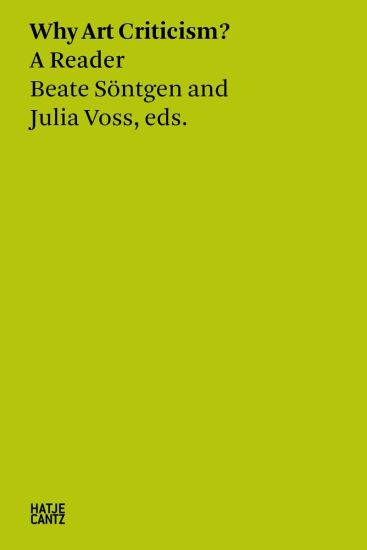
Beate Söntgen & Julia Voss: Why Art Criticism? A Reader
How is art criticism to be understood within an expanding artistic field? A look at its history and its manifestations within globalized conditions shows the variety of the genre, of the criteria and of the styles of writing. This reader is an attempt to bring a diverse range of art-critical voices and perspectives into conversation with each other, with texts from the 18th century to the present. The editors Beate Söntgen and Julia Voss have invited colleagues from various geographical and intellectual backgrounds to present and discuss the art critics of their choice, choosing one example from their respective bodies of work to comment upon. How have these writers approached art criticism? Which styles do they employ? What makes them extraordinary? What can we learn from their writings today, and why is it important in its contemporary context? Texts by: Ananda Kentish Coomaraswamy, Denis Diderot, Takashi Kashima, Patrick Mudekereza, Annemarie Sauzeau-Boetti, Bertha Zuckerkandl and many more Comments by: Juli Carson, Yuriko Furuhata, Isabelle Graw, Angela Harutyunyan, Monica Juneja, Wolfgang Kemp, Florencia Malbran, Yvette Mutumba, Azu Nwagbogu, Sarah Wilson and many more
Beate Passow: Monkey Business
In her series of images “Monkey Business” the artist Beate Passow portrays a mysterious fairy - tale world of political dimensions. The black and white images, which upon closer observation turn out to be sophisticated tapestries, question the ruling syst ems, economic structures, and political movements of contemporary Europe. A Barbary macaque sits on a martial gun barrel in Gibraltar, a powerful bear mounts a bull, a skeleton - like figure strides over destroyed refugee boats on Lampedusa. The strange fi gures that inhabit “Monkey Business” narrate a penetrating mythology of the 21st century. In her narrative approach Passow subverts the established tapestry tradition, not praising rulers and heroes, but directing criticism – at today’s Europe. Once celebr ated as the stronghold of democracy and humanism, it is today marked by a military defensive stance at its borders, by a thoroughly corrupt capitalism, and by increasingly brazen Neo - Nazi movements.