Kirjojen hintavertailu. Mukana 11 244 527 kirjaa ja 12 kauppaa.

Kirjahaku

Etsi kirjoja tekijän nimen, kirjan nimen tai ISBN:n perusteella.

1000 tulosta hakusanalla Benjamin Allen

Stir or Let It Settle

Stir or Let It Settle

Benjamin Allen

Creative Arts Management Ou
2025
sidottu
In "Stir or Let It Settle," the delicate interplay between chaos and tranquility is beautifully captured through a series of evocative poems. Each piece invites readers to explore the tension between action and inaction, challenging them to consider the consequences of stirring emotions, memories, and experiences versus the peace found in letting them settle. With vivid imagery and poignant language, the author navigates the intricacies of human relationships, personal reflection, and the cyclical nature of life. This collection serves as a mirror, reflecting the inner conflicts we all face while encouraging a journey of self-discovery and introspection. Perfect for lovers of modern poetry, "Stir or Let It Settle" is a thought-provoking exploration of the choices that shape our lives, prompting readers to ask themselves: when is it time to shake things up, and when is it wiser to embrace stillness? Dive into this lyrical tapestry and find your own rhythm amidst the stirring and the settling.
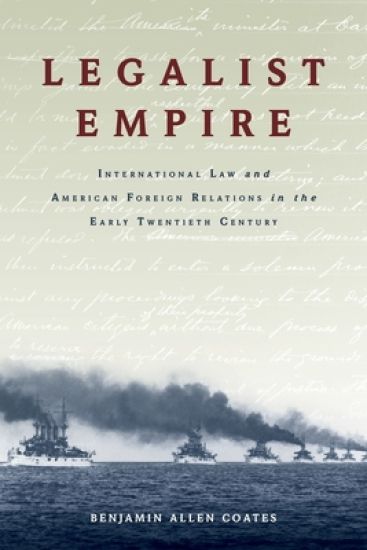
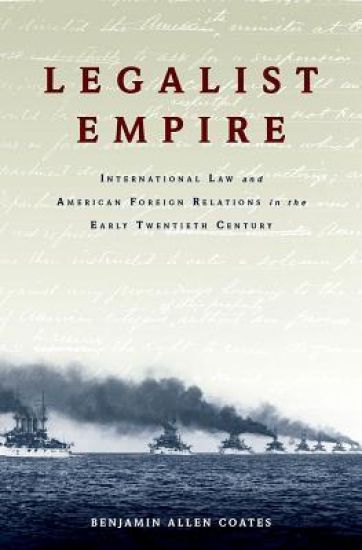
Legalist Empire

Legalist Empire

Benjamin Allen Coates

Oxford University Press Inc
2019
nidottu
America's empire expanded dramatically following the Spanish-American War of 1898. The United States quickly annexed the Philippines and Puerto Rico, seized control over Cuba and the Panama Canal Zone, and extended political and financial power throughout Latin America. This age of empire, Benjamin Allen Coates argues, was also an age of international law. Justifying America's empire with the language of law and civilization, international lawyers-serving simultaneously as academics, leaders of the legal profession, corporate attorneys, and high-ranking government officials-became central to the conceptualization, conduct, and rationalization of US foreign policy. Just as international law shaped empire, so too did empire shape international law. Legalist Empire shows how the American Society of International Law was animated by the same notions of "civilization" that justified the expansion of empire overseas. Using the private papers and published writings of such figures as Elihu Root, John Bassett Moore, and James Brown Scott, Coates shows how the newly-created international law profession merged European influences with trends in American jurisprudence, while appealing to elite notions of order, reform, and American identity. By projecting an image of the United States as a unique force for law and civilization, legalists reconciled American exceptionalism, empire, and an international rule of law. Under their influence the nation became the world's leading advocate for the creation of an international court. Although the legalist vision of world peace through voluntary adjudication foundered in the interwar period, international lawyers-through their ideas and their presence in halls of power-continue to infuse vital debates about America's global role
Legalist Empire

Legalist Empire

Benjamin Allen Coates

Oxford University Press Inc
2016
sidottu
After 1898 the United States not only solidified its position as an economic colossus, but by annexing Puerto Rico and the Philippines it had also added for the first time semi-permanent, heavily populated colonies unlikely ever to attain statehood. In short order followed a formal protectorate over Cuba, the "taking" of Panama to build a canal, and the announcement of a new Corollary to the Monroe Doctrine, proclaiming an American duty to "police" the hemisphere. Empire had been an American practice since the nation's founding, but the new policies were understood as departures from traditional methods of territorial expansion. How to match these actions with traditional non-entanglement constituted the central preoccupation of U.S. foreign relations in the early twentieth century. International lawyers proposed instead that the United States become an impartial judge. By becoming a force for law in the world, America could reconcile its republican ideological tradition with a desire to rank with the Great Powers. Lawyers' message scaled new heights of popularity in the first decade and a half of the twentieth century as a true profession of international law emerged. The American Society of International Law (ASIL) and other groups, backed by the wealth of the Carnegie Endowment for International Peace, held annual meetings and published journals. They called for the creation of an international court, the holding of regular conferences to codify the rules of law, and the education of public opinion as to the proper rights and duties of states. To an extent unmatched before or since, the U.S. government-the executive branch if not always the U.S. Senate-embraced this project. Washington called for peace conferences and pushed for the creation of a "true " international court. It proposed legal institutions to preserve order in its hemisphere. Meanwhile lawyers advised presidents and made policy. The ASIL counted among its first members every living secretary of state (but one) who held office between 1892 and 1920. Growing numbers of international lawyers populated the State Department and represented U.S. corporations with business overseas. International lawyers were not isolated idealists operating from the sidelines. Well-connected, well-respected, and well-compensated, they formed an integral part of the foreign policy establishment that built and policed an expanding empire.
Energy Of The Characteristic X-ray Emission From Molybdenum And Palladium As A Function Of The Applied Voltage
This work has been selected by scholars as being culturally important, and is part of the knowledge base of civilization as we know it. This work was reproduced from the original artifact, and remains as true to the original work as possible. Therefore, you will see the original copyright references, library stamps (as most of these works have been housed in our most important libraries around the world), and other notations in the work.This work is in the public domain in the United States of America, and possibly other nations. Within the United States, you may freely copy and distribute this work, as no entity (individual or corporate) has a copyright on the body of the work.As a reproduction of a historical artifact, this work may contain missing or blurred pages, poor pictures, errant marks, etc. Scholars believe, and we concur, that this work is important enough to be preserved, reproduced, and made generally available to the public. We appreciate your support of the preservation process, and thank you for being an important part of keeping this knowledge alive and relevant.
Unification

Unification

Benjamin Allen Sullivan

Createspace Independent Publishing Platform
2016
nidottu
The Unification publication is comprised of two equations. The first is the Sullivan Unifying Constant which is an equation that resolves the long-sought pursuit of understanding the unification of the known forces in the universe and how they interact with each other. The second equation is the Sullivan Newtonian Gravitational Equation. The equation is an altercation of Sir Isaac Newton's Universal Law of Gravitation. The equation merges and demonstrates the interaction between what is known as "Classical Physics" and modern "Quantum Theory". In addition to the equations, the Unification publication contains various thought experiments and postulates. Both equations are derived and extrapolated from a book that I authored in 2015/2016: Probability, Quantum Mechanics, and Probability-Quanta.
Seasons of Solace: Reflections on Grief

Seasons of Solace: Reflections on Grief

Rachel Flower; Benjamin Allen

Senssoma
2017
nidottu
Like seeing one's reflection on a still pond, Seasons of Solace: Reflections on Grief is a reflection of great loss resting upon nature's gentle beauty. Our greatest desire is that you will see your reflection in our reflections. Words on a page can never truly describe the emptiness found when someone we love slips beyond our reach. Yet, it is our hope that these words, born out of loss, can be a bridge to solace in your seasons of sorrow. May our hearts meet within these pages and find healing on our common path. May in our shared loss we find our shared life. May in our aloneness we discover our tears fall on the same earth and flow into the same ocean. And through these reflections may our great loss bring us into an even greater love. When we look into the still pond, into our own reflection, we can see others on the water's edge and know our solitary sorrow is not reflection our aloneness, but of our shared love. Perhaps you find here the comfort of experiencing that you are not alone. Such great loss, such great love, lives within us all. We invite you to join us within these pages in a place of healing in our seasons of solace.
A Sermon, Preached at the Ordination of the Rev. Benjamin Thurston, A.M. to the Pastoral Care of the Church at North-Hampton. November 2, 1785. By Jonathan Allen, A.M. Pastor of the First Church in Bradford
The 18th century was a wealth of knowledge, exploration and rapidly growing technology and expanding record-keeping made possible by advances in the printing press. In its determination to preserve the century of revolution, Gale initiated a revolution of its own: digitization of epic proportions to preserve these invaluable works in the largest archive of its kind. Now for the first time these high-quality digital copies of original 18th century manuscripts are available in print, making them highly accessible to libraries, undergraduate students, and independent scholars.The Age of Enlightenment profoundly enriched religious and philosophical understanding and continues to influence present-day thinking. Works collected here include masterpieces by David Hume, Immanuel Kant, and Jean-Jacques Rousseau, as well as religious sermons and moral debates on the issues of the day, such as the slave trade. The Age of Reason saw conflict between Protestantism and Catholicism transformed into one between faith and logic -- a debate that continues in the twenty-first century.++++The below data was compiled from various identification fields in the bibliographic record of this title. This data is provided as an additional tool in helping to insure edition identification: ++++British LibraryW029264Exeter N.H.]: Printed by Lamson & Ranlet, in Dearborn's new-invented printing-press, M, DCC, LXXXVI. 1786]. 32p.; 8