Reprint of the original, first published in 1872. The publishing house Anatiposi publishes historical books as reprints. Due to their age, these books may have missing pages or inferior quality. Our aim is to preserve these books and make them available to the public so that they do not get lost.
Reprint of the original, first published in 1872. The publishing house Anatiposi publishes historical books as reprints. Due to their age, these books may have missing pages or inferior quality. Our aim is to preserve these books and make them available to the public so that they do not get lost.
Socially Responsible Investment Law shows how to improve the environmental behavior of corporate financiers, such as banks, pension plans, and mutual funds. Normally, we associate environmental harm with the front-line companies that extract, consume, and pollute, but not the financiers that sponsor and profit from these activities. Corporate financiers are the economy's "unseen polluters," and they should adopt policies and practices to avoid environmental harm that may result from their loans and capital financing investments. Benjamin Richardson proposes governance reforms to encourage Socially Responsible Investment. These include: redefining the fiduciary responsibilities of institutional investors to include the environment (specifically the precautionary principle); enhancing the strategic role of national pension funds in sustainable finance; building new forms of international cooperation for transnational financial markets; democratizing and strengthening local financing through credit unions; and, for all financiers, providing a better mix of economic incentives and informational resources for SRI.
The story of four remarkable women who shaped the intellectual history of the 20th century: Elizabeth Anscombe, Philippa Foot, Mary Midgley, and Iris Murdoch. On the cusp of the Second World War, four women went to Oxford to begin their studies: a fiercely brilliant Catholic convert; a daughter of privilege longing to escape her stifling upbringing; an ardent Communist and aspiring novelist with a list of would-be lovers as long as her arm; and a quiet, messy lover of newts and mice who would become a great public intellectual of our time. They became lifelong friends. At the time, only a handful of women had ever made lives in philosophy. But when Oxford's men were drafted in the war, everything changed. As Elizabeth Anscombe, Philippa Foot, Mary Midgley, and Iris Murdoch labored to make a place for themselves in a male-dominated world, as they made friendships and families, and as they drifted toward and away from each other, they never stopped insisting that some lives are better than others. They argued that courage and discernment and justice--and love--are the heart of a good life. This book presents the first sustained engagement with these women's contributions: with the critique and the alternative they framed. Drawing on a cluster of recently opened archives and extensive correspondence and interviews with those who knew them best, Benjamin Lipscomb traces the lives and ideas of four friends who gave us a better way to think about ethics, and ourselves.
The story of four remarkable women who shaped the intellectual history of the 20th century: Elizabeth Anscombe, Philippa Foot, Mary Midgley, and Iris Murdoch. On the cusp of the Second World War, four women went to Oxford to begin their studies: a fiercely brilliant Catholic convert; a daughter of privilege longing to escape her stifling upbringing; an ardent Communist and aspiring novelist with a list of would-be lovers as long as her arm; and a quiet, messy lover of newts and mice who would become a great public intellectual of our time. They became lifelong friends. At the time, only a handful of women had ever made lives in philosophy. But when Oxford's men were drafted in the war, everything changed. As Elizabeth Anscombe, Philippa Foot, Mary Midgley, and Iris Murdoch labored to make a place for themselves in a male-dominated world, as they made friendships and families, and as they drifted toward and away from each other, they never stopped insisting that some lives are better than others. They argued that courage and discernment and justice--and love--are the heart of a good life. This book presents the first sustained engagement with these women's contributions: with the critique and the alternative they framed. Drawing on a cluster of recently opened archives and extensive correspondence and interviews with those who knew them best, Benjamin Lipscomb traces the lives and ideas of four friends who gave us a better way to think about ethics, and ourselves.
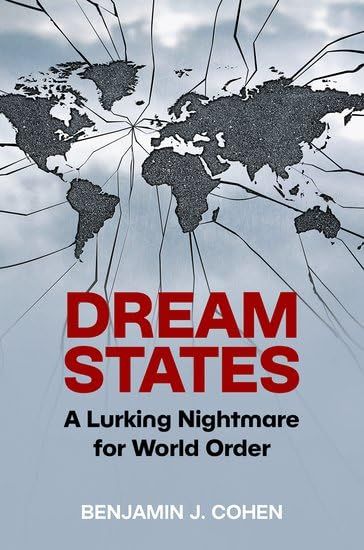
Around the world, numerous communities seek the protections of sovereignty--a "dream state" of their own--to preserve their traditional way of life. However, these secessionist movements create risk of prolonged conflict in countries of every size and location, from tiny statelets in the Caribbean or Pacific to large and fragile multiethnic federations like Russia, India, and even the United States. Dream States asks and answers two questions: How serious is the danger of separatist conflict? And what can be done about it? Using diverse examples from recent history, Benjamin J. Cohen guides readers through types of dream states, some harmless and others more threatening. Cohen argues that abandoning the traditional dichotomous conceptualization of statehood, which insists that communities are either fully sovereign or else completely subordinate, presents the best way to reduce the threat of violent conflict. Given the increasing emphasis on territorial and ethnic identity in political movements throughout the world, this book is essential reading for anyone interested in separatism and why it poses a threat to peace and international order.
Around the world, numerous communities seek the protections of sovereignty--a "dream state" of their own--to preserve their traditional way of life. However, these secessionist movements create risk of prolonged conflict in countries of every size and location, from tiny statelets in the Caribbean or Pacific to large and fragile multiethnic federations like Russia, India, and even the United States. Dream States asks and answers two questions: How serious is the danger of separatist conflict? And what can be done about it? Using diverse examples from recent history, Benjamin J. Cohen guides readers through types of dream states, some harmless and others more threatening. Cohen argues that abandoning the traditional dichotomous conceptualization of statehood, which insists that communities are either fully sovereign or else completely subordinate, presents the best way to reduce the threat of violent conflict. Given the increasing emphasis on territorial and ethnic identity in political movements throughout the world, this book is essential reading for anyone interested in separatism and why it poses a threat to peace and international order.