Rowan Williams; Makoto Fujimura; Stephanie Saldaña; Adam Nicholson; Hannah Rose Thomas; Narine Abgaryan; Leah Libresco Sergeant; Norman Wirzba; Benjamin Crosby; Kurt Armstrong; Philip Britts
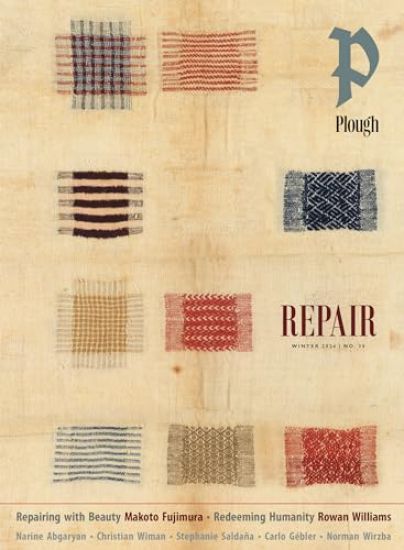
Our writers celebrate the work of repair – of objects, relationships, communities, and landscapes – and reckon with its limits. Consumers campaign for a “right to repair” in protest of products’ wasteful “planned obsolescence.” Repair cafés spring up, in which old-timers teach greenhorns to mend clothes and appliances. But much more than our possession stand in need of repair. For some, the Jewish phrase tikkun olam – to repair the world – may have become little more than a secular social justice mandate, not unlike the Christian cliché “God has no hands but ours.” Yet while we wait on God to repair the cosmos, there are indeed countless ways one can participate in this work, whether one is a mother, a handyman, a farmer, an artist, an teacher, or a pastor. The work may not be glamorous, but it calls forth our creativity and holds its own rewards. On this theme: - A handyman settles for humble work and doesn’t wish more for his children. - A mother mends her daughters’ clothes into extravagant works of arts. - A pastor in a declining denomination asks where to start repairing the church. - A farmer says a restored landscape will be more than it was before. - Yazidi, Rohingya, and Uyghur survivors of sexual violence find ways to reclaim their dignity. - Painter Makoto Fujimura says artists don’t fight culture wars, they make culture. - Prisoners and staff say prisons don’t rehabilitate, but education in prison just might. - A schoolteacher says education requires family, school, and community. - A church that prays in the language of Jesus, scattered by war, lives on in new places. Plough Quarterly features stories, ideas, and culture for people eager to apply their faith to the challenges we face. Each issue includes in-depth articles, interviews, poetry, book reviews, and art.
When a process popularly known as the Industrial Revolution first took hold in Germany in the mid-nineteenth century, many contemporaries were stunned by the scale and ferocity of the transformation. While Germany had long been considered a promising place to industrialize, given its historic ties to New World markets, skilled and educated workforce, and deep pockets of wealth, progress had been slow due to persistent indifference and skepticism across society. That people should have suddenly dropped their reservations and simply embraced the new industrial modernity defied all explanation. Grasping for answers, some concluded that the Germans must have fallen under the spell of the "capitalist spirit." Benjamin P. Hein locates the impetus for the abrupt transformation of German society after ca. 1850 in its cultural exchange with the country's burgeoning diaspora in North America, one of the largest in this century. In correspondence and other "news from America," the emigrants conveyed to their families, communities, and business associates in Europe a different set of norms and ethics regarding work, entrepreneurship, and commerce. By making it socially acceptable and politically meaningful to frequently change professions or to organize businesses as joint-stock corporations, they inadvertently mobilized an otherwise reluctant population for a more centralized regime of production that served global market forces instead of local needs and corporatist norms. They also helped popularize key institutional pillars of the new economy, like the universal bank, and inspired innovative commercial reforms, most notably the "limited liability partnership" (LLP), or "G.m.b.H." in German, which became the legal foundation of Germany's particularly robust small-business economy. While addressing global trends, The Migrant's Spirit makes these phenomena comprehensible through the lives of individuals who faced painful choices and moral quandaries as they attempted to navigate a new social and economic order and began to trust countrymen abroad over local sources of guidance. By reconstructing their struggles, Hein sheds new light on the transatlantic dimensions of Germany's path to industrial modernity.
Addressing drug use and abuse as a global phenomenon, this text draws on contemporary and international research findings to examine the causes of drug use in different countries and to explore different policy responses to its prevention and treatment. It is an invaluable resource for students, practitioners and anyone concerned with drug use.
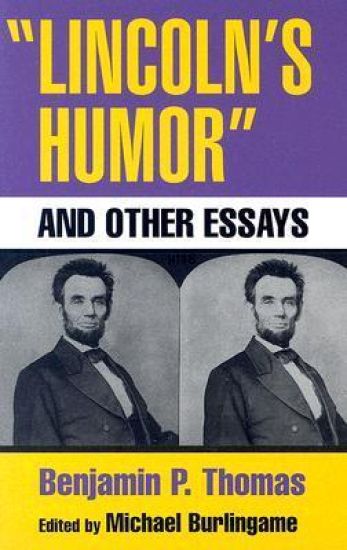
This volume gathers the best previously unpublished and uncollected writings on Abraham Lincoln and Lincoln scholarship by one of his great biographers, Benjamin P. Thomas. A skilled historian and a masterful storyteller himself, Thomas was widely regarded as the greatest Lincoln historian of his generation. With these essays, he combines historical depth with narrative grace in delineating Lincoln's qualities as a humorist, lawyer, and politician. From colorful tall tales to clever barbs aimed at political opponents, Lincoln clothed a shrewd wit in a homespun, backwoods vernacular. He used humor to defuse tension, illuminate a point, put others at ease--and sometimes for sheer fun. From an early reliance on broad humor and ridicule in speeches and on the stump, Lincoln's style shifted in 1854 to a more serious vein in which humor came primarily to elucidate an argument. "If I did not laugh occasionally I should die," he is said to have told his cabinet, "and you need this medicine as much as I do." Thomas brings his deep knowledge of Lincoln to essays on the great man's tumultuous career in Congress, his work as a lawyer, his experiences in the Courts, and his opinions of the South. A gracious survey of Lincoln's early biographers, particularly Ida Tarbell, stands alongside an appreciation of Harry Edward Pratt, a key figure in the early days of the Abraham Lincoln Association. Thomas also assesses Lincoln's use of language and the ongoing significance of the Gettysburg Address. This diverse collection is enhanced by an introduction by Michael Burlingame, himself a leading biographer of Lincoln. Burlingame provides a balanced portrait of Thomas and his circuitous path toward writing history.
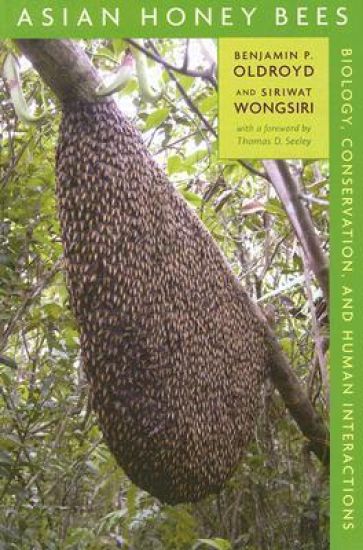
The familiar European hive bee, Apis mellifera, has long dominated honey bee research. But in the last 15 years, teams in China, Japan, Malaysia, and Thailand began to shift focus to the indigenous Asian honey bees. Benjamin Oldroyd, well known for his work on the genetics and evolution of worker sterility, has teamed with Siriwat Wongsiri, a pioneer of the study of bees in Thailand, to provide a comparative work synthesizing the rapidly expanding Asian honey bee literature. After introducing the species, the authors review evolution and speciation, division of labor, communication, and nest defense. They underscore the pressures colonies face from pathogens, parasites, and predators--including man--and detail the long and amazing history of the honey hunt. This book provides a cornerstone for future investigations on these species, insights into the evolution across species, and a direction for conservation efforts to protect these keystone species of Asia's tropical forests.
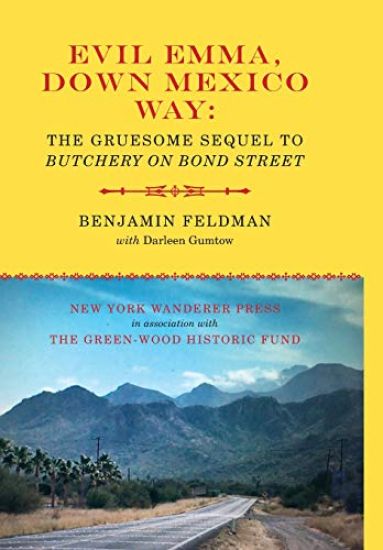
In 2007, my first book, Butchery on Bond Street: Sexual Politics and the Burdell-Cunningham Case in Ante-Bellum New York, appeared.1 The volume is the dispositive history of one of the most infamous 19th-century crimes in New York City, dominating the attention of the local and national press and public in much the same way as did O. J. Simpson in the late 20th century. Dr. Burdell was a well-to-do dentist living and working in lower Manhattan, and also a member of the demimonde of gambling, prostitution and drug use that pervaded the streets adjacent to his living quarters and clinic on Bond Street. After making the acquaintance of Emma Hempstead Cunningham, a comely widow with five children who was desperately seeking a new husband and provider, Dr. Burdell seduced her, raped her, impregnated her and then aborted her pregnancy without her consent. Emma moved into his home with her five children and became the landlady of a boardinghouse there in settlement of a breach of promise suit she maintained against Burdell in 1856. Despite settlement of the lawsuit, Emma continued to press Burdell to marry her, and was witness to an unending stream of women whom Burdell welcomed, exchanging sex for dentistry and other shenanigans. Eavesdropping under a stairwell one day, Emma overheard Burdell arranging for her replacement as landlady--which would have rendered her and her family homeless. Within two weeks, Dr. Burdell was found on the floor of his second-floor dentistry clinic, garroted, stabbed 15 times with a dirk, and very dead. Emma was immediately placed under house arrest on suspicion of murder. A coroner's jury was convened on the premises and after two weeks, the verdict held that Burdell had been murdered by Emma and a co-conspirator, both of whom were promptly indicted and jailed. Remarkably, with the aid of expert defense counsel, Emma was ac- 8 - quitted in early May 1857. Her contemporaneous suit in Surrogate's Court to take control of Dr. Burdell's fortune as a result of her alleged marriage to him during the previous year failed, and after having been caught in a sting by the District Attorney when she tried to fake a pregnancy of Dr. Burdell's unborn child to influence the civil lawsuit, Emma was jailed again in August 1857 but released for lack of sufficient proof of fraudulent criminal intent. My first book ends with that chapter, noting only in the epilogue that Emma decamped to Baja California to go into the mining business and remarry, returning to New York City, widowed and pauperized, in the late 1880s. Thanks to the magic of the internet and search engines, and much to my chagrin, Emma's Baja story was much greater than I knew. This slender volume tells of Emma's further heinous career of swindling, treachery and murder in Baja California Sur. Harvey Burdell was hardly her last victim and perhaps not the unluckiest.
This book provides an analysis of racism and goes on to provide some suggestions as to what can be done to reduce it. The issue is explored from the standpoint of both students and faculty and, in my opinion, is well worth reading and studying. --The Academic Bookshelf No topic causes more concern at today's university than a discussion of diversity in education. Controversies about affirmative action hires, admission policies, intercultural relations in the classroom, the role of ethnic studies departments, and changes in the course curriculum all seem to swirl around the changing ethnic composition of the campus. How do we all get along? Tackling this question are authors Benjamin P. Bowser, Gale S. Auletta, and Terry Jones, who suggest some practical strategies for dealing with questions of racism, diversity, and intercultural communication. Their suggestions are addressed to both European-American faculty and faculty of color, and range from strategies to improve intercultural interpersonal skills to broad structural changes the university needs to undergo to fully embrace its diverse population.
Based on extensive research in government archives and private papers, this book analyzes the secret debate within the Eisenhower administration over the pursuit of a nuclear test-ban agreement. In contrast to much recent scholarship, this study concludes that Eisenhower strongly desired to reach an accord with the Soviet Union and the United Kingdom to cease nuclear weapons testing. For Eisenhower, a test ban would ease Cold War tensions, slow the nuclear arms race, and build confidence toward disarmament; however, he faced continual resistance from his early scientific advisers, most notably Lewis L. Strauss and Edward Teller. Extensive research into previously unavailable government archival sources and collections of private manuscripts reveals the manipulative acts of test-ban opponents and other factors that inhibited Eisenhower's actions throughout his presidency. Meticulously analyzed, these sources underscore Eisenhower's dependence on the counsel of his science advisors, such as Strauss, James R. Killian, and George B. Kistiakowsky, to determine the course he pursued in regard to several components of his national security strategy. In addition to its comprehensive analysis of the test-ban debate, this book makes important contributions to the scholarly literature assessing Eisenhower's leadership and his approach to arms control.
This authoritative classic tells the story of the Illinois village on the Sangamon River in which Abraham Lincoln lived from 1831 to 1837. Benjamin P. Thomas’s three-part examination of the town often referred to as Lincoln’s “alma mater” features the founding and early history of New Salem, Lincoln’s impact on the village and its effect on him, and the story of the Lincoln legend and the reconstruction of the town. Lincoln’s New Salem highlights the young Lincoln’s arrival, his important wrestling match with Jack Armstrong, his self-education, his brief military career in the Black Hawk War, his experience as a postmaster largely indifferent to postal regulations, his financial woes with the general store, and his election to the state legislature. Making the point that New Salem was where Lincoln acquired faith in himself and in other people, Thomas introduces us to those who created New Salem and who knew, influenced, and befriended Lincoln, delving into his relationships with his neighbors and the loyal friends who often came to his aid. This colorful history closes with a discussion of the Lincoln legend, which prompted the gradual realization that New Salem was not a dismal mire from which Abraham Lincoln had to extricate himself but was, in fact, an energizing force. This realization led to research and finally to the restoration of New Salem, which began in 1932. The preservation of the village remains vitally important. First published in 1934 and revised by the author in 1954, this reissue includes a previously unpublished piece about New Salem and Illinois governor Henry Horner by Benjamin Thomas, a new introduction by Kenneth J. Winkle, and new photos by Robert Shaw, in addition to original drawings by Romaine Proctor and a 1971 foreword by Ralph G. Newman.
Thomas tells the story of the village where Abraham Lincoln lived from 1831 to 1837. His three-part examination of the village often referred to as Lincoln’s "Alma Mater" features the founding and early history of New Salem, Lincoln’s impact on the village and its effect on him, and the story of the Lincoln legend and the reconstruction of the town.Thomas argues convincingly that New Salem was the town where Lincoln acquired faith in himself, faith in people. At 22 the future president drifted into town seeking to become a blacksmith. Thomas introduces us to the people who created New Salem and who knew, influenced, and befriended Lincoln.Thomas highlights Lincoln’s arrival, his relationships with his neighbors, his important wrestling match with Jack Armstrong, his self-education, his quiet career as an Indian fighter, his experience as a postmaster largely indifferent to postal regulations, his financial woes as a businessman, his loyal friends who often came to his aid, and his election to the legislature.This colorful history closes with a discussion of the Lincoln legend. The truth of the stories is unimportant. What matters is that the growing Lincoln legend prompted the gradual realization that New Salem was not a dismal mire from which President Lincoln had had to extricate himself but was, in fact, an energizing force. This realization led to research and finally to the restoration of New Salem, which began in 1932.
What historical, political, and ecclesial realities drove the canonization of the New Testament? How are the doctrines of Early Christianity related to the formation of the New Testament? Should the New Testament differ in authority from other early Christian texts? As these questions demonstrate, the enduring influence of the New Testament does not lessen the dispute over the events and factors leading to its adoption. Five Views on the New Testament Canon presents five distinct ways of understanding how the New Testament came to be: A Conservative Evangelical Perspective -- Darian R. LockettA Progressive Evangelical Perspective -- David R. NienhuisA Liberal Protestant Perspective -- Jason David BeDuhnA Roman Catholic Perspective -- Ian BoxallAn Orthodox Perspective -- George L. Parsenios Each contributor addresses historical, theological, and hermeneutical questions related to the New Testament canon, such as what factors precipitated the establishment and recognition of the New Testament canon; the basis of any authority the New Testament has; and what the canon means for reading and interpreting the New Testament. Contributors also include a chapter each responding to the other views presented in the volume. The result is a lively exchange suitable for both undergraduate and graduate students seeking to grasp the best canon scholarship in biblical studies.