Kirjojen hintavertailu. Mukana 11 342 296 kirjaa ja 12 kauppaa.

Kirjahaku

Etsi kirjoja tekijän nimen, kirjan nimen tai ISBN:n perusteella.

1000 tulosta hakusanalla Benjamin Walter Frisch

Walter Benjamin

Walter Benjamin

Peter E. Gordon

YALE UNIVERSITY PRESS
2026
sidottu
An accessible and authoritative biography of Walter Benjamin that guides the reader through the complexity of his intellectual legacy and the turbulence of his time Walter Benjamin (1892–1940) is widely considered one of the most creative cultural critics of the twentieth century. Esteemed for his literary acumen and capacious imagination, he developed a unique style of criticism—his friend Hannah Arendt called it pearl-diving—that sought out fragments of redemption in the ruins of bourgeois civilization. Award-winning author Peter E. Gordon tells Benjamin’s story in a vivid and poetic style, inviting the reader to look beyond the image of Benjamin as a tragic figure of German-Jewish history and portraying him as a complex personality of unique and multifaceted gifts. Tracing Benjamin’s life from his Berlin childhood to his Parisian exile, through the romanticism of the youth movements and the conflicts over modernism and Marxism, Gordon brings Benjamin to life.
Walter Benjamin

Walter Benjamin

M. Kohlenbach

Palgrave Macmillan
2002
sidottu
Walter Benjamin's work represents one of the most radical and controversial responses to the problems of twentieth-century culture and society. This new interpretation analyzes some of the central enigmatic features of his writing, arguing that they result from the co-presence of religious scepticism and the desire for a religious foundation of social life. Margarete Kohlenbach focuses on the structure of self-reference as an expression of Benjamin's sceptical religiosity and examines its significance in his writing on language, literature and the cinema, as well as history, politics and modern technology.
Walter Benjamin’s First Philosophy
This book provides a study of Walter Benjamin’s first philosophy in two senses: it focuses on his early philosophy as a source of insight into his later works, and it explores his thinking about the nature of truth, method, experience, the relation of body and mind, and the limits of human knowledge.While most attention is paid to Benjamin’s later works, his writings from roughly 1914-1925 explore philosophical themes and develop a critical method. This book argues that this early work founds a series of original and lasting questions and insights. Benjamin understands experience as a broken continuum of diverse forms of spiritual expression, each of which is ephemeral. This leads Benjamin to a series of thought figures: the notion of language as a medium of experience; a philosophy of perception based in the natural history of the human body; an emphasis on mimesis as a faculty of creative assimilation; and a discovery of memory as a power for excavation of meaning in past experience. This book demonstrates that the need for a new understanding of the metaphysical structure of experience, as well as a new conception of truth, play a special role in shaping Benjamin’s subsequent work.Walter Benjamin’s First Philosophy will be of interest to scholars and advanced students working on the thought of Walter Benjamin, 20th-century Continental philosophy, comparative literature, and modern German thought.
Walter Benjamin’s First Philosophy

Walter Benjamin’s First Philosophy

Nathan Ross

TAYLOR FRANCIS LTD
2023
nidottu
This book provides a study of Walter Benjamin’s first philosophy in two senses: it focuses on his early philosophy as a source of insight into his later works, and it explores his thinking about the nature of truth, method, experience, the relation of body and mind, and the limits of human knowledge.While most attention is paid to Benjamin’s later works, his writings from roughly 1914-1925 explore philosophical themes and develop a critical method. This book argues that this early work founds a series of original and lasting questions and insights. Benjamin understands experience as a broken continuum of diverse forms of spiritual expression, each of which is ephemeral. This leads Benjamin to a series of thought figures: the notion of language as a medium of experience; a philosophy of perception based in the natural history of the human body; an emphasis on mimesis as a faculty of creative assimilation; and a discovery of memory as a power for excavation of meaning in past experience. This book demonstrates that the need for a new understanding of the metaphysical structure of experience, as well as a new conception of truth, play a special role in shaping Benjamin’s subsequent work.Walter Benjamin’s First Philosophy will be of interest to scholars and advanced students working on the thought of Walter Benjamin, 20th-century Continental philosophy, comparative literature, and modern German thought.
Walter Benjamin's Philosophy
This collection explores, in Adorno's description, `philosophy directed against philosophy'. The essays cover all aspects of Benjamin's writings, from his early work in the philosophy of art and language, through to the concept of history. The experience of time and the destruction of false continuity are identified as the key themes in Benjamin's understanding of history.
Walter Benjamin

Walter Benjamin

Howard Caygill

Routledge
1997
sidottu
This book analyses the development of Benjamin's concept of experience in his early writings showing that it emerges from an engagement with visual experience, and in particular the experience of colour.
Walter Benjamin

Walter Benjamin

Howard Caygill

Routledge
1997
nidottu
This book analyzes the development of Walter Benjamin's concept of experience in his early writings showing that it emerges from an engagement with visual experience, and in particular the experience of colour. It represents Benjamin as primarily a thinker of the visual field.
Walter Benjamin:Critical Evaluations 3V
No other single author has so commanding a critical presence across so many disciplines within the arts and humanities, in so many national contexts, as Walter Benjamin (1892-1940). The belated reception of his work as a literary critic (dating from the late 1950s) has been followed by a rapid series of critical receptions in different contexts: Frankfurt Critical Theory and Marxism, Judaism, Film Theory, Post-structuralism, Philosophical Romanticism, and Cultural Studies. This collection brings together a selection of the most critically important items in the literature, across the full range of Benjamin's cultural-theoretical interests, from all periods of the reception of his writings, but focusing upon the most recent, to produce a comprehensive overview of the best critical literature.
Walter Benjamin and Architecture
The essays compiled in this book explore aspects of Walter Benjamin’s discourse that have contributed to the formation of contemporary architectural theories. Issues such as technology and history have been considered central to the very modernity of architecture, but Benjamin’s reflection on these subjects has elevated the discussion to a critical level. The contributors in this book consider Walter Benjamin's ideas in the context of digitalization of architecture where it is the very technique itself that determines the processes of design and the final form. This book was published as a special issue of Architectural Theory Review.
Walter Benjamin and Architecture
The essays compiled in this book explore aspects of Walter Benjamin’s discourse that have contributed to the formation of contemporary architectural theories. Issues such as technology and history have been considered central to the very modernity of architecture, but Benjamin’s reflection on these subjects has elevated the discussion to a critical level. The contributors in this book consider Walter Benjamin's ideas in the context of digitalization of architecture where it is the very technique itself that determines the processes of design and the final form. This book was published as a special issue of Architectural Theory Review.
Walter Benjamin's Philosophy
This collection explores, in Adorno's description, `philosophy directed against philosophy'. The essays cover all aspects of Benjamin's writings, from his early work in the philosophy of art and language, through to the concept of history. The experience of time and the destruction of false continuity are identified as the key themes in Benjamin's understanding of history.
Walter Benjamin, Religion and Aesthetics
Walter Benjamin, Religion, and Aesthetics is an innovative and creative attempt to unsettle and reconceive the key concepts of religious studies through a reading with, and against, Walter Benjamin. Constructing what he calls an "allegorical aesthetics," Plate sifts through Benjamin's writings showing how his concepts of art, allegory, and experience undo traditionally stabilizing religious concepts such as myth, symbol, memory, narrative, creation, and redemption.
Walter Benjamin, Religion and Aesthetics
Walter Benjamin, Religion, and Aesthetics is an innovative and creative attempt to unsettle and reconceive the key concepts of religious studies through a reading with, and against, Walter Benjamin. Constructing what he calls an "allegorical aesthetics," Plate sifts through Benjamin's writings showing how his concepts of art, allegory, and experience undo traditionally stabilizing religious concepts such as myth, symbol, memory, narrative, creation, and redemption.
Walter Benjamin

Walter Benjamin

Richard Wolin

University of California Press
1994
pokkari
Few twentieth-century thinkers have proven as influential as Walter Benjamin, the German-Jewish philosopher and cultural and literary critic. Richard Wolin's book remains among the clearest and most insightful introductions to Benjamin's writings, offering a philosophically rich exposition of his complex relationship to Adorno, Brecht, Jewish Messianism, and Western Marxism. Wolin provides nuanced interpretations of Benjamin's widely studied writings on Baudelaire, historiography, and art in the age of mechanical reproduction. In a new Introduction written especially for this edition, Wolin discusses the unfinished Arcades Project, as well as recent tendencies in the reception of Benjamin's work and the relevance of his ideas to contemporary debates about modernity and postmodernity.
Walter Benjamin's Other History

Walter Benjamin's Other History

Beatrice Hanssen

University of California Press
2000
pokkari
Long considered to be an impenetrable, hermetic treatise, Walter Benjamin's The Origin of German Tragic Drama has rarely received the attention it deserves as a key text, central to a full understanding of his work. In this critically acclaimed study, distinguished Benjamin scholar Beatrice Hanssen unlocks the philosophical and ethical dimensions of his thought with great clarity and sophisitication.
Walter Benjamin: Selected Writings

Walter Benjamin: Selected Writings

Walter Benjamin

The Belknap Press
2004
nidottu
Walter Benjamin was one of the most original and important critical voices of the twentieth century, but until now only a few of his writings have been available in English. Harvard University Press has now undertaken to publish a significant portion of his work in definitive translation, under the general editorship of Michael W. Jennings. This volume, the first of three, will at last give readers of English a true sense of the man and the many facets of his thought. (The magnum opus of Benjamin’s Paris years, The Arcades Project, has been published in a separate volume.) Walter Benjamin emerged from the head-on collision of an idealistic youth movement and the First World War, which Benjamin and his close friends thought immoral. He walked away from the wreck scarred yet determined “to be considered as the principal critic of German literature.” But the scene, as he found it, was dominated by “talented fakes,” so—to use his words—“only a terrorist campaign would I suffice” to effect radical change. This book offers the record of the first phase of that campaign, culminating with “One Way Street,” one of the most significant products of the German avant-garde of the Twenties. Against conformism, homogeneity, and gentrification of all life into a new world order, Benjamin made the word his sword. Volume I of the Selected Writings brings together essays long and short, academic treatises, reviews, fragments, and privately circulated pronouncements. Fully five-sixths of this material has never before been translated into English. The contents begin in 1913, when Benjamin, as an undergraduate in imperial Germany, was president of a radical youth group, and take us through 1926, when he had already begun, with his explorations of the world of mass culture, to emerge as a critical voice in Weimar Germany’s most influential journals. The volume includes a number of his most important works, including “Two Poems by Friedrich Hölderlin,” “Goethe’s Elective Affinities,” “The Concept of Criticism in German Romanticism,” “The Task of the Translator,” and “One Way Street.” He is as compelling and insightful when musing on riddles or children’s books as he is when dealing with weightier issues such as the philosophy of language, symbolic logic, or epistemology. We meet Benjamin the youthful idealist, the sober moralist, the political theorist, the experimentalist, the translator, and, above all, the virtual king of criticism, with his magisterial exposition of the basic problems of aesthetics. Benjamin’s sentences provoke us to return to them again and again, luring us as though with the promise of some final revelation that is always being postponed. He is by turns fierce and tender, melancholy and ebullient; he is at once classically rooted, even archaic, in his explorations of the human psyche and the world of things, and strikingly progressive in his attitude toward society and what he likes to call the organs of the collective (its architectures, fashions, signboards). Throughout, he displays a far-sighted urgency, judging the present on the basis of possible futures. And he is gifted with a keen sense of humor. Mysterious though he may sometimes be (his Latvian love, Asia Lacis, once described him as a visitor from another planet), Benjamin remains perhaps the most consistently surprising and challenging of critical writers.
Walter Benjamin: Selected Writings

Walter Benjamin: Selected Writings

Walter Benjamin

The Belknap Press
2005
nidottu
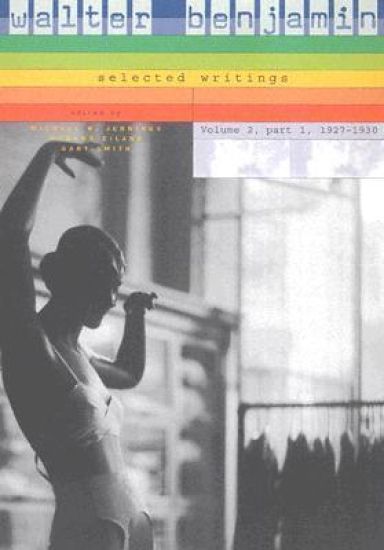
In the frenzied final years of the Weimar Republic, amid economic collapse and mounting political catastrophe, Walter Benjamin emerged as the most original practicing literary critic and public intellectual in the German-speaking world. Volume 2 of the Selected Writings is now available in paperback in two parts.In Part 1, Benjamin is represented by two of his greatest literary essays, "Surrealism" and "On the Image of Proust," as well as by a long article on Goethe and a generous selection of his wide-ranging commentary for Weimar Germany's newspapers. Part 2 contains, in addition to the important longer essays, "Franz Kafka," "Karl Kraus," and "The Author as Producer," the extended autobiographical meditation "A Berlin Chronicle," and extended discussions of the history of photography and the social situation of the French writer, previously untranslated shorter pieces on such subjects as language and memory, theological criticism and literary history, astrology and the newspaper, and on such influential figures as Paul Valery, Stefan George, Hitler, and Mickey Mouse.
Walter Benjamin: Selected Writings

Walter Benjamin: Selected Writings

Walter Benjamin

The Belknap Press
2005
nidottu
In the frenzied final years of the Weimar Republic, amid economic collapse and mounting political catastrophe, Walter Benjamin emerged as the most original practicing literary critic and public intellectual in the German-speaking world. Volume 2 of the Selected Writings is now available in paperback in two parts.In Part 1, Benjamin is represented by two of his greatest literary essays, "Surrealism" and "On the Image of Proust," as well as by a long article on Goethe and a generous selection of his wide-ranging commentary for Weimar Germany's newspapers. Part 2 contains, in addition to the important longer essays, "Franz Kafka," "Karl Kraus," and "The Author as Producer," the extended autobiographical meditation "A Berlin Chronicle," and extended discussions of the history of photography and the social situation of the French writer, previously untranslated shorter pieces on such subjects as language and memory, theological criticism and literary history, astrology and the newspaper, and on such influential figures as Paul Valery, Stefan George, Hitler, and Mickey Mouse.
Walter Benjamin: Selected Writings

Walter Benjamin: Selected Writings

Walter Benjamin

The Belknap Press
2006
nidottu
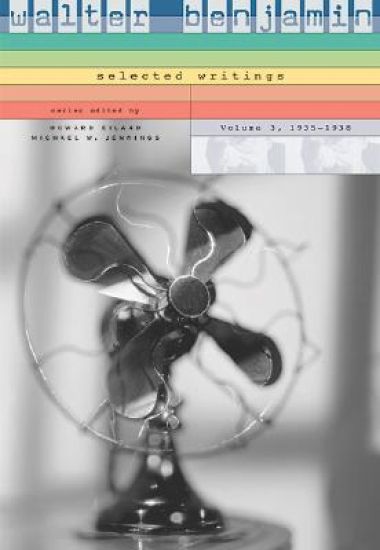
Radical critic of a European civilization plunging into darkness, yet commemorator of the humane traditions of the old bourgeoisie--such was Walter Benjamin in the later 1930s. This volume, the third in a four-volume set, offers twenty-seven brilliant pieces, nineteen of which have never before been translated.The centerpiece, A Berlin Childhood around 1900, marks the first appearance in English of one of the greatest German works of the twentieth century: a profound and beautiful account of the vanished world of Benjamin's privileged boyhood, recollected in exile. No less remarkable are the previously untranslated second version of Benjamin's most famous essay, "The Work of Art in the Age of Its Technological Reproducibility," with its striking insights into the relations between technology and aesthetics, and German Men and Women, a book in which Benjamin collects twenty-six letters by distinguished Germans from 1783 to 1883 in an effort to preserve what he called the true humanity of German tradition from the debasement of fascism.Volume 3 also offers extensively annotated translations of essays that are key to Benjamin's rewriting of the story of modernism and modernity--such as "The Storyteller" and "Paris, the Capital of the Nineteenth Century"--as well as a fascinating diary from 1938 and penetrating studies of Bertolt Brecht, Franz Kafka, and Eduard Fuchs. A narrative chronology details Benjamin's life during these four harrowing years of his exile in France and Denmark. This is an essential collection for anyone interested in his work.
Walter Benjamin: Selected Writings

Walter Benjamin: Selected Writings

Walter Benjamin

The Belknap Press
2006
nidottu
"Every line we succeed in publishing today...is a victory wrested from the powers of darkness." So wrote Walter Benjamin in January 1940. Not long afterward, he himself would fall prey to those powers, a victim of suicide following a failed attempt to flee the Nazis. However insistently the idea of catastrophe hangs over Benjamin's writings in the final years of his life, the "victories wrested" in this period nonetheless constitute some of the most remarkable twentieth-century analyses of the emergence of modern society. The essays on Charles Baudelaire are the distillation of a lifetime of thinking about the nature of modernity. They record the crisis of meaning experienced by a civilization sliding into the abyss, even as they testify to Benjamin's own faith in the written word.This volume ranges from studies of Baudelaire, Brecht, and the historian Carl Jochmann to appraisals of photography, film, and poetry. At their core is the question of how art can survive and thrive in a tumultuous time. Here we see Benjamin laying out an ethic for the critic and artist--a subdued but resilient heroism. At the same time, he was setting forth a sociohistorical account of how art adapts in an age of violence and repression. Working at the height of his powers to the very end, Benjamin refined his theory of the mass media that culminated in the final version of his essay "The Work of Art in the Age of Its Technological Reproducibility." Also included in this volume is his influential piece "On the Concept of History," completed just before his death. The book is remarkable for its inquiry into the nature of "the modern" (especially as revealed in Baudelaire), for its ideas about the transmogrification of art and the radical discontinuities of history, and for its examples of humane life and thought in the midst of barbarism. The entire collection is eloquent testimony to the indomitable spirit of humanity under siege.