Kirjojen hintavertailu. Mukana 11 244 527 kirjaa ja 12 kauppaa.

Kirjahaku

Etsi kirjoja tekijän nimen, kirjan nimen tai ISBN:n perusteella.

685 tulosta hakusanalla Bertolt Brecht

La Noce de Bertolt Brecht (fiche de lecture et analyse complète de l'oeuvre)
Venez d couvrir la pi ce de th tre de Bertolt Brecht gr ce une analyse litt raire de r f rence crite par un sp cialiste universitaire, cette fiche de lecture est recommand e par de nombreux enseignants. Cet ouvrage contient la biographie de l' crivain, le r sum d taill , le mouvement litt raire, le contexte de publication de l'oeuvre et l'analyse compl te. Retrouvez tous nos titres sur: www.fichedelecture.fr.
Bertolt Brecht

Bertolt Brecht

Herbert Cie Lang AG, Buchhandlung Antiquariat
1990
nidottu
La relation de Brecht a la tradition a ete a juste titre abordee jadis (H. Mayer, etc.) sous l'aspect general de la reinscription de l'auteur dramatique dans l'histoire culturelle et litteraire depuis, surtout, les annees 20. La critique recente recuse elle aussi l'idee d'un commencement absolu, tel qu'on l'avait defendu en France dans les annees 50. Simultanement, le recul du postulat ideologique a ouvert la voie a une perception plus proprement theatrale d'une production de fait tres variee. Le colloque tenu en Sorbonne en novembre 1988 renoue, mais d'un point de vue esthetique, avec l'examen des faits de continuite tout en replacant a chaque fois ces derniers dans leurs contextes historiques. Trois exposes sont consacres a Brecht, l'Allemagne et la RDA. La perspective methodologique principale est determinee par la dramaturgie dans ses liens avec la musique et les heritages, comiques et tragiques, de l'Antiquite, de la Renaissance et des classiques europeens. Elle conduit a reenvisager sous cet angle egalement les adaptations. La pratique scenique fait, a travers la notion de -modele-, l'objet d'une elucidation a partir du rapport entre verite, fable et histoire. Contributions en francais: G. Badia, M. Cadot, F. Fischbach, A. Gisselbrecht, J. Hermand, D. Iehl, J. Lefebvre, J. Lorang, D. Mortier, L. Richard, G. Schneilin, J.-M. Valentin. "Mit" "Beitragen in deutscher Sprache von: " Theo Buck, H. Hinck, Kl. Dt. Muller, H.G. Roloff, H. Turk ("Resumes dans l'autre" "langue" /"Zusammenfassungen in der jeweils anderen" "Sprache).""
Bertolt Brechts Hauspostille

Bertolt Brechts Hauspostille

Bertolt Brecht

SUHRKAMP VERLAG
2013
pokkari
'Diese 'Hauspostille' ist ', schreibt Bertold Brecht in der Einleitung, 'für den Gebrauch der Leser bestimmt. Sie soll nicht sinnlos hineingefressen werden. Die erste Lektion wendet sich direkt an das Gefühl des Lesers. Es empfiehlt sich, nicht zuviel davon auf einmal zu lesen. Die zweite Lektion wendet sich mehr an den verstand. Die dritte Lektion durchblättere man in den Zeiten der rohen Naturgewalten. Die vierte Lektion ist das Richtige für die Stunden des Reichtums, das Bewußtsein des Fleisches und die Anmaßung.'
Bertolt Brecht

Bertolt Brecht

Bloomsbury Academic
2020
muu
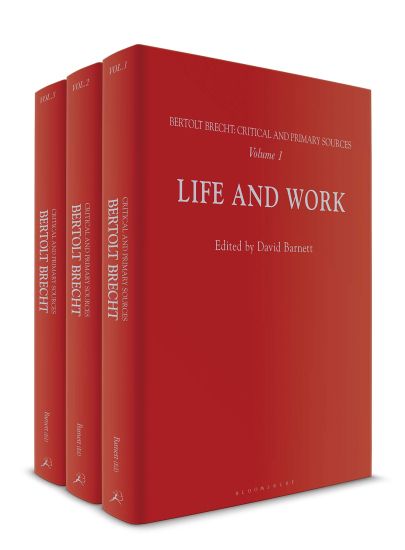
With over 80 scholarly articles, reviews, and critical interventions from the last 50 years, Bertolt Brecht: Critical and Primary Sources set covers the key periods of Brecht’s life, from his time in Augsburg (1898–1918) through the Weimer Republic (1918–1933), exile (1933–1948) and the German Democratic Republic (1949–1956). It also explores his theories, fundamentally his belief in the theatre’s ability to represent and change the world, core practices and relationships. Alongside primary sources that include writings by Brecht published in English for the first time, such as his short but important reflection in ‘originality’ in theatre production, key featured scholars include Fredric Jameson and his essay ‘Episch, or, the Third Person’, and pieces on Brecht’s collaborative working methods by Claus and Wera Küchenmeister, and the director Egon Monk. Volume 1 covers Brecht's life and work, including essays on his famous Mother Courage and Her Children, production reviews, poetry, novels and short stories, with some thoughts on his journals. Volume 2 covers theory, containing essays and primary writings on Brechtian terminology, and some of the more enigmatic terms like ‘Epic theatre’, ‘Verfremdung’, ‘Gestus’ and ‘Fabel’, features a survey of important theoretical works, a section on Brecht on non-theatre media, his relationship to other major thinkers, ideas and sources and the reception of his ideas. Volume 3 covers practice, including Brecht’s practice as documenter and director, beginning with his disastrous start in the Weimar Republic through to his later role as director as the Berliner Ensemble, his relationships with other practitioners and his own collaborators, reviews of important productions and global receptions. Each volume includes a contextualizing introduction surveying the topics covered and the development of scholarship on Brecht.
Bertolt Brecht and the David Fragments (1919-1921)

Bertolt Brecht and the David Fragments (1919-1921)

David J. Shepherd; Nicholas E. Johnson

T. T.Clark Ltd
2020
sidottu
This volume offers an examination of Brecht’s largely forgotten theatrical fragments of a life of David, written just after the Great War but prior to Brecht winning the Kleist Prize in 1922 and the acclaim that would launch hisextraordinary career. David J. Shepherd and Nicholas E. Johnson take as their starting point Brecht’s own diaries from the time, which offer a vivid picture of the young Brecht shuttling between Munich and the family home in Augsburg, surrounded by friends, torn between women, desperate for success, and all the while with ‘David on the brain’.The analysis of Brecht’s David, along with his notebooks and diaries, reveals significant connections between the reception of the Biblical David and one of Germany’s most tumultuous cultural periods. Drawing on theatrical experiments conducted with an ensemble from Trinity College Dublin, this volume includes the first ever translation of the David fragments in English, an extensive discussion of the theatrical afterlife of David in the early twentieth century as well as new interdisciplinary insights into the early Brecht: a writer entranced by the biblical David and utterly committed to translating the biblical tradition into his own evolving theatrical idiom.
Bertolt Brecht and the David Fragments (1919-1921)

Bertolt Brecht and the David Fragments (1919-1921)

David J. Shepherd; Nicholas E. Johnson

BLOOMSBURY PUBLISHING PLC
2021
nidottu
This volume offers an examination of Brecht’s largely forgotten theatrical fragments of a life of David, written just after the Great War but prior to Brecht winning the Kleist Prize in 1922 and the acclaim that would launch hisextraordinary career. David J. Shepherd and Nicholas E. Johnson take as their starting point Brecht’s own diaries from the time, which offer a vivid picture of the young Brecht shuttling between Munich and the family home in Augsburg, surrounded by friends, torn between women, desperate for success, and all the while with ‘David on the brain’.The analysis of Brecht’s David, along with his notebooks and diaries, reveals significant connections between the reception of the Biblical David and one of Germany’s most tumultuous cultural periods. Drawing on theatrical experiments conducted with an ensemble from Trinity College Dublin, this volume includes the first ever translation of the David fragments in English, an extensive discussion of the theatrical afterlife of David in the early twentieth century as well as new interdisciplinary insights into the early Brecht: a writer entranced by the biblical David and utterly committed to translating the biblical tradition into his own evolving theatrical idiom.