Kirjojen hintavertailu. Mukana 11 244 527 kirjaa ja 12 kauppaa.

Kirjahaku

Etsi kirjoja tekijän nimen, kirjan nimen tai ISBN:n perusteella.

1000 tulosta hakusanalla Bertrand
Bertrand Russell Memorial Volume

Bertrand Russell Memorial Volume

George W Roberts

Routledge
2002
sidottu
This is Volume XXII of twenty-two in a collection on 20th Century Philosophy. Originally published in 1979, this volume attempts to assess some of the achievements of Bertrand Russell in philosophy, logic and mathematics, ethics and politics.
The Collected Papers of Bertrand Russell Volume 29
Détente or Destruction, 1955-57 continues publication of Routledge's multi-volume critical edition of Bertrand Russell's shorter writings. Between September 1955 and November 1957 Russell published some sixty-one articles, reviews, statements, contributions to books and letters to editors, over fifty of which are contained in this volume. The texts, several of them hitherto unpublished, reveal the deepening of Russell's commitment to the anti-nuclear struggle, upon which he embarked in the previous volume of Collected Papers (Man's Peril, 1954-55). Continuing with the theme of nuclear peril, this volume contains discussion of nuclear weapons, world peace, prospects for disarmament and British-Soviet friendship against the backdrop of the Cold War. One of the key papers in this volume is Russell's message to the inaugural conference of the Pugwash movement, which Russell was instrumental in launching and which became an influential, independent forum of East-West scientific cooperation and counsel on issues as an internationally agreed nuclear test-ban.In addition to the issues of war and peace, Russell, now in his eighties, continued to take an interest in a wide variety of themes. Russell not only addresses older controversies over nationalism and empire, religious belief and American civil liberties, he also confronts head-on the new and pressing matters of armed intervention in Hungary and Suez, and of the manufacture and testing of the British hydrogen bomb. This volume includes seven interviews ranging from East-West Relations after the Geneva conference to a Meeting with Russell.
The Basic Writings of Bertrand Russell

The Basic Writings of Bertrand Russell

Bertrand Russell

Routledge
2009
nidottu
Few philosophers have had a more profound influence on the course of modern philosophy than Bertrand Russell. The Basic Writings of Bertrand Russell is a comprehensive anthology of Russell’s most definitive essays written between 1903 and 1959. First published in 1961, this remarkable collection is a testament to a philosopher whom many consider to be one of the most influential thinkers of the twentieth century. This is an essential introduction to the brilliance of Bertrand Russell.
Bertrand Russell's Best

Bertrand Russell's Best

Bertrand Russell

Routledge
2009
nidottu
Bertrand Russell was regarded as one of the twentieth century’s greatest minds. Well known for his profound knowledge and controversial approach to a myriad of different issues and subjects, his prolific works also exhibited great intellectual wit and humour. Bertrand Russell’s Best is a collection of Russell’s wittiest and most pungent writings. First published in 1958, this delightfully funny and entertaining book is a striking testament to the remarkable life, work and wit of Bertrand Russell.
Bertrand Russell Memorial Volume

Bertrand Russell Memorial Volume

George W Roberts

Routledge
2011
nidottu
This is Volume XXII of twenty-two in a collection on 20th Century Philosophy. Originally published in 1979, this volume attempts to assess some of the achievements of Bertrand Russell in philosophy, logic and mathematics, ethics and politics.
Bertrand Russell's Construction of the External World
First published in 2000. This is Volume III of six in the International Library of Philosophy looking at the area of Nineteenth and Twentieth Century Anglo-American Philosophy. Written in 1952, it focuses on Bertrand Russell’s Construction of the External World, which covers a wide variety of topics, attempts to answer many of the problems traditionally associated with philosophy.
Bertrand Russell: A Life

Bertrand Russell: A Life

Herbert Gottschalk

Routledge
2012
sidottu
Bertrand Russell’s eminence of intellect and person has long been unassailable. Besides his distinction as mathematician and philosopher, and a vast output of books, articles, lectures and talks on most aspects of the human condition, there is his continuing concern for day-to-day political issues, his championing of individual freedom and his readiness to stand for a cause to the point of imprisonment. To have distilled the essence of his ninety-odd years into this little book is itself quite an achievement. Originally published in 1962, it has been called a ‘pocket guide to greatness’ and forms a useful complement to the longer and slightly earlier study by Alan Wood’s The Passionate Sceptic.
Bertrand Russell's Theory of Knowledge

Bertrand Russell's Theory of Knowledge

Elizabeth Ramsden Eames

Routledge
2012
sidottu
When future generations come to analyze and survey twentieth-century philosophy as a whole, Bertrand Russell’s logic and theory of knowledge is assured a place of prime importance. Yet until this book was first published in 1969 no comprehensive treatment of his epistemology had appeared. Commentators on twentieth-century philosophy at the time assumed that Russell’s important contributions to the theory of knowledge were made before 1921. This book challenges that assumption and draws attention to features of Russell’s later work which were overlooked.The analysis starts with Russell’s earliest views and moves from book to book and article to article through his enormous span of writing on the problems and theory of knowledge. The changes in ideas as he developed the theory are traced, and the study culminates in a statement of his latest views. His work is seen in a continuity in which the changes were part of the development of his mature thought, and the total evaluation and interpretation clarify many of the common misunderstandings of his philosophy.This is naturally of interest to all philosophers, and for students this is the answer to inevitable questions on the nature of Russell’s ideas and their evolution.
Bertrand Russell On Education
Although scholars from many disciplines have turned their attention to Russell’s work and appraised its significance for a number of fields, and an extensive literature on him emerged, until this book, first published in 1963, no thorough study on Russell’s contribution to education – an area to which he devoted no small part of his energies – had yet appeared. The book is based on interviews with Russell as well as diligent research in his writings and the sources of his thought and will enlighten all who think seriously about education. It addresses specifically the usefulness of Russell’s thought for American educators, which was challenging as Russell dared to question traditional ends and means of education at the time.
Bertrand Russell: The Passionate Sceptic
‘Fascinating’, ‘brilliant’, ‘oddly moving’, ‘a warm human picture’ – this biography was enthusiastically received when it came out in 1957. And no wonder. It is not only the lively story of a distinguished man but a lucid account of his work and its significance. The author, who was himself a philosopher and journalist, has followed the bright thread of Russell’s personality with affectionate insight, from the three-day-old baby who looked about him ‘in a very energetic way’, and the boy who jibbed at taking Euclid on trust, through the many turns of his life, to the undimmed octogenarian, still questioning and still deeply concerned. The subject is a great one and the biographer has matched it.
Bertrand Russell's America

Bertrand Russell's America

Barry Feinberg; Ronald Kasrils

Routledge
2012
sidottu
Originally published in 1973, this volume documents Bertrand Russell’s travels in America covering the period 1896-1945. It is presented in two halves with the first a biographical account of Russell’s involvement with the United States, with special reference to the seven visits he made there during this time period. Throughout this section the most representative of Russell’s journalistic writings are highlighted and these are presented as full texts in the second half of the book.This collection is assembled to provide an understanding of Russell’s deep and many-sided involvement with the United States during his life. A documented account, it is supplemented with important letters, photographs and newspaper articles.
Bertrand Russell's America

Bertrand Russell's America

Barry Feinberg; Ronald Kasrils

Routledge
2012
sidottu
Originally published in 1984, this volume documents Bertrand Russell’s travels in America covering the period 1945-1970. It is presented in two halves with the first a biographical account of Russell’s involvement with the United States, with special reference to the seven visits he made there during this time period. Throughout this section the most representative of Russell’s journalistic writings are highlighted and these are presented as full texts in the second half of the book.This collection is assembled to provide an understanding of Russell’s deep and many-sided involvement with the United States during his life. A documented account, it is supplemented with important letters, photographs and newspaper articles.
Bertrand Russell's America

Bertrand Russell's America

Barry Feinberg; Ronald Kasrils

Routledge
2014
nidottu
Originally published in 1973, this volume documents Bertrand Russell’s travels in America covering the period 1896-1945. It is presented in two halves with the first a biographical account of Russell’s involvement with the United States, with special reference to the seven visits he made there during this time period. Throughout this section the most representative of Russell’s journalistic writings are highlighted and these are presented as full texts in the second half of the book.This collection is assembled to provide an understanding of Russell’s deep and many-sided involvement with the United States during his life. A documented account, it is supplemented with important letters, photographs and newspaper articles.
Bertrand Russell's America

Bertrand Russell's America

Barry Feinberg; Ronald Kasrils

Routledge
2014
nidottu
Originally published in 1984, this volume documents Bertrand Russell’s travels in America covering the period 1945-1970. It is presented in two halves with the first a biographical account of Russell’s involvement with the United States, with special reference to the seven visits he made there during this time period. Throughout this section the most representative of Russell’s journalistic writings are highlighted and these are presented as full texts in the second half of the book.This collection is assembled to provide an understanding of Russell’s deep and many-sided involvement with the United States during his life. A documented account, it is supplemented with important letters, photographs and newspaper articles.
Bertrand Russell On Education
Although scholars from many disciplines have turned their attention to Russell’s work and appraised its significance for a number of fields, and an extensive literature on him emerged, until this book, first published in 1963, no thorough study on Russell’s contribution to education – an area to which he devoted no small part of his energies – had yet appeared. The book is based on interviews with Russell as well as diligent research in his writings and the sources of his thought and will enlighten all who think seriously about education. It addresses specifically the usefulness of Russell’s thought for American educators, which was challenging as Russell dared to question traditional ends and means of education at the time.
The Collected Papers of Bertrand Russell, Volume 5
This volume of Bertrand Russell's Collected Papers finds Russell focused on writing Principia Mathematica during 1905–08. Eight previously unpublished papers shed light on his different versions of a substitutional theory of logic, with its elimination of classes and relations, during 1905-06. A recurring issue for him was whether a type hierarchy had to be part of a substitutional theory. In mid-1907 he began writing up the final version of Principia, now using a ramified theory of types, and eleven unpublished drafts from 1907-08 deal with this. Numerous letters show his thoughts on the process.The volume's 80-page introduction covers the evolution of his logic from 1896 until 1909, when volume I of Principia went to the printer.
Bertrand Russell's Dialogue with His Contemporaries (Routledge Revivals)
First published in 1989, this book considers Bertrand Russell’s philosophy through his correspondence with others. Indeed, his exchanges with his elders in philosophy, with his contemporaries, and with one of his most outstanding pupils are brought to life in this judicious exposition: meticulously documented before being judged with insight and sympathy, as well as impartiality. Elizabeth Ramsden Eames here explores the issues that emerged from Russell’s exchanges with certain other philosophers, and interprets the resulting reciprocal influences and reactions. The conversations presented cover subjects such as: the nature of relations; pluralism versus monism; the relation of the subject and object in knowledge; the analysis of experience; the definition of truth; the analysis of belief; and the theory of meaning. These have been in the forefront of philosophical discussion in our time, and Russell’s dialogue with his contemporaries promises to illumine them.
Bertrand Russell's Dialogue with His Contemporaries (Routledge Revivals)
First published in 1989, this book considers Bertrand Russell’s philosophy through his correspondence with others. Indeed, his exchanges with his elders in philosophy, with his contemporaries, and with one of his most outstanding pupils are brought to life in this judicious exposition: meticulously documented before being judged with insight and sympathy, as well as impartiality. Elizabeth Ramsden Eames here explores the issues that emerged from Russell’s exchanges with certain other philosophers, and interprets the resulting reciprocal influences and reactions. The conversations presented cover subjects such as: the nature of relations; pluralism versus monism; the relation of the subject and object in knowledge; the analysis of experience; the definition of truth; the analysis of belief; and the theory of meaning. These have been in the forefront of philosophical discussion in our time, and Russell’s dialogue with his contemporaries promises to illumine them.
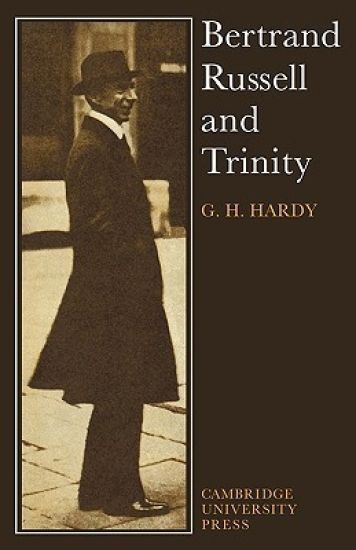
Bertrand Russell and Trinity

Bertrand Russell and Trinity

G. H. Hardy

Cambridge University Press
2009
pokkari
In 1916 Bertrand Russell was prosecuted and fined for publishing (in defence of a conscientious objector) 'statements likely to prejudice the recruiting and discipline of His Majesty's forces.' He was almost immediately afterwards dismissed from his Lectureship at Trinity College, Cambridge, by the College Council. This expulsion provoked a storm of protest and the true facts of the case became obscured by misconceptions, prejudices and uninformed gossip, to the discredit of the College. In 1942, therefore G. H. Hardy the mathematician printed for private circulation to another generation of Fellows at Trinity a full account of the incident in an attempt to explain what really happened. This is now made public. Besides provoking an authoritative record of a celebrated but misinterpreted episode in Russell's eventful academic career, this document contains interesting evidence about attitudes to pacifism in the First World War and in particular about the sympathies of such distinguished colleagues and contemporaries of Russell as Cornford, Housman, McTaggart and Whitehead.