The first comprehensive book about the Washington, D.C., art world, this study features humorous and unique stories about the artists and art districts of one of the U.S.'s most visited cities. The city's many firsts include are the first modern art museum, the first African-American gallery, and the first art fair. Important in the feminist art movement, it hosted the opening of the National Museum of Women in the Arts. Chapters are arranged by decade beginning with 1900, and highlight trends in portraits and landscapes, galleries and museums, nonprofits, cooperatives, art fairs, family stories and the Artomatic experience.
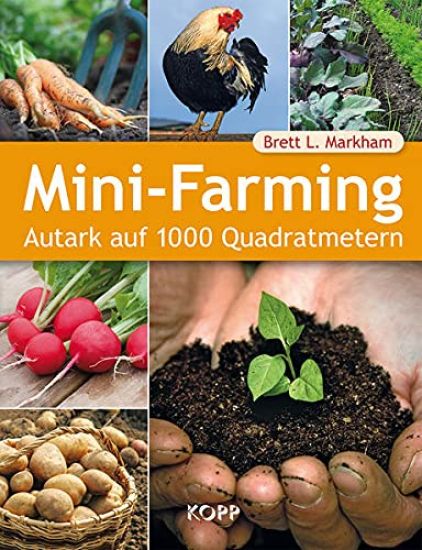
Go back to basics—compost, raising chickens, water and irrigation, dealing with pests, and much more—with this unique, full color bestseller (over 400,000 sold).Mini Farming describes a holistic approach to small-area farming that will show you how to produce 85 percent of an average family’s food on just a quarter acre—and earn $10,000 in cash annually while spending less than half the time that an ordinary job would require.Even if you have never been a farmer or a gardener, this book covers everything you need to know to get started:Buying and saving seedsStarting seedlingsEstablishing raised bedsSoil fertility practicesCompostingDealing with pest and disease problemsCrop rotationSelling your produce arm planning, and much more.Because self-sufficiency is the objective, subjects such as raising backyard chickens and home canning are also covered along with numerous methods for keeping costs down and production high. Materials, tools, and techniques are detailed with photographs, tables, diagrams, and illustrations.
Bestselling author Brett Markham’s new handbook gives us the mini farming basics along with in-depth tips on vegetable gardening, fermenting, composting, and self-sufficiency in a handy new format and design. Includes:? Soil management and making your own fertilizer ? Crop rotation and cover cropping? Composting? Seed starting and timing/planning? Raised beds and pest management? Pvc trellising and planting spacers? Raising chickens, making your own chicken plucker, and butchering? Growing fruit/nut trees and vines? Food preservation (canning and freezing)? Fermenting wine, vinegar and cheeseWith the full color photographs that made the original Mini Farming so popular, and step by step drawings, projects, graphs, and tables, you’ll have everything you need for your new or established mini farm at your fingertips. So dive in a learn how to begin and cultivate your own mini farm on less than a quarter acre.
Almost 600 pages of information on how to make your own compost, save seeds, start a compost pile, ferment your own wine, get the most out of your vegetable garden—and more! And all on just ¼ acre or less.Over 300,000 books by Brett Markham have been sold, because his books offer illustrated expert advice on how to go back to basics and live a more self-sufficient life. Here, in his biggest, most complete book, you will find detailed information on:CompostingSeed StartingPest and disease controlSelecting and saving seedRaising chicken for eggs and raising chicken for meatCabbage, broccoli, and cauliflowerCarrots and parsnipsWeed controlMaking cheese at homeAnd much, much, more !And all on just ¼ acre or less. Learn why hundreds of thousands of readers across North America have chosen Mini Farming for all their self-sufficiency needs. This is the must have guide for any farmer, homesteader, or gardener—whether they’re beginners or experienced looking for new ideas.
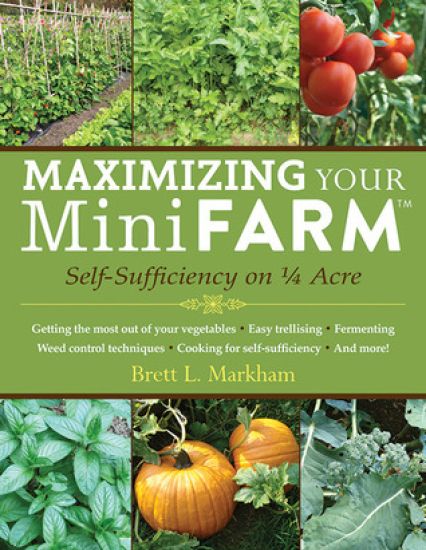
Mini farming describes a holistic approach to small-area farming that will show you how to produce 85 percent of an average family’s food on just a quarter acre—and earn $10,000 in cash annually while spending less than half the time that an ordinary job would require. Now expanding exponentially on his bestselling Mini Farming: Self-Sufficiency on 1/4 Acre, Brett Markham gives you tips, tricks, and planning advice on how to make the most of your mini farm. New topics include: Soil and Fertility Tools and Techniques Planting Guides and Seeders Easy Trellising Weed Control Techniques Greater Food Self-Sufficiency Making Your Own Country Wines Making Your Own Vinegars Making Cheese at Home Cooking for Self-Sufficiency Keep your costs down and production high with this complete guide to maximizing your mini farm—whether it’s a rooftop urban garden, a suburban backyard, or a more substantial plot of land. Materials, tools, and techniques are detailed with tables, diagrams, and 200 color illustrations and author photographs.
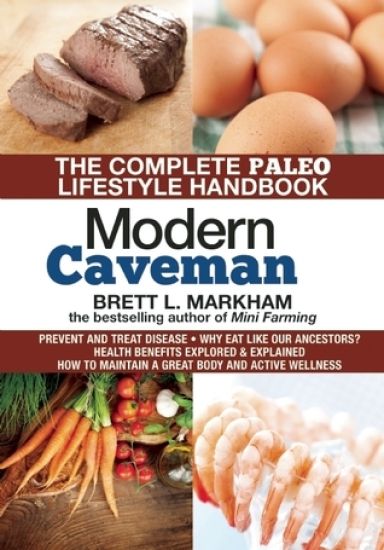
From the bestselling author of the Mini Farming series and a ten year practitioner of the paleo diet comes Modern Caveman?a comprehensive health and fitness guide to everything paleo. Nature spent millions of years forging genetic code so that you could be strong, fit and healthy throughout your life. Yet, when we look around, we see an epidemic of obesity, auto-immune diseases, young people with diabetes and people succumbing to heart disease in early middle age. Why? Though ?nature versus nurture” has long been at the heart of debates concerning psychology and sociology, it is only in the past few years that idea of conforming our diet and exercise to our genome has gained traction. And it is precisely this idea that holds the key to unlocking your potential to be happier, healthier and more fit than most can imagine is possible. Why didn't our Paleolithic forebears suffer from tooth decay at all, yet dentists offices must now be ubiquitous in our society? Why is it that middle-aged men who are gobbling whole grains by the bushel and eating tofu to banish meat from their diets are still requiring expensive life-time statin drug prescriptions to control their cholesterol? The Modern Caveman Diet tries to answer these questions, describing an evolutionarily healthful lifestyle of diet, living patterns and exercise that are easily adopted and maintained throughout life. Are you ready to fulfill the true destiny that nature has given you? The Modern Caveman Diet holds the answer to achieving and maintaining a great body, strength, energy and active wellness right into a healthy old-age with dramatically decreased risks of ?diseases of civilization.”
Now significantly revised and expanded, Decision-Making in Adult Neurology, 2nd Edition, provides nearly 140 evidence-based algorithms that offer practical guidance when encountering patients with neurologic disease, including patients with unfamiliar or complex conditions. Written by expert neurologists for neurologists, internists, emergency medicine physicians, and any specialty that routinely deals with patients with neurologic conditions, this useful handbook encourages clinicians to think systematically and follow a logical sequence through the steps necessary for efficient and effective decision-making. Each algorithm is accompanied by brief text on the facing page that explains the significance of important decision points. Outlines the key decision points in patient management, providing a wealth of systematic information that ensures you take into account the proper physical signs and test results that will guide your recommendations Begins with a section on common presenting symptoms and signs (such as headache, weakness, visual loss, or behavioral change) and then discusses specific neurologic conditions-137 diagnostic and treatment algorithms cover the conditions you’re most likely to encounter Contains important updates on the management of headache, multiple sclerosis, and stroke Includes new diagnostic algorithms for evaluation of patients with papillaedema, myelopathy, Parkinsonism, neurologic side effects of cancer treatment, coma after cardiac arrest, multiple microhemorrhages, and meningeal disorders. Includes new treatment algorithms for managing patients with Alzheimer’s disease, diabetic neuropathy, neuromyelitis optica spectrum disorder, hypersomnia, obstructive sleep apnea, and stroke-related vascular risk factors Provides visual guidance with magnetic resonance images in relevant chapters and videos that support select algorithms An eBook version is included with purchase. The eBook allows you to access all of the text, figures, and references, with the ability to search, make notes and highlights, and have content read aloud. Additional digital ancillary content may publish up to 6 weeks following the publication date
To this day, Japan's modern ascendancy challenges many assumptions about world history, particularly theories regarding the rise of the west and why the modern world looks the way it does. In this engaging new history, Brett L. Walker tackles key themes regarding Japan's relationships with its minorities, state and economic development, and the uses of science and medicine. The book begins by tracing the country's early history through archaeological remains, before proceeding to explore life in the imperial court, the rise of the samurai, civil conflict, encounters with Europe, and the advent of modernity and empire. Integrating the pageantry of a unique nation's history with today's environmental concerns, Walker's vibrant and accessible new narrative then follows Japan's ascension from the ashes of World War II into the thriving nation of today. It is a history for our times, posing important questions regarding how we should situate a nation's history in an age of environmental and climatological uncertainties.
A dictator's power is secure, the authors begin in this muscular, impressive study, only as long as citizens believe in it. When citizens suddenly believe otherwise, a dictator's power is anything but, as the Soviet Union's collapse revealed. This conviction – that power rests ultimately on citizens' beliefs – compels the world's autocrats to invest in sophisticated propaganda. This study draws on the first global data set of autocratic propaganda, encompassing nearly eight million newspaper articles from fifty-nine countries in six languages. The authors document dramatic variation in propaganda across autocracies: in coverage of the regime and its opponents, in narratives about domestic and international life, in the threats of violence issued to citizens, and in the domestic events that shape it. The book explains why Russian President Vladimir uses Donald Trump as a propaganda tool and why Chinese state propaganda is more effusive than any point since the Cultural Revolution.
A dictator's power is secure, the authors begin in this muscular, impressive study, only as long as citizens believe in it. When citizens suddenly believe otherwise, a dictator's power is anything but, as the Soviet Union's collapse revealed. This conviction – that power rests ultimately on citizens' beliefs – compels the world's autocrats to invest in sophisticated propaganda. This study draws on the first global data set of autocratic propaganda, encompassing nearly eight million newspaper articles from fifty-nine countries in six languages. The authors document dramatic variation in propaganda across autocracies: in coverage of the regime and its opponents, in narratives about domestic and international life, in the threats of violence issued to citizens, and in the domestic events that shape it. The book explains why Russian President Vladimir uses Donald Trump as a propaganda tool and why Chinese state propaganda is more effusive than any point since the Cultural Revolution.
Fuel cell performance is determined by the complex interplay of mass transport, energy transfer and electrochemical processes. The convolution of these processes leads to spatial heterogeneity in the way that fuel cells perform, particularly due to reactant consumption, water management and the design of fluid-flow plates. It is therefore unlikely that any bulk measurement made on a fuel cell will represent performance at all parts of the cell. The ability to make spatially resolved measurements in a fuel cell provides one of the most useful ways in which to monitor and optimise performance. This book reviews the range of in situ techniques being used to study fuel cells and describes the use of novel experimental techniques that the authors have used to develop an experimental functional map of polymer electrolyte fuel cell (PEFC) performance. These techniques include the mapping of current density, electrochemical impedance, electrolyte conductivity, contact resistance and CO poisoning distribution within working PEFCs, as well as mapping the flow of reactant in gas channels using laser Doppler anemometry (LDA). The combination of these techniques, applied across a range of fuel cell operating conditions allows a unique picture of the internal workings of PEFCs to be obtained and has been used to validate both numerical and analytical models.
The 18th century was a wealth of knowledge, exploration and rapidly growing technology and expanding record-keeping made possible by advances in the printing press. In its determination to preserve the century of revolution, Gale initiated a revolution of its own: digitization of epic proportions to preserve these invaluable works in the largest archive of its kind. Now for the first time these high-quality digital copies of original 18th century manuscripts are available in print, making them highly accessible to libraries, undergraduate students, and independent scholars.The Age of Enlightenment profoundly enriched religious and philosophical understanding and continues to influence present-day thinking. Works collected here include masterpieces by David Hume, Immanuel Kant, and Jean-Jacques Rousseau, as well as religious sermons and moral debates on the issues of the day, such as the slave trade. The Age of Reason saw conflict between Protestantism and Catholicism transformed into one between faith and logic -- a debate that continues in the twenty-first century.++++The below data was compiled from various identification fields in the bibliographic record of this title. This data is provided as an additional tool in helping to insure edition identification: ++++British LibraryT031935London: printed for Richard King, 1720. xxiv,51, 1]p.; 8