Kirjojen hintavertailu. Mukana 11 699 587 kirjaa ja 12 kauppaa.

Kirjahaku

Etsi kirjoja tekijän nimen, kirjan nimen tai ISBN:n perusteella.

1000 tulosta hakusanalla Brian J. Twiddy

Trust No One

Trust No One

Brian J Orr

Lulu.com
2018
pokkari
John Ballard and his constant companion Barnard Maude were spies seemingly living by the motto `Trust no One`. Ironically, they appear to have trusted one another and claimed to be soldiers surveying possible road routes. Under the tutelage of Ayrshire farmer, Mackenzie Cunninghame, they learnt to be cattle drovers and travelled Scotland establishing the strength and location of support for Mary, Queen of Scots. Ballard, a Jesuit Priest, Catholic missionary and advocate of restoring Mary to the throne of England also favoured a Spanish invasion and the assassination of Queen Elizabeth I. He was much involved in the Babington Plot and was executed for it. He trusted Barnard Maude who was in fact an English spy for Sir Francis Walsingham, who thus knew of Ballard`s intrigues, and those of Sir Anthony Babington, which enabled Walsingham to entrap Mary Queen of Scots for treason. Mackenzie Cunninghame, the enigmatic farmer from Coylton, unwittingly became a part of the English spy network.
Vladimir Jabotinsky's Russian Years, 1900-1925

Vladimir Jabotinsky's Russian Years, 1900-1925

Brian J. Horowitz

Indiana University Press
2020
sidottu
In the early 20th century, with Russia full of intense social strife and political struggle, Vladimir Yevgenyevich (Ze'ev) Jabotinsky (1880–1940) was a Revisionist Zionist leader and Jewish Public intellectual. Although previously glossed over, these years are crucial to Jabotinsky's development as a thinker, politician, and Zionist. Brian Horowitz focuses on Jabotinsky's commitments Zionism and Palestine as he embraced radicalism and fought against antisemitism and the suffering brought upon Jews through pogroms, poverty, and victimization. Horowitz also defends Jabotinsky against accusations that he was too ambitious, a fascist, and a militarist. As Horowitz delves into the years that shaped Jabotinsky's social, political, and cultural orientation, an intriguing psychological portrait emerges.
Vladimir Jabotinsky's Russian Years, 1900-1925

Vladimir Jabotinsky's Russian Years, 1900-1925

Brian J. Horowitz

Indiana University Press
2020
pokkari
In the early 20th century, with Russia full of intense social strife and political struggle, Vladimir Yevgenyevich (Ze'ev) Jabotinsky (1880–1940) was a Revisionist Zionist leader and Jewish Public intellectual. Although previously glossed over, these years are crucial to Jabotinsky's development as a thinker, politician, and Zionist. Brian Horowitz focuses on Jabotinsky's commitments to antisemitism, Zionism, and Palestine as he embraced radicalism and fought against the suffering brought upon Jews through pogroms, poverty, and victimization while also defending Jabotinsky against accusations that he was too ambitious, a fascist, and a militarist. As Horowitz delves into the years that shaped Jabotinsky's social, political, and cultural orientation, an intriguing psychological portrait emerges.
Thomas Sankara

Thomas Sankara

Brian J. Peterson

Indiana University Press
2021
sidottu
Thomas Sankara: A Revolutionary in Cold War Africa offers the first complete biography in English of the dynamic revolutionary leader from Burkina Faso, Thomas Sankara. Coming to power in 1983, Sankara set his sights on combating social injustice, poverty, and corruption in his country, fighting for women's rights, direct forms of democracy, economic sovereignty, and environmental justice. Drawing on government archival sources and over a hundred interviews with Sankara's family members, friends, and closest revolutionary colleagues, Brian J. Peterson details Sankara's political career and rise to power, as well as his assassination at age 37 in 1987, in a plot led by his close friend Blaise Compaoré. Thomas Sankara: A Revolutionary in Cold War Africa offers a unique, critical appraisal of Sankara and explores why he generated such enthusiasm and hope in Burkina Faso and beyond, why he was such a polarizing figure, how his rivals seized power from him, and why T-shirts sporting his image still appear on the streets today.
Thomas Sankara

Thomas Sankara

Brian J. Peterson

Indiana University Press
2021
pokkari
Thomas Sankara: A Revolutionary in Cold War Africa offers the first complete biography in English of the dynamic revolutionary leader from Burkina Faso, Thomas Sankara. Coming to power in 1983, Sankara set his sights on combating social injustice, poverty, and corruption in his country, fighting for women's rights, direct forms of democracy, economic sovereignty, and environmental justice. Drawing on government archival sources and over a hundred interviews with Sankara's family members, friends, and closest revolutionary colleagues, Brian J. Peterson details Sankara's political career and rise to power, as well as his assassination at age 37 in 1987, in a plot led by his close friend Blaise Compaoré. Thomas Sankara: A Revolutionary in Cold War Africa offers a unique, critical appraisal of Sankara and explores why he generated such enthusiasm and hope in Burkina Faso and beyond, why he was such a polarizing figure, how his rivals seized power from him, and why T-shirts sporting his image still appear on the streets today.
Jewish Philanthropy and Enlightenment in Late-Tsarist Russia

Jewish Philanthropy and Enlightenment in Late-Tsarist Russia

Brian J. Horowitz

University of Washington Press
2009
sidottu
The Society for the Promotion of Enlightenment among the Jews of Russia (OPE) was a philanthropic organization, the oldest Jewish organization in Russia. Founded by a few wealthy Jews in St. Petersburg who wanted to improve opportunities for Jewish people in Russia by increasing their access to education and modern values, OPE was secular and nonprofit. The group emphasized the importance of the unity of Jewish culture to help Jews integrate themselves into Russian society by opening, supporting, and subsidizing schools throughout the country.While reaching out to Jews across Russia, OPE encountered opposition on all fronts. It was hobbled by the bureaucracy and sometimes outright hostility of the Russian government, which imposed strict regulations on all aspects of Jewish lives. The OPE was also limited by the many disparate voices within the Jewish community itself. Debates about the best type of schools (secular or religious, co-educational or single-sex, traditional or "modern") were constant. Even the choice of language for the schools was hotly debated.Jewish Philanthropy and Enlightenment in Late-Tsarist Russia offers a model of individuals and institutions struggling with the concern so central to contemporary Jews in America and around the world: how to retain a strong Jewish identity, while fully integrating into modern society.
Jewish Philanthropy and Enlightenment in Late-Tsarist Russia

Jewish Philanthropy and Enlightenment in Late-Tsarist Russia

Brian J. Horowitz

University of Washington Press
2009
pokkari
The Society for the Promotion of Enlightenment among the Jews of Russia (OPE) was a philanthropic organization, the oldest Jewish organization in Russia. Founded by a few wealthy Jews in St. Petersburg who wanted to improve opportunities for Jewish people in Russia by increasing their access to education and modern values, OPE was secular and nonprofit. The group emphasized the importance of the unity of Jewish culture to help Jews integrate themselves into Russian society by opening, supporting, and subsidizing schools throughout the country.While reaching out to Jews across Russia, OPE encountered opposition on all fronts. It was hobbled by the bureaucracy and sometimes outright hostility of the Russian government, which imposed strict regulations on all aspects of Jewish lives. The OPE was also limited by the many disparate voices within the Jewish community itself. Debates about the best type of schools (secular or religious, co-educational or single-sex, traditional or "modern") were constant. Even the choice of language for the schools was hotly debated.Jewish Philanthropy and Enlightenment in Late-Tsarist Russia offers a model of individuals and institutions struggling with the concern so central to contemporary Jews in America and around the world: how to retain a strong Jewish identity, while fully integrating into modern society.
Islamization from Below

Islamization from Below

Brian J. Peterson

Yale University Press
2011
pokkari
The colonial era in Africa, spanning less than a century, ushered in a more rapid expansion of Islam than at any time during the previous thousand years. In this groundbreaking historical investigation, Brian J. Peterson considers for the first time how and why rural peoples in West Africa "became Muslim" under French colonialism. Peterson rejects conventional interpretations that emphasize the roles of states, jihads, and elites in "converting" people, arguing instead that the expansion of Islam owed its success to the mobility of thousands of rural people who gradually, and usually peacefully, adopted the new religion on their own. Based on extensive fieldwork in villages across southern Mali (formerly French Sudan) and on archival research in West Africa and France, the book draws a detailed new portrait of grassroots, multi-generational processes of Islamization in French Sudan while also deepening our understanding of the impact and unintended consequences of colonialism.
NATO

NATO

Brian J. Collins

Praeger Publishers Inc
2011
sidottu
This superb introduction to NATO is written for the national security novice, yet is full of insights for the more seasoned hand interested in how and why NATO reached its current state.In the more than half-century since NATO was founded, there has been endless debate about its purpose, about whether it is meeting that purpose, and about the strategies it employs to that end. Speculation has also been rife about the organization's "imminent demise." Those questions and more are the subject of NATO: A Guide to the Issues.Covering the organization from its founding in 1949 through the present, the guide examines aspects of NATO that have undergone tremendous change over the years, including its purpose, military mission, geographic concept of operations, and membership. At the same time, it explores key aspects of NATO's organization that have remained constant. These include the ability of members to participate in operations as much or as little as they desire, decision-making by consensus, and a general belief that people from different countries working together on a daily basis promotes cooperation, understanding, and friendship.
Diagnostic Pathology: Nonneoplastic Dermatopathology

Diagnostic Pathology: Nonneoplastic Dermatopathology

Brian J. Hall

Elsevier - Health Sciences Division
2021
sidottu
This expert volume in the Diagnostic Pathology series is an excellent point-of-care resource for practitioners at all levels of experience and training. Covering all areas of nonneoplastic dermatopathology, it incorporates the most recent clinical, pathological, and molecular knowledge in the field to provide a comprehensive overview of all key issues relevant to today's practice. Richly illustrated and easy to use, Diagnostic Pathology: Nonneoplastic Dermatopathology is a one-stop reference for accurate, complete pathology reports, ideal as a day-to-day reference or as a reliable training resource. Provides a clear framework for a better understanding of the clinical and histopathologic appearances of more than 250 nonneoplastic entities, presenting major histological and clinical differential diagnosis in order of decreasing frequency found in the general population Breaks down the complex subject of inflammatory dermatopathology into digestible chapters, organized into major histological reaction patterns and/or disease categories Features thorough updates throughout, including new chapters on COVID-related rashes, measles, and hair-shaft disorders; new details on infectious process for diseases; new information on drug rashes; new information on rare infections and clinical identification of rare diseases; and updates for unknown and previously unknown side effects regarding long-term immunosuppressed patients Includes approximately 1,500 high-quality clinical and histological images, gross pathology images, radiologic images, and full-color drawings to help practicing and in-training pathologists reach a confident diagnosis Provides practical and accessible clinical references for many lesions not often seen or taught outside of a specific clinical rotation in dermatology or dermatopathology Includes the enhanced eBook version, which allows you to search all text, figures, and references on a variety of devices
Cloud Computing

Cloud Computing

Brian J.S. Chee; Curtis Franklin Jr.

CRC Press
2019
nidottu
Modern computing is no longer about devices but is all about providing services, a natural progression that both consumers and enterprises are eager to embrace. As it can deliver those services, efficiently and with quality, at compelling price levels, cloud computing is with us to stay. Ubiquitously and quite definitively, cloud computing is answering the demand for sophisticated, flexible servicesCloud Computing: Technologies and Strategies of the Ubiquitous Data Center looks at cloud computing from an IT manager’s perspective. It answers basic as well as strategic questions from both a business and a technical perspective so that you can confidently engage both IT and financial assets in making your organization techno- savvy, efficient, and competitive. Any answers about the future of computing are definitely in the cloudThe first section of the book offers up a history of the computing roots that have evolved into cloud computing. It looks at how IT has been traditionally serving needs and how cloud computing improves and expands on these services, so you can strategize about how a cloud might provide solutions to specific IT questions or answer business needs. Next, the book shows how to begin the process of determining which organizational needs would best be served and improved by cloud computing. Presenting specific cases as examples, the book walks you through issues that your organization might likely encounter. Written clearly and succinctly, it --Introduces you to the concepts behind different types of clouds, including those used for storage, those that improve processor and application delivery, and those that mix any and all of these servicesCovers typical concerns you will hear with regard to such issues as security, application inte
A Simple Guide to Technology and Analytics
Everyday technology is constantly changing, and it’s hard to keep up with it at times. What is all this talk about automation, STEM, analytics and super-computers, and how will it really affect my daily life at work and in the home?This book is a simple guide to everyday technology and analytics written in plain language. It starts with explaining how computer networks are increasing in speed so fast that we can do more in less time than ever before. It explains the analytical jargon in plain English and why robotics in the home will be aided by the new technology of the quantum computer.Richly furnished with over 200 illustrations, photos and with minimal equations, A Simple Guide to Technology and Analytics is a ready reference book for those times when you don’t really understand the technology and analytics being talked about. It explains complicated topics such as automated character recognition in a very simple way, and has simple exercises for the reader to fully understand the technology (with answers at the back). It even has explanations on how home appliances work, which are very useful the next time you go shopping for a microwave or TV. Even the Glossary at the back can be used as a quick look-up explanation for those on the go.
A Simple Guide to Technology and Analytics

A Simple Guide to Technology and Analytics

Brian J. Evans

TAYLOR FRANCIS LTD
2023
nidottu
Everyday technology is constantly changing, and it’s hard to keep up with it at times. What is all this talk about automation, STEM, analytics and super-computers, and how will it really affect my daily life at work and in the home?This book is a simple guide to everyday technology and analytics written in plain language. It starts with explaining how computer networks are increasing in speed so fast that we can do more in less time than ever before. It explains the analytical jargon in plain English and why robotics in the home will be aided by the new technology of the quantum computer.Richly furnished with over 200 illustrations, photos and with minimal equations, A Simple Guide to Technology and Analytics is a ready reference book for those times when you don’t really understand the technology and analytics being talked about. It explains complicated topics such as automated character recognition in a very simple way, and has simple exercises for the reader to fully understand the technology (with answers at the back). It even has explanations on how home appliances work, which are very useful the next time you go shopping for a microwave or TV. Even the Glossary at the back can be used as a quick look-up explanation for those on the go.
Life in a Japanese Women's College

Life in a Japanese Women's College

Brian J. McVeigh

Routledge
1996
sidottu
One third of the Japanese female workforce are 'office ladies' and their training takes place in the many women's junior colleges. Office ladies are low-wage, low-status secretaries who have little or no job security.Brian J. McVeigh draws on his experience as a teacher at one such institution to explore the cultural and social processes used to promote 'femininity' in Japanese women. His detailed and ethnographically-informed study considers how the students of these institutions are socialized to fit their future dual roles of employees and mothers, and illuminates the sociopolitical role that the colleges play in Japanese society as a whole.
The Nature of the Japanese State

The Nature of the Japanese State

Brian J. McVeigh

Routledge
1998
sidottu
Brian J. McVeigh uses a unique anthropological approach to step outside flawed stereotypes of Japanese society and really engage in the current debate over the role of bureaucracy in Japanese politics. To many in the West, Japan appears as a paradox: a rational, high-tech economic superpower and yet at the same time a deeply ritualistic and ceremonial society. This adventurous new study demonstrates how these nominally conflicting impressions of Japan can be reconciled and a greater understanding of the state achieved.
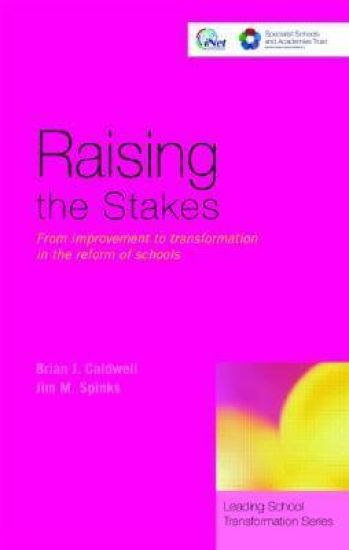
Raising the Stakes

Raising the Stakes

Brian J. Caldwell; Jim Spinks

Routledge
2007
sidottu
Raising the Stakes provides an understanding of the breadth of resources that are needed in order to provide a quality education to all students so that every individual, organisation and institution can become a stakeholder in the enterprise.This comprehensive book draws on best practice in several countries to show how resources can be allocated to help achieve high expectations for all schools. The book demonstrates how schools can move from satisfaction with improvement to accepting the challenge to transform, identifying and exploring the need to align four kinds of resources: intellectual capital, that is, the knowledge and skill of talented professionals social capital, being support in the form of cash, expertise and advocacy drawn from a range of individuals, organisations, agencies and institutions in the broader community financial capital, which must be carefully targeted to ensure that these resources are aligned and focused on priorities for learning; and finally spiritual capital, which can be viewed in a religious sense or in terms of the culture and values that bring coherence and unity to these endeavours.The authors also outline a Student-Focused Planning Model with particular attention to the deployment of resources to support each student and embracing the notion of personalising learning.Practitioners and researchers reading this book will be inspired to work more closely in networking knowledge about how ‘high quality’ and ‘high equity’ can be achieved. Raising the Stakes is essential reading for those with the responsibility of ensuring that resources are acquired and allocated to achieve the best possible outcomes for students.
Raising the Stakes

Raising the Stakes

Brian J. Caldwell; Jim Spinks

Routledge
2007
nidottu
Raising the Stakes provides an understanding of the breadth of resources that are needed in order to provide a quality education to all students so that every individual, organisation and institution can become a stakeholder in the enterprise.This comprehensive book draws on best practice in several countries to show how resources can be allocated to help achieve high expectations for all schools. The book demonstrates how schools can move from satisfaction with improvement to accepting the challenge to transform, identifying and exploring the need to align four kinds of resources: intellectual capital, that is, the knowledge and skill of talented professionals social capital, being support in the form of cash, expertise and advocacy drawn from a range of individuals, organisations, agencies and institutions in the broader community financial capital, which must be carefully targeted to ensure that these resources are aligned and focused on priorities for learning; and finally spiritual capital, which can be viewed in a religious sense or in terms of the culture and values that bring coherence and unity to these endeavours.The authors also outline a Student-Focused Planning Model with particular attention to the deployment of resources to support each student and embracing the notion of personalising learning.Practitioners and researchers reading this book will be inspired to work more closely in networking knowledge about how ‘high quality’ and ‘high equity’ can be achieved. Raising the Stakes is essential reading for those with the responsibility of ensuring that resources are acquired and allocated to achieve the best possible outcomes for students.
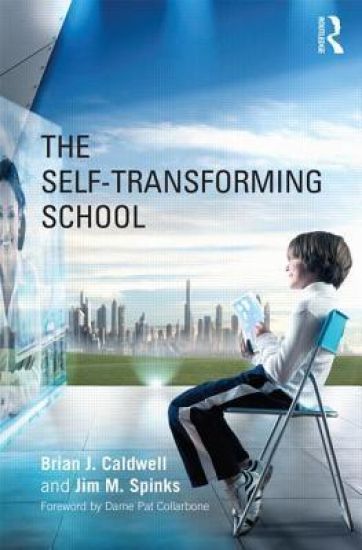
The Self-Transforming School

The Self-Transforming School

Brian J. Caldwell; Jim M. Spinks

Routledge
2013
sidottu
The Self-Transforming School combines an insightful meta-analysis of factors contributing to the success of schools, and an examination of powerful mega-trends that are shaping developments in education, to offer the first mega-analysis in education policy and practice. The book spans fifty years, beginning with Caldwell and Spinks’ ground-breaking work The Self-Managing School which advocated innovative approaches that are now accepted as preferred practice, before offering a prognosis and plan for the future.The book argues that all schools in all settings can secure success for all students in an era where society and the economy are changing constantly and dramatically. Although schools find some support in local and global networks, externally designed re-structuring, re-staffing, or command-and-control direction isn’t sufficient to achieve transformation. Instead of replicating particular approaches to achieve modest improvement, leadership of the highest quality needs to be deeply embedded in schools and their systems. Caldwell and Spinks propose three important points that need to be taken into consideration:-schools are often at different stages of self-transformation -self-transformation requires a high level of professionalism, and must include teacher education and on-going professional development -funding is critically important, and efforts to build a capacity for self-transformation are constrained by what is available.The book gives particular attention to developments in Australia, Brazil, Canada, England, Finland, Hong Kong, India, New Zealand, Shanghai, Singapore and the United States. It will be of key interest to school leaders, policy makers, and academics and postgraduate students engaged in research on equity, student performance in highly disadvantaged settings and education policy.
The Self-Transforming School

The Self-Transforming School

Brian J. Caldwell; Jim M. Spinks

Routledge
2013
nidottu
The Self-Transforming School combines an insightful meta-analysis of factors contributing to the success of schools, and an examination of powerful mega-trends that are shaping developments in education, to offer the first mega-analysis in education policy and practice. The book spans fifty years, beginning with Caldwell and Spinks’ ground-breaking work The Self-Managing School which advocated innovative approaches that are now accepted as preferred practice, before offering a prognosis and plan for the future.The book argues that all schools in all settings can secure success for all students in an era where society and the economy are changing constantly and dramatically. Although schools find some support in local and global networks, externally designed re-structuring, re-staffing, or command-and-control direction isn’t sufficient to achieve transformation. Instead of replicating particular approaches to achieve modest improvement, leadership of the highest quality needs to be deeply embedded in schools and their systems. Caldwell and Spinks propose three important points that need to be taken into consideration:-schools are often at different stages of self-transformation -self-transformation requires a high level of professionalism, and must include teacher education and on-going professional development -funding is critically important, and efforts to build a capacity for self-transformation are constrained by what is available.The book gives particular attention to developments in Australia, Brazil, Canada, England, Finland, Hong Kong, India, New Zealand, Shanghai, Singapore and the United States. It will be of key interest to school leaders, policy makers, and academics and postgraduate students engaged in research on equity, student performance in highly disadvantaged settings and education policy.
Life in a Japanese Women's College

Life in a Japanese Women's College

Brian J. McVeigh

Routledge
2014
nidottu
One third of the Japanese female workforce are 'office ladies' and their training takes place in the many women's junior colleges. Office ladies are low-wage, low-status secretaries who have little or no job security. Brian J. McVeigh draws on his experience as a teacher at one such institution to explore the cultural and social processes used to promote 'femininity' in Japanese women. His detailed and ethnographically-informed study considers how the students of these institutions are socialized to fit their future dual roles of employees and mothers, and illuminates the sociopolitical role that the colleges play in Japanese society as a whole.