Kirjojen hintavertailu. Mukana 11 699 587 kirjaa ja 12 kauppaa.

Kirjahaku

Etsi kirjoja tekijän nimen, kirjan nimen tai ISBN:n perusteella.

1000 tulosta hakusanalla Bulger J Roger

Leonora. A Tale, Translated Freely From the German of Gottfried Augustus Bürger. By J. T. Stanley, Esq. F.R.S. Second Edition
The 18th century was a wealth of knowledge, exploration and rapidly growing technology and expanding record-keeping made possible by advances in the printing press. In its determination to preserve the century of revolution, Gale initiated a revolution of its own: digitization of epic proportions to preserve these invaluable works in the largest archive of its kind. Now for the first time these high-quality digital copies of original 18th century manuscripts are available in print, making them highly accessible to libraries, undergraduate students, and independent scholars.Western literary study flows out of eighteenth-century works by Alexander Pope, Daniel Defoe, Henry Fielding, Frances Burney, Denis Diderot, Johann Gottfried Herder, Johann Wolfgang von Goethe, and others. Experience the birth of the modern novel, or compare the development of language using dictionaries and grammar discourses. ++++The below data was compiled from various identification fields in the bibliographic record of this title. This data is provided as an additional tool in helping to insure edition identification: ++++British LibraryT090566"A few copies of the German text will be printed, which may be had, sewed up with the translation, .. " Preface, p.vii.London: printed for William Miller, 1796. viii,13, 1]p., plate: ill.; 8
Burger

Burger

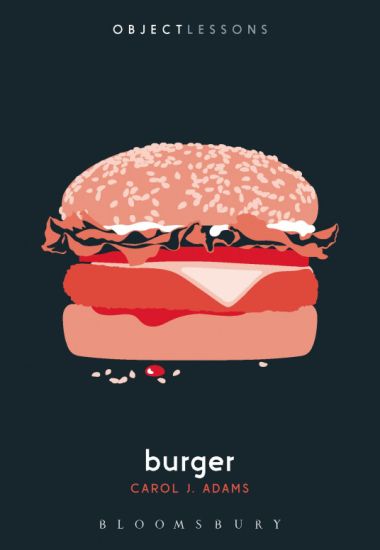
Carol J. Adams

Bloomsbury Academic USA
2018
nidottu
Object Lessons is a series of short, beautifully designed books about the hidden lives of ordinary things. The burger, long the All-American meal, is undergoing an identity crisis. From its shifting place in popular culture to efforts by investors such as Bill Gates to create the non-animal burger that can feed the world, the burger’s identity has become as malleable as that patty of protein itself, before it is thrown on a grill. Carol Adams’s Burger is a fast-paced and eclectic exploration of the history, business, cultural dynamics, and gender politics of the ordinary hamburger. Object Lessons is published in partnership with an essay series in The Atlantic.
The Burger Court and the Rise of the Judicial Right

The Burger Court and the Rise of the Judicial Right

Michael J. Graetz; Linda Greenhouse

SIMON SCHUSTER
2017
nidottu
A revelatory look at the Warren Burger Supreme Court finds that it was not moderate or transitional, but conservative--and it shaped today's constitutional landscape. It is an "important book...a powerful corrective to the standard narrative of the Burger Court" (The New York Times Book Review). When Richard Nixon campaigned for the presidency in 1968 he promised to change the Supreme Court. With four appointments to the court, including Warren E. Burger as the chief justice, he did just that. In 1969, the Burger Court succeeded the famously liberal Warren Court, which had significantly expanded civil liberties and was despised by conservatives across the country. The Burger Court is often described as a "transitional" court between the Warren Court and the Rehnquist and Roberts Courts, a court where little of importance happened. But as this "landmark new book" (The Christian Science Monitor) shows, the Burger Court veered well to the right in such areas as criminal law, race, and corporate power. Authors Graetz and Greenhouse excavate the roots of the most significant Burger Court decisions and in "elegant, illuminating arguments" (The Washington Post) show how their legacy affects us today. "Timely and engaging" (Richmond Times-Dispatch), The Burger Court and the Rise of the Judicial Right draws on the personal papers of the justices as well as other archives to provide "the best kind of legal history: cogent, relevant, and timely" (Publishers Weekly).
Livets bølger

Livets bølger

Målfrid J. Frahm Jensen

Commentum
2011
sidottu
"Livets bølger" er Målfrid J. Frahm Jensen sin andre lyrikksamling med illustrasjoner av fotograf John Sirevåg. To mennesker med hvert sitt kunstneriske uttrykk utgir igjen en spennende kombinasjon av tekster og fotografi. Forfatter og fotograf gir fra sine livserfaringer i forhold til kjærlighet, tenåringsbarn, høytid, lykke, håp, angst, psykisk sykdom, terapi, lengsel, melankoli, sult, aldring, mann, hat og refleksjon. Fotografiene utfyller og forsterker lyrikken på en kraftfull og fin måte.
Battle of the Bulge 1944 (1)

Battle of the Bulge 1944 (1)

Steven J. Zaloga

Osprey Publishing
2003
nidottu
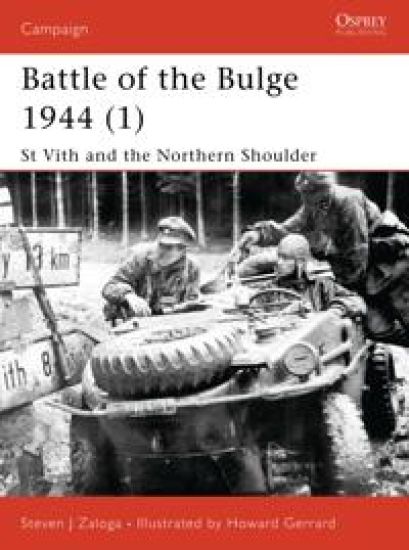
The Battle of the Bulge was the largest and most costly battle fought by the US Army in World War II.The Ardennes fighting was Hitler’s last gamble on the Western Front, crippling the Wehrmacht for the remainder of the war. In the first of two volumes on the Ardennes campaign Steven Zaloga details the fighting in the northern sector around St Vith and the Elsenborn Ridge. The Sixth Panzer Army, containing the bulk of German Panzer strength, was expected to achieve the breakthrough here.It was the failure around St Vith that forced the Germans to look south towards Bastogne.
Battle of the Bulge 1944 (2)

Battle of the Bulge 1944 (2)

Steven J. Zaloga

Osprey Publishing
2004
nidottu
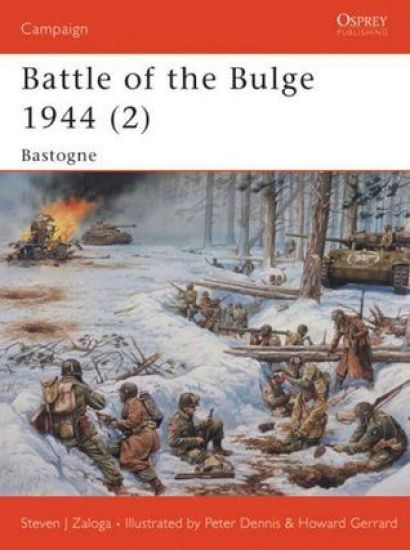
The Ardennes offensive in December 1944, known to history as the 'Battle of the Bulge', was the decisive campaign of the war in North-West Europe.When the attack in the north by 6th Panzer Army failed, Hitler switched the focus of the offensive to General Manteuffel’s 5th Panzer Army farther south. Overwhelming the green US 106th Division, German Panzers flooded towards the River Meuse.Barring their way was the crossroads town of Bastogne, reinforced at the last minute by the paratroopers of the 101st Airborne, the ‘Screaming Eagles'. The stage was set for one of the epic struggles of the war – the battle for Bastogne.
Tanks in the Battle of the Bulge

Tanks in the Battle of the Bulge

Steven J. Zaloga

Osprey Publishing
2020
nidottu
The Battle of the Bulge raises many questions which, until now, have not been adequately answered: How did the major tank types perform during the battle? What were the specific ‘lessons learned’ from the combat? And did these lessons result in changes to tanks in the subsequent months? Offering detailed answers to these questions, and many more, this book provides a survey of the principal tank and tank-equivalents (such as tank destroyers and Jagdpanzers) that took part in the Ardennes Campaign of December 1944–January 1945. Beginning with a basic overview of the campaign, accompanied by an order of battle of the major armoured units, it examines the opposing forces, covering the organization of the two tank forces to explain how they were deployed. Author Steven Zaloga also scrutinises the technical balance between the opposing sides, comparing armour, mobility and firepower as well as other important factors such as reliability, crew situational awareness, and tank layout/efficiency. Full of specially commissioned and highly accurate artwork plates of the tanks themselves, as well as fascinating technical data based on cutting-edge research, this title is the definitive guide to tank warfare in the Battle of the Bulge.
Deux Ballades Allemandes: À Mlle J. M.: Souvenir d'Un Concours

Deux Ballades Allemandes: À Mlle J. M.: Souvenir d'Un Concours

Gottfried August Bürger; Josef Von Zedlitz

Hachette Livre - BNF
2013
pokkari
Deux ballades allemandes: a Mlle J. M.: souvenir d'un concours / traduites en vers francais par G. M.Date de l'edition originale: 1896Ce livre est la reproduction fidele d'une oeuvre publiee avant 1920 et fait partie d'une collection de livres reimprimes a la demande editee par Hachette Livre, dans le cadre d'un partenariat avec la Bibliotheque nationale de France, offrant l'opportunite d'acceder a des ouvrages anciens et souvent rares issus des fonds patrimoniaux de la BnF.Les oeuvres faisant partie de cette collection ont ete numerisees par la BnF et sont presentes sur Gallica, sa bibliotheque numerique.En entreprenant de redonner vie a ces ouvrages au travers d'une collection de livres reimprimes a la demande, nous leur donnons la possibilite de rencontrer un public elargi et participons a la transmission de connaissances et de savoirs parfois difficilement accessibles.Nous avons cherche a concilier la reproduction fidele d'un livre ancien a partir de sa version numerisee avec le souci d'un confort de lecture optimal. Nous esperons que les ouvrages de cette nouvelle collection vous apporteront entiere satisfaction.Pour plus d'informations, rendez-vous sur www.hachettebnf.fr
My Heroes: The Men of Northern Indiana Chapter XXX Veterans of the Battle of the Bulge
The year was 1944 and America was at war. The Allies had landed in Normandy on June 6 and had steadily pushed the German armies out of France toward the Fatherland. On December 16, 1944, approximately 600,000 German soldiers launched, what they called, the Ardennes Offensive. The enemy attacked the American forces along the Siegfried Line where Belgium and the tiny Grand Duchy of Luxembourg border on Germany. Before the advance was halted ten days later, a bulge created in the American lines by the more than half million Nazi soldiers would give birth to the term, the Battle of the Bulge. Officially ending on January 25, 1945, the Battle of the Bulge would claim more than 80,000 American casualties - young soldiers killed, wounded or captured - all in 41 days. Now, approximately 60 years after the battle began, 35 northern Indiana soldiers who took part in the Battle of the Bulge relive their experiences as they remember it now. In one interview, a veteran says, "I can still see the faces of the men I killed in combat. I often wonder what they would have done with their lives had they lived." Another says that he has memories that haunt him to this day, and then he relates one such incident. Return with the author to the 1940s as these aged veterans reminisce about the Battle of the Bulge and discuss how those cold, dark days in Europe helped shape the remainder of their lives.
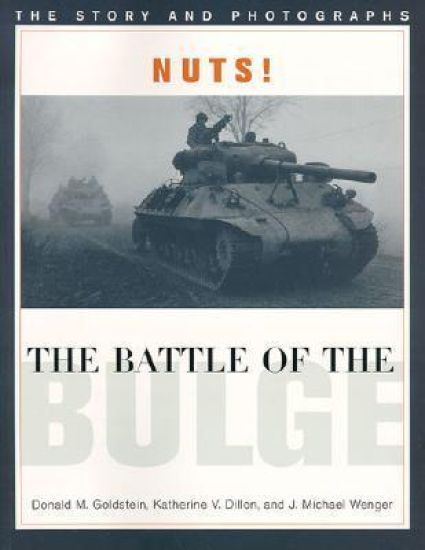
Nuts! the Battle of the Bulge

Nuts! the Battle of the Bulge

Donald M. Goldstein; Katherine V. Dillon; J. Michael Wenger

Potomac Books Inc
1997
pokkari
From the Library JournalHitler and his general staff were convinced that if the Allies on the Continent were struck a shattering blow, their unity would collapse. In mid-December 1944, they planned and executed a sudden but unsuccessful counterattack westward through the Forest of Ardennes that on combat maps produced a change in the battle line forever known as the Bulge. Following the format and scope of their earlier works The Way It Was (LJ 8/91) and D-Day Normandy(LJ 4/1/94), the authors have reconstructed the sense of those uncertain days in the frozen Belgian woods. Hundreds of photos taken from American and German sources capture the world of combat from the perspective of foot soldiers and tank crewmen in all its powerful, gritty, and often gruesome reality. A valuable addition to any collection on this subject.
Adapting Minds

Adapting Minds

David J. Buller

MIT Press
2006
pokkari
Was human nature designed by natural selection in the Pleistocene epoch? The dominant view in evolutionary psychology holds that it was-that our psychological adaptations were designed tens of thousands of years ago to solve problems faced by our hunter-gatherer ancestors. In this provocative and lively book, David Buller examines in detail the major claims of evolutionary psychology-the paradigm popularized by Steven Pinker in The Blank Slate and by David Buss in The Evolution of Desire-and rejects them all. This does not mean that we cannot apply evolutionary theory to human psychology, says Buller, but that the conventional wisdom in evolutionary psychology is misguided.Evolutionary psychology employs a kind of reverse engineering to explain the evolved design of the mind, figuring out the adaptive problems our ancestors faced and then inferring the psychological adaptations that evolved to solve them. In the carefully argued central chapters of Adapting Minds, Buller scrutinizes several of evolutionary psychology's most highly publicized "discoveries," including "discriminative parental solicitude" (the idea that stepparents abuse their stepchildren at a higher rate than genetic parents abuse their biological children). Drawing on a wide range of empirical research, including his own large-scale study of child abuse, he shows that none is actually supported by the evidence.Buller argues that our minds are not adapted to the Pleistocene, but, like the immune system, are continually adapting, over both evolutionary time and individual lifetimes. We must move beyond the reigning orthodoxy of evolutionary psychology to reach an accurate understanding of how human psychology is influenced by evolution. When we do, Buller claims, we will abandon not only the quest for human nature but the very idea of human nature itself.
Science at the White House

Science at the White House

Edward J. Burger

Johns Hopkins University Press
2020
pokkari
Originally published in 1980. In 1973 the US president's Office of Science and Technology was eliminated, a victim of its own incongruity. It was not, as was popularly proclaimed at the time, simply because the Nixon administration was particularly hostile to the scientific and academic communities. It was eliminated, argues physician-scientist Edward J. Burger Jr., because the office had tried to do its job too well—and had become a political liability. Science at the White House takes a critical look at the role of science advisers to the president and recounts the many conflicts that occurred as science and politics converged. Burger draws on his own six years of experience in the White House Office of Science and Technology in the 1970s. His book is filled with firsthand descriptions of the government's handling of such issues as national health care, environmental regulation, population control, and biomedical research.