Il rapporto tra consapevolezza e cervello (Mind-Body Problem) centrale nella riflessione sul 'mentale' in filosofia e psicologia. L'influente filosofo Daniel Dennett, discutendo una serie di dati sperimentali ottenuti con particolari tecniche di indagine, critica la concezione di un 'Io' centrale, l'idea di identit personale unitaria caratterizzata da continuit della coscienza. Proponendo una metodologia interpretativa detta 'eterofenomenologia', come approccio oggettivo scientifico al mondo introspettivo del parlante (i fenomeni della sua esperienza soggettiva e la sua trama di autonarrazioni), designa il 'S ' come baricentro narrativo del corpo. E definisce 'atteggiamento intenzionale' l'attribuzione di credenze, giudizi, desideri e aspettative, al titolare degli atti linguistici, ritenuto come agente razionale che regola la scelta dei suoi comportamenti. Il rapporto tra l'eterofenomenologo e il soggetto narrante assimilabile alla relazione psicoterapeutica tra terapeuta e paziente. L'originale e singolare teoria di Dennett riveste specifico interesse per filosofi, psicologi, formatori e chiunque opera nel campo delle neuroscienze, della clinica e della didattica.
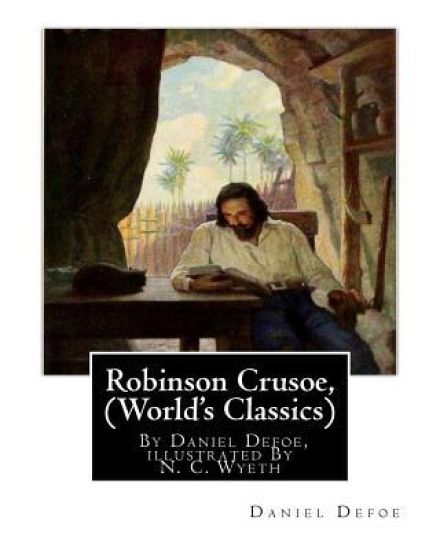
Robinson Crusoe is a novel by Daniel Defoe, first published on 25 April 1719. The first edition credited the work's protagonist Robinson Crusoe as its author, leading many readers to believe he was a real person and the book a travelogue of true incidents. It was published under the full title The Life and Strange Surprizing Adventures of Robinson Crusoe, Of York, Mariner: Who lived Eight and Twenty Years, all alone in an un-inhabited Island on the Coast of America, near the Mouth of the Great River of Oroonoque; Having been cast on Shore by Shipwreck, wherein all the Men perished but himself. With An Account how he was at last as strangely deliver'd by Pyrates. Plot sumary--Crusoe (the family name corrupted from the German name "Kreutznaer") sets sail from the Queen's Dock in Hull on a sea voyage in August 1651, against the wishes of his parents, who want him to pursue a career, possibly in law. After a tumultuous journey where his ship is wrecked in a storm, his lust for the sea remains so strong that he sets out to sea again. This journey, too, ends in disaster, as the ship is taken over by Sal pirates (the Sal Rovers) and Crusoe is enslaved by a Moor. Two years later, he escapes in a boat with a boy named Xury; a captain of a Portuguese ship off the west coast of Africa rescues him. The ship is en route to Brazil. Crusoe sells Xury to the captain. With the captain's help, Crusoe procures a plantation. Years later, Crusoe joins an expedition to bring slaves from Africa, but he is shipwrecked in a storm about forty miles out to sea on an island (which he calls the Island of Despair) near the mouth of the Orinoco river on 30 September 1659. The details of Crusoe's island were probably based on the Caribbean island of Tobago, since that island lies a short distance north of the Venezuelan coast near the mouth of the Orinoco river, in sight of Trinidad. 4] He observes the latitude as 9 degrees and 22 minutes north. He sees penguins and seals on his island. (However, seals and penguins live together in the Northern Hemisphere only around the Gal pagos Islands.) As for his arrival there, only he and three animals, the captain's dog and two cats, survive the shipwreck. Overcoming his despair, he fetches arms, tools and other supplies from the ship before it breaks apart and sinks. He builds a fenced-in habitat near a cave which he excavates. By making marks in a wooden cross, he creates a calendar. By using tools salvaged from the ship, and some he makes himself from "ironwood", he hunts, grows barley and rice, dries grapes to make raisins, learns to make pottery and raises goats. He also adopts a small parrot. He reads the Bible and becomes religious, thanking God for his fate in which nothing is missing but human society. More years pass and Crusoe discovers native cannibals, who occasionally visit the island to kill and eat prisoners. At first he plans to kill them for committing an abomination but later realizes he has no right to do so, as the cannibals do not knowingly commit a crime. He dreams of obtaining one or two servants by freeing some prisoners; when a prisoner escapes, Crusoe helps him, naming his new companion "Friday" after the day of the week he appeared. Crusoe then teaches him English and converts him to Christianity...... Daniel Defoe ( 1660 - 24 April 1731), born Daniel Foe, was an English trader, writer, journalist, pamphleteer, and spy, most famous for his novel Robinson Crusoe. Newell Convers Wyeth (October 22, 1882 - October 19, 1945), known as N. C. Wyeth, was an American artist and illustrator. He was the pupil of artist Howard Pyle and became one of America's greatest illustrators.
Title: Royal Charters and Historical Documents relating to the Town & County of Carmarthen and the Abbeys of Talley and Tygwyn-ar-Daf. By i.e. compiled by] J. R. Daniel-Tyssen ... Edited and annotated by A. C. Evans.Publisher: British Library, Historical Print EditionsThe British Library is the national library of the United Kingdom. It is one of the world's largest research libraries holding over 150 million items in all known languages and formats: books, journals, newspapers, sound recordings, patents, maps, stamps, prints and much more. Its collections include around 14 million books, along with substantial additional collections of manuscripts and historical items dating back as far as 300 BC.The HISTORY OF BRITAIN & IRELAND collection includes books from the British Library digitised by Microsoft. As well as historical works, this collection includes geographies, travelogues, and titles covering periods of competition and cooperation among the people of Great Britain and Ireland. Works also explore the countries' relations with France, Germany, the Low Countries, Denmark, and Scandinavia. ++++The below data was compiled from various identification fields in the bibliographic record of this title. This data is provided as an additional tool in helping to insure edition identification: ++++ British Library Anonymous; Evans, Alcwyn C.; 1878. 108 p.; 8 . 10368.ccc.33.









![Royal Charters and Historical Documents Relating to the Town and County of Carmarthen and the Abbeys of Talley and Tygwyn-AR-Daf. by [I.E. Compiled By] J. R. Daniel-Tyssen Edited and Annotated by A. C. Evans.](/covers/9781241326678.jpg)