Kirjojen hintavertailu. Mukana 12 016 292 kirjaa ja 12 kauppaa.

Kirjahaku

Etsi kirjoja tekijän nimen, kirjan nimen tai ISBN:n perusteella.

1000 tulosta hakusanalla Carleton University

The Carleton 1955-56; 11

The Carleton 1955-56; 11

Carleton University

Hassell Street Press
2021
nidottu
This work has been selected by scholars as being culturally important and is part of the knowledge base of civilization as we know it.This work is in the public domain in the United States of America, and possibly other nations. Within the United States, you may freely copy and distribute this work, as no entity (individual or corporate) has a copyright on the body of the work.Scholars believe, and we concur, that this work is important enough to be preserved, reproduced, and made generally available to the public. To ensure a quality reading experience, this work has been proofread and republished using a format that seamlessly blends the original graphical elements with text in an easy-to-read typeface.We appreciate your support of the preservation process, and thank you for being an important part of keeping this knowledge alive and relevant.
The Carleton 1961-62; 16

The Carleton 1961-62; 16

Carleton University

Hassell Street Press
2021
nidottu
This work has been selected by scholars as being culturally important and is part of the knowledge base of civilization as we know it.This work is in the public domain in the United States of America, and possibly other nations. Within the United States, you may freely copy and distribute this work, as no entity (individual or corporate) has a copyright on the body of the work.Scholars believe, and we concur, that this work is important enough to be preserved, reproduced, and made generally available to the public. To ensure a quality reading experience, this work has been proofread and republished using a format that seamlessly blends the original graphical elements with text in an easy-to-read typeface.We appreciate your support of the preservation process, and thank you for being an important part of keeping this knowledge alive and relevant.
The Carleton 1948-49; 4

The Carleton 1948-49; 4

Carleton University

Hassell Street Press
2021
nidottu
This work has been selected by scholars as being culturally important and is part of the knowledge base of civilization as we know it.This work is in the public domain in the United States of America, and possibly other nations. Within the United States, you may freely copy and distribute this work, as no entity (individual or corporate) has a copyright on the body of the work.Scholars believe, and we concur, that this work is important enough to be preserved, reproduced, and made generally available to the public. To ensure a quality reading experience, this work has been proofread and republished using a format that seamlessly blends the original graphical elements with text in an easy-to-read typeface.We appreciate your support of the preservation process, and thank you for being an important part of keeping this knowledge alive and relevant.
The Carleton; 1

The Carleton; 1

Carleton University

Hassell Street Press
2021
nidottu
This work has been selected by scholars as being culturally important and is part of the knowledge base of civilization as we know it.This work is in the public domain in the United States of America, and possibly other nations. Within the United States, you may freely copy and distribute this work, as no entity (individual or corporate) has a copyright on the body of the work.Scholars believe, and we concur, that this work is important enough to be preserved, reproduced, and made generally available to the public. To ensure a quality reading experience, this work has been proofread and republished using a format that seamlessly blends the original graphical elements with text in an easy-to-read typeface.We appreciate your support of the preservation process, and thank you for being an important part of keeping this knowledge alive and relevant.
The Carleton 1949-50; 5

The Carleton 1949-50; 5

Carleton University

Hassell Street Press
2021
nidottu
This work has been selected by scholars as being culturally important and is part of the knowledge base of civilization as we know it.This work is in the public domain in the United States of America, and possibly other nations. Within the United States, you may freely copy and distribute this work, as no entity (individual or corporate) has a copyright on the body of the work.Scholars believe, and we concur, that this work is important enough to be preserved, reproduced, and made generally available to the public. To ensure a quality reading experience, this work has been proofread and republished using a format that seamlessly blends the original graphical elements with text in an easy-to-read typeface.We appreciate your support of the preservation process, and thank you for being an important part of keeping this knowledge alive and relevant.
Roots and Values in Canadian Lives..

Roots and Values in Canadian Lives..

Jean-Charles (1914- ). Falardeau; Carleton University (Ottawa)

Hassell Street Press
2021
sidottu
This work has been selected by scholars as being culturally important and is part of the knowledge base of civilization as we know it.This work is in the public domain in the United States of America, and possibly other nations. Within the United States, you may freely copy and distribute this work, as no entity (individual or corporate) has a copyright on the body of the work.Scholars believe, and we concur, that this work is important enough to be preserved, reproduced, and made generally available to the public. To ensure a quality reading experience, this work has been proofread and republished using a format that seamlessly blends the original graphical elements with text in an easy-to-read typeface.We appreciate your support of the preservation process, and thank you for being an important part of keeping this knowledge alive and relevant.
Defining Factors of Successful University-Based Community Initiatives
Revision with unchanged content. Whether in business, academia, or in the public sector, solving the increa-singly complex problems we face today requires collaboration. There is tremendous potential to identify and solve community and social issues when universities work hand-in-hand with community organizations. However, the constitution of these collaborations has incredible impact on the process and outcomes of any project. This monograph reviews what is known about university-community collaborations. Then, using ethnographic methods, it explores one such project in-depth through the eyes of key stakeholders and participants. The result is a compelling model that suggests specific defining factors and refining characteristics that facilitate the successful outcome of these projects. Further, it discusses the implications for and makes recom-mendations to university personnel, community stakeholders, and funding agencies. The model may provide as much an appropriate reference for busi-ness leaders involved in joint ventures as it guides university faculty and staff in their community outreach and engagement work.
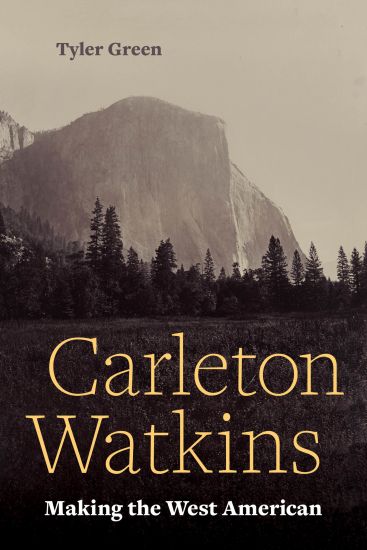
Carleton Watkins

Carleton Watkins

Tyler Green

University of California Press
2018
sidottu
"A fascinating and indispensable book."—Christopher Knight, Los Angeles TimesBest Books of 2018—The Guardian Gold Medal for Contribution to Publishing, 2018 California Book Awards Carleton Watkins (1829–1916) is widely considered the greatest American photographer of the nineteenth century and arguably the most influential artist of his era. He is best known for his pictures of Yosemite Valley and the nearby Mariposa Grove of giant sequoias. Watkins made his first trip to Yosemite Valley and Mariposa Grove in 1861 just as the Civil War was beginning. His photographs of Yosemite were exhibited in New York for the first time in 1862, as news of the Union’s disastrous defeat at Fredericksburg was landing in newspapers and while the Matthew Brady Studio’s horrific photographs of Antietam were on view. Watkins’s work tied the West to Northern cultural traditions and played a key role in pledging the once-wavering West to Union. Motivated by Watkins’s pictures, Congress would pass legislation, later signed by Abraham Lincoln, that preserved Yosemite as the prototypical “national park,” the first such act of landscape preservation in the world. Carleton Watkins: Making the West American includes the first history of the birth of the national park concept since pioneering environmental historian Hans Huth’s landmark 1948 “Yosemite: The Story of an Idea.” Watkins’s photographs helped shape America’s idea of the West, and helped make the West a full participant in the nation. His pictures of California, Oregon, and Nevada, as well as modern-day Washington, Utah, and Arizona, not only introduced entire landscapes to America but were important to the development of American business, finance, agriculture, government policy, and science. Watkins’s clients, customers, and friends were a veritable “who’s who” of America’s Gilded Age, and his connections with notable figures such as Collis P. Huntington, John and Jessie Benton Frémont, Eadweard Muybridge, Frederick Billings, John Muir, Albert Bierstadt, and Asa Gray reveal how the Gilded Age helped make today’s America. Drawing on recent scholarship and fresh archival discoveries, Tyler Green reveals how an artist didn’t just reflect his time, but acted as an agent of influence. This telling of Watkins’s story will fascinate anyone interested in American history; the West; and how art and artists impacted the development of American ideas, industry, landscape, conservation, and politics.
Carleton Watkins

Carleton Watkins

Tyler Green

University of California Press
2020
pokkari
"[A] fascinating and indispensable book."—Christopher Knight, Los Angeles TimesBest Books of 2018—The Guardian Gold Medal for Contribution to Publishing, 2019 California Book Awards Carleton Watkins (1829–1916) is widely considered the greatest American photographer of the nineteenth century and arguably the most influential artist of his era. He is best known for his pictures of Yosemite Valley and the nearby Mariposa Grove of giant sequoias. Watkins made his first trip to Yosemite Valley and Mariposa Grove in 1861 just as the Civil War was beginning. His photographs of Yosemite were exhibited in New York for the first time in 1862, as news of the Union’s disastrous defeat at Fredericksburg was landing in newspapers and while the Matthew Brady Studio’s horrific photographs of Antietam were on view. Watkins’s work tied the West to Northern cultural traditions and played a key role in pledging the once-wavering West to Union. Motivated by Watkins’s pictures, Congress would pass legislation, signed by Abraham Lincoln, that preserved Yosemite as the prototypical “national park,” the first such act of landscape preservation in the world. Carleton Watkins: Making the West American includes the first history of the birth of the national park concept since pioneering environmental historian Hans Huth’s landmark 1948 “Yosemite: The Story of an Idea.” Watkins’s photographs helped shape America’s idea of the West, and helped make the West a full participant in the nation. His pictures of California, Oregon, and Nevada, as well as modern-day Washington, Utah, and Arizona, not only introduced entire landscapes to America but were important to the development of American business, finance, agriculture, government policy, and science. Watkins’s clients, customers, and friends were a veritable “who’s who” of America’s Gilded Age, and his connections with notable figures such as Collis P. Huntington, John and Jessie Benton Frémont, Eadweard Muybridge, Frederick Billings, John Muir, Albert Bierstadt, and Asa Gray reveal how the Gilded Age helped make today’s America. Drawing on recent scholarship and fresh archival discoveries, Tyler Green reveals how an artist didn’t just reflect his time, but acted as an agent of influence. This telling of Watkins’s story will fascinate anyone interested in American history; the West; and how art and artists impacted the development of American ideas, industry, landscape, conservation, and politics.

Carleton Watkins in Yosemite

Carleton Watkins in Yosemite

. Naef

J. Paul Getty Museum
2009
sidottu
This is a stunning photographic journey around the great Yosemite Valley, following in the footsteps of one of its first surveyors. Carleton Eugene Watkins (1829-1916) was one of the most highly acclaimed early western photographers, and one of the first to photograph the natural beauty of Yosemite. It was partly due to Watkins' photographs that President Lincoln declared Yosemite Valley inviolable, leading to the creation of the America's National Parks system. "Carleton Watkins in Yosemite" is a lavishly illustrated volume that takes readers on a stunning tour through Yosemite Valley from the view at Inspiration Point to the panorama high above the valley at Glacier Point - all from the perspective of one of Yosemite's first surveyors. The images reproduced here, all selected from the J. Paul Getty Museum's collection, range from groves of giant Sequoia trees and breathtaking waterfalls to the landmarks that best symbolize the natural beauty of the Yosemite Valley.