Kirjojen hintavertailu. Mukana 11 244 527 kirjaa ja 12 kauppaa.

Kirjahaku

Etsi kirjoja tekijän nimen, kirjan nimen tai ISBN:n perusteella.

1000 tulosta hakusanalla Christian Austermann

Christian Thought in the Medieval Islamicate World

Christian Thought in the Medieval Islamicate World

Salam Rassi

Oxford University Press
2022
sidottu
Christian Thought in the Medieval Islamicate World: ?Abdisho? of Nisibis and the Apologetic Tradition is the first monograph-length study and intellectual biography of ?Abdisho? of Nisibis (d. 1318), bishop and polymath of the Church of the East. Focusing on his works of apologetic theology, it examines the intellectual strategies he employs to justify Christianity against Muslim (and to a lesser extent Jewish) criticisms. Better known to scholars of Syriac literature as a poet, jurist, and cataloguer, ?Abdisho? wrote a considerable number of works in the Arabic language, many of which have only recently come to light. He flourished at a time when Syriac Christian writers were becoming increasingly indebted to Islamic models of intellectual production. Yet many of his writings were composed during mounting religious tensions following the official conversion of the Ilkhanate to Islam in 1295. In the midst of these challenges, ?Abdisho? negotiates a centuries-long tradition of Syriac and Arabic apologetics to remind his readers of the verity of the Christian faith. His engagement with this tradition reveals how anti-Muslim apologetics had long shaped the articulation of Christian identity in the Middle East since the emergence of Islam. Through a selective process of encyclopaedism and systematisation, ?Abdisho? navigates a vast corpus of Syriac and Arabic apologetics to create a synthesis and theological canon that remains authoritative to this day.
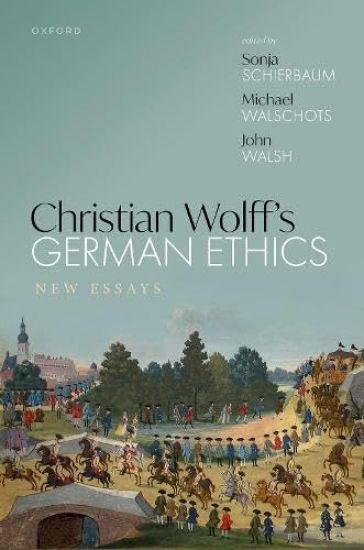
Christian Wolff's German Ethics

Christian Wolff's German Ethics

Oxford University Press
2024
sidottu
This volume offers collective exploration of major aspects of Christian Wolff's ethics. It focuses on what is arguably Wolff's most important and influential text on moral philosophy, namely his Rational Thoughts on the Action and Omission of Human Beings for the Promotion of their Happiness, originally published in 1720 and commonly referred to as the German Ethics to distinguish it from his later Latin works on ethics. The contributions cover a range of topics, including the systematic structure of the text itself and the relation between Wolff's ethics and the preceding natural law tradition, and many of the chapters consider the development of the basic tenets of Wolff's moral theory in his later Latin writings. Throughout the volume, special attention is given to the core concepts of Wolff's moral philosophy, such as obligation, perfection, the highest good, and happiness. Other notable topics include Wolff's conception of moral judgment and moral education, as well as the role of psychology and anthropology in his ethical thought. The volume also includes discussion of the influence of Wolff's ethics on subsequent figures such as C.A. Crusius, G.F. Meier, and Kant. As a whole, the volume seeks to show the importance of Wolff's German Ethics within the history of ethics as well as inspire others to engage with his thought.
Christian Symbol and Ritual

Christian Symbol and Ritual

Bernard Cooke; Gary Macy

Oxford University Press Inc
2005
sidottu
Existing books on Christian ritual and the sacraments tend to presuppose a good acquaintance with Roman Catholic thought and practice. Today, however, even at Catholic institutions students tend to lack even a basic knowledge of Christian ritual. Moreover, for many modern people the word "ritual" carries negative connotations of rigidity and boredom. In this accessibly-written book two noted authors offer an engaging introduction to this important topic. Their goal is first to demonstrate that celebration, ritual and symbol are already central to the readers' lives, even though most do not see their actions as symbolic or ritualistic. Once this point has been made, the book connects central Christian symbols to the symbols and rituals already present in the readers' lives. The Christian theology of symbol, ritual, and sacrament is thus placed in the context of everyday life. The authors go on to discuss such questions as how rituals establish and maintain power relationships, how "official" rituals are different from other "popular" Christian rituals and devotions, and how Christian rituals function in the process of human "salvation." Their lively yet solidly grounded work will appeal to intelligent lay readers and discussion groups, as well as being useful for courses in ritual and the sacraments at the undergraduate and seminary level.
Christian Symbol and Ritual

Christian Symbol and Ritual

Bernard Cooke; Gary Macy

Oxford University Press Inc
2005
nidottu
Existing books on Christian ritual and the sacraments tend to presuppose a good acquaintance with Roman Catholic thought and practice. Today, however, even at Catholic institutions students tend to lack even a basic knowledge of Christian ritual. Moreover, for many modern people the word "ritual" carries negative connotations of rigidity and boredom. In this accessibly-written book two noted authors offer an engaging introduction to this important topic. Their goal is first to demonstrate that celebration, ritual and symbol are already central to the readers' lives, even though most do not see their actions as symbolic or ritualistic. Once this point has been made, the book connects central Christian symbols to the symbols and rituals already present in the readers' lives. The Christian theology of symbol, ritual, and sacrament is thus placed in the context of everyday life. The authors go on to discuss such questions as how rituals establish and maintain power relationships, how "official" rituals are different from other "popular" Christian rituals and devotions, and how Christian rituals function in the process of human "salvation." Their lively yet solidly grounded work will appeal to intelligent lay readers and discussion groups, as well as being useful for courses in ritual and the sacraments at the undergraduate and seminary level.
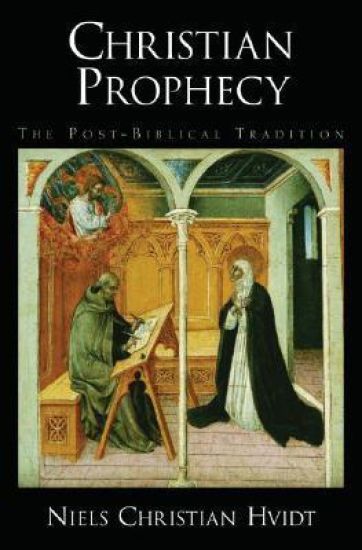
Christian Prophecy

Christian Prophecy

Niels Christian Hvidt

Oxford University Press Inc
2007
sidottu
Throughout the Hebrew Bible, God guides and saves his people through the words of his prophets. When the prophets are silenced, the people easily lose their way. What happened after the incarnation, death and resurrection of Christ? Did God fall silent? The dominant position in Christian theology is that prophecy did indeed cease at some point in the past -- if not with the Old Testament prophets, then with John the Baptist, with Jesus, with the last apostle, or with the closure of the canon of the New Testament. The charismatic revival in both Protestant and Catholic circles has once again raised the question whether there can be such a thing as true prophecy in modern times. Scholarly theological attitudes toward contemporary prophecy range from the neglectful through the dismissive to the contemptuous. Mainstream systematic theology, both Protestant and Catholic, marginalizes or ignores the gift of prophecy. In this book, however, Niels Christian Hvidt argues that prophecy has persisted in Christianity as an inherent and continuous feature in the life of the church. He presents a comprehensive history of prophecy from ancient Israel to the present and closely examines the development of theological discourse about it. The debate about prophecy, Hvidt show, leads to some profound and also surprising insights about the very nature of Christianity and the church. For example, some have argued that Christianity is a perfect state and that all that is required for salvation is acceptance of its doctrines. Others, including Aquinas, have said that God continues to intervene and guide his people onto the right path. This is the position that Hvidt forcefully and persuasively defends and develops in this ambitious and important work. Joseph Cardinal Ratzinger, now Pope Benedict XVI, has provided an appreciative Foreword.
Christian Grace and Pagan Virtue

Christian Grace and Pagan Virtue

J. Warren Smith

Oxford University Press Inc
2011
sidottu
Ambrose of Milan (340-397) was the first Christian bishop to write a systematic account of Christian ethics, in the treatise De Officiis, variously translated as "on duties" or "on responsibilities." But Ambrose also dealt with the moral life in other works, notably his sermons on the patriarchs and his addresses to catechumens and newly baptized. There is a vast modern literature on Ambrose, but only in recent decades has he begun to be taken seriously as a thinker, not just as a working bishop and ecclesiastical politician. Because Ambrose was one of the few Latin Christian writers in antiquity who knew Greek, another major area of Ambrose scholarship has been the study of his sources, notably the Jewish philosopher Philo, and Christian writers such as Origen of Alexandria. In this book, Warren Smith examines the neglected biblical, liturgical and theological foundations of Ambrose's thought on ethics. Earlier studies have found little that was distinctively Christian in Ambrose's image of the virtuous person. Smith shows that though, like the pagans, Ambrose emphasized moderation, courage, justice, and prudence, for him these characteristics were shaped by the church's beliefs about God's salvific economy. The courage of a Christian facing persecution, for example, was an expression of faith in Christ's resurrection and the church's eschatological hope. Eschatology, for Ambrose, was not pagan wisdom clothed in pious language, but the very logic upon which virtue rests.
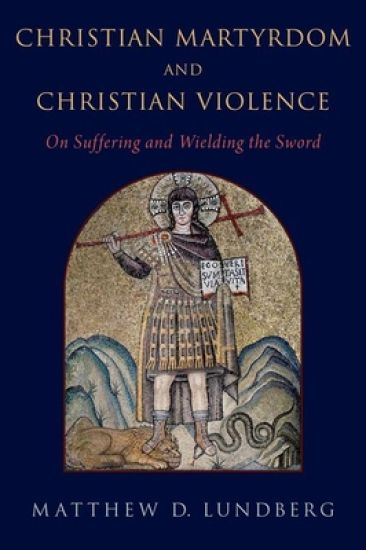
Christian Martyrdom and Christian Violence

Christian Martyrdom and Christian Violence

Matthew D. Lundberg

Oxford University Press Inc
2021
sidottu
What is the place-if any-for violence in the Christian life? At the core of Christian faith is an experience of suffering violence as the price for faithfulness, of being victimized by the world's violence, from Jesus himself to martyrs who have died while following him. At the same time, Christian history had also held the opinion that there are situations when the follower of Jesus may be justified in inflicting violence on others, especially in the context of war. Do these two facets of Christian ethics and experience present a contradiction? Christian Martyrdom and Christian Violence: On Suffering and Wielding the Sword explores the tension between Christianity's historic reverence for martyrdom (suffering violence for faith) and Christianity's historical support of a just war ethic (involving the inflicting of violence). While the book considers the possibility that the two are unreconcilable, it also argues that they are ultimately compatible; but their compatibility requires a more humanized portrait of the Christian martyr as well as a stricter approach to the justified use of violence.
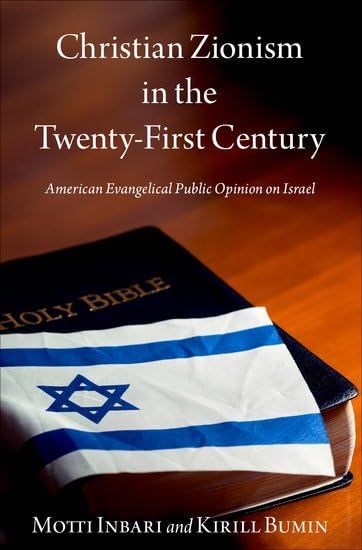
Christian Zionism in the Twenty-First Century

Christian Zionism in the Twenty-First Century

Motti Inbari; Kirill Bumin

OXFORD UNIVERSITY PRESS INC
2024
sidottu
In Christian Zionism in the Twenty-First Century authors Motti Inbari and Kirill Bumin draw on three original surveys conducted in 2018, 2020, and 2021 to explore the religious beliefs and foreign policy attitudes of evangelical and born-again Christians in the United States. They analyze the views of ordinary churchgoers and evangelical pastors to understand the religious, social, and political factors that lead the members of this religious community to support the State of Israel in the Israeli-Palestinian conflict. Through rigorous quantitative analyses and careful textual study of ordinary evangelicals' written comments, Inbari and Bumin aim to rectify misconceptions about who evangelical and born-again Christians are, about their sympathies toward Israel, Jewish people, and Palestinians, and about the sources of their foreign policy attitudes toward the conflict. Inbari and Bumin demonstrate that a generational divide is emerging within the evangelical community, one that substantially impacts evangelicals' attitudes toward Israel. They also show that frequent church attendance and certain theological beliefs have a profound impact on the evangelicals' preference of Israel over the Palestinians. Throughout, the authors aim to add nuance to the discussion, showing that contemporary evangelical and born-again Christians' attitudes are much more diverse than many portrayals suggest.
Christian Homeland

Christian Homeland

Jr. Shattuck

OXFORD UNIVERSITY PRESS INC
2023
sidottu
Christian Homeland focuses on the involvement of clergy and prominent laity of the Episcopal Church in Middle Eastern affairs, both religious and political, between the Greek War of Independence (1821-1829) and the Second Arab-Israeli War (1956-1957), with a brief epilogue covering additional events up to the present day. As the birthplace of the Christian faith, the Middle East had always been an area of fascination to church people in the West, and with the expansion of American diplomatic and commercial interests into the Mediterranean in the early nineteenth century, Episcopalians and other American Protestants felt called to similarly export their religious values into the region. Beginning in the 1830s, Episcopalians established mission posts in Athens and Constantinople (Istanbul), from which they sought to convert Muslims and Jews to Christianity. Having failed to achieve any appreciable evangelistic success with non-Christians, they soon turned their attention to reforming the ancient churches of the East instead. Later assisted by the Church of England's missionary bishopric in Jerusalem, a small, but influential corps of Episcopalians dedicated themselves to keeping church members informed about the Middle East, particularly the status of the region's Christian population, well into the twentieth century. This book analyses how the theological ideas held by Episcopal church leaders not only guided missionary and religious activities, but also influenced their denomination's response to major social and political questions of the late nineteenth and early twentieth centuries issues such as immigration into the United States, genocide, wartime refugee relief, anti-Semitism, Zionism, and the Palestinian Nakba.
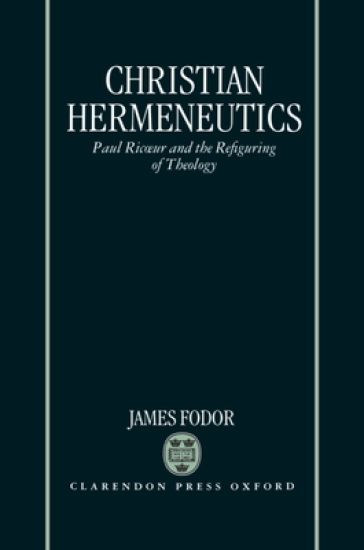
Christian Hermeneutics

Christian Hermeneutics

James Fodor

Clarendon Press
1995
sidottu
Paul Ricoeur is one of the most influential philosophers alive today. This book draws primarily on Ricouer's hermeneutic insights to address the fundamental question of how reference, truth, and meaning are related in the discourse of theology. The author defends the view that theological truth claims cannot be sustained without some appeal to the referential, or in Ricouer's terminology, "refigurative" potential intrinsic to our linguistic practices. What it means for Christians to tell the truth, for their language and life to display and thus elicit trust, cannot be understood apart from an appreciation of the refigurative power of language. By appealing to Aristotle's theory of mimesis (imitation) and muthos (plot), as well as to the ideas of Augustine and Heidegger on time, Paul Ricouer offers striking possibilities whereby theological discourse might renew its task of speaking truthfully of God, and hence of our relation to God, to one another, and to the world.
Christian Moral Realism

Christian Moral Realism

Rufus Black

Clarendon Press
2001
sidottu
Christian Moral Realism describes the shape of a Christian ethic that arises from a conversation between contemporary accounts of natural law theory, narrative and virtue ethics; and an insistence that any Christian ethic begin with a distinctively Christian description of reality. The key partners in this conversation are the leading Christian ethicists, Germain Grisez, Stanley Hauerwas and Oliver O'Donovan. The ethic that emerges from this conversation seeks to resolve the tensions in Christian ethics between creation and eschatology, narrative and natural law, objectivity and relativity, the cultivation of virtue and a focus on the resolution of moral dilemmas. In defence of its philosophical foundations, this book argues that a thoroughly realist ethic can respect the logical claim that no 'ought' can be derived from 'is'. Dr Black moves from this analytic foundation to conclude that worship lies at the heart of a theologically grounded ethic whose central concern is the flourishing of the whole human person in community with both one another and God.
Christian Communities in the Arab Middle East
Existing before the Muslim conquest of the Middle East, and integrated into the Islamic political order, which for centuries has given full rights only to Muslims, the various Eastern Christian communities have represented an important element of pluralism within Middle Eastern Arab societies. The end of the twentieth century, however, marks a crucial period for the the Christian communities, who have witnessed their base decline from 24% of the general population in 1914 to a mere 7%. The rising tide of Christian emigration is just one of the most obvious signs of the communities growing unrest. Beginning with an examination of the role played by Eastern Christians in the history of Arab society, this ground-breaking study presents a comprehensive and detailed analysis of the many challenges facing the Christian communities today. Focusing on juridical status, social, political and economic dynamics, and relationships with the the Muslim majority culture, this intriguing study highlights the various political and cultural strategies employed by Eastern Christians as they attempt to guarantee their role and status as equal citizens in their own Arab states.
Christian Character Formation

Christian Character Formation

Gifford A. Grobien

Oxford University Press
2019
sidottu
Christian Character Formation investigates worship and formation in view of Christian anthropology, particularly union with Christ. Traditions which value justification by faith wrestle to some degree with how to describe and encourage ethical formation when salvation and righteousness are presented as gracious and complete. The dialectic of law and gospel has suggested to some that forgiveness and the advocacy of ethical norms contend with each other. By viewing justification and formation in light of Christ's righteousness which is both imputed and imparted, it is more readily seen that forgiveness and ethics complement each other. In justification, God converts a person, by which he grants new character. Traditional Lutheran anthropology says that this regeneration grants a new nature in mystical union with Jesus Christ. By exploring the Finnish Luther School led by Tuomo Mannermaa, Gifford A. Grobien explains how union with Christ imparts righteousness and the corresponding new character to the believer. Furthermore, as means of grace, the Word and sacraments are the means of establishing union with Christ and nurturing new character. Considering Oswald Bayer's "suffering" the word of Christ, Louis-Marie Chauvet's "symbolic order" and Bernd Wannenwetsch's understanding of worship as Christianity's unique "form of life," Grobien argues that worship practices are the foundational and determinative context in which grace is offered and in which the distinctively Christian ethos supports virtues consistent with Christian character. This understanding is also coordinated with Stanley Hauerwas's narrative ethics and Luther's teaching of virtue and good works in view of the Ten Commandments.
Christian Philosophical Theology

Christian Philosophical Theology

Stephen T. Davis

Oxford University Press
2016
nidottu
Christian Philosophical Theology constitutes a Christian philosopher's look at various crucial topics in Christian theology, including belief in God, the nature of God, the Trinity, christology, the resurrection of Jesus, the general resurrection, redemption, and theological method. The book is tightly argued, and amounts to a coherent explanation of and case for the Christian world view. While the work is written from a broadly Reformed Protestant perspective and the author does not avoid controversial topics, the aim is to present a 'merely Christian' world view (to adapt slightly C. S. Lewis's famous term). That is, Stephen T. Davis attempts to write as much as possible from the perspective of the broad centre of Christian understanding.
Christian Radicalism in the Church of England and the Invention of the British Sixties, 1957-1970
This study provides the first postsecular account of the moral revolution that Britain experienced in the 1960s. Beginning from the groundbreaking premise that secularity is not a mere absence, but an invented culture, it argues that a new form of British secularity achieved cultural dominance during an abrupt cultural revolution which occurred in the late 1950s and early 1960s. This moral revolution had little to do with affluence or technology, but was most centrally a cultural response to the terrors of the Cold War, which pitted Christian Britain against the secular Soviet Union. By exploring contemporary prophecies of the inevitable arrival of 'the secular society', Sam Brewitt-Taylor shows that, ironically, British secularity was given decisive initial momentum by theologically radical Christians, who destigmatized the idea of 'modern secularity' and made it available for appropriation by a wide range of Sixties actors. Further than this, radical Christians played a significant contributory role in deciding what kind of secularity Britain's Sixties would adopt, by narrating Britain's moral revolution as globalist, individualist, anti-authoritarian, sexually libertarian, and politically egalitarian. In all these ways, radical Christians played a highly significant role in the early stages of Britain's Sixties.
Christian Philosophy

Christian Philosophy

Oxford University Press
2018
sidottu
One of the marks of being a philosopher is participating in debates about what counts as "philosophy." Of particular note in such debates is the question of how to distinguish philosophy from theology. Although a variety of answers to this question have been offered in the history of philosophy, in recent decades, the prominence of Christian philosophy has been heralded by many as a genuine triumph over the problematic narrowness of strong foundationalism, positivism, and scientism. For others, however, it signals that philosophy continues to risk being replaced by confessional theology. Wherever one comes down on such issues, and however one interprets recent trends in philosophy of religion, the idea of Christian philosophy continues to present pressing questions for those working in meta-philosophy, epistemology, metaphysics, hermeneutics, and value theory. In this volume, established scholars representing a variety of cultural traditions, religious perspectives, and philosophical priorities all wrestle with how the idea of Christian philosophy should be understood, appropriated, and engaged in light of where philosophy is and where it is likely to go. The volume includes classical essays that have deeply marked the field and also new essays that explore the relevance of Christian philosophy to issues in disability studies, engaged pedagogy, lived phenomenology, the academic study of religion, and the workings of social power. Rather than offer a unified view that seeks to settle things, the contributors demonstrate that Christian philosophy remains a topic of lively debate. Wherever one comes down on the issues considered here, this volume shows that Christian philosophy is neither merely of historical interest, nor of interest only to Christians, but instead remains a thoroughly philosophical topic worthy of serious consideration and substantive critique. With a Foreword by Nicholas Wolterstorff, Noah Porter Professor Emeritus of Philosophical Theology at Yale University; Senior Research Fellow in the Institute for Advanced Studies in Culture at the University of Virginia; and Honorary Professor of Australian Catholic University.
Christian Nationalism, Nation-Building, and the Making of the Holocaust in Slovakia
Previous scholarship on fascism in Slovakia has focused on either state actors operating from urban centres or the mechanisms of violence on a grassroots level - with the result being that the Holocaust is seen as primarily a top-down and state-centred process. In contrast, Hana Kubátová reveals here a dynamic and unexplored centre-periphery relationship, and how violence against the Jewish population unfolded in both cities and the countryside, and on both national and local levels. As an integral component of broader nation-building efforts, the authority of the fascist regime and the newly-founded Slovak state hinged not only on appeasing Hitler but also on civilian populations of the nation's heterogenous eastern borderlands, especially local elites, such as priest and teachers, as well as the rural masses. The book explores how this relationship was forged, how it was maintained, and how, ultimately, Christian nationalism operated as a political strategy that brought differently positioned actors together - to broker deals over resources and power accrued through the co-enactment of genocide by a broad coalition of perpetrators on the ground. In so doing, this little-known chapter of Holocaust history offers a new way to understand the dynamics and escalations of mass violence, and how collaborations between elite and popular groups can pave the way for ethnic cleansing across different territories and, even, times.
Christian Identity in the Jewish and Graeco-Roman World
'I am a Christian' is the confession of the martyrs of early Christian texts and, no doubt, of many others; but what did this confession mean, and how was early Christian identity constructed? This innovative study sets the emergence of Christian identity in the first two centuries, as it is constructed by the broad range of surviving literature, within the wider context of Jewish and Graeco-Roman identity. It uses a number of models from contemporary constructionist views of identity formation to explore how what comes to be seen as 'Christian' literature creates a sense of what to be 'a Christian' means, and traces both continuities and discontinuities with the ways in which Jewish and Graeco-Roman identity were also being constructed through their texts. It seeks to acknowledge the centrality of texts in shaping early Christianity, historically as well as in our perception of it, while also exploring how we might move from those texts to the individuals and communities who preserved them. Such an approach challenges more traditional emphases on the development of institutions, whether structures or credal and ethical formulations, which often fail to recognize the rhetorical function of the texts on which they draw, and the uncertainties of how well these reflect the actual practice and experience of individuals and communities. While building on recent recognition of the diversity of early Christianity, the book goes on to explore the question whether it is possible to speak of a distinctive Christian identity across both the range of early texts and as a pressing historical and theological question in the contemporary world.
Christian Persecution, Martyrdom, and Orthodoxy

Christian Persecution, Martyrdom, and Orthodoxy

Geoffrey de Ste. Croix

Oxford University Press
2006
sidottu
This volume brings together seven seminal papers by the great radical historian Geoffrey de Ste. Croix, who died in 2000, on early Christian topics, with an especial focus on persecution and martyrdom. Christian martyrdom is a topic which conjures up ready images of inhumane persecutors confronted by Christian heroes who perish for the instant but win the long-term battle for reputation. In five of these essays Ste. Croix scrutinizes the evidence to reveal the significant role of Christian themselves, first as volunteer martyrs and later, after the triumph of Christianity in the early fourth century, as organizers of much more effective persecutions. A sixth essay pursues the question of the control of Christianity through a comprehensive study of the context for one of the Church's most important and divisive doctrinal decisions, at the Council of Chalcedon (AD 451); the key role of the emperor and his senior secular officials is revealed, contrary to the prevailing interpretation of Church historians. Finally the attitudes of the early Church towards property and slavery are reviewed, to show the divide between the Gospel message and actual practice.
Christian Philosophical Theology

Christian Philosophical Theology

Stephen T. Davis

Oxford University Press
2006
sidottu
Christian Philosophical Theology constitutes a Christian philosopher's look at various crucial topics in Christian theology, including belief in God, the nature of God, the Trinity, christology, the resurrection of Jesus, the general resurrection, redemption, and theological method. The book is tightly argued, and amounts to a coherent explanation of and case for the Christian world view. Although written from a broadly Reformed Protestant perspective, and although the author does not avoid controversial topics, the aim is to present a `merely Christian' world view (to adapt slightly C. S. Lewis's famous term). That is, Stephen T. Davis attempts to write as much as possible from the perspective of the broad centre of Christian understanding.