Kirjojen hintavertailu. Mukana 11 244 527 kirjaa ja 12 kauppaa.

Kirjahaku

Etsi kirjoja tekijän nimen, kirjan nimen tai ISBN:n perusteella.

1000 tulosta hakusanalla Christopher Smart

Christopher Smart's English Lyrics

Christopher Smart's English Lyrics

Rosalind Powell

Routledge
2014
sidottu
In the first full-length study of Christopher Smart’s translations and the place and function of translation in Smart’s poetry, Rosalind Powell proposes a new approach to understanding the relationship between Smart’s poetics and his practice. Drawing on translation theory from the early modern period to the present day, this book addresses Smart's translations of Horace, Phaedrus and the Psalms alongside the better-known religious works such as Jubilate Agno and A Song to David. Five recurrent threads run throughout Powell’s study: the effect of translation on the identity of a narrative voice in a rewritten text; the techniques that are used to present translated texts to a new literary, cultural and linguistic readership; performance and reading contexts; the translation of great works as an attempt to achieve literary permanence; and, finally, the authorial influence of Smart himself in terms of the overt religiosity and nationalism that he champions in his writing. In exploring Smart’s major translation projects and revisiting his original poems, Powell offers insights into classical reception and translation theory; attitudes towards censorship; expressions of nationalism in the period; developments in liturgy and hymnody; and the composition of children’s books and school texts in the early modern era. Her detailed analysis of Smart’s translating poetics places them within a new, contemporary context and locality to uncover the poet's works as a coherent project of Englishing.
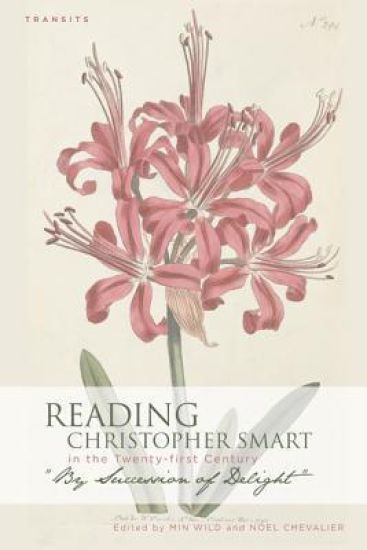
Reading Christopher Smart in the Twenty-first Century
Front Flap: Poet, essayist, actor, hymn-writer, wit, magazine editor, transvestite stage performer: Christopher Smart, Georgian don-turned-writer, was all of these. He was, and remains, a mercurial individual, an idiosyncratic yet strangely familiar writer of spiritual heights and material depths. His paradoxical exuberance fascinates scholars of eighteenth-century culture, and this collection of essays, a snapshot of current scholarship from both new and established Smart scholars, offers, among others, literary, theological, dramatic and philosophical perspectives on his writing. Here are new ways of reading familiar Smart works — including the astonishing, devout poem of his incarceration, Jubilate Agno — and unfamiliar ones, such as his translations and writing for children. Unexpected readers of Smart, from Coleridge to a testy anonymous annotator, are examined, and Smart's sacred translations and profane stage presence each find a place. Tom Keymer's re-evaluating afterword finds the quality of “betweenness” in Smart's work: between eras, between genres, between forms, Smart's vitality demands reassessment for each new generation of readers. Contributors: Karina Williamson, Min Wild, Rosalind Powell, Fraser Easton, Clement Hawes, William E. Levine, Noel Chevalier, Lori A. Branch, Daniel J. Ennis, Chris Mounsey, Debbie Welham, Tom Keymer. Back Flap: The editors Min Wild's monograph Christopher Smart and Satire on Smart's Midwife, was published in 2008, and various articles and reviews of a Smartian bent have followed. Her interest in that eighteenth-century favorite, the literary mode of prosopopoeia, has led her to investigate the personification of words, texts and literary modes themselves. She lectures in eighteenth-century literature and theory at Plymouth University, UK, and reviews in the Times Literary Supplement and elsewhere. Noel Chevalier is Associate Professor of English at Luther College, University of Regina, Canada. He has published articles on Jubilate Agno and on Smart’s challenge to “legitimate” playhouses in Mrs. Midnight’s Oratory. Although his specialty lies in the eighteenth century, his teaching and research cover a diverse range of topics, from literary responses to the Bible, to the roots of globalization, to literary representations of science and scientists. He has helped create two interdisciplinary programs at Luther: one which addresses literature for students in the sciences, and one which explores the philosophical, political, economic, and cultural contexts of globalization. Jacket illustration: "Amaryllis sarniensis or Guernsey Amaryllis," from William Curtis, The Botanical Magazine; or, Flower-Garden Displayed, Vol. IX. No. 294. London, 1795.
A Translation of the Psalms of David, Attempted in the Spirit of Christianity, and Adapted to the Divine Service. By Christopher Smart,
The 18th century was a wealth of knowledge, exploration and rapidly growing technology and expanding record-keeping made possible by advances in the printing press. In its determination to preserve the century of revolution, Gale initiated a revolution of its own: digitization of epic proportions to preserve these invaluable works in the largest archive of its kind. Now for the first time these high-quality digital copies of original 18th century manuscripts are available in print, making them highly accessible to libraries, undergraduate students, and independent scholars.The Age of Enlightenment profoundly enriched religious and philosophical understanding and continues to influence present-day thinking. Works collected here include masterpieces by David Hume, Immanuel Kant, and Jean-Jacques Rousseau, as well as religious sermons and moral debates on the issues of the day, such as the slave trade. The Age of Reason saw conflict between Protestantism and Catholicism transformed into one between faith and logic -- a debate that continues in the twenty-first century.++++The below data was compiled from various identification fields in the bibliographic record of this title. This data is provided as an additional tool in helping to insure edition identification: ++++British LibraryT012464With a list of subscribers. With 'A song to David' by Christopher Smart - Prospectus for this work issued as 'Proposals for printing by subscription, a new translation of the Psalms of David..' 1763. Titlepage in black and red. Some copies have errata London: printed by Dryden Leach, for the author; and sold by C. Bathhurst; and W. Flexney; and T. Merril, Cambridge, 1765. 16],194p.; 4
A Poetical Translation of the Fables of Phædrus, With the Appendix of Gudius, and an Accurate Edition of the Original on the Opposite Page. To Which is Added, a Parsing Index for the use of Learners. By Christopher Smart,
The 18th century was a wealth of knowledge, exploration and rapidly growing technology and expanding record-keeping made possible by advances in the printing press. In its determination to preserve the century of revolution, Gale initiated a revolution of its own: digitization of epic proportions to preserve these invaluable works in the largest archive of its kind. Now for the first time these high-quality digital copies of original 18th century manuscripts are available in print, making them highly accessible to libraries, undergraduate students, and independent scholars.Western literary study flows out of eighteenth-century works by Alexander Pope, Daniel Defoe, Henry Fielding, Frances Burney, Denis Diderot, Johann Gottfried Herder, Johann Wolfgang von Goethe, and others. Experience the birth of the modern novel, or compare the development of language using dictionaries and grammar discourses. ++++The below data was compiled from various identification fields in the bibliographic record of this title. This data is provided as an additional tool in helping to insure edition identification: ++++British LibraryT141278Parallel Latin and English texts.London: printed for J. Dodsley: and sold by J. Wilkie, and T. Merrill at Cambridge, 1765. xvii, 3],221, 65]p., plate; 12