Kirjojen hintavertailu. Mukana 11 244 527 kirjaa ja 12 kauppaa.

Kirjahaku

Etsi kirjoja tekijän nimen, kirjan nimen tai ISBN:n perusteella.

1000 tulosta hakusanalla Christopher T. Height

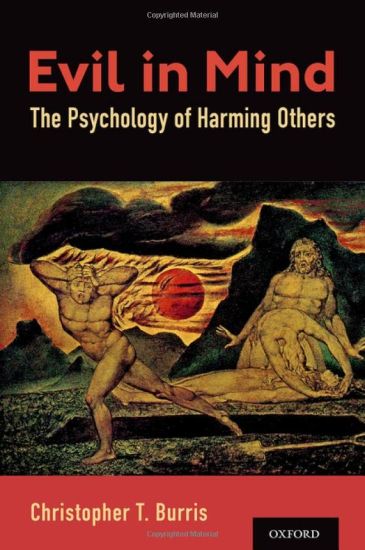
Evil in Mind

Evil in Mind

Christopher T. Burris

OXFORD UNIVERSITY PRESS INC
2022
sidottu
What is evil? Who does evil things? Who is evil? How do you know? Whether in response to witnessing mass suffering or feeling the sting of personal injustice, people confidently apply the "evil" label to perpetrators and the harm that they inflict, yet evil's essence remains mysterious to many. This book offers readers an accessible, social-scientific definition and analysis of evil in its various incarnations to foster a sophisticated and self-reflective understanding of the phenomenon, departing from ghoulish or self-righteous generalizations. Part 1 explores why most of us want to be seen as good, when and why we deem something evil, and what psychological and environmental factors increase our propensity for harming others in spite of our drive for social acceptance. Part 2 presents illustrative examples of how Part 1's insights can be applied, specifically examining hate, sadism, serial killers, group-based atrocities, organizational offenses, and familial abuse. The concluding chapter amplifies and integrates the book's big themes to foster a more mindful, informed confrontation of the elusive problem we call evil. Evil in Mind delivers a systematic, research-based psychological understanding of evil that is compact, digestible, and potentially transformative for academics, students, and educated lay readers.
America's Overseas Garrisons

America's Overseas Garrisons

Christopher T. Sandars

Oxford University Press
2000
sidottu
America's overseas Garrisons analyses the political and social problems, which arise when American forces are stationed in other countries. The United States, although critical of the British Empire during the Second World War, found itself playing an imperial role in the post-war era in order to safeguard the security of the west. In building up a global security system, with American troops in Europe, the Far East, the Atlantic, and the Caribbean and the Pacific, the United States came to resemble the former colonial powers. But whereas the colonial empire had established garrisons on territory acquired by force, the United States was obliged to negotiate basing rights for their troops by negotiating with independent sovereign states. The result was a variety of arrangements with different host nations, in which the American position, and the use America could make of her troops overseas, was critically dependant of America's political and historical relationship with the country concerned. The United States has based more troops overseas than any of the colonial empires. However, the terms of the leasehold empire have imposed severe constraints on America's freedom of manoeuvre.
Ownership and Inheritance in Sanskrit Jurisprudence

Ownership and Inheritance in Sanskrit Jurisprudence

Christopher T. Fleming

Oxford University Press
2020
sidottu
Ownership and Inheritance in Sanskrit Jurisprudence provides an account of various theories of ownership (svatva) and inheritance (daya) in Sanskrit jurisprudential literature (Dharmasastra). It examines the evolution of different juridical models of inheritance--in which families held property in trusts or in tenancies-in-common--against the backdrop of related developments in the philosophical understanding of ownership in the Sanskrit text-traditions of hermeneutics (Mima?sa) and logic (Nyaya) respectively. Christopher T. Fleming reconstructs medieval Sanskrit theories of property and traces the emergence of various competing schools of Sanskrit jurisprudence during the early modern period (roughly fifteenth-nineteenth centuries) in Bihar, Bengal, and Varanasi. Fleming attends to the ways in which ideas from these schools of jurisprudence shaped the codification of Anglo-Hindu personal law by administrators of the British East India Company during the late eighteenth and early nineteenth centuries. While acknowledging the limitations of colonial conceptions of Dharmasastra as positive law, this study argues for far greater continuity between pre-colonial and colonial Sanskrit jurisprudence than accepted previously. It charts the transformation of the Hindu law of inheritance--through precedent and statute--over the late nineteenth, twentieth, and early twenty-first centuries.
Asian American Fiction After 1965

Asian American Fiction After 1965

Christopher T. Fan

Columbia University Press
2024
sidottu
After the 1965 Immigration and Nationality Act loosened discriminatory restrictions, people from Northeast Asian countries such as South Korea, Taiwan, Japan, and eventually China immigrated to the United States in large numbers. Highly skilled Asian immigrants flocked to professional-managerial occupations, especially in science, technology, engineering, and math. Asian American literature is now overwhelmingly defined by this generation’s children, who often struggled with parental and social expectations that they would pursue lucrative careers on their way to becoming writers.Christopher T. Fan offers a new way to understand Asian American fiction through the lens of the class and race formations that shaped its authors both in the United States and in Northeast Asia. In readings of writers including Ted Chiang, Chang-rae Lee, Ken Liu, Ling Ma, Ruth Ozeki, Kathy Wang, and Charles Yu, he examines how Asian American fiction maps the immigrant narrative of intergenerational conflict onto the “two cultures” conflict between the arts and sciences. Fan argues that the self-consciousness found in these writers’ works is a legacy of Japanese and American modernization projects that emphasized technical and scientific skills in service of rapid industrialization. He considers Asian American writers’ attraction to science fiction, the figure of the engineer and notions of the “postracial,” modernization theory and time travel, and what happens when the dream of a stable professional identity encounters the realities of deprofessionalization and proletarianization. Through a transnational and historical-materialist approach, this groundbreaking book illuminates what makes texts and authors “Asian American.”
Asian American Fiction After 1965

Asian American Fiction After 1965

Christopher T. Fan

Columbia University Press
2024
pokkari
After the 1965 Immigration and Nationality Act loosened discriminatory restrictions, people from Northeast Asian countries such as South Korea, Taiwan, Japan, and eventually China immigrated to the United States in large numbers. Highly skilled Asian immigrants flocked to professional-managerial occupations, especially in science, technology, engineering, and math. Asian American literature is now overwhelmingly defined by this generation’s children, who often struggled with parental and social expectations that they would pursue lucrative careers on their way to becoming writers.Christopher T. Fan offers a new way to understand Asian American fiction through the lens of the class and race formations that shaped its authors both in the United States and in Northeast Asia. In readings of writers including Ted Chiang, Chang-rae Lee, Ken Liu, Ling Ma, Ruth Ozeki, Kathy Wang, and Charles Yu, he examines how Asian American fiction maps the immigrant narrative of intergenerational conflict onto the “two cultures” conflict between the arts and sciences. Fan argues that the self-consciousness found in these writers’ works is a legacy of Japanese and American modernization projects that emphasized technical and scientific skills in service of rapid industrialization. He considers Asian American writers’ attraction to science fiction, the figure of the engineer and notions of the “postracial,” modernization theory and time travel, and what happens when the dream of a stable professional identity encounters the realities of deprofessionalization and proletarianization. Through a transnational and historical-materialist approach, this groundbreaking book illuminates what makes texts and authors “Asian American.”
Psoriatic Arthritis, An Issue of Rheumatic Disease Clinics

Psoriatic Arthritis, An Issue of Rheumatic Disease Clinics

Christopher T. Ritchlin

Elsevier - Health Sciences Division
2016
sidottu
Some people with psoriasis can also develop psoriatic arthritis, when the immune system attacks the joints as well, causing inflammation. Like psoriasis, psoriatic arthritis symptoms flare and subside, vary from person to person, and even change locations in the same person over time. Psoriatic arthritis can affect any joint in the body, and it may affect just one joint, several joints or multiple joints. For example, it may affect one or both knees. This issue will include articles on Genetic and Epigenetic aspects of psoriatic arthritis, Clinical features and diagnostic considerations in psoriatic arthritis, Natural history, prognosis and socioeconomic aspects of psoriatic arthritis, Etiology and pathogenesis of psoriasis and many more!
Physiology and Biochemistry of Plant Cell Walls

Physiology and Biochemistry of Plant Cell Walls

Christopher T. Brett; Keith W. Waldron

Chapman and Hall
1996
nidottu
The plant cell wall plays a vital role in almost every aspect of plant physiology. New techniques in spectroscopy, biophysics and molecular biology have revealed the extraordinary complexity of its molecular architecture and just how important this structure is in the control of plant growth and development. The Second Edition of this accessible and integrated textbook has been revised and updated throughout. As well as focusing on the structure and function of plant cell walls the book also looks at the applications of this research. It discusses how plant cell walls can be exploited by the biotechnology industry and some of the main challenges for future research. Key topics include: architecture and skeletal functions of the wall; cell-wall formation; control of cell growth; role in intracellular transport; interactions with other organisms; cell-wall degradation; biotechnological applications of cell-walls; role in diet and health. This textbook provides a clear, well illustrated introduction to the physiology and biochemistry of plant cell walls which will be invaluable to upper level undergraduate and post graduate students of plant physiology, plant pathology, plant biotechnology and biochemistry.
Physiology and Biochemistry of Plant Cell Walls

Physiology and Biochemistry of Plant Cell Walls

Christopher T. Brett; Keith W. Waldron

Chapman and Hall
1996
sidottu
The plant cell wall plays a vital role in almost every aspect of plant physiology. New techniques in spectroscopy, biophysics and molecular biology have revealed the extraordinary complexity of its molecular architecture and just how important this structure is in the control of plant growth and development. The Second Edition of this accessible and integrated textbook has been revised and updated throughout. As well as focusing on the structure and function of plant cell walls the book also looks at the applications of this research. It discusses how plant cell walls can be exploited by the biotechnology industry and some of the main challenges for future research. Key topics include: architecture and skeletal functions of the wall; cell-wall formation; control of cell growth; role in intracellular transport; interactions with other organisms; cell-wall degradation; biotechnological applications of cell-walls; role in diet and health. This textbook provides a clear, well illustrated introduction to the physiology and biochemistry of plant cell walls which will be invaluable to upper level undergraduate and post graduate students of plant physiology, plant pathology, plant biotechnology and biochemistry.
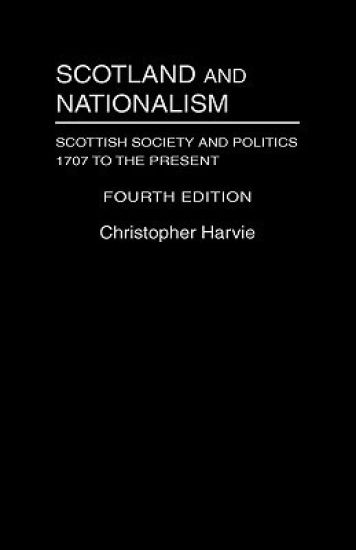
Scotland and Nationalism

Scotland and Nationalism

Christopher T. Harvie; Christopher Harvie

Routledge
2004
sidottu
Scotland and Nationalism provides an authoritative survey of Scottish social and political history from 1707 to the present day. Focusing on political nationalism in Scotland, Christopher Harvie examines why this nationalism remained apparently in abeyance for two and a half centuries, and why it became so relevant in the second half of the twentieth century.This fourth edition brings the story and historiography of Scottish society and politics up-to-date. Additions also include a brand new biographical index of key personalities, along with a glossary of nationalist groups.
Scotland and Nationalism

Scotland and Nationalism

Christopher T. Harvie; Christopher Harvie

Routledge
2004
nidottu
Scotland and Nationalism provides an authoritative survey of Scottish social and political history from 1707 to the present day. Focusing on political nationalism in Scotland, Christopher Harvie examines why this nationalism remained apparently in abeyance for two and a half centuries, and why it became so relevant in the second half of the twentieth century.This fourth edition brings the story and historiography of Scottish society and politics up-to-date. Additions also include a brand new biographical index of key personalities, along with a glossary of nationalist groups.
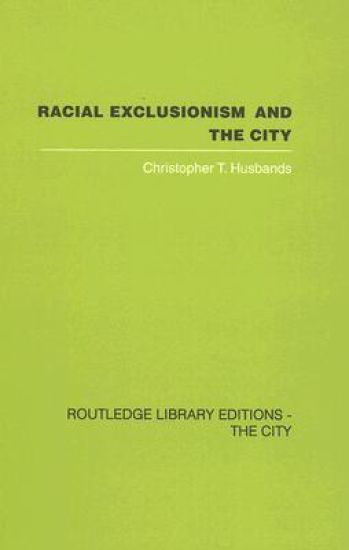
Racial Exclusionism and the City

Racial Exclusionism and the City

Christopher T. Husbands

Routledge
2006
sidottu
First published in 1983, this book reports on the results of a survey in thirteen areas of England where the National Front (NF) had previously gained significant levels of electoral support and examines the social and political histories of these areas to reveal not only who and was voting for the NF in the 1970s but also why.
Racial Exclusionism and the City

Racial Exclusionism and the City

Christopher T. Husbands

Routledge
2013
nidottu
First published in 1983, this book reports on the results of a survey in thirteen areas of England where the National Front (NF) had previously gained significant levels of electoral support and examines the social and political histories of these areas to reveal not only who and was voting for the NF in the 1970s but also why.
Nonlinear Pricing

Nonlinear Pricing

Christopher T. May

John Wiley Sons Inc
1999
sidottu
In a totally new way of looking at financial economics, Nonlinear Pricing abandons the traditional assumptions of equilibrium in economics and randomness in a time-series. These shortcomings are becoming increasingly awkward given a superior technological infrastructure and advances in mathematics and the sciences. Despite these advances and their empirical proof, much remains confused or muddled. In this groundbreaking new book, leading hedge fund manager Christopher T. May explores the nature and role of nonlinearity, an inherent part of everyday reality, and illustrates a profit-making strategy.One of the many striking applications of nonlinear technology in recent years, nonlinear pricing uses cutting-edge technology to identify and exploit patterns hidden within the seemingly helter-skelter rise and fall of daily stock prices. Nonlinear Pricing sheds much needed light on the principles behind this innovative view of reality and provides clear explanations of how it is employed to predict—at least partially—the unpredictable.Beginning with an incisive introduction to the topic, May presents the roots of nonlinearity through the examples of calendrics, geometry, and music. He then illustrates the application and integration of various nonlinear technologies, including genetic algorithms, fuzzy logic, fractal imaging, and nonlinear dynamics, to such essentials as trading strategies, asset allocation, risk management, and derivative pricing and hedging. Along with practical methodologies and a wealth of real-world examples, this comprehensive resource contains a glossary of terms, a bibliography, and in-depth information on: *Fractal analysis—power law distributions, fractional Brownian motion, and their relationships *The Hurst Exponent—the KAOS screen and its practical implementation *Resonance—time domain versus frequency domain, Brownian motion, and the Gaussian distribution *Advanced concepts—Soros's Reflexivity, nonequilibrium economics, kernel of theoretical nonlinear pricing, May's Law, resolution and resonance."Nonlinear Pricing is an eminently readable book which I found satisfied both the theorist and the practitioner in me. For the theorist, there are new insights into the relationship between complexity and the markets. For the practitioner, there are practical ideas on how to fashion investment strategies. I highly recommend Nonlinear Pricing to all students of the markets."—Edgar E. Peters, Chief Investment Strategist, PanAgora Asset Management; author, Chaos and Order in the Capital Markets."Nonlinear Pricing goes further than any book I am aware of in drawing a connection between the real world of economics and the new ideas about economics coming from the science of self-organized systems. Written in a lively, informal style, this is a wonderful read for those of us who have been wondering whether anyone understands anything at all about how markets work."—Lee Smolin, PhD, Department of Physics, Pennsylvania State University."Required reading for the enlightened financial professional. Enjoyable for the intelligent investor. A dash of physics, bite-sized pieces of nonlinear concepts, and a broth of hands-on experience make this a cookbook for the modern trader."—Richard E. Morley, Potts Medal recipient and founder of the Breakfast Club."A real eye-opener—Nonlinear Pricing explains a complex subject in easy terms and makes the reader aware of the many opportunities offered by this new technology."—Richard Olsen, founder, Olsen and Associates, Zurich."I, of course, think highly of this book as it credits Dance of the Money Bees with inventing 'swarm theory,' now a discipline in computer science. There are many other splendid insights."—John Train, author and President of the Montrose Fund"An extraordinary tour d'horizon, this book challenges conventional thinking about finance, investing, and much else besides. Brimming with ideas and eye-opening connections, it makes a powerful case for our need to understand the extent to which nonlinearity shapes our lives."—Andrew Freeman, Managing Editor, Financial Services, The Economist Intelligence Unit; coauthor, Seeing Tomorrow: Rewriting the Rules of Risk."Nonlinear Pricing: Theory & Applications by Christopher T. May makes nice reading even for people like me who are not economists. This is an ambitious book as it presents economics starting from fundamental physics. It deserves a large readership."—Ilya Prigogine, 1977 Nobel Laureate, Chemistry; author, The End of Certainty; and world's foremost non-equilibrium scientist.Written by one of the few practitioners using this breakthrough methodology to trade the markets successfully, Nonlinear Pricing fills an important niche in investment literature. It is a must read for anyone seeking to understand—and capitalize on—twenty-first century financial economics.
Seeing Clearly

Seeing Clearly

Christopher T Monnette

Christopher T. Monnette
2022
pokkari
A deeply moving and courageous memoir, Seeing Clearly is the story of one man's journey of self-discovery as he grapples with progressive vision loss. At age 54, after emerging from one of the darkest periods of his life, Chris Monnette is diagnosed with neovascular macular degeneration, an incurable retinal disease that slowly robs him of his eyesight. As each cell in his macula dies and his vision diminishes, he is forced, literally and figuratively, to see the world through different eyes.Raised in the shadow of an emotionally stifled father, Chris learns early on to mirror the belief that vulnerability equals weakness, a philosophy reinforced during his time at the Virginia Military Institute and as an officer in the Marine Corps. Blind to his own emotions, he goes on to build an outwardly successful career-one that masks a deeply unstable life marred by infidelity, divorce, and the painful fracture of his family.As Chris' field of vision shrinks, his sense of self blurs around the edges. Once an active person who loved to fly airplanes, ride motorcycles, and ski, he becomes increasingly dependent on others for even the most basic tasks and is left with no choice but to embrace the vulnerability he has so long avoided. In doing so, he is able to take ownership of his mistakes, find true intimacy, and create a life of abundance on the other side of fear.A piercingly honest meditation on the emotionnal legacy of stoicism, Seeing Clearly is much-needed proof that being a man and being vulnerable are one and the same.
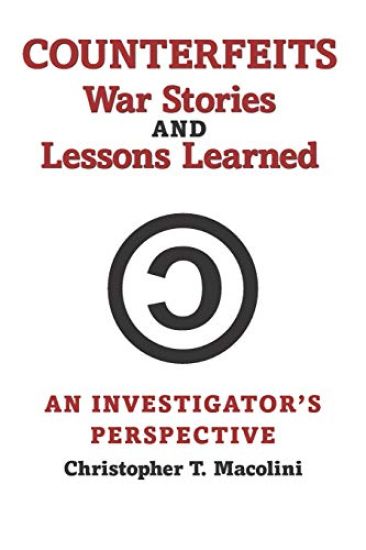
Counterfeits, War Stories and Lessons Learned: An Investigator's Perspective
As the international economy has grown and developed greater and greater interlocking relationships, the practices of counterfeiting and IP theft have likewise expanded, both in scale and sophistication. And despite major and persistent efforts by law enforcement agencies and private enterprises alike, these criminal practices remain major causes for concern for any company with a recognizable brand. In Counterfeits, War Stories and Lessons Learned, Christopher T. Macolini provides brand owners and investigators with a reliable roadmap for conducting professional operations against these threats. With over three decades of experience, Chris has compiled a vast knowledge of anticounterfeiting, IP-theft and investigative techniques to educate brand owners and investigators alike. Using a mix of practical advice and descriptions of his real-life professional experiences, he presents invaluable guidance to conduct successful campaigns against those who threaten the hard-won value of brand-name products and their owners.
Exposed

Exposed

Christopher T. Robertson

Harvard University Press
2019
sidottu
A sharp exposé of the roots of the cost-exposure consensus in American health care that shows how the next wave of reform can secure real access and efficiency.The toxic battle over how to reshape American health care has overshadowed the underlying bipartisan agreement that health insurance coverage should be incomplete. Both Democrats and Republicans expect patients to bear a substantial portion of health care costs through deductibles, copayments, and coinsurance. In theory this strategy empowers patients to make cost-benefit tradeoffs, encourages thrift and efficiency in a system rife with waste, and defends against the moral hazard that can arise from insurance. But in fact, as Christopher T. Robertson reveals, this cost-exposure consensus keeps people from valuable care, causes widespread anxiety, and drives many patients and their families into bankruptcy and foreclosure.Marshalling a decade of research, Exposed offers an alternative framework that takes us back to the core purpose of insurance: pooling resources to provide individuals access to care that would otherwise be unaffordable. Robertson shows how the cost-exposure consensus has changed the meaning and experience of health care and exchanged one form of moral hazard for another. He also provides avenues of reform. If cost exposure remains a primary strategy, physicians, hospitals, and other providers must be held legally responsible for communicating those costs to patients, and insurance companies should scale cost exposure to individuals’ ability to pay.New and more promising models are on the horizon, if only we would let go our misguided embrace of incomplete insurance.
The Information Society

The Information Society

Christopher T. May

Polity Press
2002
nidottu
This text surveys some of the most important writings that declare we are entering a new information age. It suggests that while there have been some important changes prompted by the information technology revolution, these are often changes only in the forms of activity and not their substance.
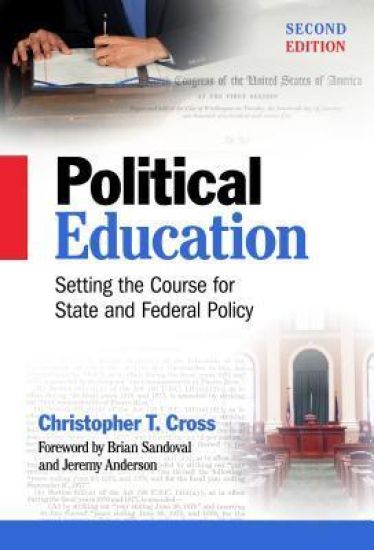
Political Education

Political Education

Christopher T. Cross

Teachers' College Press
2014
nidottu
In this volume, political insider Christopher Cross updates his critically acclaimed bestseller with new chapters and important new insights into future education policy. Cross draws on his own experience in Washington, along with research and interviews, to present a highly readable history of federal education policy, from WWII to the Obama administration. The book highlights the key players who helped shape federal policy because, as Cross writes in his introduction, “policy development is woven of personalities, events, and timing.” This fascinating chronicle demonstrates, among other things, how federal policy has been a constant influence on what states and local districts do, especially with respect to students most at-risk.