Kirjojen hintavertailu. Mukana 11 358 475 kirjaa ja 12 kauppaa.

Kirjahaku

Etsi kirjoja tekijän nimen, kirjan nimen tai ISBN:n perusteella.

1000 tulosta hakusanalla Clarke Samuel

The Foundation of Morality in Theory and Practice Considered, in an Examination of the Learned Dr. Samuel Clarke's Opinion, Concerning the Original of Moral Obligation; ... By John Clarke,
The 18th century was a wealth of knowledge, exploration and rapidly growing technology and expanding record-keeping made possible by advances in the printing press. In its determination to preserve the century of revolution, Gale initiated a revolution of its own: digitization of epic proportions to preserve these invaluable works in the largest archive of its kind. Now for the first time these high-quality digital copies of original 18th century manuscripts are available in print, making them highly accessible to libraries, undergraduate students, and independent scholars.The Age of Enlightenment profoundly enriched religious and philosophical understanding and continues to influence present-day thinking. Works collected here include masterpieces by David Hume, Immanuel Kant, and Jean-Jacques Rousseau, as well as religious sermons and moral debates on the issues of the day, such as the slave trade. The Age of Reason saw conflict between Protestantism and Catholicism transformed into one between faith and logic -- a debate that continues in the twenty-first century.++++The below data was compiled from various identification fields in the bibliographic record of this title. This data is provided as an additional tool in helping to insure edition identification: ++++British LibraryT017532With a final leaf of advertisements and errata.York: printed by Thomas Gent: and sold by A. Bettesworth, London]; T. Hammond, jun. in York; and T. Ryles in Hull, 1726]. 112, 2]p.; 8
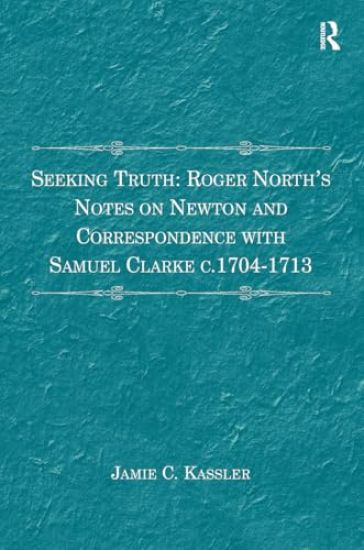
Seeking Truth: Roger North's Notes on Newton and Correspondence with Samuel Clarke c.1704-1713
In the early 1690s Roger North was preparing to remove from London to Rougham, Norfolk, where he planned to continue his search for truth, which for him meant knowledge of nature, including human nature. But this search was interrupted by three events. First, between c.1704 and the early part of 1706, he read Newton’s book on rational (quantitative) mechanics and, afterwards, his book on optics in Clarke’s Latin translation. Second, towards the latter part of 1706, he and Clarke, a Norfolk clergyman, corresponded about matters relating to Newton’s two books, after which Clarke removed to London and the correspondence ceased. Third, in 1712 North received a letter from Clarke, requesting him to read and respond to his new publication on the philosophy of the Godhead. As Kassler details, each of these events presented a number of challenges to North’s values, as well as the way of philosophising he had learned as a student and practitioner of the common law. Because he never made public his responses to the challenges, her book also includes editions of North's notes on reading Newton’s books, as well as what now remains of the 1706 and later correspondence with Clarke. In addition, she presents analyses of some of North’s ’second thoughts’ about the issues raised in the notes and 1706 correspondence and, from an examination of Clarke’s main writings, provides a context for understanding the correspondence relating to the 1712 book.
Seeking Truth: Roger North's Notes on Newton and Correspondence with Samuel Clarke c.1704-1713
In the early 1690s Roger North was preparing to remove from London to Rougham, Norfolk, where he planned to continue his search for truth, which for him meant knowledge of nature, including human nature. But this search was interrupted by three events. First, between c.1704 and the early part of 1706, he read Newton’s book on rational (quantitative) mechanics and, afterwards, his book on optics in Clarke’s Latin translation. Second, towards the latter part of 1706, he and Clarke, a Norfolk clergyman, corresponded about matters relating to Newton’s two books, after which Clarke removed to London and the correspondence ceased. Third, in 1712 North received a letter from Clarke, requesting him to read and respond to his new publication on the philosophy of the Godhead. As Kassler details, each of these events presented a number of challenges to North’s values, as well as the way of philosophising he had learned as a student and practitioner of the common law. Because he never made public his responses to the challenges, her book also includes editions of North's notes on reading Newton’s books, as well as what now remains of the 1706 and later correspondence with Clarke. In addition, she presents analyses of some of North’s ’second thoughts’ about the issues raised in the notes and 1706 correspondence and, from an examination of Clarke’s main writings, provides a context for understanding the correspondence relating to the 1712 book.
An Exposition of the Church-catechism. By Samuel Clarke, ... Published From the Author's Manuscript. By John Clarke,
The 18th century was a wealth of knowledge, exploration and rapidly growing technology and expanding record-keeping made possible by advances in the printing press. In its determination to preserve the century of revolution, Gale initiated a revolution of its own: digitization of epic proportions to preserve these invaluable works in the largest archive of its kind. Now for the first time these high-quality digital copies of original 18th century manuscripts are available in print, making them highly accessible to libraries, undergraduate students, and independent scholars.The Age of Enlightenment profoundly enriched religious and philosophical understanding and continues to influence present-day thinking. Works collected here include masterpieces by David Hume, Immanuel Kant, and Jean-Jacques Rousseau, as well as religious sermons and moral debates on the issues of the day, such as the slave trade. The Age of Reason saw conflict between Protestantism and Catholicism transformed into one between faith and logic -- a debate that continues in the twenty-first century.++++The below data was compiled from various identification fields in the bibliographic record of this title. This data is provided as an additional tool in helping to insure edition identification: ++++British LibraryT132059With the text. Also issued as part of: 'An exposition of the church-catechism. By Samuel Clarke, .. To which is added, his Three practical essays, on baptism, confirmation, and repentance. ..', Dublin, 1730.Dublin: printed by S. Powell, for G. Risk, G. Ewing, and W. Smith, 1730. 4],172p.; 8
An Exposition of the Church-catechism. By Samuel Clarke, ... Published From the Author's Manuscript. By John Clarke, ... To Which is Added, his Three Practical Essays, on Baptism, Confirmation, and Repentance.
The 18th century was a wealth of knowledge, exploration and rapidly growing technology and expanding record-keeping made possible by advances in the printing press. In its determination to preserve the century of revolution, Gale initiated a revolution of its own: digitization of epic proportions to preserve these invaluable works in the largest archive of its kind. Now for the first time these high-quality digital copies of original 18th century manuscripts are available in print, making them highly accessible to libraries, undergraduate students, and independent scholars.The Age of Enlightenment profoundly enriched religious and philosophical understanding and continues to influence present-day thinking. Works collected here include masterpieces by David Hume, Immanuel Kant, and Jean-Jacques Rousseau, as well as religious sermons and moral debates on the issues of the day, such as the slave trade. The Age of Reason saw conflict between Protestantism and Catholicism transformed into one between faith and logic -- a debate that continues in the twenty-first century.++++The below data was compiled from various identification fields in the bibliographic record of this title. This data is provided as an additional tool in helping to insure edition identification: ++++Cambridge University LibraryT212209'An exposition' and 'Three practical essays' have separate titlepages, registers and pagination, and were also issued separately in the same year.Dublin: printed by S. Powell, for G. Risk, G. Ewing, and W. Smith, 1730. 6],172; 8],140p.; 8
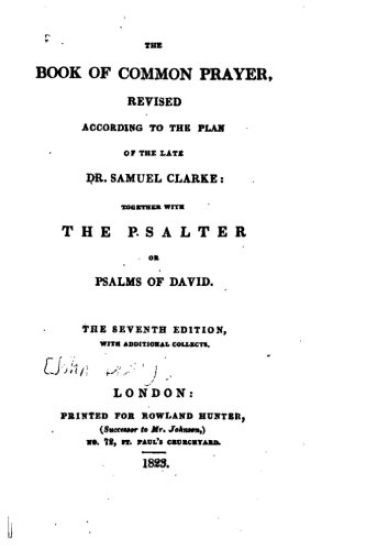
The Book of Common Prayer Reformed According to the Plan of the Late Dr. Samuel Clarke. Together with the Psalter or Psalms of David
The 18th century was a wealth of knowledge, exploration and rapidly growing technology and expanding record-keeping made possible by advances in the printing press. In its determination to preserve the century of revolution, Gale initiated a revolution of its own: digitization of epic proportions to preserve these invaluable works in the largest archive of its kind. Now for the first time these high-quality digital copies of original 18th century manuscripts are available in print, making them highly accessible to libraries, undergraduate students, and independent scholars.The Age of Enlightenment profoundly enriched religious and philosophical understanding and continues to influence present-day thinking. Works collected here include masterpieces by David Hume, Immanuel Kant, and Jean-Jacques Rousseau, as well as religious sermons and moral debates on the issues of the day, such as the slave trade. The Age of Reason saw conflict between Protestantism and Catholicism transformed into one between faith and logic -- a debate that continues in the twenty-first century.++++The below data was compiled from various identification fields in the bibliographic record of this title. This data is provided as an additional tool in helping to insure edition identification: ++++British LibraryT115152London: printed for J. Johnson, 1774. vii, 1],97, 123]
Rohault's System of Natural Philosophy, Illustrated With Dr. Samuel Clarke's Notes Taken Mostly out of Sir Isaac Newton's Philosophy. With Additions. ... Done Into English by John Clarke, ... of 2; Volume 1
The 18th century was a wealth of knowledge, exploration and rapidly growing technology and expanding record-keeping made possible by advances in the printing press. In its determination to preserve the century of revolution, Gale initiated a revolution of its own: digitization of epic proportions to preserve these invaluable works in the largest archive of its kind. Now for the first time these high-quality digital copies of original 18th century manuscripts are available in print, making them highly accessible to libraries, undergraduate students, and independent scholars.Medical theory and practice of the 1700s developed rapidly, as is evidenced by the extensive collection, which includes descriptions of diseases, their conditions, and treatments. Books on science and technology, agriculture, military technology, natural philosophy, even cookbooks, are all contained here.++++The below data was compiled from various identification fields in the bibliographic record of this title. This data is provided as an additional tool in helping to insure edition identification: ++++British LibraryT115947Titlepages in red and black. In two parts; vol.2, comprising the second part, is thus: Vol.II. Part II. Translated from Samuel Clarke's Latin version of Rohault's 'Trait de physique'.London: printed for James Knapton, 1723. 2v., plates; 8
Rohault's System of Natural Philosophy, Illustrated With Dr. Samuel Clarke's Notes Taken Mostly out of Sir Isaac Newton's Philosophy. ... Done Into English by John Clarke, ... The Third Edition. of 2; Volume 2
The 18th century was a wealth of knowledge, exploration and rapidly growing technology and expanding record-keeping made possible by advances in the printing press. In its determination to preserve the century of revolution, Gale initiated a revolution of its own: digitization of epic proportions to preserve these invaluable works in the largest archive of its kind. Now for the first time these high-quality digital copies of original 18th century manuscripts are available in print, making them highly accessible to libraries, undergraduate students, and independent scholars.Medical theory and practice of the 1700s developed rapidly, as is evidenced by the extensive collection, which includes descriptions of diseases, their conditions, and treatments. Books on science and technology, agriculture, military technology, natural philosophy, even cookbooks, are all contained here.++++The below data was compiled from various identification fields in the bibliographic record of this title. This data is provided as an additional tool in helping to insure edition identification: ++++British LibraryT114004Titlepages in red and black.London: printed for James, John, and Paul Knapton, 1735. 2v.,27 plates; 8
A Paraphrase on the Gospel of St. John. by Samuel Clarke, ... the Second Edition
The 18th century was a wealth of knowledge, exploration and rapidly growing technology and expanding record-keeping made possible by advances in the printing press. In its determination to preserve the century of revolution, Gale initiated a revolution of its own: digitization of epic proportions to preserve these invaluable works in the largest archive of its kind. Now for the first time these high-quality digital copies of original 18th century manuscripts are available in print, making them highly accessible to libraries, undergraduate students, and independent scholars.The Age of Enlightenment profoundly enriched religious and philosophical understanding and continues to influence present-day thinking. Works collected here include masterpieces by David Hume, Immanuel Kant, and Jean-Jacques Rousseau, as well as religious sermons and moral debates on the issues of the day, such as the slave trade. The Age of Reason saw conflict between Protestantism and Catholicism transformed into one between faith and logic -- a debate that continues in the twenty-first century.++++The below data was compiled from various identification fields in the bibliographic record of this title. This data is provided as an additional tool in helping to insure edition identification: ++++British LibraryT130056In: 'A paraphrase on the four evangelists', 1714, vol.2. With a final advertisement leaf.London: printed for James Knapton, 1714. 6],232, 2]p.; 8
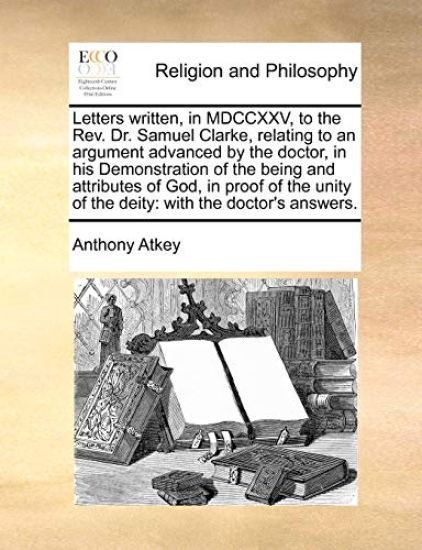
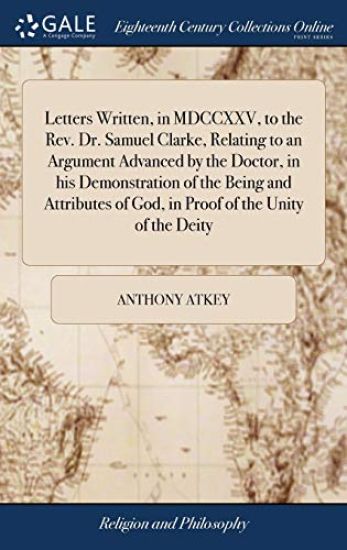
Letters Written, in MDCCXXV, to the Rev. Dr. Samuel Clarke, Relating to an Argument Advanced by the Doctor, in his Demonstration of the Being and Attributes of God, in Proof of the Unity of the Deity
The 18th century was a wealth of knowledge, exploration and rapidly growing technology and expanding record-keeping made possible by advances in the printing press. In its determination to preserve the century of revolution, Gale initiated a revolution of its own: digitization of epic proportions to preserve these invaluable works in the largest archive of its kind. Now for the first time these high-quality digital copies of original 18th century manuscripts are available in print, making them highly accessible to libraries, undergraduate students, and independent scholars.The Age of Enlightenment profoundly enriched religious and philosophical understanding and continues to influence present-day thinking. Works collected here include masterpieces by David Hume, Immanuel Kant, and Jean-Jacques Rousseau, as well as religious sermons and moral debates on the issues of the day, such as the slave trade. The Age of Reason saw conflict between Protestantism and Catholicism transformed into one between faith and logic -- a debate that continues in the twenty-first century.++++The below data was compiled from various identification fields in the bibliographic record of this title. This data is provided as an additional tool in helping to insure edition identification: ++++British LibraryT088444The letters are attributed to Anthony Atkey. Half-title: 'Letters to Dr. Samuel Clarke. With his answers'.London: printed by Daniel Browne, for M. Cooper, 1745. viii,40p.; 8