

Kirjahaku
Etsi kirjoja tekijän nimen, kirjan nimen tai ISBN:n perusteella.
1000 tulosta hakusanalla Constantinos Paschalidis

The settlement of the maritime boundary disputes between China and Japan in the East China Sea, and between Greece and Turkey in the Aegean Sea, is politically deadlocked. While diplomatic settlement efforts have been ongoing for the past several decades, neither side in each case appears prepared to back down from its respective maritime and territorial claims. Several incidents at sea have occurred, prompting diplomatic protests, military standoffs, even exchange of fire. The existing status quo is inherently unstable and does not favour either side to the extent that it holds hostage the multiple benefits that could otherwise be generated from the exploitation of the seabed energy and mineral resources in the disputed waters, creating an urgent need for a meaningful discussion on finding a practical way forward. This monograph undertakes a comprehensive analysis of these disputes based on the rules and principles of international law, critically evaluating possible institutional designs of inter-State cooperation over seabed activities in disputed maritime areas and makes recommendations for the prospect of realising joint development regimes in the East China Sea and the Aegean to coordinate the exploration for and exploitation of resources without having resorted previously to boundary delimitation settlement.
Digital technologies have allowed for the proliferation of new business models, something that has attracted the attention of academic research. Much of this research has focused on (i) understanding what a business model is and its theoretical connection to the concept of strategy, and (ii) exploring what business model innovation is and what its sources and outcomes are. Less work has gone into studying the issues that established firms face in business model innovation – such as how to respond to the arrival of a disruptive business model in one's industry, or how to compete with dual business models or how to migrate from one business model to another. This Element approaches the topic of business model innovation from the perspective of the established firm and examines the unique strategic and organizational issues that big, established companies face when a new business model enters their markets.

Retail Depositor and Retail Investor Protection under EU Law
Constantinos Tokatlides
Routledge
2017
sidottu
Retail Depositor and Retail Investor Protection under EU Law offers an original perspective on EU financial law in the area of retail investor protection, examining the status of protection awarded by EU law to retail depositors and retail investors in the event of financial institution failure. The analysis of relevant EU law is on the basis of effectiveness and has been elaborated in two levels of comparison. The first comparative approach examines relevant EU law both externally and internally: externally, vis-à-vis relevant international initiatives and developments in the area of financial law, as the latter affect the features and evolution of EU law, and internally by examining relevant instruments of EU law with regard to each other as to their normative structure and content. The second comparative approach also examines the status of retail depositors in relation to that of retail investors under EU law, in the event of financial institution failure, and the relevant legal consequences thereof.

This title was first published in 2002: Ethnicity, culture and sexual orientation are salient aspects of human identity. While diversity adds richness to the threads of our human tapestry, minorities often feel vulnerable with open disclosure and retreat from exposures they fear could leave them in jeopardy. This is especially so with gay men of colour. Xenophobia, homophobia and fear of HIV/AIDS combine to make our society a difficult one for gay men of colour. This book explores a broad range of culture-related topics specific to the experience of Anglo-Cypriot men resident in Britain who have sex with men. Along with empirical, clinical and theoretical discussions, the inclusion of personal accounts offers poignant insight into additional complexities, pressures and losses that gay men of colour must cope with in a world that often handles diversity with the closed fist of bigotry.
This title was first published in 2002: Ethnicity, culture and sexual orientation are salient aspects of human identity. While diversity adds richness to the threads of our human tapestry, minorities often feel vulnerable with open disclosure and retreat from exposures they fear could leave them in jeopardy. This is especially so with gay men of colour. Xenophobia, homophobia and fear of HIV/AIDS combine to make our society a difficult one for gay men of colour. This book explores a broad range of culture-related topics specific to the experience of Anglo-Cypriot men resident in Britain who have sex with men. Along with empirical, clinical and theoretical discussions, the inclusion of personal accounts offers poignant insight into additional complexities, pressures and losses that gay men of colour must cope with in a world that often handles diversity with the closed fist of bigotry.

Preaching was an integral part of the crusade movement. This book focuses on the efforts of the first four Avignon popes to organize crusade preaching campaigns to the Eastern Mediterranean and on the role of the secular and regular clergy in their implementation. Historians have treated the fall of Acre in 1291 as an arbitrary boundary in crusader studies for far too long. The period 1305–1352 was particularly significant for crusade preaching, yet it has not been studied in detail. This volume thus constitutes an important addition to the flourishing field of late medieval crusade historiography. The core of the book deals with two interlocking themes: the liturgy for the Holy Land and the popular response to crusade preaching between the papacies of Clement V and Clement VI. The book analyses the evolving use of the liturgy for the crusade in combination with preaching and it illustrates the catalytic role of these measures in driving popular pro-crusade sentiments. A key theme in the account is the analysis of the surviving crusade sermons of the Parisian theologians from the era. Critical editions of these previously neglected propagandistic texts are a valuable addition to our corpus of papal correspondence relating to the crusades in the later Middle Ages. This book will be of interest both to specialized historians and to students of late medieval crusading.


We live in a world of continuous disruption. Before we have a chance to respond to one disruption, another hits. Before we finish one transformation journey, we need to embark on another. How do you prepare the organization for this new normal of continuous disruption? This is the challenge that every organization is now facing, no matter how successful their digital transformation of the past decade has been. Organizing for the New Normal explores how to prepare the organization for this unique challenge. How do you develop a strategy for what is coming next while you are busily driving your current transformation? And how do you convince emotionally exhausted employees to join you on the journey? The book does not provide a ready-made recipe for success, but rather explores how to put together the ingredients that will improve the odds of success. Organizing for the New Normal outlines the leadership competencies critical for success in the "new normal", such as: · How to create a "permanent" sense of urgency and an organization-wide unease with the status quo · How to convince people to exploit disruption as an opportunity when all they see around them are the negative consequences of disruption · How to institutionalize into the DNA of the organization the day to day behaviors that would allow us to identify and respond to change early-and how to achieve this in a decentralized way · How to develop a strategic response that is innovative and aims to attack the disruption rather than defend against it.
We live in a world of continuous disruption. Before we have a chance to respond to one disruption, another hits. Before we finish one transformation journey, we need to embark on another. How do you prepare the organization for this new normal of continuous disruption? This is the challenge that every organization is now facing, no matter how successful their digital transformation of the past decade has been. Organizing for the New Normal explores how to prepare the organization for this unique challenge. How do you develop a strategy for what is coming next while you are busily driving your current transformation? And how do you convince emotionally exhausted employees to join you on the journey? The book does not provide a ready-made recipe for success, but rather explores how to put together the ingredients that will improve the odds of success. Organizing for the New Normal outlines the leadership competencies critical for success in the "new normal", such as: · How to create a "permanent" sense of urgency and an organization-wide unease with the status quo · How to convince people to exploit disruption as an opportunity when all they see around them are the negative consequences of disruption · How to institutionalize into the DNA of the organization the day to day behaviors that would allow us to identify and respond to change early-and how to achieve this in a decentralized way · How to develop a strategic response that is innovative and aims to attack the disruption rather than defend against it.
Mortuary Practices in the Process of Levantine Neolithisation
Constantinos Koutsadelis
BAR Publishing
2007
nidottu
This study examines the mortuary practices of the Pre-Pottery Neolithic (10,000-7,000 BC) and the early Pottery Neolithic (7,000-6,000) BC. This period saw the transformation of the economy and start of agriculture, and a corresponding explosion of symbolic development of mortuary practices. The book attempts to provide a chronology for changes in burial practices, and situating the symbolism of these practices in the context of wider economic and cultural change, interprets their meaning and function. The analysis owes much to the psychoanalytic techniques of Freud and Lacan.
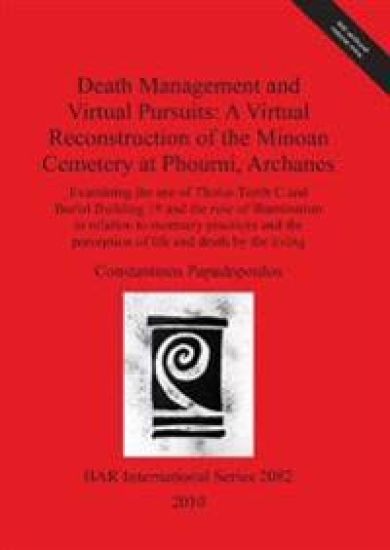
Death Management and Virtual Pursuits: A Virtual Reconstruction of the Minoan Cemetery at Phourni Archanes
Constantinos Papadopoulos
BAR Publishing
2010
muu
This volume embraces computer based research to provide a virtual reconstruction of Tholos Tomb C and Burial Building 19 at the cemetery at Phourni, using the resultant models to reassess the archaeological dataset, and in particular human interaction with the tomb, burial rites, and the tomb through time. A special focus is placed on the role of light in how the tomb would have been perceived, and the effects of both natural and artificial light are modelled.

Learning about Immigration Law, third edition, is the most up-to-date immigration law book available and takes into account all of the changes made in immigration law since September 11, 2001. The text offers real-life examples that make the material come alive for the student and walks the student through the entire background, process, and tools essential for a legal professionals mastery of immigration law. The text is designed for everyone from experienced legal professionals to those who have no formal knowledge of the law. This book also shows the average consumer how to help a friend, neighbor, or family member with immigration law questions or concerns. It assumes no previous knowledge and works as an instructional manual discussing immigration law. There is an Appendix A that provides American Citizenship Preparation guidelines with practice questions and an Appendix B that includes the most common forms used in immigration matters. The text also discusses new procedural and substantive laws with detailed explanations about why these laws were created in the aftermath of 9/11. The text takes a complex subject and breaks it down into simple terms. It makes the immigration law experience up-to-date, complete, and enjoyable.
Dynamic Analysis of Robot Manipulators
Constantinos A. Balafoutis; Rajnikant V. Patel
Springer-Verlag New York Inc.
2012
nidottu
The purpose of this monograph is to present computationally efficient algorithms for solving basic problems in robot manipulator dynamics. In par ticular, the following problems of rigid-link open-chain manipulator dynam ics are considered : i) computation of inverse dynamics, ii) computation of forward dynamics, and iii) generation of linearized dynamic models. Com putationally efficient solutions of these problems are prerequisites for real time robot applications and simulations. Cartesian tensor analysis is the mathematical foundation on which the above mentioned computational algorithms are based. In particular, it is shown in this monograph that by exploiting the relationships between second order Cartesian tensors and their vector invariants, a number of new tensor vector identities can be obtained. These identities enrich the theory of Carte sian tensors and allow us to manipulate complex Cartesian tensor equations effuctively. Moreover, based on these identities the classical vector descrip tion for the Newton-Euler equations of rigid body motion are rewritten in an equivalent tensor formulation which is shown to have computational advan tages over the classical vector formulation. Thus, based on Cartesian tensor analysis, a conceptually simple, easy to implement and computationally efficient tensor methodology is presented in this monograph for studying classical rigid body dynamics. XlI Application of this tensor methodology to the dynamic analysis of rigid-link open-chain robot manipulators is simple and leads to an efficient fonnulation of the dynamic equations of motion.

Gravity, Special Relativity, and the Strong Force
Constantinos G. Vayenas; Stamatios N.-A. Souentie
Springer-Verlag New York Inc.
2012
sidottu
This book shows that the strong interaction forces, which keep hadrons and nuclei together, are relativistic gravitational forces exerted between very small particles in the mass range of neutrinos. First, this book considers the motion of two or three charged particles under the influence of electrostatic and gravitational forces only, which shows that bound states are formed by following the same semi-classical methodology used by Bohr to describe the H atom. This approach is also coupled with Newton’s gravitational law and with Einstein’s special relativity. The results agree with experiments on the masses, binding energies, radii, angular moments and magnetic moments of hadrons. The model provides the means to rationalize all the main experimental features of the strong force. Some of the implications for the unification of forces and the nature of our micro-cosmos and macro-cosmos are also discussed. The creation of mass itself, in other words, of hadrons from particlesas light as neutrinos, can now be modeled in a straightforward manner.

Gravity, Special Relativity, and the Strong Force
Constantinos G. Vayenas; Stamatios N.-A. Souentie
Springer-Verlag New York Inc.
2016
nidottu
This book shows that the strong interaction forces, which keep hadrons and nuclei together, are relativistic gravitational forces exerted between very small particles in the mass range of neutrinos. First, this book considers the motion of two or three charged particles under the influence of electrostatic and gravitational forces only, which shows that bound states are formed by following the same semi-classical methodology used by Bohr to describe the H atom. This approach is also coupled with Newton’s gravitational law and with Einstein’s special relativity. The results agree with experiments on the masses, binding energies, radii, angular moments and magnetic moments of hadrons. The model provides the means to rationalize all the main experimental features of the strong force. Some of the implications for the unification of forces and the nature of our micro-cosmos and macro-cosmos are also discussed. The creation of mass itself, in other words, of hadrons from particlesas light as neutrinos, can now be modeled in a straightforward manner.


As a term of praise for having won the Civil War and having kept the nation together, the Republicans were dubbed the Grand Old Party or GOP. In their century-and-a-half of history, they elected more presidents than any other party. After losing the popular vote in the 2000 presidential election, eking out a tough win in 2004, and losing in 2008 and particularly in 2012 to an incumbent on whose watch a listless economy couldn't push unemployment much below 8 percent, the attitude of the Republican Party turned sour and negative. GOP might as well had stood for Grumpy Old Party.But all is not lost. In Grumpy Old Party, author Constantinos Scaros identifies 20 tips that will help the party move beyond recent losses, reclaim their respectability, and win."If the Republican powers-that-be actually read this book and implemented the changes outlined in it, they'd have a lock on the White House for multiple elections and could force the Democrats to come to the negotiating table in good faith." - David Collison, Reform Party National Chairman"Though I do not agree with everything in this book, I think it should be required reading for all Republicans." - Michael Dukakis, Former Governor of Massachusetts and 1988 Democratic Presidential Nominee."This book provides a positive approach to solving the challenges we face. That is a priority we share, and I believe the nation needs to elect people who advance the American idea on which our success has been built." - Jimmy Kemp, Executive VP of Group 47 and President of the Jack Kemp Foundation.


A Closer Look at Russia and Its Influence on the World
Constantinos (EDT) Filis
Nova Science Pub Inc
2019
sidottu