
Kirjahaku
Etsi kirjoja tekijän nimen, kirjan nimen tai ISBN:n perusteella.
1000 tulosta hakusanalla Cornell Kelly
Cornell's Lives Of Clergymen, Physicians And Eminent Business Men Of The Nineteenth Century, With Recollections Of The Olden Time
William Mason Cornell
Kessinger Pub
2007
pokkari

Cornell University. Studies in Classical Philology. No. I. the Cum-Constructions
William Gardner Hale
Trieste Publishing
2018
nidottu
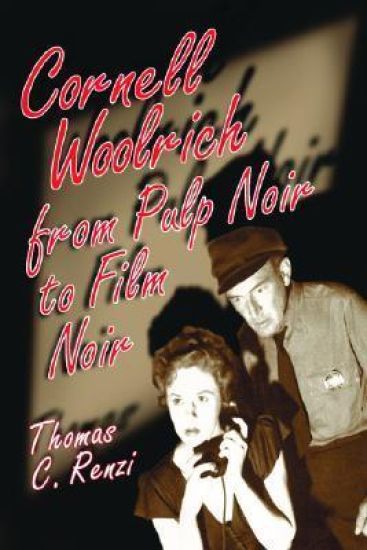
Extremely popular and prolific in the 1930s and 1940s, Cornell Woolrich still has diehard fans who thrive on his densely packed descriptions and his spellbinding premises. A contemporary of Hammett and Chandler, he competed with them for notoriety in the pulps and became the single most adapted writer for films of the noir period. Perhaps the most famous film adaptation of a Woolrich story is Alfred Hitchcock's Rear Window (1954). Even today, his work is still onscreen; Michael Cristofer's Original Sin (2001) is based on one of his tales. This book offers a detailed analysis of many of Woolrich's novels and short stories; examines films adapted from these works; and shows how Woolrich's techniques and themes influenced the noir genre. Twenty-two stories and 30 films compose the bulk of the study, though many other additions of films noirs are also considered because of their relevance to Woolrich's plots, themes and characters. The introduction includes a biographical sketch of Woolrich and his relationship to the noir era, and the book is illustrated with stills from Woolrich's noir classics.
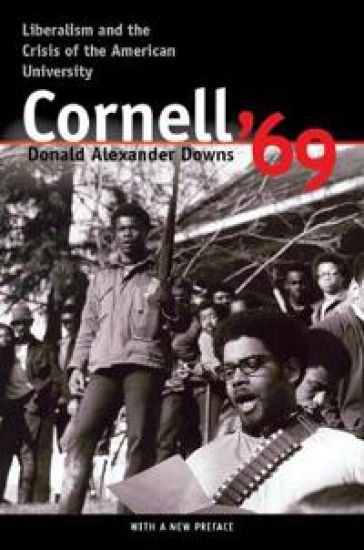
Cornell '69
Cornell University Press
1999
sidottu
In April 1969, one of America's premier universities was celebrating parents' weekend—and the student union was an armed camp, occupied by over eighty defiant members of the campus's Afro-American Society. Marching out Sunday night, the protesters brandished rifles, their maxim: "If we die, you are going to die." Cornell '69 is an electrifying account of that weekend which probes the origins of the drama and describes how it was played out not only at Cornell but on campuses across the nation during the heyday of American liberalism.Donald Alexander Downs tells the story of how Cornell University became the battleground for the clashing forces of racial justice, intellectual freedom, and the rule of law. Eyewitness accounts and retrospective interviews depict the explosive events of the day and bring the key participants into sharp focus: the Afro-American Society, outraged at a cross-burning incident on campus and demanding amnesty for its members implicated in other protests; University President James A. Perkins, long committed to addressing the legacies of racism, seeing his policies backfire and his career collapse; the faculty, indignant at the university's surrender, rejecting the administration's concessions, then reversing itself as the crisis wore on. The weekend's traumatic turn of events is shown by Downs to be a harbinger of the debates raging today over the meaning of the university in American society. He explores the fundamental questions it posed, questions Americans on and off campus are still struggling to answer: What is the relationship between racial justice and intellectual freedom? What are the limits in teaching identity politics? And what is the proper meaning of the university in a democratic polity?
This succinct and engaging history of the founding of Cornell University traces the institution's origins within the educational climate of mid-nineteenth-century America. Originally delivered as six lectures celebrating the seventy-fifth anniversary of the opening the university, this book was first published by Cornell University Press in 1943. Beginning with a survey of collegiate education prior to the Civil War, Carl L. Becker details the history of the Morrill Land Grant College Act that made possible the establishment of Cornell (among other universities); deftly portrays the lives of the Ezra Cornell, who supplied the essential idea and funding for the university, and Andrew D. White, who, as legislator, lobbyist, and first university president, made Cornell's dream a reality; and desrcibes the events surrounding the incorporation and opening of the university in 1868. Also included in this book are fifteen documents pertaining to its founding, as well as Becker's 1940 lecture, "The Cornell Tradition: Freedom and Responsibility."
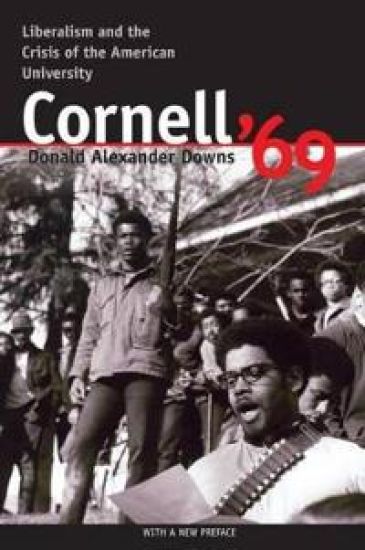
In April 1969, one of America's premier universities was celebrating parents' weekend—and the student union was an armed camp, occupied by over eighty defiant members of the campus's Afro-American Society. Marching out Sunday night, the protesters brandished rifles, their maxim: "If we die, you are going to die." Cornell '69 is an electrifying account of that weekend which probes the origins of the drama and describes how it was played out not only at Cornell but on campuses across the nation during the heyday of American liberalism. Donald Alexander Downs tells the story of how Cornell University became the battleground for the clashing forces of racial justice, intellectual freedom, and the rule of law. Eyewitness accounts and retrospective interviews depict the explosive events of the day and bring the key participants into sharp focus: the Afro-American Society, outraged at a cross-burning incident on campus and demanding amnesty for its members implicated in other protests; University President James A. Perkins, long committed to addressing the legacies of racism, seeing his policies backfire and his career collapse; the faculty, indignant at the university's surrender, rejecting the administration's concessions, then reversing itself as the crisis wore on. The weekend's traumatic turn of events is shown by Downs to be a harbinger of the debates raging today over the meaning of the university in American society. He explores the fundamental questions it posed, questions Americans on and off campus are still struggling to answer: What is the relationship between racial justice and intellectual freedom? What are the limits in teaching identity politics? And what is the proper meaning of the university in a democratic polity?
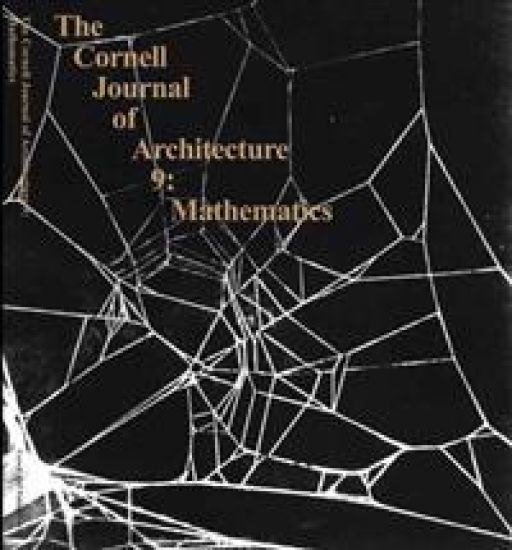
Cornell Journal of Architecture 9
Cornell AAP Publications
2013
nidottu
While mathematics in architecture has historically referenced notions of order, proportion, and ideal form, the discipline of mathematics itself has shifted to encompass uncertainty, incompleteness, relativity, and chaos towards a situation in which truth itself is elusive. This move stems in part from an engagement with real phenomena, in which natural systems were shown to behave non-linearly and unpredictably. In architecture, while computational developments enabling dynamic and variable modeling have been subsumed into our culture of design and production, a new kind of idealism has emerged. Formally prolific and inherently multiplicitous, this book proposes algorithmic truth and statistical outcomes over predetermined objectives; it signifies a retreat away from reality and back towards abstraction and simulation in the smooth space of possibility. Meanwhile, the consequences of uncertainty have pervaded our culture to its core. Recovering from the initial high of fractal and random geometrical proficiency, architecture is just beginning to re-embrace the underlying issues embedded within this contemporary mathematics: uncertainty, unpredict-ability, chance, recursion, wildness, and informality. Contributors: Cecil Balmond, Mario Carpo, Lily Chi + Adrian Lewis, Dana Cupkova + Kevin Pratt, Tom Fecht, Francois Roche, Jenny Sabin, Anthony Vidler and others.
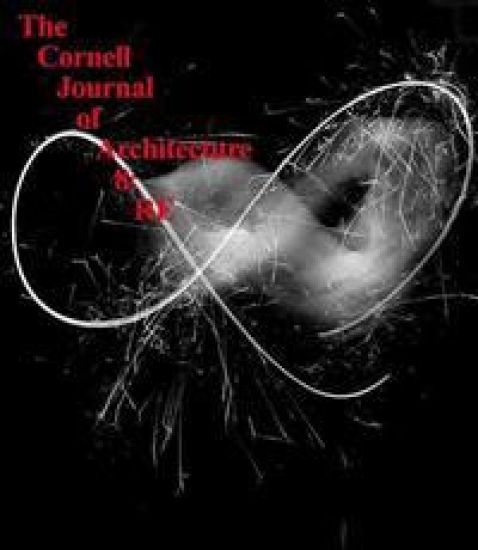
Cornell Journal of Architecture
Cornell AAP Publications
2011
nidottu
This issue of the Cornell Journal of Architecture is about the now, the new, and the next in architecture, while simultaneously acknowledging that every possible future is intrinsically linked to the existent, to the present and its attendant past. At the heart of issue 8: RE is the understanding that the creative act itself is reiterative; that in rethinking, recombining, reshuffling, recycling, and reimagining aspects of the world around us, we produce work that both belongs to the current moment and establishes new future trajectories. The texts reflect the interconnected strands of technology, history, theory, and intuition that necessarily reinforce each other in architectural education and practice today: issues of reuse and recycling; of feedback loops and regression; of dialogue, criticism, and correspondence; and of the role that changing technologies have in restructuring the way we think, see, and remember.
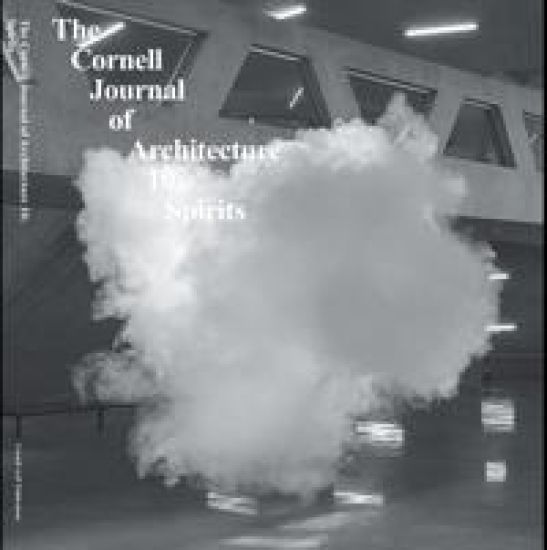
Cornell Journal of Architecture 10
Cornell AAP Publications
2018
pokkari
In distilling, the small amount of alcohol evaporated during the aging process is known as the angels share. at is, while lost to us, the alcohol does not cease to exist, but instead is given to or taken by the angels. Architecture s own angels share the notion of an absent and intangible other has too been personi ed. From Genius Loci to Zeitgeist, the gure of the spirit is perhaps the most fundamental component of architecture, even before walls or columns. Whether phenomenal or conceptual, without this ickering spirit, one might say, there is no architecture. As technology enables the virtual realm to be inhabited in more everyday ways, the notion of another kind of spirit becomes more present yet more blurred. e digital, as architecture s alternate and now ickering specter, skirmishes with architecture s existing ghosts."
Cornell Journal of Architecture 13: Missing
Cornell Aap Publications
2026
nidottu


A heartbroken lover wants to forget. Supernatural super sleuth Cornell Dyer desperately tries to solve a mystery as his memory vanishes. Meanwhile, he keeps showing up at places he's certain are clues but can't recall how or why he arrived. In this "back to front" story, Cornell races his fading mind to save the day - but which will win?