Kirjojen hintavertailu. Mukana 12 390 323 kirjaa ja 12 kauppaa.

Kirjahaku

Etsi kirjoja tekijän nimen, kirjan nimen tai ISBN:n perusteella.

874 tulosta hakusanalla Creighton Broadhurst

General Creighton Abrams' Conduct of Design in Operational Art During the Vietnam War
General Abrams presents a sound historical example of the practical application of operational art as viewed through the lens of the Army Design Methodology. When General Abrams'; assumed command of Military Assistance Command Vietnam (MACV), he was able to frame his environment enabling him to enact measures to solve the correct problem which was, how to equip and train the ARVN while simultaneously focusing on population centric efforts in counterinsurgency--ultimately eliminating the need for U.S. presence in Vietnam. Under his authority, American forces were broken up into small units that would live with and train the South Vietnamese civilians to defend their villages from guerrilla or conventional Northern incursions. Not only did he successfully frame the problem in 1968 but he was able to re-frame in 1970 in accordance with the Nixon administration's abrupt announcement of a rapid withdrawal of forces from Vietnam. These efforts proved successful as evidenced by the ability of ARVN forces to repel a full-scale NVA Easter Offensive in 1972. This study validates the Army Design Methodology as a framework for the assessment operational art. This work has been selected by scholars as being culturally important, and is part of the knowledge base of civilization as we know it. This work was reproduced from the original artifact, and remains as true to the original work as possible. Therefore, you will see the original copyright references, library stamps (as most of these works have been housed in our most important libraries around the world), and other notations in the work. This work is in the public domain in the United States of America, and possibly other nations. Within the United States, you may freely copy and distribute this work, as no entity (individual or corporate) has a copyright on the body of the work. As a reproduction of a historical artifact, this work may contain missing or blurred pages, poor pictures, errant marks, etc. Scholars believe, and we concur, that this work is important enough to be preserved, reproduced, and made generally available to the public. We appreciate your support of the preservation process, and thank you for being an important part of keeping this knowledge alive and relevant.
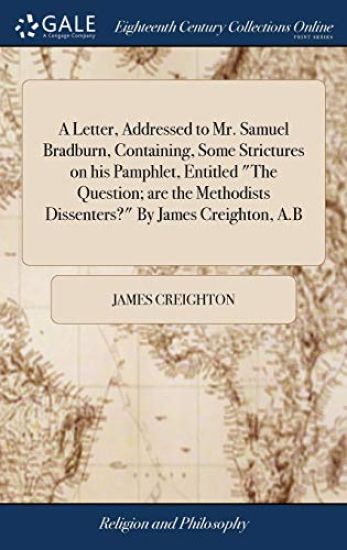
A Letter, Addressed to Mr. Samuel Bradburn, Containing, Some Strictures on his Pamphlet, Entitled "The Question; are the Methodists Dissenters?" By James Creighton, A.B
The 18th century was a wealth of knowledge, exploration and rapidly growing technology and expanding record-keeping made possible by advances in the printing press. In its determination to preserve the century of revolution, Gale initiated a revolution of its own: digitization of epic proportions to preserve these invaluable works in the largest archive of its kind. Now for the first time these high-quality digital copies of original 18th century manuscripts are available in print, making them highly accessible to libraries, undergraduate students, and independent scholars.The Age of Enlightenment profoundly enriched religious and philosophical understanding and continues to influence present-day thinking. Works collected here include masterpieces by David Hume, Immanuel Kant, and Jean-Jacques Rousseau, as well as religious sermons and moral debates on the issues of the day, such as the slave trade. The Age of Reason saw conflict between Protestantism and Catholicism transformed into one between faith and logic -- a debate that continues in the twenty-first century.++++The below data was compiled from various identification fields in the bibliographic record of this title. This data is provided as an additional tool in helping to insure edition identification: ++++Huntington LibraryN020186'The question, are the Methodists Dissenters' was first published in 1792. The paper is watermarked: 1803.London, 1793 1803]. 20p.; 8
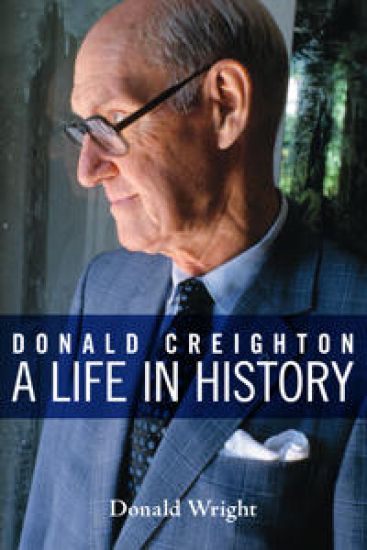
Donald Creighton

Donald Creighton

Donald Wright

University of Toronto Press
2015
pokkari
A member of the same intellectual generation as Harold Innis, Northrop Frye, and George Grant, Donald Creighton (1902–1979) was English Canada’s first great historian. The author of eleven books, including The Commercial Empire of the St. Lawrence and a two-volume biography of John A. Macdonald, Creighton wrote history as if it “had happened,” he said, “the day before yesterday.” And as a public intellectual, he advised the prime minister of Canada, the premier of Ontario, and – at least on one occasion – the British government. Yet he was, as Donald Wright shows, also profoundly out of step with his times. As the nation was re-imagined along bilingual and later multicultural lines in the 1960s and 1970s, Creighton defended a British definition of Canada at the same time as he began to fear that he would be remembered only “as a pessimist, a bigot, and a violent Tory partisan.” Through his virtuoso research into Creighton’s own voluminous papers, Wright paints a sensitive portrait of a brilliant but difficult man. Ultimately, Donald Creighton captures the twentieth-century transformation of English Canada through the life and times of one of its leading intellectuals.
Donald Creighton

Donald Creighton

Donald Wright

University of Toronto Press
2015
sidottu
A member of the same intellectual generation as Harold Innis, Northrop Frye, and George Grant, Donald Creighton (1902–1979) was English Canada’s first great historian. The author of eleven books, including The Commercial Empire of the St. Lawrence and a two-volume biography of John A. Macdonald, Creighton wrote history as if it “had happened,” he said, “the day before yesterday.” And as a public intellectual, he advised the prime minister of Canada, the premier of Ontario, and – at least on one occasion – the British government. Yet he was, as Donald Wright shows, also profoundly out of step with his times. As the nation was re-imagined along bilingual and later multicultural lines in the 1960s and 1970s, Creighton defended a British definition of Canada at the same time as he began to fear that he would be remembered only “as a pessimist, a bigot, and a violent Tory partisan.” Through his virtuoso research into Creighton’s own voluminous papers, Wright paints a sensitive portrait of a brilliant but difficult man. Ultimately, Donald Creighton captures the twentieth-century transformation of English Canada through the life and times of one of its leading intellectuals.