Kirjojen hintavertailu. Mukana 11 342 296 kirjaa ja 12 kauppaa.

Kirjahaku

Etsi kirjoja tekijän nimen, kirjan nimen tai ISBN:n perusteella.

742 tulosta hakusanalla Culbert B. Laney

Integrative Pediatrics

Integrative Pediatrics

Timothy Culbert; Karen Olness

Oxford University Press Inc
2009
sidottu
There is ample evidence that children and adolescents in large numbers are actively using integrative (complementary and alternative) therapies. Various studies now indicate that over 50% of pediatricians surveyed would refer a patient for integrative therapy, and they would welcome more natural therapies for children provided they were safe and effective. However, there has been little training for pediatricians in this area. Integrative Pediatrics addresses these issues and provides guidelines for pediatricians, parents, and general audiences in a balanced, evidence-based manner. In this volume in the Weil Integrative Medicine Library series, the authors describe a rational and evidence-based approach to the integrative therapy of childhood disorders and well-child care, integrating the principles of alternative and complementary therapies into the principles and practice of conventional pediatrics. The authors examine what works and what doesn't and offer practical guidelines for physicians to incorporate integrative medicine into their practice and how to advise patients and their parents on reasonable and effective therapies. The text also covers areas of controversy and identifies areas of uncertainty where future research is needed. Chapters also cite the best available evidence for both safety and efficacy of all therapies discussed. The series editor is Andrew Weil, MD, Professor and Director of the Program of Integrative Medicine at the University of Arizon. Dr. Weil's program was the first academic program in the US and he is the major name in integrative medicine in the US, and well-known around the world. His program's stated goal is "to combine the best ideas and practices of conventional and alternative medicine into cost effective treatments without embracing alternative practices uncritically."

Paralyses

Paralyses

John Culbert

University of Nebraska Press
2011
sidottu
Modernity has long been equated with motion, travel, and change, from Marx's critical diagnoses of economic instability to the Futurists' glorification of speed. Likewise, metaphors of travel serve widely in discussions of empire, cultural contact, translation, and globalization, from Deleuze's "nomadology" to James Clifford's "traveling cultures." John Culbert, in contrast, argues that the key texts of modernity and postmodernity may be approached through figures and narratives of paralysis: motion is no more defining of modern travel than fixations, resistance, and impasse; concepts and figures of travel, he posits, must be rethought in this more static light. Focusing on the French and Francophone context, in which paralyzed travel is a persistent motif, Culbert also offers new insights into French critical theory and its often paradoxical figures of mobility, from Blanchot's pas au-delà and Barthes's dérive to Derrida's aporias and Glissant's diversions. Here we see that paralysis is not merely the failure of transport but rather the condition in which travel, by coming to a crisis, calls into question both mobility and stasis in the language of desire and the order of knowledge. Paralyses provides a close analysis of the rhetoric of empire and the economy of tourism precisely at their points of breakdown, which in turn enables a deconstruction of master narratives of exploration, conquest, and exoticism. A reassessment of key authors of French modernity—from Nerval and Gautier to Fromentin, Paulhan, Beckett, Leiris, and Boudjedra—Paralyses also constitutes a new theoretical intervention in debates on travel, translation, ethics, and postcoloniality.
Don't Kill the Bosses! Escaping the Hierarchy Trap
Don't Kill the Bosses! is a cool-headed blueprint for changing companies by challenging the idea of boss-dominated relationships. The book explores the critical flaw of the boss/subordinate relationship: Management fails to establish a framework for subordinates to communicate in a forthright manner, so subordinates spin the facts for their bosses. The book identifies the culprit as one-sided accountability and shows the consequences: warped communication, corrupt internal politics, illusionary teamwork, and a pass-the-buck mentality. The proposed solution is surprisingly simple: Replace this particular hierarchical relationship -- without disposing of the organizational chart -- with an alternative model. The authors demonstrate how to establish candid, equal-footing relationships that allow organizations to work effectively and productively.
Purgatory Press / After the End, The

Purgatory Press / After the End, The

John Culbert

John Hunt Publishing
2013
nidottu
Vanished poets, overlooked artists, hapless visionaries: The Purgatory Press opens a tantalizing window on a publisher's catalogue of improbable books. Dark, comical, and startlingly inventive, After the End is a dazzling display of postmodern storytelling. These short fictions showcase the many talents of an emerging author.
Proximities: Literature, Mobility, and the Politics of Displacement
Ebook available to libraries exclusively as part of the JSTOR Path to Open intiative. As the era of high globalization has given way to a time of resurgent nationalisms, the discourse of travel has undergone significant change. The previous era’s keywords of freedom, mobility and connection increasingly vie with a language of borders, security and national identity. In this study of the politics of modern travel and migration, John Culbert shows how today’s contradictions of global mobility are an abiding feature of modernity and an outgrowth of coloniality as an ongoing practice of land theft, displacement and dispossession. Focussing on English, American, and Anglophone literary writing on travel, and spanning early twentieth-century tourism to present-day refugee narratives, Proximities examines contexts and situations in which travellers of discrepant rights and privileges meet, arguing that such scenes of 'proximity' yield unforeseen prospects for ethical rapports and political solidarity. In so doing, Culbert makes a strong case for humanistic and interdisciplinary critical study at a time when research on mobility and migration is dominated by social-scientific knowledge. Pointing out that the contradictions of global mobility are reflected in the academy itself, Culbert advocates for a reflexive, decolonial critique of the conditions of knowledge production today. Proximities is a vital contribution to current debates on citizenship, human rights, decoloniality and the right to move.
Tiffany and Jeff

Tiffany and Jeff

Carol Ann Culbert Johnson

Lulu.com
2019
pokkari
Tiffany has finally found the man of her dreams, and his name is Jeff Tobias. The two are happy, but Tiffany's ex-boyfriend, Ronald White won't leave her alone. He's obsessed with Tiffany, and Ronald is very dangerous too. Will Tiffany find happiness with Jeff?
Tiffany and Jeff

Tiffany and Jeff

Carol Ann Culbert Johnson

Lulu.com
2019
pokkari
Tiffany and Jeff are still going strong in book 4 of this series, Tiffany and Jeff. Tiffany and Jeff decides to meet with family and friends who just don't get along, especially Jeff's sister, Jiffy, who is the black sheep of the family. In this circle of family and friends, fireworks are sparkling and secrets are spilled.
The Ultimate Sins

The Ultimate Sins

Carol Ann Culbert Johnson

Lulu.com
2014
pokkari
A serial killer is on the loose, and African-American woman are not safe from this maniac, who has issues that makes him kill. Detective Hash Brown, and his partner, Jason Little are on the case to bring this serial killer to justice. Along this ride of maniac tendencies, romance takes a part of this novel of crimes of passion, and then some
Playing the Game

Playing the Game

Carol Ann Culbert Johnson

Lulu.com
2015
nidottu
Fish and Electric is attracted to each other as they meet when Electric makes her dreams come true, and Fish is the reason. Their chemistry is explosive, but both have baggage in their lives, and the chaos begins.
Torn Between Two Lovers

Torn Between Two Lovers

Carol Ann Culbert Johnson

Lulu.com
2006
pokkari
Candy Thomas is happy with Mace James, but when she meets an attorney in her law firm, Jordan Hayes, she begins to wonder about her relationship with Mace. Mace has been taking their relationship for granted and Candy is exhausted with his excuses. They live together, but the sparks are not visible anymore. When Jordan flirts with Candy she tries to ignore him because of the issues he has with her weight. In the midst of Candy's problems, she has two friends, Lisa Parks and Helen Jones. Lisa is an actress, and likes men. When she falls for one, her life changes, and can Lisa handle it? Helen is in love with her husband, but he can't keep his hands off the other women. Helen takes action, and her husband won't see the dice when the chips fall as they may. Who will Candy choose Mace or Jordan?
The Lyons Den

The Lyons Den

Carol Ann Culbert Johnson

iUniverse
2020
pokkari
Madison Johnson is fighting battles of being overweight. After embarking on a self-journey with exercise and a diet education, she loses the weight, and has kept it off. She is eager to begin her new life with her new body, but the insecurities are still there when she meets a possible soul mate for life. Will Madison let the devil of emotions forfeit a new love in her life? Toxic Lyons, a very wealthy and debonair male is looking for the love of his life. He meets Madison at his restaurant, and the sparks are booming with dynamite. He has relationship issues, and is buried with Madison's insecurities. Will Madison and Toxic find love? Or is their relationship just to toxic for them both? Take a ride with me and romance
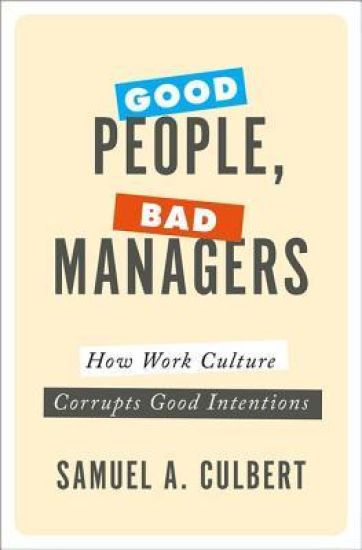
Good People, Bad Managers

Good People, Bad Managers

Samuel A. Culbert

Oxford University Press Inc
2017
sidottu
What's worse than a bad manager who everybody knows is bad? A bad manager who is well-intentioned and considered to be good. Yet these well-intentioned bad managers make up the bulk of management today. How did that happen? How did so many of today's managers end up with a self-preservation mindset that doesn't always translate to a productive and mission-oriented environment? How did so many good people become wedded to a work culture that saps morale, well-being and performance at both the individual and organizational levels? an the well-intentioned doling it out realize... and even In Good People, Bad Managers: How Work Culture Corrupts Good Intentions, author Samuel A. Culbert sheds a light on the bad habits that are routinely followed by these well-intended managers. Managers need to understand the causes of their misguided practices. They need to become more aware of the damage they inflict, and the hollowness of the rationales they use to justify what they do. Company leaders, CEOs, and top-tier managers must become aware of how they have gone astray as a first step in implementing the truly beneficial management mentality that their companies, their managers and their employees require to succeed.
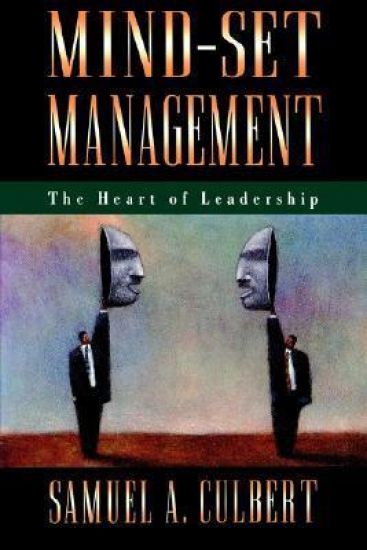
Mind-Set Management

Mind-Set Management

Samuel A. Culbert

Oxford University Press Inc
1996
sidottu
You can follow any business guru you want, be it Peter Drucker or Tom Peters. You can adopt any new management concept, from reengineering to `empowering people'. But Samuel A. Culbert has one caveat: no matter what managerial `religion' you follow - and there are many sound ones out there - before you can lead, manage, or team up effectively, you must comprehend the mind-sets of the people with whom you deal. In Mind-Set Management, Culbert provides a model for thinking about other people - about their self-interested motives and about their biased views of work events - as he shows managers at all levels how to use psychology instead of manipulation to give more productive advice. The essence of managing, says Culbert, is `staging the conditions for others to be effective', which today entails giving advice and feedback, not directives. This is particularly true with today's `empowering' management styles. But as most managers know all too well, advice is often resisted, resented, or ignored. The problem, Culbert contends, is that managers don't have the other person in focus, that when most managers formulate advice, they think they are attuned to the other person, but in fact the person they have listened to most is themselves. Mind-Set Management will help you focus on the person you want to advise, explaining what you need to learn and to know prior to giving advice and feedback. It will prompt you to ask yourself (and will help you answer) such questions as: Why do people insist on seeing events with their own particular biases and distortions? Why do others resist my best ideas and advice for how they can perform more effectively? Why can't I get them to change how they think? Why do people have so much difficulty putting internal politics aside? What's needed for people to trust one another and listen to advice? Why are some people blind to the obvious logic behind the feedback and advice they receive? Culbert has packed the book with vivid case illustrations and stories that people at every level, from CEOs through staff, will identify with, weaving the concepts and stories together to present evidence that makes the lessons compelling and personal. With these lessons, managers at all levels will view management as a psychological art. You will be better able to see where the other person's interests lie and how they view the corporation and the task at hand, and you will be able to give great advice, advice that will be followed because it serves the interests of the person who receives it even as it advances the company's goals. Today there are many new ideas about how to manage more effectively, but without the psychological component that Samuel Culbert provides in Mind-Set Management, these hot new concepts won't work any better than the old ones did. Thus this is an important, groundbreaking work. Indeed, Warren Bennis, in the Foreword, calls it `one of the lasting contributions of this decade to our understanding of corporations, the psychology of people who work in them, and perhaps most of all, a contribution to understanding ourselves."
World War II, Film, and History

World War II, Film, and History

Chambers; Culbert

Oxford University Press Inc
1997
nidottu
The immediacy and apparent truth of the visual image, plus film and television's ostensible ability to propel viewers back into the past, confers a sense of veracity on the most powerful historical films. Examining the effect of film and television on perceptions of the Second World War and history is the guiding purpose of this collection of original essays.