
Kirjahaku
Etsi kirjoja tekijän nimen, kirjan nimen tai ISBN:n perusteella.
1000 tulosta hakusanalla Cyrus F. Rea

Electricity in Daily Life
Cyrus F. Brackett; Herbert Laws Webb; Franklin Leonard Pope
Kessinger Pub
2007
pokkari
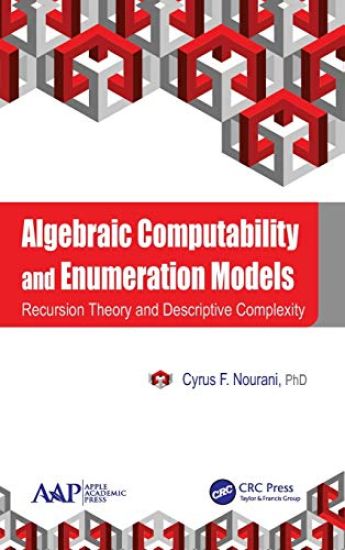
Algebraic Computability and Enumeration Models
Cyrus F. Nourani
Apple Academic Press Inc.
2016
sidottu
This book, Algebraic Computability and Enumeration Models: Recursion Theory and Descriptive Complexity, presents new techniques with functorial models to address important areas on pure mathematics and computability theory from the algebraic viewpoint. The reader is first introduced to categories and functorial models, with Kleene algebra examples for languages. Functorial models for Peano arithmetic are described toward important computational complexity areas on a Hilbert program, leading to computability with initial models. Infinite language categories are also introduced to explain descriptive complexity with recursive computability with admissible sets and urelements. Algebraic and categorical realizability is staged on several levels, addressing new computability questions with omitting types realizably. Further applications to computing with ultrafilters on sets and Turing degree computability are examined. Functorial models computability is presented with algebraic trees realizing intuitionistic types of models. New homotopy techniques are applied to Marin Lof types of computations with model categories. Functorial computability, induction, and recursion are examined in view of the above, presenting new computability techniques with monad transformations and projective sets.This informative volume will give readers a complete new feel for models, computability, recursion sets, complexity, and realizability. This book pulls together functorial thoughts, models, computability, sets, recursion, arithmetic hierarchy, filters, with real tree computing areas, presented in a very intuitive manner for university teaching, with exercises for every chapter. The book will also prove valuable for faculty in computer science and mathematics.
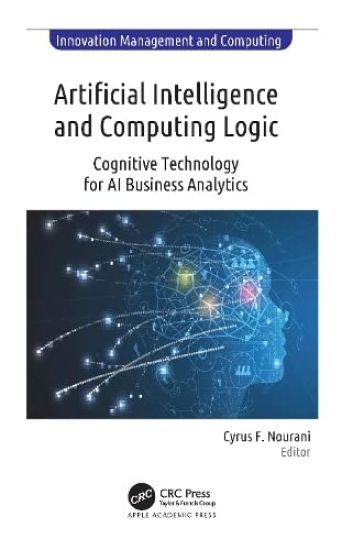
Focusing on the cutting-edge applications of AI cognitive computing from neuromorphic to quantum cognition as applied to AI business analytics, this new volume explores AI’s importance in managing cognitive processes along with ontological modeling concepts for venturing into new business frontiers. The volume presents a selection of significant new accomplishments in the areas of AI cognitive computing ranging from neurocognition perception and decision-making in the human brain—combining neurocognitive techniques and effective computing—to basic facial recognition computing models. Topics include:Agent neurocomputing techniques for facial expression recognitionComputing haptic motion and ontology epistemicCharacterizations of morph schemas for visual analyticsLearning and perceptive computingFunctional and structural neuroimaging modelingObserved links between facial recognition and affective emotional processesInteraction of cognitive and emotional processes during social decision-makingNeurocognitive processing of emotional facial expressions in individualsNeurocognitive affective system for emotive robot androidsVirtual reality-based affect adaptive neuromorphic computingExecutive surveys indicate that cognitive adoption is very important in business strategy for success and to remain competitive. Employing cognitive-based processes provides the way to get the right information in the right hands at the right time, which is the key to winning in the digital era and to driving business value that emphasizes competitive differentiation. Several chapters of the volume address the goal of using cognitive technology to improve search capabilities, to provide personalized customer service in business and in health and wellness, and to create better workflow management. Key features:Looks at the newest frontiers on very popular AI and analytics topicsDiscusses new techniques for visual analytics and data filteringShows how AI and cognitive science merges with quantum neurocognitive computingPresents ontology models with ontology preservation data filtering techniquesProvides a cross-transposition on AI and digitizations for business model innovationsArtificial Intelligence and Computing Logic: Cognitive Technology for AI Business Analytics is a valuable resource that informs businesses and other enterprises the value of artificial intelligence and computing logic applications.
This book is an introduction to a functorial model theory based on infinitary language categories. The author introduces the properties and foundation of these categories before developing a model theory for functors starting with a countable fragment of an infinitary language. He also presents a new technique for generating generic models with categories by inventing infinite language categories and functorial model theory. In addition, the book covers string models, limit models, and functorial models.
Algebraic Computability and Enumeration Models
Cyrus F. Nourani
Apple Academic Press Inc.
2021
nidottu
This book, Algebraic Computability and Enumeration Models: Recursion Theory and Descriptive Complexity, presents new techniques with functorial models to address important areas on pure mathematics and computability theory from the algebraic viewpoint. The reader is first introduced to categories and functorial models, with Kleene algebra examples for languages. Functorial models for Peano arithmetic are described toward important computational complexity areas on a Hilbert program, leading to computability with initial models. Infinite language categories are also introduced to explain descriptive complexity with recursive computability with admissible sets and urelements. Algebraic and categorical realizability is staged on several levels, addressing new computability questions with omitting types realizably. Further applications to computing with ultrafilters on sets and Turing degree computability are examined. Functorial models computability is presented with algebraic trees realizing intuitionistic types of models. New homotopy techniques are applied to Marin Lof types of computations with model categories. Functorial computability, induction, and recursion are examined in view of the above, presenting new computability techniques with monad transformations and projective sets.This informative volume will give readers a complete new feel for models, computability, recursion sets, complexity, and realizability. This book pulls together functorial thoughts, models, computability, sets, recursion, arithmetic hierarchy, filters, with real tree computing areas, presented in a very intuitive manner for university teaching, with exercises for every chapter. The book will also prove valuable for faculty in computer science and mathematics.
Focusing on the cutting-edge applications of AI cognitive computing from neuromorphic to quantum cognition as applied to AI business analytics, this new volume explores AI’s importance in managing cognitive processes along with ontological modeling concepts for venturing into new business frontiers. The volume presents a selection of significant new accomplishments in the areas of AI cognitive computing ranging from neurocognition perception and decision-making in the human brain—combining neurocognitive techniques and effective computing—to basic facial recognition computing models. Topics include:Agent neurocomputing techniques for facial expression recognitionComputing haptic motion and ontology epistemicCharacterizations of morph schemas for visual analyticsLearning and perceptive computingFunctional and structural neuroimaging modelingObserved links between facial recognition and affective emotional processesInteraction of cognitive and emotional processes during social decision-makingNeurocognitive processing of emotional facial expressions in individualsNeurocognitive affective system for emotive robot androidsVirtual reality-based affect adaptive neuromorphic computingExecutive surveys indicate that cognitive adoption is very important in business strategy for success and to remain competitive. Employing cognitive-based processes provides the way to get the right information in the right hands at the right time, which is the key to winning in the digital era and to driving business value that emphasizes competitive differentiation. Several chapters of the volume address the goal of using cognitive technology to improve search capabilities, to provide personalized customer service in business and in health and wellness, and to create better workflow management. Key features:Looks at the newest frontiers on very popular AI and analytics topicsDiscusses new techniques for visual analytics and data filteringShows how AI and cognitive science merges with quantum neurocognitive computingPresents ontology models with ontology preservation data filtering techniquesProvides a cross-transposition on AI and digitizations for business model innovationsArtificial Intelligence and Computing Logic: Cognitive Technology for AI Business Analytics is a valuable resource that informs businesses and other enterprises the value of artificial intelligence and computing logic applications.
This book is an introduction to a functorial model theory based on infinitary language categories. The author introduces the properties and foundation of these categories before developing a model theory for functors starting with a countable fragment of an infinitary language. He also presents a new technique for generating generic models with categories by inventing infinite language categories and functorial model theory. In addition, the book covers string models, limit models, and functorial models.
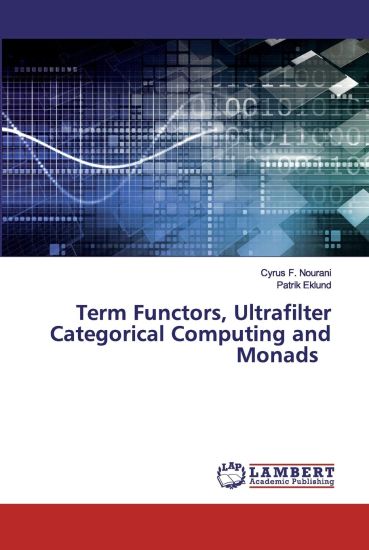
Term Functors, Ultrafilter Categorical Computing and Monads
Cyrus F Nourani; Patrik Eklund
LAP Lambert Academic Publishing
2020
pokkari
This book is an introduction to a term functorial mathematics and monad-based model theory on infinitary language categories. Term functors are important new techniques that bring categorical models mathematics bases closer to computability studies. The book bridges over important areas between CS and Mathematics with newer important insights. Lifting to power signatures to bridge onto n-type functors with ultrafilters for computability with n-type models for point set fragments. The accomplishment bring forth newer avenues between mathematics and TCS with newer benefits to both disciplines. The functorial model perspective is different from the preceding authors', in that functorial model theory is based on defining categories on language fragments, then carrying on functors to categories and filter monads. Infinitary language categories abbreviated IFLCS in the first authors publications over a decade ago. An important consequence is that we have a direct reach to all developed model theory techniques at categories. Therefore, we do not reinvent all that at topos, but carry that at topos.





Fisher, F: Cyprus, our new colony, and what we know about it
Antigonos Verlag
2024
nidottu

Fisher, F: Cyprus, our new colony, and what we know about it
Antigonos Verlag
2024
sidottu

Carus, F: Nachgelassene Werke: Geschichte der Psychologie, 1
Nabu Press
2010
Tuntematon sidosasu