

Kirjahaku
Etsi kirjoja tekijän nimen, kirjan nimen tai ISBN:n perusteella.
1000 tulosta hakusanalla D. W. Barrett

D. W. Griffith
OmniScriptum
2026
pokkari
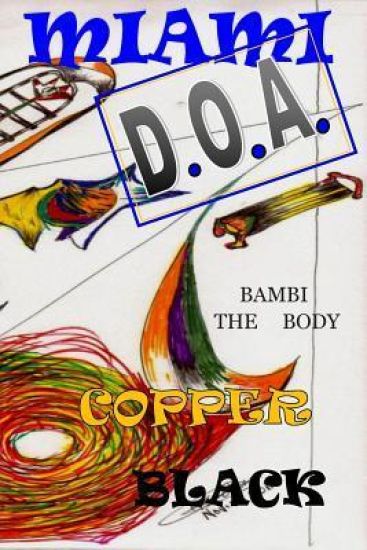
Miami D.O A.: Bambi the Body B&W
Melody Black Thorp
Createspace Independent Publishing Platform
2014
nidottu
Catalogue d'Estampes Anciennes Et Modernes: Collection de W. Drugulin Vente 19 Novembre 1860
Sans Auteur
Hachette Livre - BNF
2013
pokkari
Catalogue d'estampes anciennes et modernes...: collection de M. D. V... W. Drugulin] ... vente... 19 novembre 1860... / expert] VigneresDate de l'edition originale: 1860Sujet de l'ouvrage: Drugulin, Wilhelm Eduard (1825-1879) -- Collections d'art" Vente. Estampes. 1860-11-19 - 1860-11-20. Paris] Collection. Estampes. Drugulin, W.. 1860]Reference bibliographique: Lugt, 25807"Ce livre est la reproduction fidele d'une oeuvre publiee avant 1920 et fait partie d'une collection de livres reimprimes a la demande editee par Hachette Livre, dans le cadre d'un partenariat avec la Bibliotheque nationale de France, offrant l'opportunite d'acceder a des ouvrages anciens et souvent rares issus des fonds patrimoniaux de la BnF.Les oeuvres faisant partie de cette collection ont ete numerisees par la BnF et sont presentes sur Gallica, sa bibliotheque numerique.En entreprenant de redonner vie a ces ouvrages au travers d'une collection de livres reimprimes a la demande, nous leur donnons la possibilite de rencontrer un public elargi et participons a la transmission de connaissances et de savoirs parfois difficilement accessibles.Nous avons cherche a concilier la reproduction fidele d'un livre ancien a partir de sa version numerisee avec le souci d'un confort de lecture optimal. Nous esperons que les ouvrages de cette nouvelle collection vous apporteront entiere satisfaction.Pour plus d'informations, rendez-vous sur www.hachettebnf.frhttp: //gallica.bnf.fr/ark: /12148/bpt6k63710146

D-r Y.S.R Rythubharosa: Finansowaq pomosch' fermeram w ATR
Yerram Venkata Subba Reddy; Morusu Siwa Cankar
Sciencia Scripts
2022
nidottu

Donal'd Tramp i bor'ba s terrorizmom w Sahele. Primer Mali
Jeka Jesongo Saleh; Justin Mulendq Dady
Sciencia Scripts
2022
nidottu
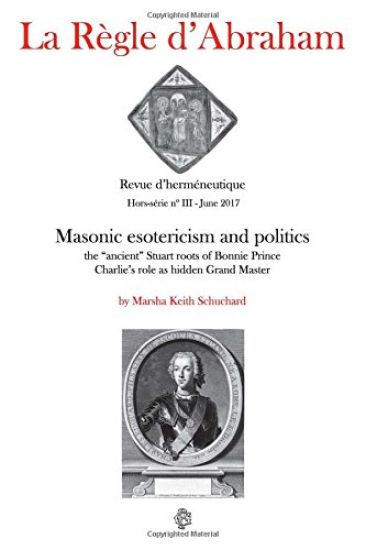
La Règle d'Abraham Hors-série #3 (B&W): Masonic esotericism and politics: the "ancient" Stuart roots of Bonnie Prince Charlie's role as hidden Grand M
Marsha Keith Schuchard
Createspace Independent Publishing Platform
2017
nidottu
Mainly focused on the study of esoteric traditions within the three monotheist Revelations, La R gle d'Abraham is a periodical founded and directed by Patrick Geay since April 1996. This special edition in English, with 20 rare Masonic illustrations, is dedicated to an important article by Marsha Keith Schuchard on Masonic esotericism and politics: the "ancient" Stuart roots of Bonnie Prince Charlie's role as hidden Grand Master Research into Charles Edward Stuart's alleged affiliation with Jacobite or Ecossais Freemasonry has long been hampered by the misleading assumption, which became academic "conventional wisdom," that Freemasonry virtually began in England when the Grand Lodge of London was formed in 1717. Moreover, it was generally characterized as non-political and rationalistic, devoted to the Protestant succession, the Hanoverian government, Newtonian science, and latitudinarian religion. However, the recent international expansion of Masonic and Jacobite studies makes possible a more credible and documented study of the Stuart prince's political and Masonic activities, within a context of anti-Hanoverian, politically-active, diplomatically-diverse, and spiritually-oriented Masonry that draws upon the early Scots-Irish traditions maintained by the Stuart kings in Greater Britain and by the exiles in the Jacobite diaspora. Ranging from the 1590s in Scotland to the 1780s in Italy, the Stuart-Masonic themes of Jewish mysticism, Lullist illuminated knighthood, Solomonic architecture, and religious toleration sustained the military and political campaigns of James II, James III, and "Bonnie Prince Charlie" in their struggle to reclaim the thrones of their ancestors. Table of contents Introduction Swift, Lull, and the masonic Art of Memory Stuart freemasonry and solomonic architecture Jacobite versus Hanoverian rivalries Mar, Ramsay, and the restoration of Stuart freemasonry "Bonnie Prince Charlie" emerges on the masonic stage The Royal Order of Heredom and Kilwinning The ancient chivalry of the Temple of Jerusalem The fates of the Jacobite Grand Masters The hidden Grand Master and the cossais network Old world royalists and new world revolutionaries Restoring the Temple in the North Conclusion Fond e en 1996 La R gle d'Abraham est une revue annuelle fran aise d'herm neutique principalement consacr e l' tude des traditions sot riques issues des trois r v lations monoth istes: juda sme, christianisme, islam. Pour autant, elle est aussi vou e la connaissance approfondie de toutes les religions du monde. Son but est de favoriser une meilleure compr hension de celles-ci, mais galement d' tablir l'existence d'un v ritable fond commun universel partir de leur dimension int rieure, m taphysique, cosmologique et symbolique. Notre revue vise en ce sens le r tablissement d'une interpr tation spirituelle du sacr en g n ral, en opposition toutes les formes de r ductionnisme qu'elle critique. Elle fait appel des sp cialistes, universitaires le plus souvent ou ind pendants. Nous publions des recherches originales in dites ainsi que des traductions de textes anciens et contemporains. Certains articles parus dans La R gle d'Abraham ont eux-m mes t traduits et publi s en Espagne, en Italie et aux Etats-Unis.

Options d'alimentation infantile recommandées par le W.H.O
Henry Ilunga Kasongo Kelakazola
Editions Notre Savoir
2021
pokkari

Srawnitel'noe issledowanie D-slota i prqmogo slota w kompaktnom prqdenii
Nasir Mahmud; Kamar Tusif; Gulam Murtaza
Sciencia Scripts
2022
nidottu

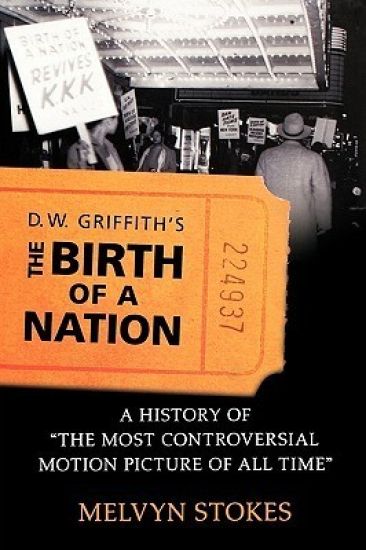
In this deeply researched and vividly written volume, Melvyn Stokes illuminates the origins, production, reception and continuing history of this ground-breaking, aesthetically brilliant, and yet highly controversial movie landmark. By going back to the original archives, particularly the NAACP and D. W. Griffith Papers, Stokes explodes many of the myths surrounding The Birth of a Nation (1915). Yet the story that remains is fascinating: the longest American film of its time, Griffith's film incorporated many new features, including the first full musical score compiled for an American film. It was distributed and advertised by pioneering methods that would quickly become standard. Through the high prices charged for admission and the fact that it was shown, at first, only in "live" theaters with orchestral accompaniment, Birth played a major role in reconfiguring the American movie audience by attracting more middle-class patrons. But if the film was a milestone in the history of cinema, it was also undeniably racist. Stokes shows that the darker side of this classic movie has its origins in the racist ideas of Thomas Dixon, Jr. and Griffith's own Kentuckian background and earlier film career. The book reveals how, as the years went by, the campaign against the film became increasingly successful. In the 1920s, for example, the NAACP exploited the fact that the new Ku Klux Klan, which used Griffith's film as a recruiting and retention tool, was not just anti-black, but also anti-Catholic and anti-Jewish, as a way to mobilize new allies in opposition to the film. This crisply written book sheds light on both the film's racism and the aesthetic brilliance of Griffith's filmmaking. It is a must-read for anyone interested in the cinema.
In this deeply researched and vividly written volume, Melvyn Stokes illuminates the origins, production, reception and continuing history of this ground-breaking, aesthetically brilliant, and yet highly controversial movie. By going back to the original archives, particularly the NAACP and D. W. Griffith Papers, Stokes explodes many of the myths surrounding The Birth of a Nation (1915). Yet the story that remains is fascinating: the longest American film of its time, Griffith's film incorporated many new features, including the first full musical score compiled for an American film. It was distributed and advertised by pioneering methods that would quickly become standard. Through the high prices charged for admission and the fact that it was shown, at first, only in "live" theaters with orchestral accompaniment, Birth played a major role in reconfiguring the American movie audience by attracting more middle-class patrons. But if the film was a milestone in the history of cinema, it was also undeniably racist. Stokes shows that the darker side of this classic movie has its origins in the racist ideas of Thomas Dixon, Jr. and Griffith's own Kentuckian background and earlier film career. The book reveals how, as the years went by, the campaign against the film became increasingly successful. In the 1920s, for example, the NAACP exploited the fact that the new Ku Klux Klan, which used Griffith's film as a recruiting and retention tool, was not just anti-black, but also anti-Catholic and anti-Jewish, as a way to mobilize new allies in opposition to the film. This crisply written book sheds light on both the film's racism and the aesthetic brilliance of Griffith's filmmaking. It is a must-read for anyone interested in the cinema.

D.W. Griffith and the Origins of American Narrative Film
Tom Gunning
University of Illinois Press
1993
nidottu
The legendary filmmaker D. W. Griffith directed nearly 200 films during 1908 and 1909, his first years with the Biograph Company. While those one-reel films are a testament to Griffith's inspired genius as a director, they also reflect a fundamental shift in film style from "cheap amusements" to movie storytelling complete with characters and narrative impetus. In this comprehensive historical investigation, drawing on films preserved by the Library of Congress and the Museum of Modern Art, Tom Gunning reveals that the remarkable cinematic changes between 1900 and 1915 were a response to the radical reorganization within the film industry and the evolving role of film in American society. The Motion Picture Patents Company, the newly formed Film Trust, had major economic aspirations. The newly emerging industry's quest for a middle-class audience triggered Griffith's early experiments in film editing and imagery. His unique solutions permanently shaped American narrative film.
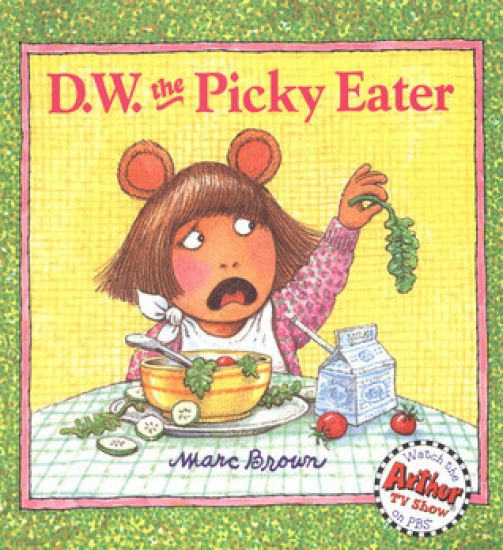
There's a whole slew of edibles that D.W. finds disgusting, but spinach is at the top of her list. Dining out with her family, she causes a scene when her parents suggest that she give her salad greens a try - no more restaurants for the picky little aardvark after that. Staying home with a sitter is boring, though, so when she hears about her grandmother's birthday dinner at a fancy restaurant, she wants to come, too. She orders the Little Bo Peep Pot Pie, devours it with relish, amazing everybody, including herself, and learns a lesson. The text is spare and funny, and while all the coloured-pencil illustrations reflect Brown's sense of humour and familiarity with the little details of childhood, some are downright hilarious. Charming endpapers feature some of the foods D.W. loves to hate. Although she wears an expression of pure horror when she discovers the main ingredient of her pie, readers will suspect that she'll keep that delicious spinach down and her mind and mouth open to new eating possibilities in the future.

A distillation of painstaking research into the life of Donald Winnicott, tracing his life from his childhood in Plymouth, through his career in paediatrics, to his election as President of the British Psycho-Analytic Society. The author makes many interesting links between Winnicott's life and the development of his theories.


A critical study of the background of D.W. Griffith's film masterpiece, the 1916 epic Intolerance. The most expensive ($2,000,000) film made prior to 1920, Intolerance was critically acclaimed and is now considered a classic. The book traces the artistic and political influences that shaped the director's vision, discusses the influences of the Progressive movement, and connects the film to the social and political climate of the early 20th century.

`The importance of Michael Jacobs' book lies in his attempt to convey... Winnicott's profound influence.... Jacobs rightly delights in the creativity and imagination of his subject and illustrates these with numerous quotations and descriptions from Winnicott's writings.... What is conveyed throughout the book is the essence of Winnicott.... [whose] gift was to make psychoanalytic language, methods and concepts more widely available, accepted and appreciated to a nonpsychoanalytic world' - British Psychological Society Counselling Psychology Review One of the best-known British psychoanalysts, D W Winnicott attracts the interest of counsellors and psychotherapists far beyond the strict psychoanalytic tradition in which he was trained. He coined many phrases that have entered the discourse of therapy, such as `good enough mother', `transitional object' and `facilitating environment'. Winnicott has had a profound impact on research into the mother-baby relationship, and his unorthodox manner and sparkling writing style have attracted enthusiastic acclaim. In this book, Michael Jacobs summarizes Winnicott's life and explains his major theoretical concepts. He also rigorously evaluates his practice as a clinician - for example, the holding and management of deeply regressed patients. While highlighting Winnicott's brilliance and creativity, Jacobs is not afraid to scrutinize his contributions more critically. He also discusses criticisms others have made of Winnicott, notably within the psychoanalytic movement. The final chapter assesses the influence of Winnicott's thinking in other countries as well as in Britain.

"This magnificent and important biography...is the best ever written on the man." -The New Republic "Mr. Schickel's excellent and important biography makes it clear that when the movers of our century are tallied, D.W. Griffith, flawed genius that he was, can never lose his eminent position." -Peter Bogdanovich, The New York Times Book Review
![An Oration on the Death of Mr. Eli Kelsey, a Senior in Yale College. by D.W. Lewis. [Three Lines from Shakespeare].](/covers/9781170867273.jpg)
An Oration on the Death of Mr. Eli Kelsey, a Senior in Yale College. by D.W. Lewis. [Three Lines from Shakespeare].
D W Lewis
Gale Ecco, Print Editions
2010
pokkari
![A Texas Scrap-Book. Made up of the history, biography, and miscellany of Texas and its people. Compiled by D. W. C. Baker. [With plates, including portraits.]](/covers/9781241419769.jpg)
A Texas Scrap-Book. Made up of the history, biography, and miscellany of Texas and its people. Compiled by D. W. C. Baker. [With plates, including portraits.]
D W C Baker
British Library, Historical Print Editions
2011
pokkari
Title: A Texas Scrap-Book. Made up of the history, biography, and miscellany of Texas and its people. Compiled by D. W. C. Baker. With plates, including portraits.]Publisher: British Library, Historical Print EditionsThe British Library is the national library of the United Kingdom. It is one of the world's largest research libraries holding over 150 million items in all known languages and formats: books, journals, newspapers, sound recordings, patents, maps, stamps, prints and much more. Its collections include around 14 million books, along with substantial additional collections of manuscripts and historical items dating back as far as 300 BC.The GENERAL HISTORICAL collection includes books from the British Library digitised by Microsoft. This varied collection includes material that gives readers a 19th century view of the world. Topics include health, education, economics, agriculture, environment, technology, culture, politics, labour and industry, mining, penal policy, and social order. ++++The below data was compiled from various identification fields in the bibliographic record of this title. This data is provided as an additional tool in helping to insure edition identification: ++++ British Library Baker, D W. C.; 1875 xii. 657 p.; 8 . 10412.ee.8.