Kirjojen hintavertailu. Mukana 11 244 527 kirjaa ja 12 kauppaa.

Kirjahaku

Etsi kirjoja tekijän nimen, kirjan nimen tai ISBN:n perusteella.

390 tulosta hakusanalla DUGALD MACFADYEN

Elements of the Philosophy of the Human Mind. By Dugald Stewart, ... Volume Second. of 3; Volume 2
The 18th century was a wealth of knowledge, exploration and rapidly growing technology and expanding record-keeping made possible by advances in the printing press. In its determination to preserve the century of revolution, Gale initiated a revolution of its own: digitization of epic proportions to preserve these invaluable works in the largest archive of its kind. Now for the first time these high-quality digital copies of original 18th century manuscripts are available in print, making them highly accessible to libraries, undergraduate students, and independent scholars.The Age of Enlightenment profoundly enriched religious and philosophical understanding and continues to influence present-day thinking. Works collected here include masterpieces by David Hume, Immanuel Kant, and Jean-Jacques Rousseau, as well as religious sermons and moral debates on the issues of the day, such as the slave trade. The Age of Reason saw conflict between Protestantism and Catholicism transformed into one between faith and logic -- a debate that continues in the twenty-first century.++++The below data was compiled from various identification fields in the bibliographic record of this title. This data is provided as an additional tool in helping to insure edition identification: ++++British LibraryT101038Volume II is dated 1814 and was published at Edinburgh; volume III dated 1827 and published at London.London: printed for A. Strahan, and T. Cadell; and W. Creech, Edinburgh, 1792-1827. 3v.; 4
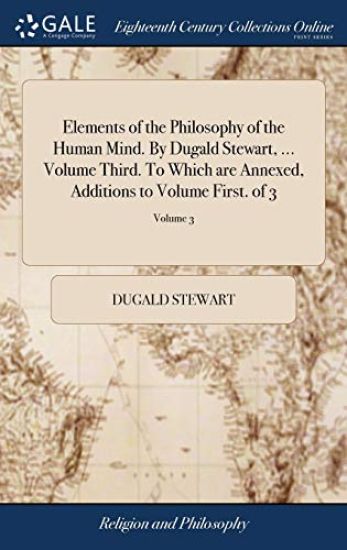
Elements of the Philosophy of the Human Mind. By Dugald Stewart, ... Volume Third. To Which are Annexed, Additions to Volume First. of 3; Volume 3
The 18th century was a wealth of knowledge, exploration and rapidly growing technology and expanding record-keeping made possible by advances in the printing press. In its determination to preserve the century of revolution, Gale initiated a revolution of its own: digitization of epic proportions to preserve these invaluable works in the largest archive of its kind. Now for the first time these high-quality digital copies of original 18th century manuscripts are available in print, making them highly accessible to libraries, undergraduate students, and independent scholars.The Age of Enlightenment profoundly enriched religious and philosophical understanding and continues to influence present-day thinking. Works collected here include masterpieces by David Hume, Immanuel Kant, and Jean-Jacques Rousseau, as well as religious sermons and moral debates on the issues of the day, such as the slave trade. The Age of Reason saw conflict between Protestantism and Catholicism transformed into one between faith and logic -- a debate that continues in the twenty-first century.++++The below data was compiled from various identification fields in the bibliographic record of this title. This data is provided as an additional tool in helping to insure edition identification: ++++British LibraryT101038Volume II is dated 1814 and was published at Edinburgh; volume III dated 1827 and published at London.London: printed for A. Strahan, and T. Cadell; and W. Creech, Edinburgh, 1792-1827. 3v.; 4
Dugald Stewart

Dugald Stewart

Dugald Stewart

Imprint Academic
2007
pokkari
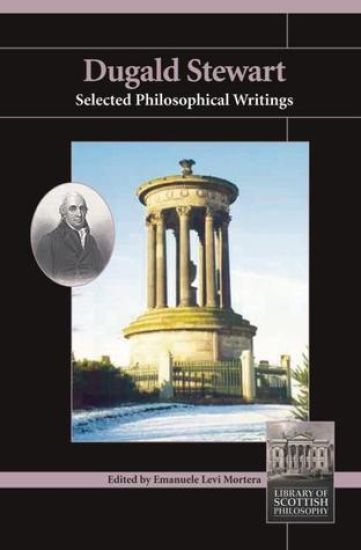
Dugald Stewart was appointed assistant professor of mathematics in the University of Edinburgh in 1772, aged only 19. He became one of the most influential academics in the eighteenth- and nineteenth-century European 'Republic of Letters'. Both Stewart’s contemporaries and modern scholars have recognised the impact his influential figure had over many young minds. He was one of the leading figures of the Scottish Common Sense school, a name by which we are used to identifying the philosophical tradition headed by Thomas Reid. The selection given here departs in some ways from Stewart’s own division of the subject, and aims to reflect the logical priority of each discipline, a priority which Stewart himself seems to give in the internal development of his ‘system’.
Dugald Stewart

Dugald Stewart

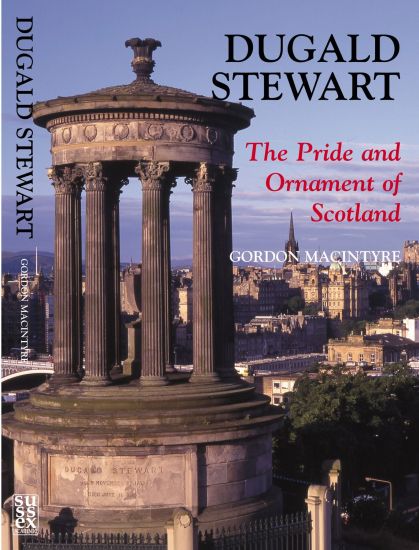
Gordon Macintyre

Sussex Academic Press
2003
sidottu
This book tells the personal story of Dugald Stewart (1753-1828), whose circular memorial monument on Calton Hill is one of Edinburgh's best known landmarks. Originally a mathematician like his father, Stewart held the Chair of Moral Philosophy at Edinburgh University for 25 years and became the most distinguished philosopher in Britain. He was a gifted teacher whose character and eloquence influenced students who were to become famous in many walks of life. Two of them became Prime Minister. A lifelong Whig, Stewart was in France at the outbreak of the French Revolution, and there knew Benjamin Franklin and Thomas Jefferson. He wrote biographical memoirs of Adam Smith and two other contemporaries. He gave Britain's first course on economics, attended by all four founder members of the 'Edinburgh Review', and his political, as well as his philosophical influence extended well into the 19th century. His wife was a generous hostess whose lively and amusing letters are quoted extensively in the book, and she and Stewart are shown to have been significant figures in the cultural life of the time.