Kirjojen hintavertailu. Mukana 11 244 527 kirjaa ja 12 kauppaa.

Kirjahaku

Etsi kirjoja tekijän nimen, kirjan nimen tai ISBN:n perusteella.

1000 tulosta hakusanalla Daniel F. Austin

The Moroccan Argan Trade

The Moroccan Argan Trade

Daniel F. Robinson

Routledge
2020
sidottu
This book provides one of the most detailed and comprehensive examinations of the Moroccan argan tree, the products derived from it and its cultural significance. The Moroccan argan trade is booming, but as the tree provides important ecological functions and plays an important role, both financially and culturally, for the Amazigh (Berber) people it has become a key topic of debate. This book thoroughly examines the production stories, benefits and impacts and provides a value-chain analysis which compares different cooperatives and approaches to production. It assesses the fair-trade approaches and attempts at sustainable production of the bio-trade resource. While being a vital source of income, the argan tree has a significant cultural importance to the Indigenous people and the book assesses the impact of the argan trade on their well-being, community and livelihoods. It examines Indigenous knowledge and intellectual property issues relating to the trade, as well as Berber-state law and politics. Assessing factors relating to legal and economic geography international trade, socio-cultural and human-nature relationships, the book provides a comprehensive analysis of the argan tree which will appeal to students, scholars and practitioners.
Curriculum Studies as an International Conversation

Curriculum Studies as an International Conversation

Daniel F. Johnson-Mardones

Routledge
2021
nidottu
Examining Curriculum Studies from an international perspective, this book focuses on the relations between the Anglo-Saxon and Latin American educational traditions. Informed by William F. Pinar’s conceptualization of curriculum as currere, Johnson-Mardones reconsiders curriculum as an international conversation and advances an intercultural dialogue among educational traditions to put forth a more comprehensive and inclusive theory of curriculum. Moving beyond the Anglo-Saxon space and into the Global South, Johnson-Mardones brings in his own non-Western educational experience to the center of this inquiry, and situates cosmopolitanism as a necessary but complex component of Curriculum Studies.
Subjectivity and the Reproduction of Imperial Power
This book brings forth a new contribution to the study of imperialism and colonial discourse by theorizing the emergence and function of individual identity as product and producer of imperial power. While recent decades of theoretical reflections on imperialism have yielded important understandings of how the West has repeatedly reconsolidated its power, this book seeks to grasp the complex role of subjectivity in reformulating the terms of imperial domination from early modern European expansion to late capitalism. This entails approaching Empire as a constantly shifting system of differences and meanings as well as an ontological project, a mode of historical writing, and economy of desire that repeatedly envelops the subject into the realm of western power. The analysis of an array of literary texts and cultural artifacts is undertaken by means of a theoretically eclectic approach – drawing on psychoanalysis, post-structuralism, postcolonial theory, and Marxism – with the aim of forwarding current knowledge of Empire while also contributing to different branches of critical theory. In exploring the formation of imperial subjectivity in different historical moments, Silva raises new questions related to the signification of otherness in European expansion and colonial settlement, slavery and eugenics in post-independence Americas, and late capitalist circulation of bodies and commodities. The volume also covers a broad range of geo-cultural spaces in order to locate western power in time and space. This book’s diversity in terms of approach, historical scope, and cultural contexts makes it a useful tool for research and teaching among students and scholars of disciplines including Postcolonial Studies, Colonial History, Literature, and Globalization.
Pediatric Psychopharmacology

Pediatric Psychopharmacology

Daniel F. Connor; Bruce M. Meltzer

WW Norton Co
2006
nidottu
This new title in the Fast Facts series, full of up-to-date and authoritative information, is a critical resource for all health care professionals working with children and adolescents.Psychiatrists, prescribing psychologists, psychotherapists, pediatricians, family practice physicians, pediatric neurologists, nurse practitioners, allied mental health professionals, and trainees in these professions are provided with: General introductory reviews of the principles of pediatric psychopharmacology and related patient assessment issues;Detailed discussions of psychiatric medications organized by drug class;A comprehensive review of child and adolescent psychiatric disorders.Rich background information and clear explanations of clinical directions for the prescriber and nonprescriber alike. Authored by two child and adolescent psychiatrists, Pediatric Psychopharmacology provides empirically-based, state-of-the-art knowledge as well as clear practical guidance regarding assessment, prescription, monitoring, and discontinuation of medications.
Biodiversity, Access and Benefit-Sharing

Biodiversity, Access and Benefit-Sharing

Daniel F. Robinson

Routledge
2014
sidottu
The Nagoya Protocol to the Convention on Biological Diversity (CBD) is rapidly receiving signatures and ratifications. Many countries are preparing to implement the protocol through national research permit systems and/or biodiversity laws. Yet there is still considerable confusion about how to implement the Protocol, regarding access and benefit-sharing (ABS) procedures, and minimal experience in many countries. This book seeks to remedy this gap in understanding by analysing a number of ABS case studies in light of the Nagoya Protocol. The case studies are wide-ranging, with examples of plants for medicinal, cosmetic, biotech and food products from or for development in Australia, North Africa, Madagascar, Switzerland, Thailand, USA and Oceania. These will encourage countries to develop national systems which maximise their benefits (both monetary and non-monetary) towards conservation and support for local communities that hold traditional knowledge. In addition, the author analyses new expectations raised by the Nagoya Protocol, such as the encouragement of the development of community protocols by indigenous and local communities. As a result, stakeholders and policy-makers will be able to learn the steps involved in establishing ABS agreements, issues that arise between stakeholders, and the types of benefits that might be realistic.
The United Front

The United Front

Daniel F. Calhoun

Cambridge University Press
2008
pokkari
The book concerns the Soviet effort during the 1920s to make contact with - and if possible revolutionize - the European labour movement, by first establishing a special relationship with the British Trades Union Congress. The ultimate failure of that effort, after the collapse of the general strike in 1926, inspired Trotsky to try one last time to oust Stalin, a confrontation that led to utter collapse of the Trotskyite opposition in 1927–28. The author suggests the failure of this particular 'united front' effort was a major factor in the sectarianism and isolationism of the Communist movement from 1928 to 1934, and thus had a significant affect on the rise of the Nazi party in Germany.
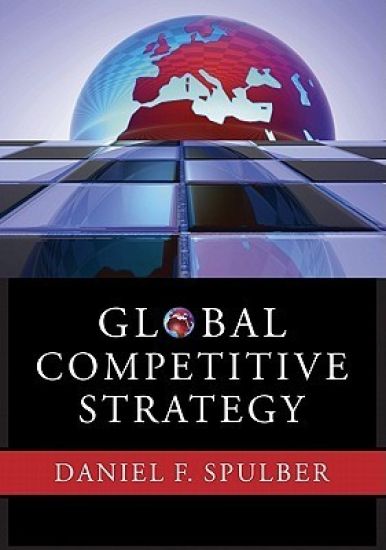
Global Competitive Strategy

Global Competitive Strategy

Daniel F. Spulber

Cambridge University Press
2011
pokkari
Globalization has fundamentally changed the game of business. Strategic frameworks developed for the analysis of purely domestic business necessarily fall short in the international business context. Managers and business students require alternative approaches to understand and cope with these far-reaching changes. We must learn to think globally in order to succeed. Global Competitive Strategy shows how we can do this by providing a unique set of strategic tools for international business. Such tools include the 'star analysis' that allows strategy makers to integrate geographic information with market information about the global business environment. Also introduced is the 'global value connection' that shows managers how to account for the gains from trade and the costs of trade. Aimed at MBA students taking courses in international strategy, consultants and practising managers with responsibility for strategic development, this 2007 book offers a comprehensive strategic framework for gaining competitive advantage in the global marketplace.
The Theory of the Firm

The Theory of the Firm

Daniel F. Spulber

Cambridge University Press
2009
sidottu
The Theory of the Firm presents a path-breaking general framework for understanding the economics of the firm. The book addresses why firms exist, how firms are established, and what contributions firms make to the economy. The book presents a new theoretical analysis of the foundations of microeconomics that makes institutions endogenous. Entrepreneurs play a central economic role by establishing firms. In turn, firms create and operate markets and organizations. The book provides innovative models of economic equilibrium that endogenously determine the structure and function of economic institutions. The book proposes an 'intermediation hypothesis' - the establishment of firms depends on the effects of transaction costs and on the extent of the market.
Market Microstructure

Market Microstructure

Daniel F. Spulber

Cambridge University Press
1999
sidottu
This book presents a theory of the firm based on its economic role as an intermediary between customers and suppliers. Professor Spulber demonstrates how the intermediation theory of the firm explains firm formation by showing how they arise in a market equilibrium. In addition, the theory helps explain how markets work by showing how firms select market-clearing prices. Models of intermediation and market microstructure from microeconomics and finance shed considerable light on the formation and market-making activities of firms. The intermediation theory of the firm is compared to existing economic theories of the firm including the neoclassical, industrial organization, transaction cost, and principal-agent models.
The Strange World of Quantum Mechanics

The Strange World of Quantum Mechanics

Daniel F. Styer

Cambridge University Press
2000
sidottu
This is an exceptionally accessible, accurate, and non-technical introduction to quantum mechanics. After briefly summarizing the differences between classical and quantum behaviour, this engaging account considers the Stern-Gerlach experiment and its implications, treats the concepts of probability, and then discusses the Einstein-Podolsky-Rosen paradox and Bell's theorem. Quantal interference and the concept of amplitudes are introduced and the link revealed between probabilities and the interference of amplitudes. Quantal amplitude is employed to describe interference effects. Final chapters explore exciting new developments in quantum computation and cryptography, discover the unexpected behaviour of a quantal bouncing-ball, and tackle the challenge of describing a particle with no position. Thought-provoking problems and suggestions for further reading are included. Suitable for use as a course text, The Strange World of Quantum Mechanics enables students to develop a genuine understanding of the domain of the very small. It will also appeal to general readers seeking intellectual adventure.
The Strange World of Quantum Mechanics

The Strange World of Quantum Mechanics

Daniel F. Styer

Cambridge University Press
2000
pokkari
This is an exceptionally accessible, accurate, and non-technical introduction to quantum mechanics. After briefly summarizing the differences between classical and quantum behaviour, this engaging account considers the Stern-Gerlach experiment and its implications, treats the concepts of probability, and then discusses the Einstein-Podolsky-Rosen paradox and Bell’s theorem. Quantal interference and the concept of amplitudes are introduced and the link revealed between probabilities and the interference of amplitudes. Quantal amplitude is employed to describe interference effects. Final chapters explore exciting new developments in quantum computation and cryptography, discover the unexpected behaviour of a quantal bouncing-ball, and tackle the challenge of describing a particle with no position. Thought-provoking problems and suggestions for further reading are included. Suitable for use as a course text, The Strange World of Quantum Mechanics enables students to develop a genuine understanding of the domain of the very small. It will also appeal to general readers seeking intellectual adventure.
The Theory of the Firm

The Theory of the Firm

Daniel F. Spulber

Cambridge University Press
2009
pokkari
The Theory of the Firm presents a path-breaking general framework for understanding the economics of the firm. The book addresses why firms exist, how firms are established, and what contributions firms make to the economy. The book presents a new theoretical analysis of the foundations of microeconomics that makes institutions endogenous. Entrepreneurs play a central economic role by establishing firms. In turn, firms create and operate markets and organizations. The book provides innovative models of economic equilibrium that endogenously determine the structure and function of economic institutions. The book proposes an 'intermediation hypothesis' - the establishment of firms depends on the effects of transaction costs and on the extent of the market.
Networks in Telecommunications

Networks in Telecommunications

Daniel F. Spulber; Christopher S. Yoo

Cambridge University Press
2009
sidottu
Networks in Telecommunications addresses fundamental issues in discussions of regulatory policy by offering an integrated framework for understanding the economics and law of networks. It extends theories on network design associated with the mathematics of graph theory, which provides insights into the complex, systemic interrelationship between network components. It also applies the principles of transaction cost economics to analyze decisions about the appropriate boundaries of proprietary network architecture. The book introduces network theory to the study of the economics and law of telecommunications. The discussion opens up the black box of the cost function in telecommunications. The analysis also goes beyond the 'network externalities' approach that focuses primarily on the size of networks. The book highlights the effects of network architecture and the tradeoffs inherent in network design.
Global Competitive Strategy

Global Competitive Strategy

Daniel F. Spulber

Cambridge University Press
2007
sidottu
Globalization has fundamentally changed the game of business. Strategic frameworks developed for the analysis of purely domestic business necessarily fall short in the international business context. Managers and business students require alternative approaches to understand and cope with these far-reaching changes. We must learn to think globally in order to succeed. Global Competitive Strategy shows how we can do this by providing a unique set of strategic tools for international business. Such tools include the 'star analysis' that allows strategy makers to integrate geographic information with market information about the global business environment. Also introduced is the 'global value connection' that shows managers how to account for the gains from trade and the costs of trade. Aimed at MBA students taking courses in international strategy, consultants and practising managers with responsibility for strategic development, this 2007 book offers a comprehensive strategic framework for gaining competitive advantage in the global marketplace.
Business Wargaming

Business Wargaming

Daniel F. Oriesek; Jan Oliver Schwarz

Gower Publishing Ltd
2008
sidottu
Industry consolidation, mergers, changes to business models, the emergence of new threats all require managers to understand highly complex situations, assess risk and opportunity and make informed decisions. How can senior managers do this effectively when so often they are wrestling with brand new scenarios? One of the emerging solutions is business wargaming. Daniel F. Oriesek and Jan Oliver Schwarz provide the first comprehensive look at wargaming as a business tool in a book that explores the anatomy and success factors of a typical wargame. The authors explain how and when wargaming can be used to test strategies, plan and prepare for crises, manage change or increase your organization's ability to anticipate and adapt for the future. Creating imaginative and credible scenarios, and testing them against smart opponents who are eager to find holes and counter your strategy, allows you to learn about a plan or a new venture in the security of the conference room rather than learning the hard way when you go live. Business wargames are sophisticated but they are also very demanding in terms of time and resources. Business Wargaming: Securing Corporate Value will enable you to assess the potential value of the technique for your own organization, to understand what you will be committing to and develop an informed business case and brief for working with the organization that will facilitate the game.
Jesus, an Emerging Jewish Mosaic

Jesus, an Emerging Jewish Mosaic

Daniel F. Moore

T. T.Clark Ltd
2008
sidottu
Since Martin Buber in Two Types of Faith acknowledged Jesus as his "great brother," other Jewish writers have sought to ascertain a place for Jesus within the larger context of Jewish history. In the aftermath of the Shoah, specifically in the afflicted consciousness of humanity, Jew and Christian alike began to ask how this tragedy could have happened, especially among and against people of faith. In an effort to assure that such a tragedy never happens again, the focus of some fell upon Jesus, previously the obstacle to reconciliation, but now perceived as the obvious and most viable bridge to span the chasm and assuage the wound of anti-Jewish and anti-Christian sentiments. Still others chose to join and expand the academic quest for the historical Jesus, adding Jewish voices to the effort to explore more rigorously and objectively the figure of Jesus in historical writing. In this unique and illuminating volume, Father Daniel F. Moore presents the historical identity of Jesus through lens of such Jewish scholars as Schalom Ben-Chorin, David Flusser, Geza Vermes, and Jacob Neuser. A useful book for those interesting in ecumenical discourse and Jesus studies.
Jesus, an Emerging Jewish Mosaic

Jesus, an Emerging Jewish Mosaic

Daniel F. Moore

T. T.Clark Ltd
2011
nidottu
Since Martin Buber in Two Types of Faith acknowledged Jesus as his "great brother," other Jewish writers have sought to ascertain a place for Jesus within the larger context of Jewish history. In the aftermath of the Shoah, specifically in the afflicted consciousness of humanity, Jew and Christian alike began to ask how this tragedy could have happened, especially among and against people of faith. In an effort to assure that such a tragedy never happens again, the focus of some fell upon Jesus, previously the obstacle to reconciliation, but now perceived as the obvious and most viable bridge to span the chasm and assuage the wound of anti-Jewish and anti-Christian sentiments. Still others chose to join and expand the academic quest for the historical Jesus, adding Jewish voices to the effort to explore more rigorously and objectively the figure of Jesus in historical writing. In this unique and illuminating volume, Father Daniel F. Moore presents the historical identity of Jesus through lens of such Jewish scholars as Schalom Ben-Chorin, David Flusser, Geza Vermes, and Jacob Neuser. A useful book for those interesting in ecumenical discourse and Jesus studies.