Kirjojen hintavertailu. Mukana 11 342 296 kirjaa ja 12 kauppaa.

Kirjahaku

Etsi kirjoja tekijän nimen, kirjan nimen tai ISBN:n perusteella.

1000 tulosta hakusanalla Daniel M. Davis

Nominations of Luis A. Aguilar, Daniel M. Gallagher, Jr., Anthony Frank D'Agostino, and Gregory S. Karawan

Nominations of Luis A. Aguilar, Daniel M. Gallagher, Jr., Anthony Frank D'Agostino, and Gregory S. Karawan

United States Senate; Committee on Banking; United States Congress

Createspace Independent Publishing Platform
2017
nidottu
Nominations of Luis A. Aguilar, Daniel M. Gallagher, Jr., Anthony Frank D'Agostino, and Gregory S. Karawan: hearing before the Committee on Banking, Housing, and Urban Affairs, United States Senate, One Hundred Twelfth Congress, first session, on nominations of Luis A. Aguilar, of Georgia, to be a member, Securities and Exchange Commission; Daniel M. Gallagher, Jr.,
Can Your Heart Stand the Shocking Facts? by Dr. Brentwood Masterling, M.F.A., D.V.M., Ph. D.
(a parody by Daniel M. Kimmel)Daniel M. Kimmel has made us think about film as the veteran critic who wrote the Hugo finalist Jar Jar Binks Must Die... and other observations about science fiction movies. He's made us laugh as the author of Shh It's a Secret: a novel about aliens, Hollywood, and the Bartender's Guide, Time on My Hands: My Misadventures in Time Travel, and Father of the Bride of Frankenstein. Now, for the first time anywhere, in the guise of his pompous alter ego Dr. Brentwood Masterling, M.F.A., D.V.M., Ph. D., he gets to do both.Can Your Heart Stand the Shocking Facts? is indeed a "deep dive" into the world of director Edward D. Wood, Jr.'s Golden Turkey Award winner for Worst Film, Plan 9 from Outer Space. In it, Dr. Masterling provides an annotated complete transcript of the movie, along with an essay about Wood, and several questions for further discussion. Herein you'll learn how star Bela Lugosi cleverly died before the film was even made, and how Plan 1 had been to bring a gift basket to Earth. Is any of it true? As the Amazing Criswell asks in the film's stirring climax, "Can you prove that it didn't happen?"
Dear Prudence: Liberating Lessons from Slate.Com's Beloved Advice Column
Based on the long-running Slate advice column, a collection of the most eye-opening, illuminating, and provocative installments during Daniel M. Lavery's tenure as the titular Prudence.Every week, millions of readers visit Slate for the irresistible "Dear Prudence," an advice column that promises a healthy dose of reality and good humor alongside its indispensable suggestions and life lessons. The ever-hilarious and insightful Danny Lavery was one of "Dear Prudence"'s most beloved columnists, and he recounts his time as Prudie in this side-splitting, candid collection--complete with new commentary and exclusive stories--drawing out the broader themes of his informative, unfailingly illuminating guidance. From guilt and blame ("Am I in the Wrong Here?") to downright confusion ("Maybe This Is All a Misunderstanding"), from recently discovered wrenches-in-the-machine ("The Other Shoe Just Dropped") to the travails of parenthood ("My Kids Are Growing Up. Can Someone Please Stop This?"), Dear Prudence isn't afraid to go the extra mile in its search for the much-needed corrective, gentle reminder, or tough love. This is the go-to guide for anyone who's just trying to figure it all out--with a helpful nudge.
Women's Hotel

Women's Hotel

Daniel M. Lavery

Harpervia
2024
sidottu
National BestsellerONE OF FALL'S MOST ANTICIPATED READS--New York Times, Vulture, BookPage, Kirkus Reviews, and moreFrom the New York Times bestselling author and advice columnist, a poignant and funny debut novel about the residents of a women's hotel in 1960s New York City.The Biedermeier might be several rungs lower on the ladder than the real-life Barbizon, but its residents manage to occupy one another nonetheless. There's Katherine, the first-floor manager, lightly cynical and more than lightly suggestible. There's Lucianne, a workshy party girl caught between the love of comfort and an instinctive bridling at convention, Kitty the sponger, Ruth the failed hairdresser, and Pauline the typesetter. And there's Stephen, the daytime elevator operator and part-time Cooper Union student.The residents give up breakfast, juggle competing jobs at rival presses, abandon their children, get laid off from the telephone company, attempt to retrain as stenographers, all with the shared awareness that their days as an institution are numbered, and they'd better make the most of it while it lasts.As trenchant as the novels of Dawn Powell and Rona Jaffe and as immersive as The Marvelous Mrs. Maisel and Lessons in Chemistry, Women's Hotel is a modern classic--and it is very, very funny.
Meeting New People

Meeting New People

Daniel M. Lavery

Harpervia
2026
sidottu
From the author of the national bestseller Women's Hotel, the irresistible and wildly entertaining story of one woman contending with age and friendship--a narrative that reads like an homage to Nora Ephron's Heartburn. Sixtysomething, twice-divorced Barbara is at a crossroads. In the midst of her emotional uncertainty, she looks back on the dissolution of the nine best friendships of her life, in hopes of figuring out how to optimize finding her tenth, and hopefully last, best friend. Barbara is acerbic, opinionated, and wrong about many things, but she also doesn't shy away when she's at fault. The turning point of her predicament comes from Barbara's choice, in friends, between (too-young) Caitlyn and the (unsuitable) Other Barbara. Will she repeat the exciting mistakes of the past, or will she try a new kind of mistake for a change? She feels like an out-of-season Scrooge who is unexpectedly, and all at once, surprised and entirely transformed by the possibility of joy. For readers who loved Bobby Finger's The Old Place and Elif Bautmann's Either/Or, Meeting New People will feel like a long-lost companion--Lavery at the height of his storytelling powers. It is an unforgettable novel from one of our most inventive and brilliant writers.
Christmas at the Women's Hotel: A Biedermeier Story
New York Times bestselling author Daniel M. Lavery returns to the world of Women's Hotel in this delightful and heartwarming novella about one especially lively Christmastime at the Biedermeier. Christmas at the Biedermeier Hotel means work. For much of the year, employment comes infrequently to Biedermeier residents. But during the Advent season, they're in high demand all over the city: as holiday window dressers, sales-girls at the card stores on Forty-Second Street, Broadway usherettes, assisting the Lincoln Center laundress at the Nutcracker, or working for Pinkerton as off-season security guards at the World's Fair.Katherine explores the possibility of reconnecting with a younger sister moving to New York. Lucianne goes into business for herself, running a telephone-order, strictly Social Register male escort agency out of her room, while Mrs. Mossler attempts to solve the mystery of the Biedermeier's skyrocketing phone bill and frets over Christmas tips for the hotel's few remaining employees.And while the three gem thieves who broke into the American Museum of Natural History have recently been apprehended, not all of the stolen jewels have been recovered--and Patricia and Carol have been behaving very strangely recently. Christmas is a season of wonder and mystery, after all.
Calculus of Thought

Calculus of Thought

Daniel M Rice

Academic Press Inc
2013
sidottu
Calculus of Thought: Neuromorphic Logistic Regression in Cognitive Machines is a must-read for all scientists about a very simple computation method designed to simulate big-data neural processing. This book is inspired by the Calculus Ratiocinator idea of Gottfried Leibniz, which is that machine computation should be developed to simulate human cognitive processes, thus avoiding problematic subjective bias in analytic solutions to practical and scientific problems. The reduced error logistic regression (RELR) method is proposed as such a "Calculus of Thought." This book reviews how RELR's completely automated processing may parallel important aspects of explicit and implicit learning in neural processes. It emphasizes the fact that RELR is really just a simple adjustment to already widely used logistic regression, along with RELR's new applications that go well beyond standard logistic regression in prediction and explanation. Readers will learn how RELR solves some of the most basic problems in today’s big and small data related to high dimensionality, multi-colinearity, and cognitive bias in capricious outcomes commonly involving human behavior.
Energy Efficiency

Energy Efficiency

Daniel M. Martinez; Ben W. Ebenhack; Travis P. Wagner

Elsevier Science Publishing Co Inc
2019
nidottu
Energy Efficiency: Concepts and Calculations is the first book of its kind to provide an applied, systems oriented description of energy intensity and efficiency in modern economies across the entire energy chain. With an emphasis on analysis, specifically energy flow analysis, lifecycle energy accounting, economic analysis, technology evaluation, and policies/strategies for adopting high energy efficiency standards, the book provides a comprehensive understanding of the concepts, tools and methodologies for studying and modeling macro-level energy flows through, and within, key economic sectors (electric power, industrial, commercial, residential and transportation). Providing a technical discussion of the application of common methodologies (e.g. cost-benefit analysis and lifecycle assessment), each chapter contains figures, charts and examples from each sector, including the policies that have been put in place to promote and incentivize the adoption of energy efficient technologies.
MyPoliSciLab Pegasus with Pearson eText -- Instant Access -- for Living Democracy
NEW! MyPoliSciLab, also available in Blackboard and WebCT platforms. MyPoliSciLab is an easy-to-use online resource that allows instructors to assess student progress and adapt course material to meet the specific needs of the class. MyPoliSciLab enables students to diagnose their progress by completing an online self-assessment test. Based on the results of this test, each student is provided with a customized study plan, including a variety of tools to help them fully master the material. MyPoliSciLab then reports the self-assessment results to the instructor, as individual student grades as well as an aggregate report of class progress. Based on these reports, the instructor can adapt course material to suit the needs of individual students or the class as a whole. Additionally, MyPoliSciLab offers the major resources for Living Democracy–including Faculty Resource PowerPoint presentations, Make It Real online resources, and ABC News video clips–in one convenient location. URL: www.prenhall.com/mypoliscilab
Valuing Health

Valuing Health

Daniel M. Hausman

Oxford University Press Inc
2015
sidottu
In Valuing Health Daniel M. Hausman provides a philosophically sophisticated overview of generic health measurement that suggests improvements in standard methods and proposes a radical alternative. He shows how to avoid relying on surveys and instead evaluate health states directly. Hausman goes on to tackle the deep problems of evaluation, offering an account of fundamental evaluation that does not presuppose the assignment of values to the properties and consequences of alternatives. After discussing the purposes of generic health measurement, Hausman defends a naturalistic concept of health and its relations to measures such as quality-adjusted life-years (QALYs) and disability-adjusted life years (DALYs). In examining current health-measurement systems, Valuing Health clarifies their value commitments and the objections to relying on preference surveys to assign values to health states. Relying on an interpretation of liberal political philosophy, Hausman argues that the public value of health states should be understood in terms of the activity limits and suffering that health states impose. Hausman also addresses the moral conundrums that arise when policy-makers attempt to employ the values of health states to estimate the health benefits of alternative policies and to adopt the most cost-effective. He concludes with a general discussion of the difficulties of combining consequentialist and non-consequentialist moral considerations in policy-making.
Fantasies of Flight

Fantasies of Flight

Daniel M. Ogilvie

Oxford University Press Inc
2004
sidottu
Fantasies of Flight invigorates the field of personality psychology by challenging the contemporary academic view that individuals are best studied as carriers of traits. Daniel Ogilvie exchanges a heart-to-heart, case study approach to understanding human behaviour for the current strategies of categorizing and comparing individuals according to their manifest traits. Ogilvie asks and endeavours to answer questions like "What were the psychological conditions that led Sir James Barrie to create a character named Peter Pan?", and "What were the dynamics behind the Marshall Herff Applewhite's conviction that a space ship, hiding behind the Hale-Bopp comet, would rescue him and his Heaven's Gate followers after they enacted a mass suicide pact in 1997?" Answering these questions requires him to resurrect 'old' ways to think about personality and 'old' strategies for studying individuals one by one. Early in the book, Ogilvie reviews the history of why intensive case studies were discredited in psychology and describes how Sigmund Freud's psychobiographical account of Leonardo da Vinci's fascination with flight inadvertently abetted critics of psychoanalytic psychology. He then performs a partial psychobiography of James Barrie and the origins of Peter Pan, followed by an investigation of Carl Jung, who fashioned the collective unconscious to serve as humankind's link to eternity. Arguing that personality psychology needs to become less insular, Ogilvie integrates information from the disciplines of developmental psychology and neuroscience into a theory regarding the latent needs that both Barrie and Jung sought to satisfy. The theory, including its emphasis on the onset of self and consciousness, is then applied to an array of well-known and obscure individuals with ascensionistic inclinations. Well written and accessible, but complex and scholarly, this volume will restore interest in the investigation of people's inner lives.
Psychological and Psychiatric Issues in Patients with Chronic Pain
Part of the What Do I Do Now? Pain Medicine series, Psychological and Psychiatric Issues in Patients with Chronic Pain presents a variety of succinct case studies and "curb-side" consults on the complexity of chronic pain and its successful management. Chapters present models for understanding issues related to chronic pain within a psycho-social context, including cases on specific psychological or psychiatric issues, as well as broad considerations such as selecting among behavioral therapies options and the use of complementary therapies and non-opioid analgesics. Recognizing that most clinicians do not always have the time or resources to conduct the type of psychological assessment that each case may require, chapters focus on the key elements of each diagnosis, covering background information, assessment approach, treatment recommendations, and key points to remember.
How Health Care Can Be Cost-Effective and Fair

How Health Care Can Be Cost-Effective and Fair

Daniel M. Hausman

OXFORD UNIVERSITY PRESS INC
2023
sidottu
Methods designed to guide the allocation of healthcare so as to maximize population health have been criticized as fundamentally unfair. In a closer analysis of this ethical critique of the use of cost-effectiveness author Daniel M. Hausman responds to the main complaints about the unfairness of cost-effectiveness, while also recognizing that there should be other factors--especially in cases of discrimination--guiding health-related treatment. Central to How Health Care Can Be Cost-Effective and Fair is whether cost-effective allocation of healthcare violates ethical constraints. Several commentators argue that using cost-effective reasoning to guide the distribution of healthcare is fundamentally unfair, not just because it does not take distribution into account, but because it fails to prioritize the severity of illness and fails to give everyone, and especially disabled people and those from historically underprivileged populations, a fair chance of being treated. While Hausman recognizes the complexity and shortcomings of cost-effective reasoning, he maintains that it should be a leading principle in the allocation of health-related resources. In Hausman's view, many values--such as compassion, freedom, respect, and solidarity should govern healthcare in addition to promoting well-being and treating individuals fairly. In its efforts to promote population health fairly, healthcare should respond to and respect individuals' values and choices.
Pain: Dynamics and Complexities

Pain: Dynamics and Complexities

Daniel M. Doleys

Oxford University Press Inc
2014
sidottu
Despite the proliferation of pain clinics and various pain-oriented therapies, there is an absence of data supporting any substantial change in the statistics regarding the incidence, development and persistence of pain. As renowned pain clinician and scientist Daniel M. Doleys argues, there may be a need for a fundamental shift in the way we view pain. In this thoughtful work, Doleys presents the evolving concept and complex nature of pain with the intention of promoting a broadening of the existing paradigm within which pain is viewed and understood. Combining neuroscience, psychology, and philosophy of science, this book reviews the history of pain and outlines the current concepts and theories regarding the mechanisms involved in the experience of pain. Experimental and clinical research in a broad array of areas including neonatal pain, empathy and pain, psychogenic pain, and genetics and pain is summarized. The notion of pain as a disease process rather than a symptom is highlighted. Although there is a continued interest in activation of the peripheral nociceptive system as a determining factor in the experience of pain, the growing appreciation for the brain as the intimate 'pain generator' is emphasized. The definition of consciousness and conscious awareness and a theory as to how it relates to nociceptive processing is discussed. Finally, the author describes the potential benefit of incorporating some of the concepts from systems and quantum theory into our thinking about pain. The area of pain research and treatment seems on the precipice of change. This work intends to provide a glimpse of what these changes might be in the context of where pain research and therapy has come from, where it currently is, and where it might be headed.
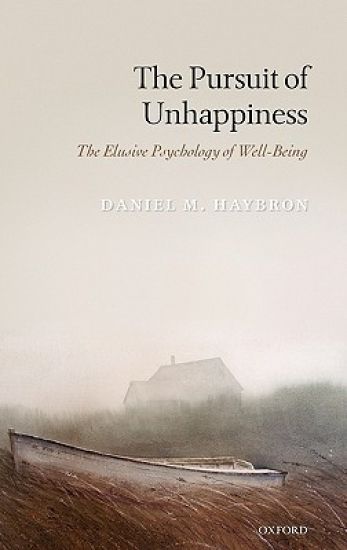
The Pursuit of Unhappiness

The Pursuit of Unhappiness

Daniel M. Haybron

Oxford University Press
2008
sidottu
The pursuit of happiness is a defining theme of the modern era. But what if people aren't very good at it? This and related questions are explored in this book, the first comprehensive philosophical treatment of happiness in the contemporary psychological sense. In these pages, Dan Haybron argues that people are probably less effective at judging, and promoting, their own welfare than common belief has it. For the psychological dimensions of well-being, particularly our emotional lives, are far richer and more complex than we tend to realize. Knowing one's own interests is no trivial matter. As well, we tend to make a variety of systematic errors in the pursuit of happiness. We may need, then, to rethink traditional assumptions about human nature, the good life, and the good society. Thoroughly engaged with both philosophical and scientific work on happiness and well-being, this book will be a definitive resource for philosophers, social scientists, policy makers, and other students of human well-being.
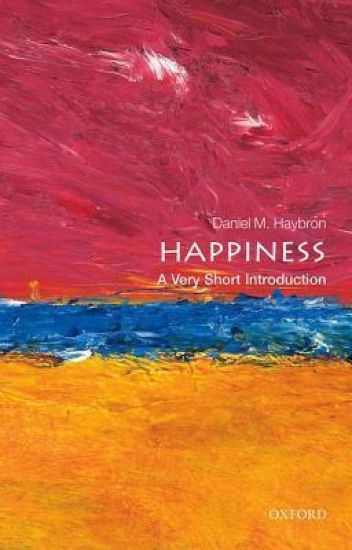
Happiness

Happiness

Daniel M. Haybron

Oxford University Press
2013
nidottu
Happiness is an everyday term in our lives, and most of us strive to be happy. But defining happiness can be difficult. In this Very Short Introduction, Dan Haybron considers the true nature of happiness. By examining what it is, assessing its importance in our lives, and how we can (and should) pursue it, he considers the current thinking on happiness, from psychology to philosophy. Illustrating the diverse routes to happiness, Haybron reflects on contemporary ideas about the pursuit of a good life and considers the influence of social context on our satisfaction and well-being. ABOUT THE SERIES: The Very Short Introductions series from Oxford University Press contains hundreds of titles in almost every subject area. These pocket-sized books are the perfect way to get ahead in a new subject quickly. Our expert authors combine facts, analysis, perspective, new ideas, and enthusiasm to make interesting and challenging topics highly readable.
The Pursuit of Unhappiness

The Pursuit of Unhappiness

Daniel M. Haybron

Oxford University Press
2010
nidottu
The pursuit of happiness is a defining theme of the modern era. But what if people aren't very good at it? That is the question posed by this book, the first comprehensive philosophical treatment of happiness, understood here as a psychological phenomenon. Engaging heavily with the scientific literature, Dan Haybron argues that people probably know less about their own welfare, and may be less effective at securing it, than common belief has it. This is largely because human nature is surprisingly ill-suited to the pursuit of happiness. For the happiness that counts for well-being is not a matter of what we think about our lives, but of the quality of our emotional conditions. Yet our emotional lives are remarkably difficult to grasp. Moreover, we make a variety of systematic errors in the pursuit of happiness. These considerations suggest that we should rethink traditional assumptions about the good life and the good society. For instance, the pursuit of happiness may be primarily a matter of social context rather than personal choice. This book offers an extensive guide to philosophical thinking about happiness and well-being, correcting serious misconceptions that have beset the literature. It will be a definitive resource for philosophers, social scientists, policymakers, and other students of well-being.