Kirjojen hintavertailu. Mukana 11 244 527 kirjaa ja 12 kauppaa.

Kirjahaku

Etsi kirjoja tekijän nimen, kirjan nimen tai ISBN:n perusteella.

1000 tulosta hakusanalla Daniel P. Todes

The Oxford Handbook of Evidence-Based Crime and Justice Policy

The Oxford Handbook of Evidence-Based Crime and Justice Policy

Daniel P. Mears

OXFORD UNIVERSITY PRESS INC
2024
sidottu
The need for and the threats to improved public policy are equally acute. Crime policy agenda continues to be driven by anecdotal evidence and political ideology, resulting in a patchwork of programs, policies, and practices. All-too-frequently, the need for them is uncertain, they rest on unclear theoretical foundations, they are implemented poorly, and their effectiveness in preventing or controlling crime, or furthering justice, is unknown. Putting research evidence at center-stage in political and policy decisions can go a long way to addressing this state of affairs by ensuring that the best available data informs decisions that affect the public good. Situated within this wider context, The Oxford Handbook of Evidence-Based Crime and Justice Policy showcases much of what is right with evidence-based crime and justice policy as well as confronts the challenges that it faces today and looking forward. Bringing together leading scholars and researchers in criminology, criminal justice, sociology, psychology, education, health, and the law, this handbook promotes new and productive ways to think about evidence-based policy, shows how research can contribute to and guide evidence-based policy in juvenile justice, criminal justice, and alternatives to system responses, and identifies strategies that can increase reliance on evidence-based policy. It is the most authoritative and scholarly source on research and experience on evidence-based policy as it applies to crime and justice in the United States and across the Western world.

The Cosmic Common Good

The Cosmic Common Good

Daniel P. Scheid

Oxford University Press Inc
2016
sidottu
As ecological degradation continues to threaten permanent and dramatic changes for life on our planet, the question of how we can protect our imperiled Earth has become more pressing than ever before. In this book, Daniel Scheid draws on Catholic social thought as the foundation for a new type of interreligious ecological ethics, which he calls the cosmic common good, that sees humans as just a part of the greater whole of the cosmos. The cosmic common good emphasizes the instrumental and intrinsic value of nature and the integral connection between religious practice and the pursuit of the common good. Scheid begins his analysis by rooting his vision of the cosmic common good in the classical doctrines of creation found in the works of Augustine and Thomas Aquinas and in Thomas Berry's interpretation of the evolutionary cosmic story. He goes on to explore conceptions of a cosmic common good in other traditions, such as Hinduism, Buddhism, and American Indian religion. Scheid demonstrates that dialogue with these non-Christian traditions both confirms and expands the cosmic common good as a theologically authentic moral framework that re-envisions humanity's role in the universe.
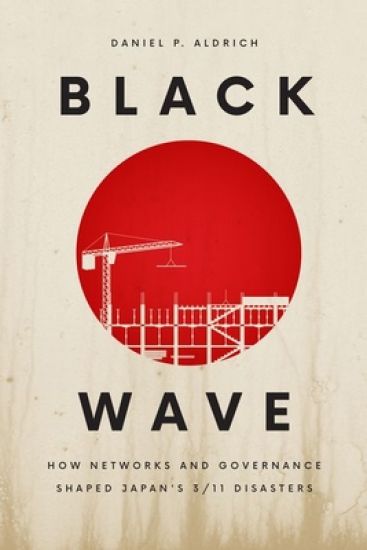
Black Wave

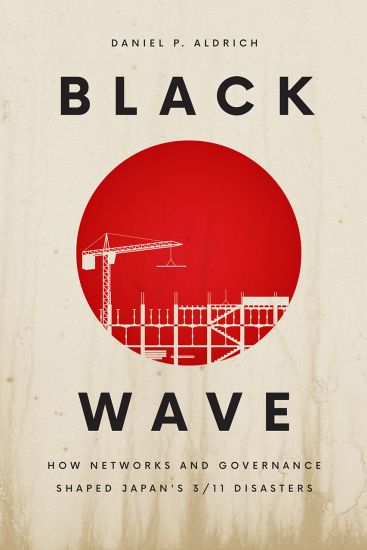
Black Wave

Daniel P Aldrich

University of Chicago Press
2019
sidottu
Despite the devastation caused by the magnitude 9.0 earthquake and 60-foot tsunami that struck Japan in 2011, some 96% of those living and working in the most disaster-stricken region of Tohoku made it through. Smaller earthquakes and tsunamis have killed far more people in nearby China and India. What accounts for the exceptionally high survival rate? And why is it that some towns and cities in the Tohoku region have built back more quickly than others? Black Wave illuminates two critical factors that had a direct influence on why survival rates varied so much across the Tohoku region following the 3/11 disasters and why the rebuilding process has also not moved in lockstep across the region. Individuals and communities with stronger networks and better governance, Daniel P. Aldrich shows, had higher survival rates and accelerated recoveries. Less connected communities with fewer such ties faced harder recovery processes and lower survival rates. Beyond the individual and neighborhood levels of survival and recovery, the rebuilding process has varied greatly, as some towns and cities have sought to work independently on rebuilding plans, ignoring recommendations from the national governments and moving quickly to institute their own visions, while others have followed the guidelines offered by Tokyo-based bureaucrats for economic development and rebuilding.
Black Wave

Black Wave

Daniel P Aldrich

University of Chicago Press
2019
pokkari
Despite the devastation caused by the magnitude 9.0 earthquake and 60-foot tsunami that struck Japan in 2011, some 96% of those living and working in the most disaster-stricken region of Tohoku made it through. Smaller earthquakes and tsunamis have killed far more people in nearby China and India. What accounts for the exceptionally high survival rate? And why is it that some towns and cities in the Tohoku region have built back more quickly than others? Black Wave illuminates two critical factors that had a direct influence on why survival rates varied so much across the Tohoku region following the 3/11 disasters and why the rebuilding process has also not moved in lockstep across the region. Individuals and communities with stronger networks and better governance, Daniel P. Aldrich shows, had higher survival rates and accelerated recoveries. Less connected communities with fewer such ties faced harder recovery processes and lower survival rates. Beyond the individual and neighborhood levels of survival and recovery, the rebuilding process has varied greatly, as some towns and cities have sought to work independently on rebuilding plans, ignoring recommendations from the national governments and moving quickly to institute their own visions, while others have followed the guidelines offered by Tokyo-based bureaucrats for economic development and rebuilding.
Dawn at Mineral King Valley: The Sierra Club, the Disney Company, and the Rise of Environmental Law
The story behind the historic Mineral King Valley case, which reveals how the Sierra Club battled Disney's ski resort development and launched a new environmental era in America. In our current age of climate change-induced panic, it's hard to imagine a time when private groups were not actively enforcing environmental protection laws in the courts. It wasn't until 1972, however, that a David and Goliath-esque Supreme Court showdown involving the Sierra Club and Disney set a revolutionary legal precedent for the era of environmental activism we live in today. Set against the backdrop of the environmental movement that swept the country in the late 1960s and early 1970s, Dawn at Mineral King Valley tells the surprising story of how the US Forest Service, the Disney company, and the Sierra Club each struggled to adapt to the new, rapidly changing political landscape of environmental consciousness in postwar America. Proposed in 1965 and approved by the federal government in 1969, Disney's vast development plan would have irreversibly altered the practically untouched Mineral King Valley, a magnificently beautiful alpine area in the Sierra Nevada mountains. At first, the plan met with unanimous approval from elected officials, government administrators, and the press--it seemed inevitable that this expanse of wild natural land would be radically changed and turned over to a private corporation. Then the scrappy Sierra Club forcefully pushed back with a lawsuit that ultimately propelled the modern environmental era by allowing interest groups to bring litigation against environmentally destructive projects. An expert on environmental law and appellate advocacy, Daniel P. Selmi uses his authoritative narrative voice to recount the complete history of this revolutionary legal battle and the ramifications that continue today, almost 50 years later.
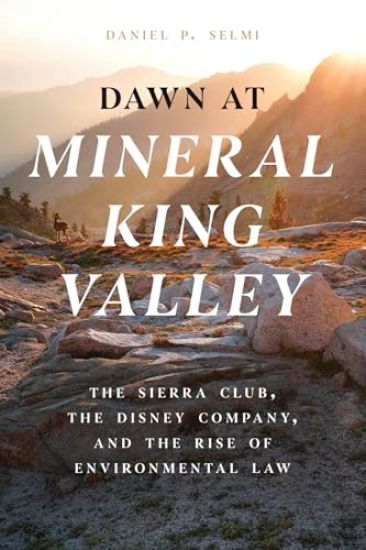
Dawn at Mineral King Valley

Dawn at Mineral King Valley

Daniel P. Selmi

THE UNIVERSITY OF CHICAGO PRESS
2024
nidottu
The story behind the historic Mineral King Valley case, which reveals how the Sierra Club battled Disney’s ski resort development and launched a new environmental era in America. In our current age of climate change–induced panic, it’s hard to imagine a time when private groups were not actively enforcing environmental protection laws in the courts. It wasn’t until 1972, however, that a David and Goliath–esque Supreme Court showdown involving the Sierra Club and Disney set a revolutionary legal precedent for the era of environmental activism we live in today. Set against the backdrop of the environmental movement that swept the country in the late 1960s and early 1970s, Dawn at Mineral King Valley tells the surprising story of how the US Forest Service, the Disney company, and the Sierra Club each struggled to adapt to the new, rapidly changing political landscape of environmental consciousness in postwar America. Proposed in 1965 and approved by the federal government in 1969, Disney’s vast development plan would have irreversibly altered the practically untouched Mineral King Valley, a magnificently beautiful alpine area in the Sierra Nevada mountains. At first, the plan met with unanimous approval from elected officials, government administrators, and the press—it seemed inevitable that this expanse of wild natural land would be radically changed and turned over to a private corporation. Then the scrappy Sierra Club forcefully pushed back with a lawsuit that ultimately propelled the modern environmental era by allowing interest groups to bring litigation against environmentally destructive projects. An expert on environmental law and appellate advocacy, Daniel P. Selmi uses his authoritative narrative voice to recount the complete history of this revolutionary legal battle and the ramifications that continue today, almost 50 years later.
City Symphonies

City Symphonies

Daniel P. Schwartz

MCGILL-QUEEN'S UNIVERSITY PRESS
2024
sidottu
Cinema scholars categorize city symphony films of the 1920s and early 1930s as a subgenre of the silent film. Defined in visual terms, the city symphony organizes the visible elements of urban experience according to musical principles such as rhythm and counterpoint.In City Symphonies Daniel Schwartz explores the unheard sonic dimensions of these ostensibly silent films. The book turns its ear to the city symphony as an audible phenomenon, one that encompasses a multitude of works beyond the cinema, such as musical compositions, mass spectacles, radio experiments, and even paintings. What these works have in common is their treatment of the city as a medium for sound. The city is neither background nor content; rather, it is the material through which avant-garde works express themselves. In resonating through the city, these multimedia pieces perform experiments that undermine the borders between sight and sound.Applying an interdisciplinary approach, City Symphonies expands our understanding of the genre, breaking out of the confines of the cinema and onto the street.
City Symphonies

City Symphonies

Daniel P. Schwartz

MCGILL-QUEEN'S UNIVERSITY PRESS
2024
nidottu
Cinema scholars categorize city symphony films of the 1920s and early 1930s as a subgenre of the silent film. Defined in visual terms, the city symphony organizes the visible elements of urban experience according to musical principles such as rhythm and counterpoint.In City Symphonies Daniel Schwartz explores the unheard sonic dimensions of these ostensibly silent films. The book turns its ear to the city symphony as an audible phenomenon, one that encompasses a multitude of works beyond the cinema, such as musical compositions, mass spectacles, radio experiments, and even paintings. What these works have in common is their treatment of the city as a medium for sound. The city is neither background nor content; rather, it is the material through which avant-garde works express themselves. In resonating through the city, these multimedia pieces perform experiments that undermine the borders between sight and sound.Applying an interdisciplinary approach, City Symphonies expands our understanding of the genre, breaking out of the confines of the cinema and onto the street.
Principles of Commodity Economics and Finance
A rigorous but practical introduction to the economic, financial, and political principles underlying commodity markets.Commodities have become one of the fastest growing asset classes of the last decade and the object of increasing attention from investors, scholars, and policy makers. Yet existing treatments of the topic are either too theoretical, ignoring practical realities, or largely narrative and nonrigorous. This book bridges the gap, striking a balance between theory and practice. It offers a solid foundation in the economic, financial, and political principles underlying commodities markets. The book, which grows out of courses taught by the author at Columbia and Johns Hopkins, can be used by graduate students in economics, finance, and public policy, or as a conceptual reference for practitioners.After an introduction to basic concepts and a review of the various types of commodities-energy, metals, agricultural products-the book delves into the economic and financial dynamics of commodity markets, with a particular focus on energy. The text covers fundamental demand and supply for resources, the mechanics behind commodity financial markets, and how they motivate investment decisions around both physical and financial portfolio exposure to commodities, and the evolving political and regulatory landscape for commodity markets. Additional special topics include geopolitics, financial regulation, and electricity markets. The book is divided into thematic modules that progress in complexity. Text boxes offer additional, related material, and numerous charts and graphs provide further insight into important concepts.
Essentials of Programming Languages

Essentials of Programming Languages

Daniel P. Friedman; Mitchell Wand

MIT Press
2008
sidottu
A new edition of a textbook that provides students with a deep, working understanding of the essential concepts of programming languages, completely revised, with significant new material.This book provides students with a deep, working understanding of the essential concepts of programming languages. Most of these essentials relate to the semantics, or meaning, of program elements, and the text uses interpreters (short programs that directly analyze an abstract representation of the program text) to express the semantics of many essential language elements in a way that is both clear and executable. The approach is both analytical and hands-on. The book provides views of programming languages using widely varying levels of abstraction, maintaining a clear connection between the high-level and low-level views. Exercises are a vital part of the text and are scattered throughout; the text explains the key concepts, and the exercises explore alternative designs and other issues. The complete Scheme code for all the interpreters and analyzers in the book can be found online through The MIT Press web site. For this new edition, each chapter has been revised and many new exercises have been added. Significant additions have been made to the text, including completely new chapters on modules and continuation-passing style. Essentials of Programming Languages can be used for both graduate and undergraduate courses, and for continuing education courses for programmers.
The Little Prover

The Little Prover

Daniel P. Friedman; Carl Eastlund; J Strother Moore; Matthias Felleisen

MIT Press
2015
pokkari
An introduction to writing proofs about computer programs, written in an accessible question-and-answer style, complete with step-by-step examples and a simple proof assistant.The Little Prover introduces inductive proofs as a way to determine facts about computer programs. It is written in an approachable, engaging style of question-and-answer, with the characteristic humor of The Little Schemer (fourth edition, MIT Press). Sometimes the best way to learn something is to sit down and do it; the book takes readers through step-by-step examples showing how to write inductive proofs. The Little Prover assumes only knowledge of recursive programs and lists (as presented in the first three chapters of The Little Schemer) and uses only a few terms beyond what novice programmers already know. The book comes with a simple proof assistant to help readers work through the book and complete solutions to every example.
The Reasoned Schemer

The Reasoned Schemer

Daniel P. Friedman; William E. Byrd; Oleg Kiselyov; Jason Hemann; Guy Lewis Steele; Gerald Jay Sussman; Robert A. Kowalski

MIT Press
2018
pokkari
A new edition of a book, written in a humorous question-and-answer style, that shows how to implement and use an elegant little programming language for logic programming.The goal of this book is to show the beauty and elegance of relational programming, which captures the essence of logic programming. The book shows how to implement a relational programming language in Scheme, or in any other functional language, and demonstrates the remarkable flexibility of the resulting relational programs. As in the first edition, the pedagogical method is a series of questions and answers, which proceed with the characteristic humor that marked The Little Schemer and The Seasoned Schemer. Familiarity with a functional language or with the first five chapters of The Little Schemer is assumed. For this second edition, the authors have greatly simplified the programming language used in the book, as well as the implementation of the language. In addition to revising the text extensively, and simplifying and revising the "Laws" and "Commandments," they have added explicit "Translation" rules to ease translation of Scheme functions into relations.
The Little Typer

The Little Typer

Daniel P. Friedman; David Thrane Christiansen; Robert Harper; Conor McBride

MIT Press
2018
pokkari
An introduction to dependent types, demonstrating the most beautiful aspects, one step at a time.A program's type describes its behavior. Dependent types are a first-class part of a language, and are much more powerful than other kinds of types; using just one language for types and programs allows program descriptions to be as powerful as the programs they describe. The Little Typer explains dependent types, beginning with a very small language that looks very much like Scheme and extending it to cover both programming with dependent types and using dependent types for mathematical reasoning. Readers should be familiar with the basics of a Lisp-like programming language, as presented in the first four chapters of The Little Schemer. The first five chapters of The Little Typer provide the needed tools to understand dependent types; the remaining chapters use these tools to build a bridge between mathematics and programming. Readers will learn that tools they know from programming-pairs, lists, functions, and recursion-can also capture patterns of reasoning. The Little Typer does not attempt to teach either practical programming skills or a fully rigorous approach to types. Instead, it demonstrates the most beautiful aspects as simply as possible, one step at a time.
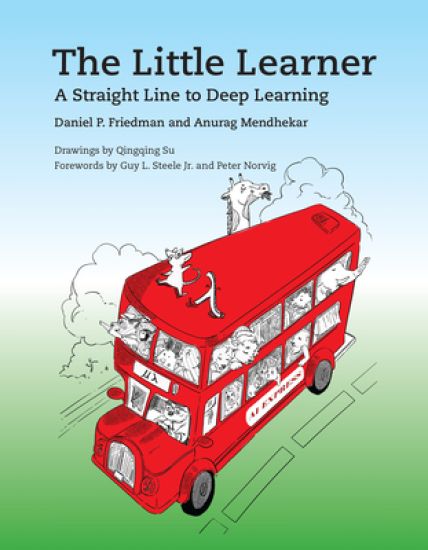
The Little Learner

The Little Learner

Daniel P. Friedman; Anurag Mendhekar

MIT PRESS LTD
2023
nidottu
A highly accessible, step-by-step introduction to deep learning, written in an engaging, question-and-answer style. The Little Learner introduces deep learning from the bottom up, inviting students to learn by doing. With the characteristic humor and Socratic approach of classroom favorites The Little Schemer and The Little Typer, this kindred text explains the workings of deep neural networks by constructing them incrementally from first principles using little programs that build on one another. Starting from scratch, the reader is led through a complete implementation of a substantial application: a recognizer for noisy Morse code signals. Example-driven and highly accessible, The Little Learner covers all of the concepts necessary to develop an intuitive understanding of the workings of deep neural networks, including tensors, extended operators, gradient descent algorithms, artificial neurons, dense networks, convolutional networks, residual networks, and automatic differentiation. Conversational style, illustrations, and question-and-answer format make deep learning accessible and funIncremental approach constructs advanced concepts from first principlesPresents key ideas of machine learning using a small, manageable subset of the Scheme languageSuitable for anyone with knowledge of high school math and some programming experience
The Little Schemer

The Little Schemer

Daniel P. Friedman; Matthias Felleisen

MIT Press
1995
pokkari
The notion that "thinking about computing is one of the most exciting things the human mind can do" sets both The Little Schemer (formerly known as The Little LISPer) and its new companion volume, The Seasoned Schemer, apart from other books on LISP. The authors' enthusiasm for their subject is compelling as they present abstract concepts in a humorous and easy-to-grasp fashion. Together, these books will open new doors of thought to anyone who wants to find out what computing is really about. The Little Schemer introduces computing as an extension of arithmetic and algebra; things that everyone studies in grade school and high school. It introduces programs as recursive functions and briefly discusses the limits of what computers can do. The authors use the programming language Scheme, and interesting foods to illustrate these abstract ideas. The Seasoned Schemer informs the reader about additional dimensions of computing: functions as values, change of state, and exceptional cases. The Little LISPer has been a popular introduction to LISP for many years. It had appeared in French and Japanese. The Little Schemer and The Seasoned Schemer are worthy successors and will prove equally popular as textbooks for Scheme courses as well as companion texts for any complete introductory course in Computer Science.
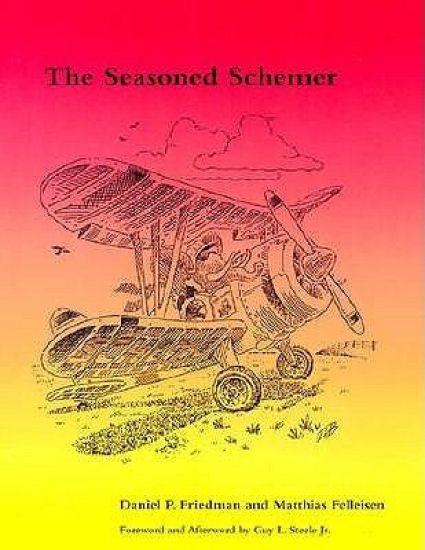
The Seasoned Schemer

The Seasoned Schemer

Daniel P. Friedman; Matthias Felleisen; Guy Lewis Steele Jr.

MIT Press
1995
pokkari
The notion that "thinking about computing is one of the most exciting things the human mind can do" sets both The Little Schemer (formerly known as The Little LISPer) and its new companion volume, The Seasoned Schemer, apart from other books on LISP. The authors' enthusiasm for their subject is compelling as they present abstract concepts in a humorous and easy-to-grasp fashion. Together, these books will open new doors of thought to anyone who wants to find out what computing is really about. The Little Schemer introduces computing as an extension of arithmetic and algebra; things that everyone studies in grade school and high school. It introduces programs as recursive functions and briefly discusses the limits of what computers can do. The authors use the programming language Scheme, and interesting foods to illustrate these abstract ideas. The Seasoned Schemer informs the reader about additional dimensions of computing: functions as values, change of state, and exceptional cases. The Little LISPer has been a popular introduction to LISP for many years. It had appeared in French and Japanese. The Little Schemer and The Seasoned Schemer are worthy successors and will prove equally popular as textbooks for Scheme courses as well as companion texts for any complete introductory course in Computer Science.
Phoenix from the Ashes

Phoenix from the Ashes

Daniel P. Marston D. Phil.

Praeger Publishers Inc
2003
sidottu
Referring to both Indian and British troops serving in Malaya and Burma against the Imperial Japanese Army, Marston (war studies, Royal Military Academy, Sandhurst, UK) presents an organizational and institutional history of the Indian Army from its origins through its service during World War II. H
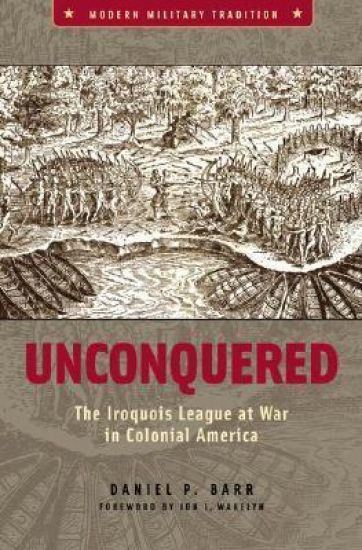
Unconquered

Unconquered

Daniel P. Barr

Praeger Publishers Inc
2006
sidottu
Unconquered explores the complex world of Iroquois warfare, providing a narrative overview of nearly two hundred years of Iroquois conflict during the colonial era of North America. Detailing Iroquois wars against the French, English, Americans, and a host of Indian enemies, Unconquered builds upon decades of modern scholarship to reveal the vital importance of warfare in Iroquois society and culture, at the same time exploring the diverse motivations—especially Iroquoian spiritual and cultural beliefs—that guided such warfare. Economic competition and rivalry for trade were important factors in Iroquois warfare, but they often provided less motivation for waging war than Iroquoian spiritual and cultural beliefs, including the important tradition of the mourning war. Nor were European agendas particularly important to Iroquois warfare, except in that they occasionally coincided with Iroquois designs. Europeans influenced and incited, both directly and indirectly, conflict within the Iroquois League and with other Indian nations, but the peoples of the Iroquois League waged war according to their own cultural beliefs and by their own rules. In reality, the Iroquoi League rarely waged war against anyone. Rather its individual member nations drove the warfare often attributed to the whole, creating a shifting, amorphous political and military position that allowed member nations to pursue separate policies of war and peace against common foes and multiple enemies. Unconquered also seeks to dispel longstanding beliefs about the invincible Iroquois empire, myths that have been dispelled by focused academic studies, but still retain a powerful resonance among popular conceptions of the Iroquois League. While the Iroquois created far-reaching networks of trade and destroyed or dispersed Indian peoples along their borders, they created no expansive territorial empires. Nor were Iroquois warriors unequaled in battle. Europeans, Americans, and Indians defeated Iroquois warriors and burned Iroquois villages as often as they tasted defeat, and on more than one occasion they brought the Iroquois League to the brink of utter ruin. Yet the Iroquois were never completely destroyed.
The Way of the Franciscans

The Way of the Franciscans

Daniel P. Horan Horan

SPCK Publishing
2021
pokkari
Whereas some religious traditions within Christianity offer a singular approach or spiritual focus, the Franciscan tradition is wonderfully diverse and manifold. The Way of the Franciscans is a lovely Lent book for 2022 that offers a practical introduction to Franciscan spirituality, and the many distinctive and dynamic approaches to prayer, contemplation and action found within it. Split into six chapters, with each focusing on a key Franciscan spiritual master and their way of prayer, The Way of the Franciscans is the perfect guide to help you prepare for Easter and deepen your spirituality throughout Lent. As well as exploring the history of the different Franciscan spiritual traditions and how they are united in their focus on living according to the Gospels, it offers practical, applicable guidance for making Franciscan spirituality part of your everyday prayer life. The Way of the Franciscans is an ideal Lent devotional for 2022 for anyone wanting to increase their understanding of Franciscan spirituality, or for anyone looking for new ways to revitalise their prayer life during Lent. Suitable for reading individually or using as a small group, this is a Lent book that will leave you with a new appreciation of the relevance of the Franciscan spiritual tradition and forms of prayer for Christians today, and equip you with practices for becoming part of this ever-growing tradition.
Our Year of War

Our Year of War

Daniel P. Bolger

Da Capo Press Inc
2017
sidottu
The gritty and engaging story of two brothers, Chuck and Tom Hagel, who went to war in Vietnam, fought in the same unit, and saved each other's life. One supported the war, the other detested it, but they fought it together.1968. It was the worst year of America's most divisive war. Flag-draped caskets came home by the thousands. Riots ravaged our cities. Assassins shot our political leaders. Black fought white, young fought old, fathers fought sons. And it was the year that two brothers from Nebraska went to war.In Vietnam, Chuck and Tom Hagel served side by side in the same rifle platoon. Together they fought in the Tet Offensive, battled snipers in Saigon, chased the enemy through the jungle, and each saved the other's life under fire. Yet, like so many American families, one brother supported the war while the other detested it.Tom and former Secretary of Defense Chuck Hagel never set out to be heroes, but they epitomized the best, and lived through the worst, of the most tumultuous, amazing, and consequential year in the last half century. Following the brothers' paths from the prairie heartland through a war on the far side of the world and back to a divided America, Our Year of War tells the story of two brothers at war, serving their divided country. It is a story that resonates to this day, an American story.