Kirjojen hintavertailu. Mukana 12 390 323 kirjaa ja 12 kauppaa.

Kirjahaku

Etsi kirjoja tekijän nimen, kirjan nimen tai ISBN:n perusteella.

1000 tulosta hakusanalla Daniele Torcellini

Daniele Barbaro’s Perspective of 1568

Daniele Barbaro’s Perspective of 1568

Kim Williams; Cosimo Monteleone; Philip Steadman

Springer Nature Switzerland AG
2021
sidottu
A year after the second edition of his famous translation and commentary on Vitruvius, Daniele Barbaro published The Practice of Perspective, a text he had begun working on many years before. Barbaro was the first to publish a formal treatise entirely dedicated to the science of geometric perspective. In an informal style especially addressed to practicing artists and architects, Barbaro begins by drawing on and expanding the manuscript treatise of Piero della Francesca with regards to basics of perspective constructions for representing three-dimensional solids on two-dimensional media, and then goes on to show that perspective is a particularly suitable instrument for other scientific and artistic applications as well, including cartography, cosmology, stage set design, and anamorphosis. Here for the first time Barbaro’s The Practice of Perspective is made available to contemporary scholars in an English translation, augmented by annotations relating the printed treatise to the three unpublished manuscripts in Italian and Latin of the work now conserved in Venice’s Biblioteca Nazionale Marciana. A foreword by Philip Steadman sets the stage for this book. In-depth essays by authors Kim Williams and Cosimo Monteleone situate the treatise within the editorial panorama of the Cinquecento, outline the innovations that Barbaro brought to the study of perspective, and focus particularly on his creative explorations of geometric solids and the construction of clocks. Sometimes dismissed in recent studies as a compilation of known principles, the aim of this present book is to reveal the truly innovative nature of Barbaro’s experiments and results and restore him to his rightful place as an original scholar of Renaissance perspective theory.

Daniele Barbaro’s Perspective of 1568

Daniele Barbaro’s Perspective of 1568

Kim Williams; Cosimo Monteleone; Philip Steadman

Springer Nature Switzerland AG
2022
nidottu
A year after the second edition of his famous translation and commentary on Vitruvius, Daniele Barbaro published The Practice of Perspective, a text he had begun working on many years before. Barbaro was the first to publish a formal treatise entirely dedicated to the science of geometric perspective. In an informal style especially addressed to practicing artists and architects, Barbaro begins by drawing on and expanding the manuscript treatise of Piero della Francesca with regards to basics of perspective constructions for representing three-dimensional solids on two-dimensional media, and then goes on to show that perspective is a particularly suitable instrument for other scientific and artistic applications as well, including cartography, cosmology, stage set design, and anamorphosis. Here for the first time Barbaro’s The Practice of Perspective is made available to contemporary scholars in an English translation, augmented by annotations relating the printed treatise to the three unpublished manuscripts in Italian and Latin of the work now conserved in Venice’s Biblioteca Nazionale Marciana. A foreword by Philip Steadman sets the stage for this book. In-depth essays by authors Kim Williams and Cosimo Monteleone situate the treatise within the editorial panorama of the Cinquecento, outline the innovations that Barbaro brought to the study of perspective, and focus particularly on his creative explorations of geometric solids and the construction of clocks. Sometimes dismissed in recent studies as a compilation of known principles, the aim of this present book is to reveal the truly innovative nature of Barbaro’s experiments and results and restore him to his rightful place as an original scholar of Renaissance perspective theory.
Daniele Barbaro and the University of Padova
This book, edited by Kim Williams and Cosimo Monteleone, follows the publication of two other books dedicated to Daniele Barbaro and published by Springer: Daniele Barbaro's Vitruvius of 1567 (Kim Williams, 2019) and Daniele Barbaro's Perspective of 1568 (Kim Williams and Cosimo Monteleone, 2021). Therefore, it can be considered another installment in a series that has deepened the scientific treatises published by Daniele Barbaro. Due to the numerous scientific interests that Barbaro matured in the years he spent at the University of Padua, we have invited experts in these topics to discuss Barbaro in relation to his training. In particular, the book opens with the essays of the two editors to frame its general theme in relation to mathematics. Cosimo Monteleone addressed the relationship between Barbaro's perspective theory with Euclid's optics, the Aristotelian process of knowledge and the ophthalmological discoveries of the University of Padova in the Renaissance. Kim Williams underlines how Barbaro's arithmetic and geometry established `the most certain sciences' and set the base of the `primary sciences'. A series of essays concerning Barbaro's training at the University of Padua complete the theoretical framework analyzed by the two editors. These studies embrace the following subjects: mathematical instruments (Filippo Camerota), astronomy and sundials (Cristiano Guarneri), mathematics, geometry and polyhedral (Vera Viana), perspective and anamorphosis (Agostino De Rosa), botany and the foundation of the botanical garden (Stefano Zaggia), Vitruvius' architecture (Ekaterina Igoshina, Ilya Anikyev, Anna Markova) and Aristotelianism (Branko Mitrovic). A foreword by Xavier Salomon sets the stage for this book, outlining the innovations that Barbaro brought to scientific knowledge.Barbaro's scientific efforts are sometimes dismissed in recent studies as a compilation of known principles. The aim of this present book is to reveal the truly innovative nature of Barbaro's experiments and results and restore him to his rightful place as an original scholar of Renaissance.
Daniele Barbaro and the University of Padova
This book, edited by Kim Williams and Cosimo Monteleone, follows the publication of two other books dedicated to Daniele Barbaro and published by Springer: Daniele Barbaro's Vitruvius of 1567 (Kim Williams, 2019) and Daniele Barbaro's Perspective of 1568 (Kim Williams and Cosimo Monteleone, 2021). Therefore, it can be considered another installment in a series that has deepened the scientific treatises published by Daniele Barbaro. Due to the numerous scientific interests that Barbaro matured in the years he spent at the University of Padua, we have invited experts in these topics to discuss Barbaro in relation to his training. In particular, the book opens with the essays of the two editors to frame its general theme in relation to mathematics. Cosimo Monteleone addressed the relationship between Barbaro's perspective theory with Euclid's optics, the Aristotelian process of knowledge and the ophthalmological discoveries of the University of Padova in the Renaissance. Kim Williams underlines how Barbaro's arithmetic and geometry established `the most certain sciences' and set the base of the `primary sciences'. A series of essays concerning Barbaro's training at the University of Padua complete the theoretical framework analyzed by the two editors. These studies embrace the following subjects: mathematical instruments (Filippo Camerota), astronomy and sundials (Cristiano Guarneri), mathematics, geometry and polyhedral (Vera Viana), perspective and anamorphosis (Agostino De Rosa), botany and the foundation of the botanical garden (Stefano Zaggia), Vitruvius' architecture (Ekaterina Igoshina, Ilya Anikyev, Anna Markova) and Aristotelianism (Branko Mitrovic). A foreword by Xavier Salomon sets the stage for this book, outlining the innovations that Barbaro brought to scientific knowledge.Barbaro's scientific efforts are sometimes dismissed in recent studies as a compilation of known principles. The aim of this present book is to reveal the truly innovative nature of Barbaro's experiments and results and restore him to his rightful place as an original scholar of Renaissance.
Daniele Marques

Daniele Marques

Quart Publishers
2014
pokkari
This architect from Lucerne was one of the first protagonists of German-Swiss architecture in the 80s and 90s. His most recent and largest project is the sports arena in Lucerne in combination with a separate indoor swimming pool and two apartment buildings. This volume presents these projects and other buildings from the last four years. Text in English and German.
Daniele Buetti

Daniele Buetti

Max Hollein; Matthias Ulrich

Hirmer Verlag
2014
nidottu
Orange, yellow, green, blue – what happens in the human brain when colours are not seen with the physical eye, but instead aurally experienced with one’s ears? This pub lication focuses on a sound installation by the Swiss artist Daniele Buetti commissioned by the Schirn Museum in Frankfurt, which transfers colour theory, meditation and hypnosis into an artistic context. The Swiss conceptual artist Daniele Buetti, born in 1955, is a professor at the Academy of Fine Arts Münster in Germany. His artistic work spans many media. In the 1990s he rose to fame with his modified photographs of supermodels. His sound installation It’s all in the mind is based on a 25-minute audio performance taking the audience through techniques of hypnosis. In his work, Buetti uses 'colour purification’ techniques of hypnotic suggestion that conjure up different colours and their psychological effects. Interviews with well-known specialists complement this interdisciplinary volume.
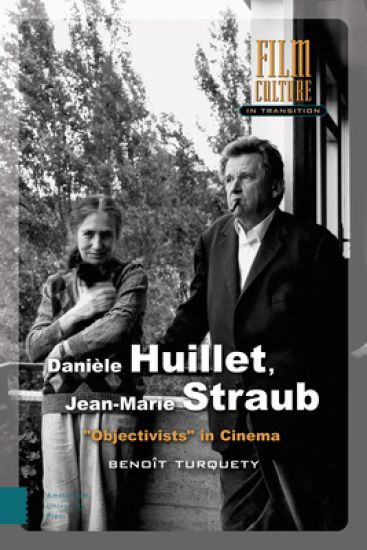
Danièle Huillet, Jean-Marie Straub

Danièle Huillet, Jean-Marie Straub

Benoît Turquety

Amsterdam University Press
2020
sidottu
Danièle Huillet and Jean-Marie Straub collaborated on films together from the mid-1960s through the mid-2000s, making formally radical adaptations in several languages of major works of European literature by authors including Franz Kafka, Bertolt Brecht, Friedrich Hölderlin, Pierre Corneille, Arnold Schoenberg, Cesare Pavese, and Elio Vittorini. The impact of their work comes in part from a search for radical objectivity, a theme present in certain underground currents of modernist art and theory in the writings of Benjamin and Adorno as well as in the "Objectivist" movement, a crucial group within American modernist poetry whose members included Louis Zukofsky, George Oppen, and Charles Reznikoff, with connections to William Carlos Williams and Ezra Pound. Through a detailed analysis of the films of Straub and Huillet, the works they adapted, and Objectivist poems and essays, Benoît Turquety locates common practices and explores a singular aesthetic approach where a work of art is conceived as an object, the artist an anonymous artisan, and where the force of politics and formal research attempt to reconcile with one another.
Il mio nome è Daniele: Il tuo libro da colorare personale, in modo che tutti conoscano il tuo nome - Quaderno - Libro per ragazzi - Blocco da
Il mio nome DanieleLibro da colorare personalizzato per persone speciali. Con un design dolce gatto che sorprendono il vostro bambino con certezza. I libri da colorare sono un'idea regalo molto folle e non diventano mai noiosi, rimane un pezzo di memoria per l'eternit .I nostri bellissimi quaderni disposti sono ideali per appunti, con l'apprendimento nella scuola o in un'universit per riempire il pensiero. Scrivi i tuoi pensieri, esperienze, escursioni o impressioni personali in modo da poterle cercare in seguito. Cos i momenti belli non rimangono solo ricordi, ma sono scritti con fermezza e possono essere rivisitati e rivisti pi volte. Adatto per uso personale o come regalo per il riconoscimento. Sul lavoro o nello sport come attivit da fare o per essere in grado di misurare i propri progressi. Pu essere utilizzato per molti scopi e quindi qualcosa di molto speciale Fatto con amore.Dettagli: Formato: 15,24 x 22,86 cm (6x9 pollici)100 pagine bianche numerate, utilizzo versatile (scrivere, disegnare o scarabocchiare)Carta bianca, piacevole da scrivere e disegnareCopertina morbida opacaVi auguriamo tanta gioia Non hai trovato il tuo nome? Basta inserire "Il mio nome + nome" nella maschera di ricerca di Amazon e selezionare.
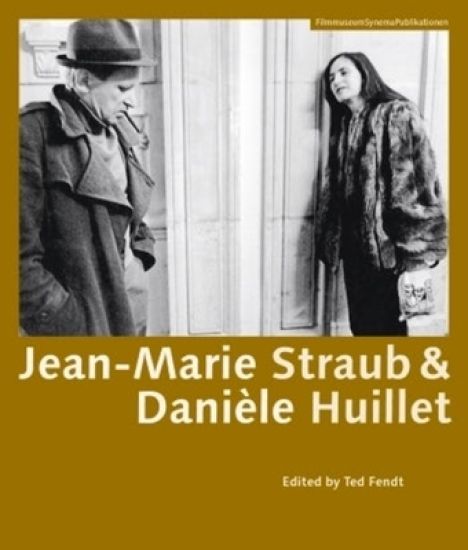
Jean–Marie Straub & Danièle Huillet

Jean–Marie Straub & Danièle Huillet

Ted Fendt

Synema Gesellschaft Fur Film u. Medien
2016
nidottu
From their first film in 1963, Jean-Marie Straub and Danièle Huillet distinguished themselves as two of Europe's most inventive, generous, and uncompromising filmmakers. From Machorka-Muff (1963) through These Encounters of Theirs (2006), and in the subsequent solo work of Jean-Marie Straub, they developed groundbreaking and unique approaches to film adaptation, performance, sound recording, cinematography, and translation in films made across Germany, Italy, and France – including such modern classics as The Chronicle of Anna Magdalena Bach (1967), Moses and Aaron (1974), Class Relations (1983), and Sicilia! (1999). On the occasion of the first complete North American retrospective of their films in more than two decades, this volume traces the history of Straub's and Huillet's work, placing their films in the specific cultural, linguistic, and critical contexts in which they were produced and providing an account of their distribution and reception in the English-speaking world.