Kirjojen hintavertailu. Mukana 12 406 711 kirjaa ja 12 kauppaa.

Kirjahaku

Etsi kirjoja tekijän nimen, kirjan nimen tai ISBN:n perusteella.

882 tulosta hakusanalla Dariusz Adrianowski

Power in Business Relationships

Power in Business Relationships

Dariusz Siemieniako; Maciej Mitrega; Hannu Makkonen; Gregor Pfajfar

TAYLOR FRANCIS LTD
2022
sidottu
Focusing on the issue of power as the main building block of relationships between business buyers and sellers, this book explains the complex nature of power with its multidimensional and multi-directional character. As a complex construct, inter-firm power is treated as a matter of perception as well as in terms of total and relative power. The book analyses extensively the issue of power asymmetry with its dynamics and its consequences for business-to-business (B2B) relationships, particularly analyzing the dynamic mechanism of power. Various theoretical domains or research streams regarding managing an asymmetrical business relationship by the weaker partner are also examined. Based on the studies of other scholars as well as on the authors' own research, this book shows how weaker suppliers or buyers deal with high-power partners in business relationships and the approaches of more powerful parties to asymmetrical relationship development. Additionally, the book presents the specific nature of power in international B2B relationships, including its connection to culture and conflict, as well as how to handle power in managing export performance within international B2B relationships. It is written for scholars and students who are interested in academic research concerning B2B marketing and B2B relationship marketing domains, specifically those who are interested in literature dealing with supply chain management, key account management, relationship portfolio management, distribution channel management and the network approach.

Power in Business Relationships

Power in Business Relationships

Dariusz Siemieniako; Maciej Mitrega; Hannu Makkonen; Gregor Pfajfar

TAYLOR FRANCIS LTD
2024
nidottu
Focusing on the issue of power as the main building block of relationships between business buyers and sellers, this book explains the complex nature of power with its multidimensional and multi-directional character. As a complex construct, inter-firm power is treated as a matter of perception as well as in terms of total and relative power. The book analyses extensively the issue of power asymmetry with its dynamics and its consequences for business-to-business (B2B) relationships, particularly analyzing the dynamic mechanism of power. Various theoretical domains or research streams regarding managing an asymmetrical business relationship by the weaker partner are also examined. Based on the studies of other scholars as well as on the authors' own research, this book shows how weaker suppliers or buyers deal with high-power partners in business relationships and the approaches of more powerful parties to asymmetrical relationship development. Additionally, the book presents the specific nature of power in international B2B relationships, including its connection to culture and conflict, as well as how to handle power in managing export performance within international B2B relationships. It is written for scholars and students who are interested in academic research concerning B2B marketing and B2B relationship marketing domains, specifically those who are interested in literature dealing with supply chain management, key account management, relationship portfolio management, distribution channel management and the network approach.
Identity, Aesthetics, and Sound in the Fin de Siècle
This book is an analytic and historical portrait of the volatile decades at the beginning of the 20th century. Engaging with avant-garde art and thought, and concentrating on two of the most controversial and still culturally relevant personalities of Viennese modernism - Sigmund Freud and Arnold Schoenberg - it tells the story of a cultural experiment of unprecedented proportions, an experiment that attempted to redesign the senses and the concept of individual identity. The book describes the shape of this identity through its mutually overlapping artistic and intellectual dimensions, as it explores the relationship between psychoanalysis and music.
The LIBOR Market Model in Practice

The LIBOR Market Model in Practice

Dariusz Gatarek; Przemyslaw Bachert; Robert Maksymiuk

John Wiley Sons Inc
2006
sidottu
The LIBOR Market Model (LMM) is the first model of interest rates dynamics consistent with the market practice of pricing interest rate derivatives and therefore it is widely used by financial institution for valuation of interest rate derivatives. This book provides a full practitioner's approach to the LIBOR Market Model. It adopts the specific language of a quantitative analyst to the largest possible level and is one of first books on the subject written entirely by quants. The book is divided into three parts - theory, calibration and simulation. New and important issues are covered, such as various drift approximations, various parametric and nonparametric calibrations, and the uncertain volatility approach to smile modelling; a version of the HJM model based on market observables and the duality between BGM and HJM models. Co-authored by Dariusz Gatarek, the 'G' in the BGM model who is internationally known for his work on LIBOR market models, this book offers an essential perspective on the global benchmark for short-term interest rates.
The Language of Deception

The Language of Deception

Dariusz Galasinski

SAGE Publications Inc
2000
sidottu
Author Dariusz Galasinski employs a discourse analytical approach to the study of deception in The Language of Deception. The book focuses on the deceptive messages themselves -- how language is used to deceive others and what kinds of linguistic devices are used. Galasinski develops a theory of deception based on his extensive study of debates and interviews of American and British politicians. Actual exchanges such as the one in which a politician is asked the same question 14 times and evades it 14 times, provide fascinating insight into deceptive linguistic practices.
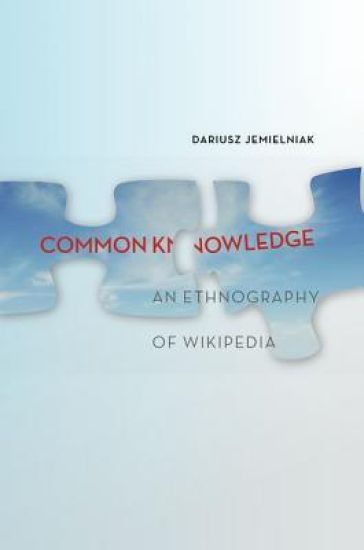
Common Knowledge?

Common Knowledge?

Dariusz Jemielniak

Stanford University Press
2014
sidottu
With an emphasis on peer–produced content and collaboration, Wikipedia exemplifies a departure from traditional management and organizational models. This iconic "project" has been variously characterized as a hive mind and an information revolution, attracting millions of new users even as it has been denigrated as anarchic and plagued by misinformation. Have Wikipedia's structure and inner workings promoted its astonishing growth and enduring public relevance? In Common Knowledge?, Dariusz Jemielniak draws on his academic expertise and years of active participation within the Wikipedia community to take readers inside the site, illuminating how it functions and deconstructing its distinctive organization. Against a backdrop of misconceptions about its governance, authenticity, and accessibility, Jemielniak delivers the first ethnography of Wikipedia, revealing that it is not entirely at the mercy of the public: instead, it balances open access and power with a unique bureaucracy that takes a page from traditional organizational forms. Along the way, Jemielniak incorporates fascinating cases that highlight the tug of war among the participants as they forge ahead in this pioneering environment.
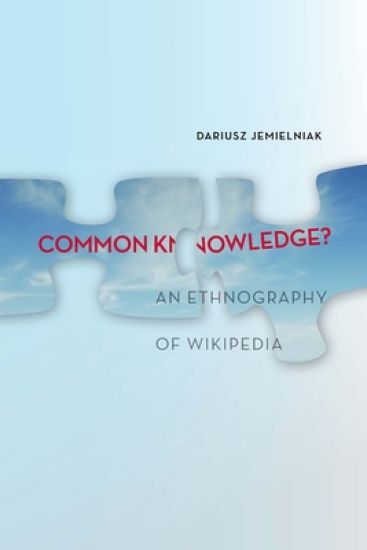
Common Knowledge?

Common Knowledge?

Dariusz Jemielniak

Stanford University Press
2015
pokkari
With an emphasis on peer–produced content and collaboration, Wikipedia exemplifies a departure from traditional management and organizational models. This iconic "project" has been variously characterized as a hive mind and an information revolution, attracting millions of new users even as it has been denigrated as anarchic and plagued by misinformation. Have Wikipedia's structure and inner workings promoted its astonishing growth and enduring public relevance? In Common Knowledge?, Dariusz Jemielniak draws on his academic expertise and years of active participation within the Wikipedia community to take readers inside the site, illuminating how it functions and deconstructing its distinctive organization. Against a backdrop of misconceptions about its governance, authenticity, and accessibility, Jemielniak delivers the first ethnography of Wikipedia, revealing that it is not entirely at the mercy of the public: instead, it balances open access and power with a unique bureaucracy that takes a page from traditional organizational forms. Along the way, Jemielniak incorporates fascinating cases that highlight the tug of war among the participants as they forge ahead in this pioneering environment.
Microwave-Enhanced Polymer Chemistry and Technology

Microwave-Enhanced Polymer Chemistry and Technology

Dariusz Bogdal; Aleksander Prociak

Iowa State University Press
2007
sidottu
While polymer technology forms one of the largest areas of application of microwave technology, and the methods and procedures used therein are among the most developed, there is still a relative lack of published information on the subject. Microwave-Enhanced Polymer Chemistry and Technology describes novel approaches to polymer processing using microwave technologies. Coverage includes background and scientific data, analysis of processes and product properties in comparison with existing technology, applications that are being used in various approaches, and the status of current research. Features of microwave irradiation, i.e., solvent-free reactions, low waste, energy efficiency, high yield, short reaction time, and possible use of alternative solvents, can play an important role in the development of green chemistry methods.
Geometric Phases in Classical and Quantum Mechanics

Geometric Phases in Classical and Quantum Mechanics

Dariusz Chruscinski; Andrzej Jamiolkowski

Birkhauser Boston Inc
2004
sidottu
Several well-established geometric and topological methods are used in this work in an application to a beautiful physical phenomenon known as the geometric phase. This book examines the geometric phase, bringing together different physical phenomena under a unified mathematical scheme. The material is presented so that graduate students and researchers in applied mathematics and physics with an understanding of classical and quantum mechanics can handle the text.
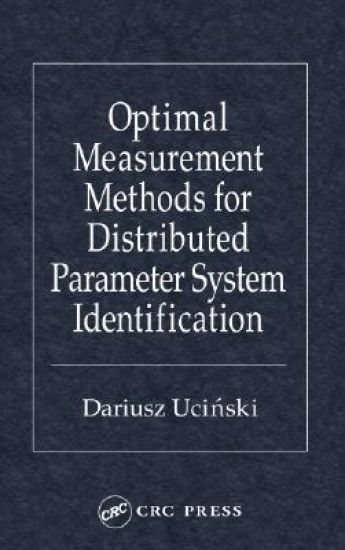
Optimal Measurement Methods for Distributed Parameter System Identification
For dynamic distributed systems modeled by partial differential equations, existing methods of sensor location in parameter estimation experiments are either limited to one-dimensional spatial domains or require large investments in software systems. With the expense of scanning and moving sensors, optimal placement presents a critical problem. Optimal Measurement Methods for Distributed Parameter System Identification discusses the characteristic features of the sensor placement problem, analyzes classical and recent approaches, and proposes a wide range of original solutions, culminating in the most comprehensive and timely treatment of the issue available. By presenting a step-by-step guide to theoretical aspects and to practical design methods, this book provides a sound understanding of sensor location techniques. Both researchers and practitioners will find the case studies, the proposed algorithms, and the numerical examples to be invaluable. This text also offers results that translate easily to MATLAB and to Maple. Assuming only a basic familiarity with partial differential equations, vector spaces, and probability and statistics, and avoiding too many technicalities, this is a superb resource for researchers and practitioners in the fields of applied mathematics, electrical, civil, geotechnical, mechanical, chemical, and environmental engineering.
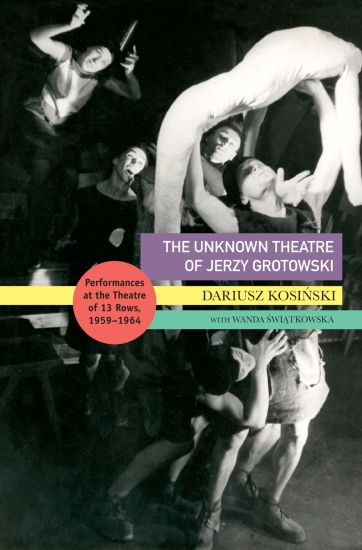
The Unknown Theatre of Jerzy Grotowski

The Unknown Theatre of Jerzy Grotowski

Dariusz Kosinski; Wanda Swiatkowska

SEAGULL BOOKS LONDON LTD
2023
nidottu
Examines the previously unresearched formative years of Polish director Jerzy Grotowski’s career. Polish director Jerzy Grotowski (1933–1999) was an international leader in experimental theater who became famous in the late 1960s for his revolutionary approach to audience involvement. This volume is devoted to Grotowski’s early work—the performances he directed in the Theatre of 13 Rows (later Laboratory Theatre of 13 Rows) between 1959 and 1964 when the theater was working in the provincial town Opole in south-western Poland. Having decided to work in his own independent theater, Grotowski moved to Opole in September 1956 and developed his ideas with young, inexperienced actors, creating important performances that foreshadowed his renowned masterpieces of the late 1960s. In The Unknown Theatre of Jerzy Grotowski, Dariusz Kosinski and Wanda Swiatkowska reconstruct, analyze, and interpret each of the nine performances directed by Grotowski over this period: from Orpheus based onJean Cocteau (1959) to Hamlet Study based on Stanislaw Wyspianski (1964). Previously mentioned mainly in the context of the development of Grotowski’s method, these performances dealt with important social, political, and philosophical problems of postwar and post-Holocaust Poland. Grotowski also used these performances to experiment with the forces and problems that he later tried to be discreet about, such as sexuality. Revealing unnoticed and forgotten aspects of Grotowski’s theater, this landmark book presents new materials and perspectives that give fresh life to the study of a genius of twentieth-century theater.
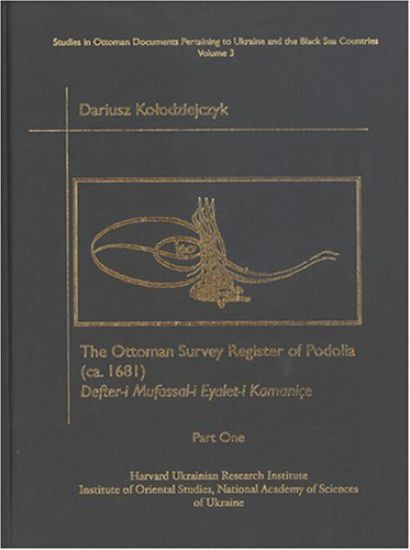
The Ottoman Survey Register of Podolia (ca. 1681), Part One

The Ottoman Survey Register of Podolia (ca. 1681), Part One

Dariusz Kolodziejczyk

Harvard Ukrainian Research Institute,U.S.
2004
sidottu
Ottoman survey registers are recognized as unparalleled sources on the demographic, economic, and linguistic characteristics of the regions for which they were made. The register for Kamaniçe (the region of Podolia and the city of Kam'janec', which the Ottomans conquered in 1672) is the only surviving survey register of Ukrainian lands. The full text of the defter is given in transcription in the first part, with a facsimile edition given in the second part. All narrative documents are translated in appendices, while narrative segments of the registry portion of the defter are translated in the notes. Commentary includes extensive notes and an introduction. The Ottoman Survey Register of Podolia provides important new information on the Ottomans and their subjects living in Ukrainian territory. Interpretive maps keyed to the register and indices and glossaries are included.
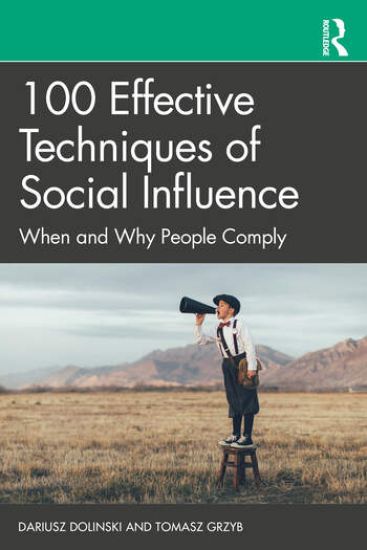
100 Effective Techniques of Social Influence

100 Effective Techniques of Social Influence

Dariusz Dolinski; Tomasz Grzyb

TAYLOR FRANCIS LTD
2022
nidottu
100 Effective Techniques of Social Influence provides a revolutionary look into the effectiveness of many techniques of social influence, providing an overview of the ways in which people use techniques to persuade others to meet various requests, suggestions, and commands.For each technique, the authors explore the idea behind it, what empirical research says about it, and what the psychological mechanism behind its effectiveness is, aka, why it works. The techniques included span across multiple areas in people’s everyday lives, ranging from business negotiations, managements, marketing, and close relationships, to people’s behavior in public as well as in their private sphere. Covering research from the 1970s to the present day, the book describes techniques of social influence with the purpose of provoking certain behaviors, such as convincing an individual to donate to a charity or purchase a certain product. By exclusively focusing on techniques influencing human behaviors, rather than beliefs, biases, or emotions, the authors show how humans can be reliably convinced to behave in a certain way in a huge range of situations and contexts. Rather than being based on anecdotal evidence or legends of famous people, the authors have only included techniques that have been proven to be effective through scientific research.With each technique described in an engaging manner, this is ideal reading for students and academics in fields such as social psychology, leadership, marketing, sociology, management, and communication. It will also appeal to professionals who need to influence others, and any readers who desire a better and more contemporary understanding of how people interact and influence others on a daily basis.
100 Effective Techniques of Social Influence

100 Effective Techniques of Social Influence

Dariusz Dolinski; Tomasz Grzyb

TAYLOR FRANCIS LTD
2022
sidottu
100 Effective Techniques of Social Influence provides a revolutionary look into the effectiveness of many techniques of social influence, providing an overview of the ways in which people use techniques to persuade others to meet various requests, suggestions, and commands.For each technique, the authors explore the idea behind it, what empirical research says about it, and what the psychological mechanism behind its effectiveness is, aka, why it works. The techniques included span across multiple areas in people’s everyday lives, ranging from business negotiations, managements, marketing, and close relationships, to people’s behavior in public as well as in their private sphere. Covering research from the 1970s to the present day, the book describes techniques of social influence with the purpose of provoking certain behaviors, such as convincing an individual to donate to a charity or purchase a certain product. By exclusively focusing on techniques influencing human behaviors, rather than beliefs, biases, or emotions, the authors show how humans can be reliably convinced to behave in a certain way in a huge range of situations and contexts. Rather than being based on anecdotal evidence or legends of famous people, the authors have only included techniques that have been proven to be effective through scientific research.With each technique described in an engaging manner, this is ideal reading for students and academics in fields such as social psychology, leadership, marketing, sociology, management, and communication. It will also appeal to professionals who need to influence others, and any readers who desire a better and more contemporary understanding of how people interact and influence others on a daily basis.
The Economics of Sustainable Development and Distribution
Drawing on a broad transdisciplinary background, this book compares distributive justice systems and related socioeconomic institutions within the liberal and sustainable development traditions. Confronting the capitalist worldview of prominent Nobel Prize–winning economist Milton Friedman, the book offers a theoretical framework for sustainable development: a new paradigm of economics grounded in environmental and social issues. The analysis takes as its starting point that the development and evolution of human beings is codetermined by socioeconomic institutions. These institutions facilitate models of society, morality and human behaviour: they are all social constructs. This matters because the liberal system of justice uses the claim that ‘life is unfair’ as the justification of socioeconomic inequalities, and it is these institutions which determine the concepts of fairness and justice. Therefore, the liberal system’s favouring of entrepreneurs should require advance measures to safeguard the interests of the losers—instead, it seeks to justify their misfortunes. It is argued that this liberal notion of fairness can only be fairly executed in conditions of perfect market competition, which have never existed. In contrast, the principles of sustainable development pay attention to the problems generated by the unjust and unfair distribution of resources and postulate wider use of the fairness formula ‘to each according to their needs’. It is thus more focused on fair ends than on fair procedures. This book is addressed to scholars and advanced students in ecological economics, environmental economics, economics of sustainable development and political science.
The Economics of Sustainable Development and Distribution
Drawing on a broad transdisciplinary background, this book compares distributive justice systems and related socioeconomic institutions within the liberal and sustainable development traditions. Confronting the capitalist worldview of prominent Nobel Prize–winning economist Milton Friedman, the book offers a theoretical framework for sustainable development: a new paradigm of economics grounded in environmental and social issues. The analysis takes as its starting point that the development and evolution of human beings is codetermined by socioeconomic institutions. These institutions facilitate models of society, morality and human behaviour: they are all social constructs. This matters because the liberal system of justice uses the claim that ‘life is unfair’ as the justification of socioeconomic inequalities, and it is these institutions which determine the concepts of fairness and justice. Therefore, the liberal system’s favouring of entrepreneurs should require advance measures to safeguard the interests of the losers—instead, it seeks to justify their misfortunes. It is argued that this liberal notion of fairness can only be fairly executed in conditions of perfect market competition, which have never existed. In contrast, the principles of sustainable development pay attention to the problems generated by the unjust and unfair distribution of resources and postulate wider use of the fairness formula ‘to each according to their needs’. It is thus more focused on fair ends than on fair procedures. This book is addressed to scholars and advanced students in ecological economics, environmental economics, economics of sustainable development and political science.
Suicide and the Self

Suicide and the Self

Dariusz Galasinski; Justyna Ziólkowska

TAYLOR FRANCIS LTD
2025
sidottu
This book centres on self-accounts of suicidal behavior, using a Critical Discourse Analysis (CDA) approach to offer a qualitative perspective within current suicidology and suicide prevention research.Suicide and the Self: A Discourse Analysis Approach to Self-Narratives of Suicide is the first qualitative study to explore suicide through the eyes of the person experiencing it. The volume is grounded in foundational CDA concepts, which view social reality as constructed through language and draw on data from real people’s writings, interviews, visual representations, and farewell letters to understand the discursive resources and linguistic patterns in these narratives from varied temporal perspectives.By focusing on how individuals construct their own stories, Galasinski and Ziólkowska show how a discourse analytic approach can enrich suicidological research and inform suicide prevention efforts. This book is essential reading for scholars in suicidology, medical humanities, allied health, and discourse analysis.
Workbook for Explorations in Music Theory

Workbook for Explorations in Music Theory

Dariusz Terefenko; Benjamin Wadsworth

TAYLOR FRANCIS LTD
2024
sidottu
Explorations in Music Theory: Harmony, Musicianship, Improvisation offers an innovative learning approach to music theory, centered on instrumental skills, improvisation, and composition. Providing a comprehensive textbook to support music theory curricula, along with an accompanying workbook, it includes extensive performance-based exercises in each chapter, alongside written theory and analysis. This book teaches harmony as a series of historical practices, each with different advantages and disadvantages. Classes are empowered to critically compare these practices and adopt those that they find most effective. Designed to support multiple learning modalities, and incorporating repertoire from a diverse array of composers, this book offers instructors and students a comprehensive and engaging foundation in music theory.Features of this book include:? Modular lessons centered on inquiry-driven pedagogy, offering flexibility? Lesson difficulty is marked to allow instructors to easily organize their course? A wide variety of exercises and practice tasks incorporated throughout the chapters? Improvisation Labs allow students to practice concepts through improvisation? Historical Minutes introduce students to historical theorists and enable them to understand music theory as a living practice? Composer Spotlights highlight the stories of composers whose work is featured in the chapter, bringing forward underrepresented composers? Explore Online features provide additional exercises and coverage of advanced topics through an accompanying online resourceA flexible, modular organization allows the book to be used in a variety of course structures, accommodating a wide variety of schools. Enhancing improvisation and composition skills, introducing historical perspectives, incorporating diverse repertoire, and enabling students to better connect theory concepts with practical applications, this text provides a new and effective way to teach harmony.This accompanying workbook offers exercises to accompany each chapter in the book. Divided into warmup and homework sections, the exercises in the workbook provide additional practice with the skills addressed in the textbook through a range of approaches, including writing, composition, and identification.
Workbook for Explorations in Music Theory

Workbook for Explorations in Music Theory

Dariusz Terefenko; Benjamin Wadsworth

TAYLOR FRANCIS LTD
2024
nidottu
Explorations in Music Theory: Harmony, Musicianship, Improvisation offers an innovative learning approach to music theory, centered on instrumental skills, improvisation, and composition. Providing a comprehensive textbook to support music theory curricula, along with an accompanying workbook, it includes extensive performance-based exercises in each chapter, alongside written theory and analysis. This book teaches harmony as a series of historical practices, each with different advantages and disadvantages. Classes are empowered to critically compare these practices and adopt those that they find most effective. Designed to support multiple learning modalities, and incorporating repertoire from a diverse array of composers, this book offers instructors and students a comprehensive and engaging foundation in music theory.Features of this book include:· Modular lessons centered on inquiry-driven pedagogy, offering flexibility· Lesson difficulty is marked to allow instructors to easily organize their course· A wide variety of exercises and practice tasks incorporated throughout the chapters· Improvisation Labs allow students to practice concepts through improvisation· Historical Minutes introduce students to historical theorists and enable them to understand music theory as a living practice· Composer Spotlights highlight the stories of composers whose work is featured in the chapter, bringing forward underrepresented composers· Explore Online features provide additional exercises and coverage of advanced topics through an accompanying online resourceA flexible, modular organization allows the book to be used in a variety of course structures, accommodating a wide variety of schools. Enhancing improvisation and composition skills, introducing historical perspectives, incorporating diverse repertoire, and enabling students to better connect theory concepts with practical applications, this text provides a new and effective way to teach harmony.This accompanying Workbook offers exercises to accompany each chapter in the book. Divided into warmup and homework sections, the exercises in the Workbook provide additional practice with the skills addressed in the textbook through a range of approaches, including writing, composition, and identification.