Kirjojen hintavertailu. Mukana 11 244 527 kirjaa ja 12 kauppaa.

Kirjahaku

Etsi kirjoja tekijän nimen, kirjan nimen tai ISBN:n perusteella.

1000 tulosta hakusanalla David Cartwright

Schopenhauer

Schopenhauer

David E. Cartwright

Cambridge University Press
2014
pokkari
In his quest to solve 'the ever-disquieting riddle of existence', Schopenhauer explored almost every dimension of human existence, developing a darkly compelling worldview that found deep resonance in contemporary literature, music, philosophy, and psychology. This is the first comprehensive biography of Schopenhauer written in English. Placing him in his historical and philosophical contexts, David E. Cartwright tells the story of Schopenhauer's life to convey the full range of his philosophy. He offers a fully documented portrait in which he explores Schopenhauer's fractured family life, his early formative influences, his critical loyalty to Kant, his personal interactions with Fichte and Goethe, his ambivalent relationship with Schelling, his contempt for Hegel, his struggle to make his philosophy known, and his reaction to his late-arriving fame.

Historical Dictionary of Schopenhauer's Philosophy

Historical Dictionary of Schopenhauer's Philosophy

David E. Cartwright

Rowman Littlefield
2016
sidottu
Arthur Schopenhauer made the momentous decision to become a philosopher when he was approximately 22 years old. Prior to that decision, he had been studying medicine at the university in Göttingen. By that age, however, he had concluded that life was a troublesome affair. So he resolved to spend his life reflecting upon it. Schopenhauer was doggedly determined to persevere in what he considered his mission in life, to reflect on the “ever-disquieting puzzle of existence,” to ascertain the meaning of living in a world steeped in suffering and death. He was confident that eventually his work would be recognized, a confidence that enabled him to weather laboring in relative philosophical obscurity for some forty years. What initiated the dawn of Schopenhauer’s fame was a review of his philosophy that appeared in a British journal in 1853, and ever since that time, Schopenhauer drew a readership, one broader than most Western philosophers. He is read not simply and solely by professional philosophers, but also by the wider learned world. Indeed, some have claimed that he is the most widely read Western philosopher. This second edition of Historical Dictionary of Schopenhauer's Philosophy contains a chronology, an introduction, an appendix, and an extensive bibliography. The dictionary section has over 300 cross-referenced entries on all of Schopenhauer’s books, significant philosophical ideas and concepts, as well as entries covering significant figures in his life and those influenced by this thinking.. This book is an excellent access point for students, researchers, and anyone wanting to know more about Arthur Schopenhauer.
Achiever Fever

Achiever Fever

David G. Cartwright

David G. Cartwright an Imprint of Telemachus
2012
nidottu
Achiever Fever is "Your Ticket to Make It(TM) " You'll find the book to be an inspirational, yet practical guide, helping you "Step Your Way to Success-One Step at a Time(TM)." Whether you need assistance in one part of your life or all areas covered in the book, you have the tools necessary here to get what you want. Now Go Ahead-Catch the Fever and Be an Achiever(TM)
Red Riding Hood

Red Riding Hood

Sarah Blakley-Cartwright; David Leslie Johnson

Poppy Books
2011
nidottu
Valerie's sister was beautiful, kind, and sweet. Now she is dead. Henri, the handsome son of the blacksmith, tries to console Valerie, but her wild heart beats fast for another: the outcast woodcutter, Peter, who offers Valerie another life far from home. After her sister's violent death, Valerie's world begins to spiral out of control. For generations, the werewolf has been kept at bay with a monthly sacrifice. But no one is safe. When an expert wolf hunter arrives, the villagers learn that the creature lives among them - it could be anyone in town. It soon becomes clear that Valerie is the only one who can hear the voice of creature. The Wolf says she must surrender herself before the Blood Moon wanes . . . or everyone she loves will die. This is a dangerous new vision of a classic fairy tale, and for readers who want even more of Valerie's riveting story, a bonus chapter that extends the drama is available at http: //www.redridinghoodbook.com/.
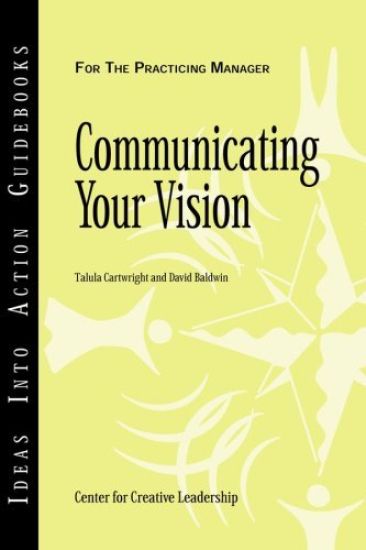
Communicating Your Vision

Communicating Your Vision

Cartwright Talula; David Baldwin

CENTRE FOR CREATIVE LEADERSHIP
2007
nidottu
A vision has to be shared in order to do what it is meant to do: inspire, clarify, and focus the work of your organization. One part of your job as a leader is to create commitment to your organization's vision. In order to do this, you have to communicate the vision effectively. In this guidebook we suggest many ways to communicate a vision. We also discuss how to deal with a resistant audience and what to do in the event that you yourself are resistant. You'll learn how to communicate a vision to others in ways that will help them understand it, remember it, and then go on to share it themselves.
Left Face

Left Face

David Cortright; Max Watts

Praeger Publishers Inc
1991
sidottu
Based on more than one hundred interviews and group discussions with low-ranking soldiers, conscripts, and volunteers, this volume provides a unique perspective on the history, and analyzes the current status, of soldier unions and resistance movements in more than twenty countries. Beginning with the isolated, spontaneous incidents that characterized military protest in the mid-1960s, the study traces the changing profile of resistance movements in the conscript armies of Europe; the volunteer forces of the United States, Great Britain, Canada, and Australia; and the armed forces of Portugal, Chile, Iran, and the Phillipines. From the information and data collected, David Cortright and Max Watts hypothesize that resistance among low-ranking soldiers occurs only in countries with a high degree of capital accumulation, a new concept they refer to as the Threshold Theory of Military Resistance.Support for the Threshold Theory is based on data extracted from in-depth descriptions of the origins and organization of military unions and protest movements in Holland, West Germany, Scandinavia, France, Italy, Spain, East Germany, and the Soviet Union, as well as in countries below the threshold. A detailed examination of the United States army's resistance activities after the Vietnam conflict, its attempted unionization, and its continuing struggle with lack of discipline and low morale completes the global scope of this work. It will offer military sociologists, scholars, social scientists, soldiers, and veterans a singular survey of the dynamics of protest within the military around the world.
Economic Sanctions

Economic Sanctions

David Cortright; George Lopez

Routledge
2019
sidottu
As the challenge of preventing military conflict has become increasingly complex in the post-Cold War era, economic sanctions are being applied with growing frequency. Sanctions are also being used to enforce international law, to deter aggression and terrorism, to defend democracy and human rights, and to prevent nuclear proliferation. This study
Peace

Peace

David Cortright

Cambridge University Press
2008
pokkari
Veteran scholar and peace activist David Cortright offers a definitive history of the human striving for peace and an analysis of its religious and intellectual roots. This authoritative, balanced, and highly readable volume traces the rise of peace advocacy and internationalism from their origins in earlier centuries through the mass movements of recent decades: the pacifist campaigns of the 1930s, the Vietnam antiwar movement, and the waves of disarmament activism that peaked in the 1980s. Also explored are the underlying principles of peace - nonviolence, democracy, social justice, and human rights - all placed within a framework of 'realistic pacifism'. Peace brings the story up-to-date by examining opposition to the Iraq War and responses to the so-called 'war on terror'. This is history with a modern twist, set in the context of current debates about 'the responsibility to protect', nuclear proliferation, Darfur, and conflict transformation.
Peace

Peace

David Cortright

Cambridge University Press
2008
sidottu
Veteran scholar and peace activist David Cortright offers a definitive history of the human striving for peace and an analysis of its religious and intellectual roots. This authoritative, balanced, and highly readable volume traces the rise of peace advocacy and internationalism from their origins in earlier centuries through the mass movements of recent decades: the pacifist campaigns of the 1930s, the Vietnam antiwar movement, and the waves of disarmament activism that peaked in the 1980s. Also explored are the underlying principles of peace - nonviolence, democracy, social justice, and human rights - all placed within a framework of 'realistic pacifism'. Peace brings the story up-to-date by examining opposition to the Iraq War and responses to the so-called 'war on terror'. This is history with a modern twist, set in the context of current debates about 'the responsibility to protect', nuclear proliferation, Darfur, and conflict transformation.
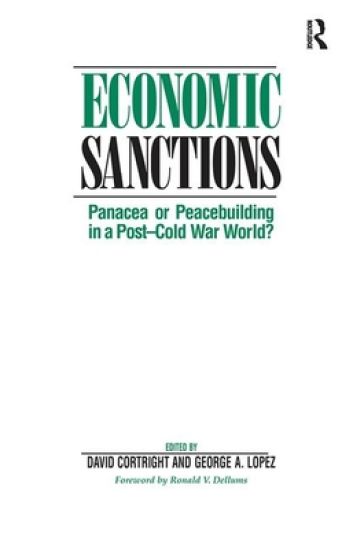
Economic Sanctions

Economic Sanctions

David Cortright; George Lopez

Westview Press Inc
1995
pokkari
As the challenge of preventing military conflict has become increasingly complex in the post-Cold War era, economic sanctions are being applied with growing frequency. Sanctions are also being used to enforce international law, to deter aggression and terrorism, to defend democracy and human rights, and to prevent nuclear proliferation. This study addresses questions about the utility, appropriateness and success or failure of sanctions, as well as their impact on the poor and innocent. Specific case studies, focusing on recent conflicts such as those in Haiti, Iraq, South Africa and the former Yugoslavia, demonstrate the principal aspects of economic sanctions.
Protest and Policy in the Iraq, Nuclear Freeze and Vietnam Peace Movements
This Element addresses questions about social movement effectiveness and the strategies and methods that are most likely to achieve policy change. It examines the nature of peace movements through a comparative analysis of three major movements, focusing on their policy impacts. It assesses social movement dynamics and the mechanisms through which movements gain influence. The purpose is to mine campaign experiences from the past to develop action guidelines for more effective citizen activism against war and nuclear weapons in the future. The Element examines non-institutional and institutional forms of politics and the relationship between the two, and how they can be mutually reinforcing. It traces examples of inside-outside approaches within the three peace movements and their effects. Lessons from the analysis and case studies are applied in the final section to proposals for a new global freeze movement to stop the emerging international arms race.
Protest and Policy in the Iraq, Nuclear Freeze and Vietnam Peace Movements
This Element addresses questions about social movement effectiveness and the strategies and methods that are most likely to achieve policy change. It examines the nature of peace movements through a comparative analysis of three major movements, focusing on their policy impacts. It assesses social movement dynamics and the mechanisms through which movements gain influence. The purpose is to mine campaign experiences from the past to develop action guidelines for more effective citizen activism against war and nuclear weapons in the future. The Element examines non-institutional and institutional forms of politics and the relationship between the two, and how they can be mutually reinforcing. It traces examples of inside-outside approaches within the three peace movements and their effects. Lessons from the analysis and case studies are applied in the final section to proposals for a new global freeze movement to stop the emerging international arms race.
Governance for Peace

Governance for Peace

David Cortright; Conor Seyle; Kristen Wall

Cambridge University Press
2017
pokkari
Governance for Peace presents a comprehensive analysis of the dimensions of governance that are most likely to prevent armed conflict and foster sustainable peace. It is an accessible study written for the general reader that brings together the best empirical evidence across numerous disciplines showing how effective governance and inclusive, participatory, and accountable institutions help to reduce violence by addressing social needs and providing mechanisms for resolving disputes. This balanced and incisive book gives meaning to the term 'good governance' and identifies the specific features of political and economic institutions that are most likely to promote peace within and between states. Concepts and topics examined in the book include political legitimacy, human security, 'political goods', governance and power, inclusion, accountability, social cohesion, gender equality, countering corruption, the role of civil society, democratic participation, development as freedom, capitalism and economic growth, the governance of markets, China and the 'East Asian peace', the European Union, and global institutions.
Governance for Peace

Governance for Peace

David Cortright; Conor Seyle; Kristen Wall

Cambridge University Press
2017
sidottu
Governance for Peace presents a comprehensive analysis of the dimensions of governance that are most likely to prevent armed conflict and foster sustainable peace. It is an accessible study written for the general reader that brings together the best empirical evidence across numerous disciplines showing how effective governance and inclusive, participatory, and accountable institutions help to reduce violence by addressing social needs and providing mechanisms for resolving disputes. This balanced and incisive book gives meaning to the term 'good governance' and identifies the specific features of political and economic institutions that are most likely to promote peace within and between states. Concepts and topics examined in the book include political legitimacy, human security, 'political goods', governance and power, inclusion, accountability, social cohesion, gender equality, countering corruption, the role of civil society, democratic participation, development as freedom, capitalism and economic growth, the governance of markets, China and the 'East Asian peace', the European Union, and global institutions.
Gandhi and Beyond

Gandhi and Beyond

David Cortright

Paradigm
2006
sidottu
"David Cortright is a life-long activist and respected scholar. In Gandhi and Beyond, he convincingly shows the power of nonviolence as a philosophy of life, not just a method of social action. His practical analysis of Gandhi, Martin Luther King, Dorothy Day, Cesar Chavez, and others brings new insights and inspiration to those of us attempting to live that philosophy, and to those, especially a new generation, who are seeking a better way to respond to their world. I commend this book to all who are seeking an alternative to violence." Jim Wallis, author of God's Politics and editor of Sojourners Is there room for nonviolence in an age of terrorism? Drawing on the legend and lessons of Gandhi, Cortright traces the history of nonviolent social activism through the early twentieth century to the civil rights movement, the Vietnam era, and up to the present war in Iraq. Gandhi and Beyond offers a critical evaluation and refinement of Gandhi's message, laying the foundation for a renewed and deepened dedication to nonviolence as the universal path to social progress and antidote to terrorism.