Kirjojen hintavertailu. Mukana 11 244 527 kirjaa ja 12 kauppaa.

Kirjahaku

Etsi kirjoja tekijän nimen, kirjan nimen tai ISBN:n perusteella.

1000 tulosta hakusanalla David Reuben

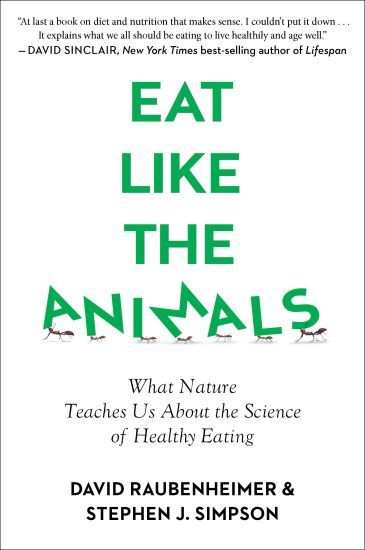
Eat Like the Animals: What Nature Teaches Us about the Science of Healthy Eating

Eat Like the Animals: What Nature Teaches Us about the Science of Healthy Eating

David Raubenheimer; Stephen J. Simpson

HOUGHTON MIFFLIN
2020
mp3 cd-levyllä
Our evolutionary ancestors once possessed the ability to intuit what food their bodies needed, in what proportions, and ate the right things in the proper amounts--effortlessly balanced. When and why did we lose this ability, and how can we get it back? David Raubenheimer and Stephen Simpson answer these questions in a compelling narrative, based upon five "eureka" moments they experienced in the course of their groundbreaking research. The book shares their colorful scientific journey--from the foothills of Cape Town, to the deserts of Australia--culminating in a unifying theory of nutrition that has profound implications for our current epidemic of metabolic diseases and obesity. The authors ultimately offer useful prescriptions to understand the unwanted side effects of fad diets, gain control over one's food environment, and see that delicious and healthy are integral parts of proper eating.
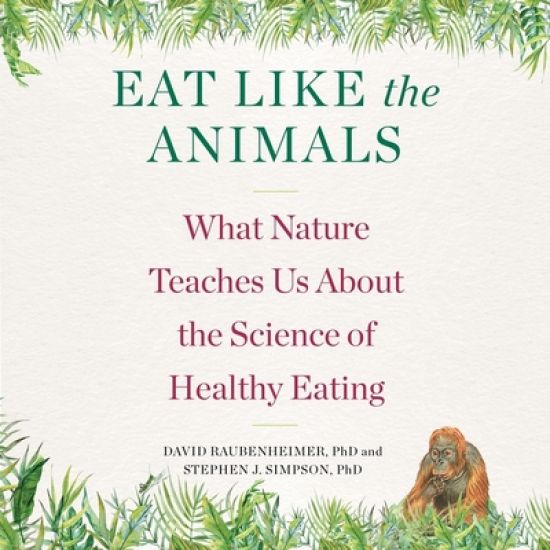
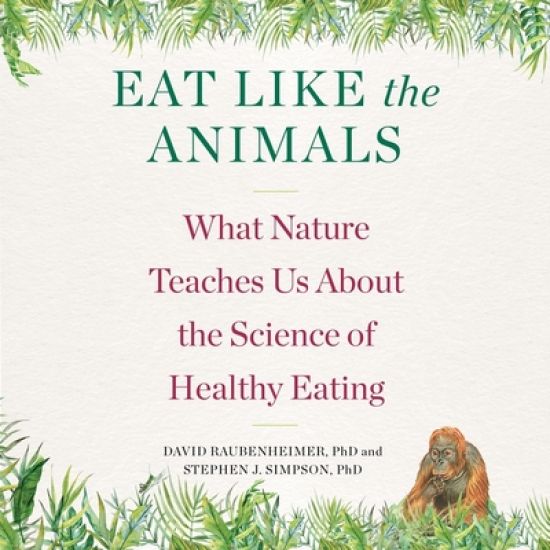
Eat Like the Animals Lib/E: What Nature Teaches Us about the Science of Healthy Eating
Our evolutionary ancestors once possessed the ability to intuit what food their bodies needed, in what proportions, and ate the right things in the proper amounts--effortlessly balanced. When and why did we lose this ability, and how can we get it back? David Raubenheimer and Stephen Simpson answer these questions in a compelling narrative, based upon five "eureka" moments they experienced in the course of their groundbreaking research. The book shares their colorful scientific journey--from the foothills of Cape Town, to the deserts of Australia--culminating in a unifying theory of nutrition that has profound implications for our current epidemic of metabolic diseases and obesity. The authors ultimately offer useful prescriptions to understand the unwanted side effects of fad diets, gain control over one's food environment, and see that delicious and healthy are integral parts of proper eating.
Strategic Risk and Crisis Management

Strategic Risk and Crisis Management

David Rubens

KOGAN PAGE LTD
2023
nidottu
From natural disasters to cyber-attacks to global pandemics, the modern risk environment is highly complex and challenges our fundamental understanding of risk and crisis management. All senior risk and crisis managers face a similar challenge: maximizing their organization's ability to prepare for a potential high-impact event. Blending practical insights with rigorous research, Strategic Risk and Crisis Management provides a range of realistic solutions for any operational environment. It introduces concepts, frameworks and processes that will allow businesses to not only survive but respond and recover at a time of maximum chaos and confusion. Authored by a recognized global authority on the strategic management of complex events, the book covers the integration of multiple stakeholders and the importance of information exchange and critical decision-making under pressure at strategic, tactical and operational levels. It also includes material on leadership, sense-making, resilience, wicked problems and the challenges of global urban resilience, as well as case studies with detailed analysis of organizational failures and the lessons learned, including COVID-19, the WannaCry attack, the Texas snowstorm, and the Gatwick Airport Drone Incident. Strategic Risk and Crisis Management is an essential read for professionals working in security, risk, crisis management and emergency response. It will also be a valuable text for university students taking modules on security, risk, emergency response and crisis management.
Strategic Risk and Crisis Management

Strategic Risk and Crisis Management

David Rubens

KOGAN PAGE LTD
2023
sidottu
From natural disasters to cyber-attacks to global pandemics, the modern risk environment is highly complex and challenges our fundamental understanding of risk and crisis management. All senior risk and crisis managers face a similar challenge: maximizing their organization's ability to prepare for a potential high-impact event. Blending practical insights with rigorous research, Strategic Risk and Crisis Management provides a range of realistic solutions for any operational environment. It introduces concepts, frameworks and processes that will allow businesses to not only survive but respond and recover at a time of maximum chaos and confusion. Authored by a recognized global authority on the strategic management of complex events, the book covers the integration of multiple stakeholders and the importance of information exchange and critical decision-making under pressure at strategic, tactical and operational levels. It also includes material on leadership, sense-making, resilience, wicked problems and the challenges of global urban resilience, as well as case studies with detailed analysis of organizational failures and the lessons learned, including COVID-19, the WannaCry attack, the Texas snowstorm, and the Gatwick Airport Drone Incident. Strategic Risk and Crisis Management is an essential read for professionals working in security, risk, crisis management and emergency response. It will also be a valuable text for university students taking modules on security, risk, emergency response and crisis management.
The Nature of Nutrition

The Nature of Nutrition

Stephen J. Simpson; David Raubenheimer

PRINCETON UNIVERSITY PRESS
2012
sidottu
Nutrition has long been considered more the domain of medicine and agriculture than of the biological sciences, yet it touches and shapes all aspects of the natural world. The need for nutrients determines whether wild animals thrive, how populations evolve and decline, and how ecological communities are structured. The Nature of Nutrition is the first book to address nutrition's enormously complex role in biology, both at the level of individual organisms and in their broader ecological interactions. Stephen Simpson and David Raubenheimer provide a comprehensive theoretical approach to the analysis of nutrition--the Geometric Framework. They show how it can help us to understand the links between nutrition and the biology of individual animals, including the physiological mechanisms that determine the nutritional interactions of the animal with its environment, and the consequences of these interactions in terms of health, immune responses, and lifespan. Simpson and Raubenheimer explain how these effects translate into the collective behavior of groups and societies, and in turn influence food webs and the structure of ecosystems. Then they demonstrate how the Geometric Framework can be used to tackle issues in applied nutrition, such as the problem of optimizing diets for livestock and endangered species, and how it can also help to address the epidemic of human obesity and metabolic disease Drawing on a wealth of examples from slime molds to humans, The Nature of Nutrition has important applications in ecology, evolution, and physiology, and offers promising solutions for human health, conservation, and agriculture.
Yua: Spirit of the Arctic

Yua: Spirit of the Arctic

William Fitzhugh; Chuna Mcintyre; Hillary Olcott; David Ruben Piqtoukun; Abraham Anghik Ruben

Prestel
2020
sidottu
Over the course of his life, artist, adventurer, and collector Thomas G. Fowler gathered a rich and diverse group of works by Native artists from the Arctic. He was inspired by the concept of yua, a recognition that all things, including objects, have a unique inner essence or spirit. The works in his collection embody this view and highlight the raw materials used to make them— walrus tusk, whale bone, driftwood, stone—evoking the Arctic environment and attesting to Fowler’s appreciation of form and design. With works dating from 300 BCE to the 21st century, his collection includes objects meant to be used and admired: utensils, weapons, dance regalia, kayak models, decorative pipes, and cribbage boards. It also features dynamic, mixed-media sculptures by contemporary artists such as Abraham Anghik Ruben, David Ruben Piqtoukun, Judas Ullulaq, and Susie Silook. With colour illustrations highlighting eighty objects, this book explores a variety of topics relating to the North American Arctic region: the ancient cultures of the Bering Strait, historic ways of life in northwestern Alaska, the ethos of Yup’ik dance, and the history of collecting Arctic art. Combining art historical and anthropological essays with lively, personal accounts from modern artists and scholars, the volume explores the connection between humans and the environment, the interwoven nature of the spiritual and the quotidian, and the aesthetics of Arctic life.
Action and its Explanation

Action and its Explanation

David-Hillel Ruben

Clarendon Press
2003
sidottu
David-Hillel Ruben's new book pursues some novel and unusual standpoints in the philosophy of action. He rejects, for example, the most widely held view about how to count actions, and argues for what he calls a 'prolific theory' of act individuation. He also describes and argues against the two leading theories of the nature of action, the causal theory and the agent causal theory. The causal theory cannot account for skilled activity, nor for mental action. The agent causalist theory unnecessarily reifies causings. He identifies an assumption that they share, and that most action theorists have assumed to be unproblematic and uncontroversial, that an action is, or entails the existence of, an event. Several different meanings to that claim are disentangled and in the most interesting sense of that claim, Ruben denies that it is true. His own alternative is simple and unpretentious: nothing informative can be said about the nature of action that explicates action in any other terms. Ruben sketches a theory of causal explanation of action that eschews the requirement for laws or generalisations, and this effectively quashes one argument for the oft-repeated view that no explanations of action can be causal, on the grounds that there are no convincing cases of laws of human action. He addresses a number of questions about the knowledge an agent has of his own actions, looking particularly at examples of pathological cases of action in which, for one reason or another, the agent does not know what he is doing. Inspiring and enlightening in its challenge to received wisdom, and in its convincing defence of some unfashionable positions, Action and its Explanation will be required reading for anyone working in this field.
Explaining Explanation

Explaining Explanation

David-Hillel Ruben

Routledge
1992
nidottu
This book introduces readers to the topic of explanation. The insights of Plato, Aristotle, J.S. Mill and Carl Hempel are examined, and are used to argue against the view that explanation is merely a problem for the philosophy of science. Having established its importance for understanding knowledge in general, the book concludes with a bold and original explanation of explanation.
Explaining Explanation

Explaining Explanation

David-Hillel Ruben

Paradigm
2012
sidottu
This second edition of David-Hillel Ruben's influential and highly acclaimed book on the philosophy of explanation has been revised and expanded, and the author has made substantial changes in light of the extensive reviews the first edition received. Ruben's views on the place of laws in explanation has been refined and clarified. What is perhaps the central thesis of the book, his realist view of explanation, describing the way in which explanation depends on metaphysics, has been updated and extended and engages with some of the work in this area published since the book's first edition.
Explaining Explanation

Explaining Explanation

David-Hillel Ruben

Paradigm
2012
nidottu
This second edition of David-Hillel Ruben's influential and highly acclaimed book on the philosophy of explanation has been revised and expanded, and the author has made substantial changes in light of the extensive reviews the first edition received. Ruben's views on the place of laws in explanation has been refined and clarified. What is perhaps the central thesis of the book, his realist view of explanation, describing the way in which explanation depends on metaphysics, has been updated and extended and engages with some of the work in this area published since the book's first edition.
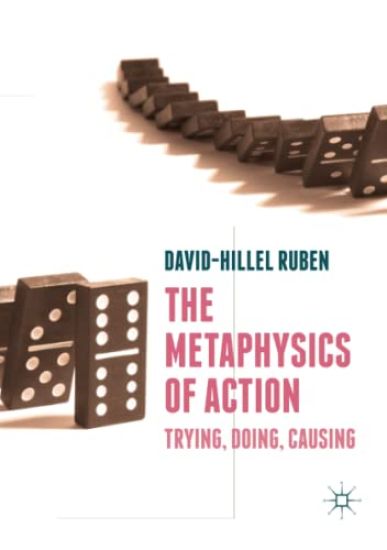
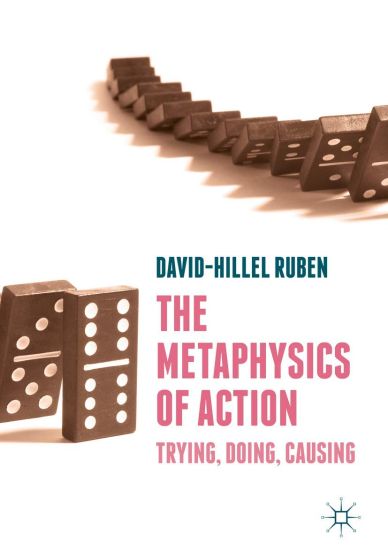
The Metaphysics of Action

The Metaphysics of Action

David-Hillel Ruben

Springer Nature Switzerland AG
2019
nidottu
In this book, the author provides an account of three central ideas in the philosophy of action: trying to act, acting or doing, and one’s action causing further consequences. In all three cases, novel theories of these phenomena are offered: trying to act is not a particular mental or physical act but can be explained using conditionals; that action is not the same as causing something to happen; and in the case of a special but important subset of actions, for example the opening of a window, the action is identical to the event of the window’s opening. A result of this last account is that it places actions out in the world, sometimes far removed in time and space from the actor’s body. The world is full of action; actions do not just exist in the many little islands of space and time that all of our bodies inhabit. In the final chapter, Ruben describes and discusses a skeptical challenge to the idea that we can ever know whether or not someone else has acted, rather than just passive events having happened to that person.
The Metaphysics of Action

The Metaphysics of Action

David-Hillel Ruben

Springer International Publishing AG
2018
sidottu
In this book, the author provides an account of three central ideas in the philosophy of action: trying to act, acting or doing, and one’s action causing further consequences. In all three cases, novel theories of these phenomena are offered: trying to act is not a particular mental or physical act but can be explained using conditionals; that action is not the same as causing something to happen; and in the case of a special but important subset of actions, for example the opening of a window, the action is identical to the event of the window’s opening. A result of this last account is that it places actions out in the world, sometimes far removed in time and space from the actor’s body. The world is full of action; actions do not just exist in the many little islands of space and time that all of our bodies inhabit. In the final chapter, Ruben describes and discusses a skeptical challenge to the idea that we can ever know whether or not someone else has acted, rather than just passive events having happened to that person.
Beyond Wall Street

Beyond Wall Street

Rubenstein David

HarperCollins
2009
sidottu
Rubenstein offers the first look at an industry that touches ordinary investors through pension funds, university and charitable endowments, and funds that may someday be available to almost anyone who is attracted to returns that consistently outperform the stock market.