Reprint of the original, first published in 1859. The publishing house Anatiposi publishes historical books as reprints. Due to their age, these books may have missing pages or inferior quality. Our aim is to preserve these books and make them available to the public so that they do not get lost.
Reprint of the original, first published in 1859. The publishing house Anatiposi publishes historical books as reprints. Due to their age, these books may have missing pages or inferior quality. Our aim is to preserve these books and make them available to the public so that they do not get lost.
The world of community development finance has grown increasingly sophisticated in its multi-faceted responses to poverty, joblessness and environmental degradation. One of the most sophisticated approaches involves the marriage of the tools of venture capital and private equity investing with a wide range of social goals. This approach — what is termed by its adherents 'community venture capital'— has been successful at stimulating productive economic activity in resource-starved communities while encouraging the creation and growth of business dedicated to the 'double bottom line.' The authors of Standard Documents for Community Development Venture Capital Transactions have adapted the model documents found in Joe Bartlett's Equity Finance treatise for use by a coalition of funds engaged in a different kind of private equity investing. Co-published with Community Development Venture Capital Transactions.
Now that I am eighty years old, I feel that I have learned a few things about living. Honesty: A person's word is his/her honor. There are times when it is tempting to tell a falsehood, but if the truth is found out, the trust of another person is likely to be lost, and it may not ever be regained. However, one should not be brutally honest if it will hurt someone unnecessarily, and there are times when a little blarney adds zest to a conversation and a relationship. Appreciation and Compliments: All of us have a need to feel worthwhile and of some importance, and honest compliments foster those feelings. Compliments don't have to be about big things. They can be about little things: "You look very nice." "The dinner was really good." Thank you's, both written and oral, are important. On the other hand, slurs cast a dark shadow on the speaker as well as on the one being talked about. Outlook: It is more enjoyable to be with someone who has a pleasant outlook than with someone who has a negative one. Sarcasm: Should be used sparingly, if at all. It has a cutting edge which tends to be hurtful. Graciousness: There are many definitions for graciousness, but the one I like best is that it is that quality which, simply, makes another person comfortable. It is the quality which is entailed in all of the above suggestions. My father-in-law, Dr. Tom Hawkins, was a wise man. He said, "Don't take yourself too seriously, and let your friends fight your battles for you." Doing nice things for others brings happiness, so be kind, and, if you want to have friends, be one.
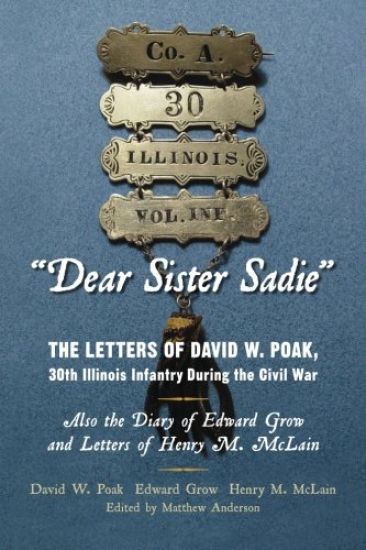
The letters and diaries of three civil war soldiers from the 30th Illinois Infantry during the Civil War. These writings give insight to what a soldier that served with this regiment experienced from the letters they wrote home and the diaries that was written as a personal record of their experience. David W. Poak was well educated and quite literate, Edward Grow and even more so Henry McLain wrote the words as they sounded to them. I tried to keep their spelling and punctuation as close to their written text as possible so the reader can get a better feel for the soldier himself.This is a book for those who are familiar with the Civil War and are looking to expand their knowledge from the soldier's perspective."Sister Sadie" or "Dear Sister" was how David Watson Poak usually addressed his many letters to Sarah J. Poak during his Civil War service with Company A, 30th Illinois Infantry. D. W. Poak was born and raised in Mt. Jackson, Lawrence Co., Pennsylvania, which was a small farming community in the mid-nineteenth century. He and his sister Sadie were the only children born to John Poak and Sarah Duff Poak. Their mother died in 1847. and the father married Emeline McCurley and they had two daughters, Ella and Nancy. His sister Sadie was born in 1841, David was born 1842, Ella in 1854 and Nancy 1859. Sometime around 1858-9 David W. Poak moved to Millersburg, Mercer County, Illinois along with another dozen or so residents of Lawrence County, PA. Mercer County was a thriving area of Illinois at the time, and towns like Aledo, the county seat, Millersburg, Keithsburg, New Boston, Viola and others were growing In Millersburg his occupation was a teacher, and he did this until the call came for volunteers from the state of Illinois to suppress the rebellion. So on August 12, 1861 David W. Poak enlisted into Co. A, 30th Illinois Volunteer Infantry as a Sergeant. The enlistment record says Poak was twenty years old, five foot five and a quarter inches tall, fair complexion, blue eyes, and had sandy colored hair. During the conflict on January 33, 1863 he would rise to the rank of 1st Lieutenant. During the Battle of Atlanta on July 22nd, 1864 he became acting adjutant and received the Seventeenth Corp Silver Medal of Honor for bravery. After the war, David Poak returned to Millersburg, IL, then moved to the newly incorporated town of Pleasanton, Linn County, Kansas. There he became a school director on February 19, 1870 and was elected Pleasanton's first mayor on October 25th, 1870. In 1872 he is listed as cashier for the Fannin County Bank in Bonham, Fannin County, Texas. In the 1876-77 City Directory for Sherman, TX his occupation is listed as vice-president of the Bank of Sherman, Grayson Co., TX. Sometime afterwards he went back to his home in Mt. Jackson, PA. His obituary on page one of the New Castle Courant, dated April 4th, 1879, stated that David W. Poak died "last week" (March 27th, 1879) at his home of consumption and is buried at the Westfield Presbyterian Church Cemetery. As for his sister Sarah J Polk, she married James Hayes October 26th, 1893. She died in 1919 and is also buried at the Westfield Presbyterian Church Cemetery.