Kirjojen hintavertailu. Mukana 11 717 486 kirjaa ja 12 kauppaa.

Kirjahaku

Etsi kirjoja tekijän nimen, kirjan nimen tai ISBN:n perusteella.

1000 tulosta hakusanalla David Williams

America Illustrated. Edited by J. D. Williams.

America Illustrated. Edited by J. D. Williams.

J David Williams

British Library, Historical Print Editions
2011
pokkari
Title: America Illustrated. Edited by J. D. Williams.Publisher: British Library, Historical Print EditionsThe British Library is the national library of the United Kingdom. It is one of the world's largest research libraries holding over 150 million items in all known languages and formats: books, journals, newspapers, sound recordings, patents, maps, stamps, prints and much more. Its collections include around 14 million books, along with substantial additional collections of manuscripts and historical items dating back as far as 300 BC.The HISTORY OF COLONIAL NORTH AMERICA collection includes books from the British Library digitised by Microsoft. This collection refers to the European settlements in North America through independence, with emphasis on the history of the thirteen colonies of Britain. Attention is paid to the histories of Jamestown and the early colonial interactions with Native Americans. The contextual framework of this collection highlights 16th century English, Scottish, French, Spanish, and Dutch expansion. ++++The below data was compiled from various identification fields in the bibliographic record of this title. This data is provided as an additional tool in helping to insure edition identification: ++++ British Library Williams, J David; 1876. 121 p.; 4 . 10411.i.20.
Death of a Prodigal

Death of a Prodigal

David Williams

HARPERCOLLINS PUBLISHERS
2014
pokkari
Mervyn Davies left South Wales under a cloud forty years ago, but now he's back to collect a vast inheritance left to him by his childhood friend Edwin Edworth. Some are surprised; others are disgusted ... but who wanted him dead?
Dead in the Market

Dead in the Market

David Williams

HARPERCOLLINS PUBLISHERS
2014
pokkari
DCI Merlin Parry has to use all his skill and experience to crack a murder case where the victim was killed in front of thousands of shoppers, but not a single witness is to be found.
Elements of Mechanics

Elements of Mechanics

David Williams

Oxford University Press
1997
nidottu
Mechanics is the first foundation for the study of physics. This book takes first-year undergraduates through an entertaining and instructive set of practical examples of the uses of mechanics. The author adopts a fresh approach which recognizes mechanics as an observational science, and uses worked examples that can be easily visualized and understood by the reader. By the end of the book students will have not only painlessly learned the principles of mechanics, but will have also obtained a good grasp of techniques needed for solving typical mechanics problems. They will also have covered all the essentials of a first-year university course in mechanics. The book can then be used as a reference of a quick aid to revision.
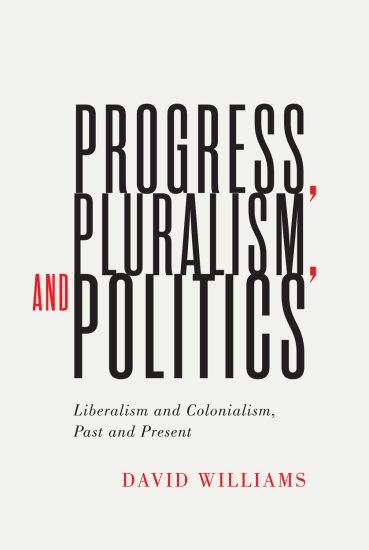
Progress, Pluralism, and Politics

Progress, Pluralism, and Politics

David Williams

McGill-Queen's University Press
2020
sidottu
Liberal thinkers of the eighteenth and nineteenth centuries were alert to the political costs and human cruelties involved in European colonialism, but they also thought that European expansion held out progressive possibilities. In Progress, Pluralism, and Politics David Williams examines the colonial and anti-colonial arguments of Adam Smith, Immanuel Kant, Jeremy Bentham, and L.T. Hobhouse.Williams locates their ambivalent attitude towards European conquest and colonial rule in a set of tensions between the impact of colonialism on European states, the possibilities of progress in distant and diverse places, and the relationship between universalism and cultural pluralism. In so doing he reveals some of the central ambiguities that characterize the ways that liberal thought has dealt with the reality of an illiberal world. Of particular importance are appeals to various forms of universal history, attempts to mediate between the claims of identity and the reality of difference, and the different ways of thinking about the achievement of liberal goods in other places.Pointing to key elements in still ongoing debates within liberal states about how they should relate to illiberal places, Progress, Pluralism, and Politics enriches the discussion on political thought and the relationship between liberalism and colonialism.
Progress, Pluralism, and Politics

Progress, Pluralism, and Politics

David Williams

McGill-Queen's University Press
2020
nidottu
Liberal thinkers of the eighteenth and nineteenth centuries were alert to the political costs and human cruelties involved in European colonialism, but they also thought that European expansion held out progressive possibilities. In Progress, Pluralism, and Politics David Williams examines the colonial and anti-colonial arguments of Adam Smith, Immanuel Kant, Jeremy Bentham, and L.T. Hobhouse.Williams locates their ambivalent attitude towards European conquest and colonial rule in a set of tensions between the impact of colonialism on European states, the possibilities of progress in distant and diverse places, and the relationship between universalism and cultural pluralism. In so doing he reveals some of the central ambiguities that characterize the ways that liberal thought has dealt with the reality of an illiberal world. Of particular importance are appeals to various forms of universal history, attempts to mediate between the claims of identity and the reality of difference, and the different ways of thinking about the achievement of liberal goods in other places.Pointing to key elements in still ongoing debates within liberal states about how they should relate to illiberal places, Progress, Pluralism, and Politics enriches the discussion on political thought and the relationship between liberalism and colonialism.
The Communion of the Book

The Communion of the Book

David Williams

MCGILL-QUEEN'S UNIVERSITY PRESS
2022
sidottu
The modern world was not created by the civilization of Renaissance Italy, the advent of the printing press, or the marriage restrictions imposed by the medieval church. Rather, it was widespread reading that brought about most of the cognitive, psychological, and social changes that we recognize as peculiarly modern.David Williams combines book and communications history with readings of major works by Petrarch, Bruni, Valla, Reuchlin, Erasmus, Foxe, and Milton to argue that expanding literacy in the Renaissance was the impetus for modern civilization, turning a culture of arid logic and religious ceremonialism into a world of individual readers who discovered a new form of communion in the act of reading. It was not the theologians Luther and Calvin who first taught readers to become what they read, but the biblical philologist Erasmus, who encountered the divine presence on every page of the gospels. From this sacramental form of reading came other modes of humanist reading, particularly in law, history, and classics, leading to the birth of the nation-state. As literacy rates rose, readers of all backgrounds gained and embodied the distinctly modern values of liberty, free speech, toleration, individualism, self-determination, and democratic institutions. Communion and community were linked, performed in novel ways through revolutionary forms of reading. In this conclusion to a quartet of books on media change, Williams makes a compelling case for readers and acts of reading as the true drivers of social, political, and cultural modernity – and for digital media as its looming nemesis.
Liberalism in Time

Liberalism in Time

David Williams

MCGILL-QUEEN'S UNIVERSITY PRESS
2025
sidottu
We are living through a crisis that casts doubt on the idea of progress, the defining trope of liberalism. The concept of progress as the achievement of liberalism developed over time, in relation to changing ideas about time. Understanding skepticism about progress requires us to ask questions about the relationship between liberalism, time, and history.Drawing on a range of thinkers from John Locke to John Rawls, Liberalism in Time links the history of liberal thought with wider changes in theology, geology, archaeology, and biology. David Williams explores the diverse ways in which liberal thinkers have understood the relationship between liberalism and time, demonstrating that liberal patterns of thought are characterized by temporal paradoxes. Liberal thinkers ostensibly understand liberalism as situated within time and history, but they treat it as timeless when it is convenient.Reflecting on whether and how liberal thinking about time and history is suitable for the challenges liberalism now faces, Liberalism in Time shows how temporal paradoxes have characterized liberal patterns of thought throughout history.
Ken Frane Short Stories

Ken Frane Short Stories

David Williams

Lulu.com
2019
pokkari
Five Short Stories to excite and enthrall. Here are examples of the anti-detective novel genre. Ken Frane is not a very successful gumshoe but he is tenacious. Former police detective turned private investigator he embarks on a number of strange and challenging cases. After a gentle introduction to the protagonist himself in the Dubrovnik Postcard affair he takes a holiday in Barmouth which turns into Big trouble in little Bermo. His lifelong love of Cardiff City FC gives him that extra bit of insight into solving the Bluebird Voodoo Doll. The Welsh political establishment is shaken by the murder of Andrew Leighton on the steps of the National Assembly and Ken Frane is inadvertently drawn into the Arab Israeli conflict in the final short story Farewell and a Jew. Tall tales that will keep you thinking long after you have closed the book.
The Leiden Triangle Mystery

The Leiden Triangle Mystery

David Williams

Lulu.com
2017
pokkari
Ken Frane, antediluvian anti-hero, the last of the Cardiff Docks' detectives. Former Detective with South Wales C.I.D now fallen from grace, picking up whatever jobs and leads his old friends can provide him with. Ken Frane, old school, flies to the Netherlands to act as advisor on a disturbing child murder case to his old friend Jan Van der Bleet of Politie.nl Frane is introduced in a short story at the beginning in the 'Dubrovnik Postcard' affair and then we follow the hard bitten private investigator as he navigates the biker gangs and right wing extremists of modern day Netherlands. Once you see how Ken Frane operates in this opening novella, you will be wanting more and more.
Sign of the Times

Sign of the Times

David Williams

Lulu.com
2018
pokkari
Clenched Fist Poetry from the Punk Performance Poet. Since his last book 'Graffiti Girls' David has been combining humorous verse and angry rants to give you his latest offering which is indeed a 'Sign of the Times'. Contemporary Wales is his backdrop and he is more than a little disappointed with the current state of play at the Welsh Assembly.Drawing from the influences of his heroes, Charles Bukowski, John Cooper Clarke and Cardiff Poet John Tripp, Williams attempts to awaken the latent anarchic spirit in his readership."nothing less than a revolution' said a translated Saunders Lewis.
The Miners' Strike Mystery

The Miners' Strike Mystery

David Williams

Lulu.com
2018
pokkari
Ken Frane returns to the Valleys of his childhood. Antediluvian anti-hero reopens a cold case from the Miners' Strike, when he was a beat copper in Cardiff, called back to police the industrial dispute. Ken Frane 'Last of the Cardiff Docks' detectives' on his second adventure, on home turf this time, having returned none too successfully from Leiden in the Netherlands in the first novella. The charred remains of striking miner Andy Halligan are found on a mattress up the Twyn in 1985 and it wasn't because he was a scab. This is an anti-detective novel which rejects the expected outcome of restored order found in most mysteries.STRONG LANGUAGE/ADULT CONTENT Over 16 Advisory
Japan: Beyond the End of History

Japan: Beyond the End of History

David Williams

Routledge
1993
nidottu
In this analysis of Japan's policy-making, David Williams places his argument within the debates about Japanese political economy in the United States and Britain, debates previously polarised between `market' and `ministry' views. He presents Japanese-style nationalist development as a serious challenge to Western values and theory.
Japan and the Enemies of Open Political Science
The central argument of Japan and the Enemies of Open Political Science is that Eurocentric blindness is not a moral but a scientific failing. In this wide-ranging critique of Western social science, Anglo-American philosophy and French theory, Williams works on the premise that Japan is the most important political system of our time. He explains why social scientists have been so keen to ignore or denigrate Japan's achievements. If social science is to meet the needs of the `Pacific Century', it requires a sustained act of intellectual demolition and subsequent renewal.
Japan and the Enemies of Open Political Science
The central argument of Japan and the Enemies of Open Political Science is that Eurocentric blindness is not a moral but a scientific failing. In this wide-ranging critique of Western social science, Anglo-American philosophy and French theory, Williams works on the premise that Japan is the most important political system of our time. He explains why social scientists have been so keen to ignore or denigrate Japan's achievements. If social science is to meet the needs of the `Pacific Century', it requires a sustained act of intellectual demolition and subsequent renewal.
Defending Japan's Pacific War

Defending Japan's Pacific War

David Williams

Routledge
2004
sidottu
This book puts forward a revisionist view of Japanese wartime thinking. It seeks to explore why Japanese intellectuals, historians and philosophers of the time insisted that Japan had to turn its back on the West and attack the United States and the British Empire. Based on a close reading of the texts written by members of the highly influential Kyoto School, and revisiting the dialogue between the Kyoto School and the German philosopher Heidegger, it argues that the work of Kyoto thinkers cannot be dismissed as mere fascist propaganda, and that this work, in which race is a key theme, constitutes a reasoned case for a post-White world. The author also argues that this theme is increasingly relevant at present, as demographic changes are set to transform the political and social landscape of North America and Western Europe over the next fifty years.
Defending Japan's Pacific War

Defending Japan's Pacific War

David Williams

Routledge
2004
nidottu
This book puts forward a revisionist view of Japanese wartime thinking. It seeks to explore why Japanese intellectuals, historians and philosophers of the time insisted that Japan had to turn its back on the West and attack the United States and the British Empire. Based on a close reading of the texts written by members of the highly influential Kyoto School, and revisiting the dialogue between the Kyoto School and the German philosopher Heidegger, it argues that the work of Kyoto thinkers cannot be dismissed as mere fascist propaganda, and that this work, in which race is a key theme, constitutes a reasoned case for a post-White world. The author also argues that this theme is increasingly relevant at present, as demographic changes are set to transform the political and social landscape of North America and Western Europe over the next fifty years.
The World Bank and Social Transformation in International Politics
In the 1990s the World Bank changed its policy to take the position that the problems of poverty and governance are inextricably linked, and improving the governance of its borrower countries became increasingly accepted as a legitimate and important part of the World Bank’s development activities. This book examines why the World Bank came to see good governance as important and evaluate what the World Bank is doing to improve the governance of its borrower countries. David Williams examines changing World Bank policy since the late 1970s to show how a concern with good governance grew out of the problems the World Bank was experiencing with structural adjustment lending, particularly in Sub-Saharan Africa. The book provides an account of the early years of the World Bank and traces the increasing acceptance of the idea of good governance within the Bank through the 1990s, while systematically relating the policies of good governance to liberalism. The author provides a detailed case study of World Bank lending to Ghana to demonstrate what the attempt to improve ‘governance’ looks like in practice. Williams assesses whether the World Bank has been successful in its attempts to improve governance, and draws out some of the implications of the argument for how we should think about sovereignty, for how we should understand the connections between liberalism and international politics.This book will be of interest to students and scholars of international relations, politics, economics, development and African studies.