Kirjojen hintavertailu. Mukana 11 699 587 kirjaa ja 12 kauppaa.

Kirjahaku

Etsi kirjoja tekijän nimen, kirjan nimen tai ISBN:n perusteella.

1000 tulosta hakusanalla Denes McIntosh

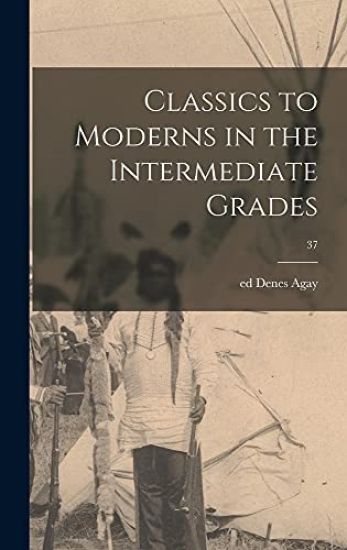
Classics to Moderns in the Intermediate Grades; 37

Classics to Moderns in the Intermediate Grades; 37

Denes Ed Agay

Hassell Street Press
2021
sidottu
This work has been selected by scholars as being culturally important and is part of the knowledge base of civilization as we know it.This work is in the public domain in the United States of America, and possibly other nations. Within the United States, you may freely copy and distribute this work, as no entity (individual or corporate) has a copyright on the body of the work.Scholars believe, and we concur, that this work is important enough to be preserved, reproduced, and made generally available to the public. To ensure a quality reading experience, this work has been proofread and republished using a format that seamlessly blends the original graphical elements with text in an easy-to-read typeface.We appreciate your support of the preservation process, and thank you for being an important part of keeping this knowledge alive and relevant.
Classics to Moderns in the Intermediate Grades; 37

Classics to Moderns in the Intermediate Grades; 37

Denes Ed Agay

Hassell Street Press
2021
nidottu
This work has been selected by scholars as being culturally important and is part of the knowledge base of civilization as we know it.This work is in the public domain in the United States of America, and possibly other nations. Within the United States, you may freely copy and distribute this work, as no entity (individual or corporate) has a copyright on the body of the work.Scholars believe, and we concur, that this work is important enough to be preserved, reproduced, and made generally available to the public. To ensure a quality reading experience, this work has been proofread and republished using a format that seamlessly blends the original graphical elements with text in an easy-to-read typeface.We appreciate your support of the preservation process, and thank you for being an important part of keeping this knowledge alive and relevant.
Theory of Finite and Infinite Graphs

Theory of Finite and Infinite Graphs

Denes König

Birkhauser Boston Inc
2012
nidottu
To most graph theorists there are two outstanding landmarks in the history of their subject. One is Euler's solution of the Konigsberg Bridges Problem, dated 1736, and the other is the appearance of Denes Konig's textbook in 1936. "From Konigsberg to Konig's book" sings the poetess, "So runs the graphic tale ..." [10]. There were earlier books that took note of graph theory. Veb- len's Analysis Situs, published in 1931, is about general combinato- rial topology. But its first two chapters, on "Linear graphs" and "Two-Dimensional Complexes", are almost exclusively concerned with the territory still explored by graph theorists. Rouse Ball's Mathematical Recreations and Essays told, usually without proofs, of the major graph-theoretical advances ofthe nineteenth century, of the Five Colour Theorem, of Petersen's Theorem on I-factors, and of Cayley's enumerations of trees. It was Rouse Ball's book that kindled my own graph-theoretical enthusiasm. The graph-theoretical papers of Hassler Whitney, published in 1931-1933, would have made an excellent textbook in English had they been collected and published as such. But the honour of presenting Graph Theory to the mathe- matical world as a subject in its own right, with its own textbook, belongs to Denes Konig. Low was the prestige of Graph Theory in the Dirty Thirties. It is still remembered, with resentment now shading into amuse- ment, how one mathematician scorned it as "The slums of Topol- ogy".
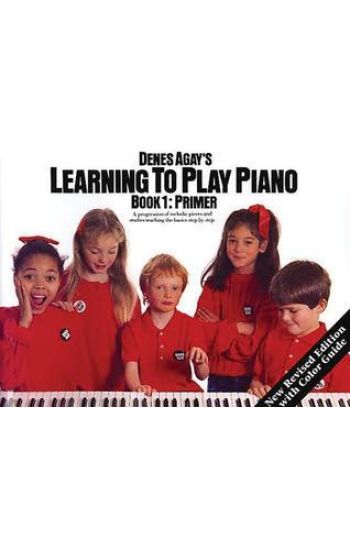
The Joy of First-Year Piano

The Joy of First-Year Piano

Denes Agay

Music Sales Ltd
2013
nidottu
(Piano Solo Songbook). Method book with repertory for the beginning pianist by renowned teacher, arranger and musicologist, Denes Agay. CD tracks demonstrate how the pieces should sound and, in some cases, provide a piano part with which the student can play along.
Magyar Warriors Vol 2: The History of the Royal Hungarian Armed Forces 1919-1945
The Hungarian armed forces (known as the Honv ds g) were built up from the 1920s, their expansion gaining momentum once Hungary became free of the strict post-First World War Trianon treaty limitations in August 1938. Politically, Hungary was looking for a strong ally, who would help it to recover at least some of the territories containing sizeable Magyar ethnic populations that had been lost after the First World War. Initially, in the mid-1930s, Italy gave political assistance and supplied military materiel; then - on the eve of the Second World War - Germany also lent some support. In November 1938, Hungary managed to peacefully recover a chunk of its former territory from Czechoslovakia, followed by the Sub-Carpathian area during a brief border war in March 1939, and then the northern part of Transylvania from Rumania in August 1940. Later, in April 1941, the Bachka region and parts of Baranya were also taken back from the dismembered Yugoslavia, in a swift military action. The rub is that Hungary was sucked into the cauldron of the Eastern Front, and soon the Honv ds (Hungarian soldiers) found themselves deep in Soviet territory, outgunned and outnumbered by the Red Army. Later on, from August 1944, the beleaguered Honv ds g had to fight in defense of its own territory. Alongside tiny Croatia, Hungary remained the last German ally up to the bitter end, and paid the price accordingly. This comprehensive reference, to be published in three volumes - the fruit of over twenty years of meticulous research - strives to provide a complete picture of the Hungarian armed forces between the years 1919 and 1945. Volume 1 (published in 2015) presents a brief history of the Magyars up until the end of the Second World War, as well as the building of the armed forces, and details the armored formations and their equipment. Volume 2 covers in great details the activity of the air force (Chapter 4), the river flotilla (Chapter 5), as well as the combat operations of the Honv ds g (Chapter 6). The final volume will contain type sheets of every weapon and vehicle used by the Army, as well as all aircraft types in service with the Air Force. The discussed topics are described in great details, and illustrated with over 500 photographs, several maps and many tables.
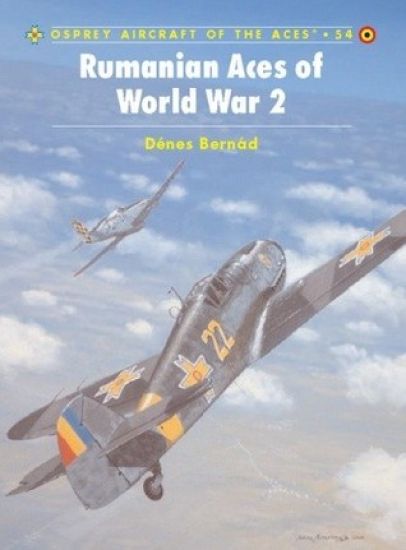
Rumanian Aces of World War 2

Rumanian Aces of World War 2

Dénes Bérnad

Osprey Publishing
2003
nidottu
First seeing action in the wake of the German invasion of the USSR in June 1941, the Royal Romanian Air Force had been allied to the Luftwaffe since the Romanian government signed a Tripartite Pact with Germany and Italy in November 1940. This book reveals how, despite suffering heavy losses to the numerically superior Russian forces, the Romanians inflicted even greater casualties on the communists. Locked in bitter conflict with the Soviets until September 1944, when the Red Army poured across the Romanian frontier and forced an armistice, the modest fighter force claimed 1500+ kills using primarily Bf 109's, Fs and Gs.
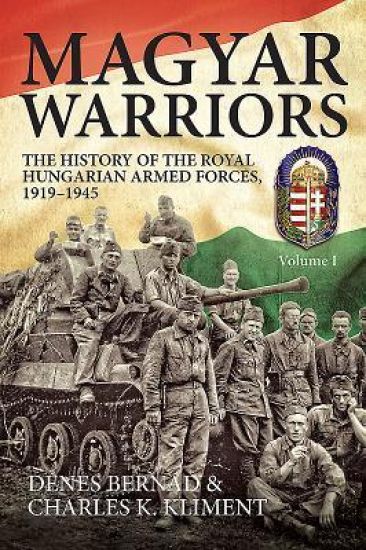
Magyar Warriors Volume 1

Magyar Warriors Volume 1

Dénes Bernád; Charles K. Kliment

Helion Company
2014
sidottu
The Hungarian armed forces, known as the Honvédség, were built up in the 1930s, their expansion gaining momentum once Hungary became free of the strict post- World War I Trianon treaty limitations in August 1938. Politically, Hungary was looking for a strong ally, who would help it to recover at least some of the territories that had been lost after the First World War. Initially, in the mid-1930s, Italy gave political assistance and supplied military matériel, then, on the eve of World War II, Germany also lent support. In November 1938, Hungary managed to peacefully recover a chunk of its former territory from Czechoslovakia, followed by the Sub-Carpathian area and the northern part of Transylvania from Rumania in August 1940. Later, in April 1941, the Bachka region and parts of Baranya were also taken back from the dismembered Yugoslavia, in a swift military action. The rub was that Hungary was sucked into the cauldron of the Eastern front, and soon the Honvéds found themselves deep in Soviet territory, outgunned and outnumbered. From August 1944, the beleaguered Honvédség had to fight against the mighty Soviet army in defense of its own territory. However, alongside tiny Croatia, Hungary remained the last German ally up to the bitter end. This comprehensive reference, to be published in two volumes, and the fruit of over twenty years of meticulous research by Hungarian historian Dénes Bernád, and AFV expert Charles K. Kliment, strives to provide a complete picture of the Hungarian armed forces between the years 1919–1945. It describes the political situation in Hungary before and during World War II, the building of the armed forces, the growth of domestic arms manufacturers and the organisation of the armed forces units and how they changed during the war. The various campaigns of the war are described in great detail, illustrated with many photographs, colour plates and maps.
Magyar Warriors, Volume 1

Magyar Warriors, Volume 1

Dénes Bernád

Helion Company
2019
nidottu
The Hungarian armed forces (known as the Honvédség) were built up in the 1930s, their expansion gaining momentum once Hungary became free of the strict post-WWI Trianon treaty limitations in August 1938. Politically, Hungary was looking for a strong ally, who would help it to recover at least some of the territories containing sizeable Magyar ethnic populations that had been lost after the First World War. Initially, in the mid-1930s, Italy gave political assistance and supplied military matériel, then - on the eve of WWII - Germany also lent support. In November 1938, Hungary managed to peacefully recover a chunk of its former territory from Czechoslovakia, followed by the Sub-Carpathian area during a brief border war in March 1939, then the northern part of Transylvania from Rumania in August 1940. Later, in April 1941, the Bachka region and parts of Baranya were also taken back from the dismembered Yugoslavia, in a swift military action. The rub was that Hungary was sucked into the cauldron of the Eastern front, and soon the Honvéds (Hungarian soldiers) found themselves deep in Soviet territory, outgunned and outnumbered by the Red Army. Later on, from August 1944, the beleaguered Honvédség had to fight against the mighty Soviet army in defense of its own territory. Alongside tiny Croatia, Hungary remained the last German ally up to the bitter end. This comprehensive reference, to be published in three volumes, and the fruit of over twenty years of meticulous research, strives to provide a complete picture of the Hungarian armed forces between the years 1919-1945. It starts with a brief history of the Magyars, describes the political situation in Hungary before and during WWII, the building of the armed forces, the growth of domestic arms manufacturers, the organization of the armed forces units and how they changed during the war. The various campaigns of the war are described in great detail, illustrated with many photographs and maps. This, the first volume, contains approximately 550 photographs, many previously unpublished, as well as numerous tables and maps of the various campaigns. The authors drew on official Hungarian and German archives, and a multitude of private sources, both from individuals living in Hungary and Hungarian émigrés from the Western Diaspora. The result of this herculean effort is a three-volume series destined to be the reference work on the topic, a must for people fascinated by military history, or generally interested in the 1100-year-long rich history of Hungary and its Magyar Warriors.
Quantum Information Theory and Quantum Statistics

Quantum Information Theory and Quantum Statistics

Dénes Petz

Springer-Verlag Berlin and Heidelberg GmbH Co. K
2007
sidottu
This concise and readable book addresses primarily readers with a background in classical statistical physics and introduces quantum mechanical notions as required. Conceived as a primer to bridge the gap between statistical physics and quantum information, it emphasizes concepts and thorough discussions of the fundamental notions and prepares the reader for deeper studies, not least through a selection of well chosen exercises.
Quantum Information Theory and Quantum Statistics

Quantum Information Theory and Quantum Statistics

Dénes Petz

Springer-Verlag Berlin and Heidelberg GmbH Co. K
2010
nidottu
This concise and readable book addresses primarily readers with a background in classical statistical physics and introduces quantum mechanical notions as required. Conceived as a primer to bridge the gap between statistical physics and quantum information, it emphasizes concepts and thorough discussions of the fundamental notions and prepares the reader for deeper studies, not least through a selection of well chosen exercises.