Kirjojen hintavertailu. Mukana 12 390 323 kirjaa ja 12 kauppaa.

Kirjahaku

Etsi kirjoja tekijän nimen, kirjan nimen tai ISBN:n perusteella.

1000 tulosta hakusanalla Dewei Zhang

Dewey for a New Age of Fascism

Dewey for a New Age of Fascism

Nathan Crick

Pennsylvania State University Press
2020
pokkari
During the rise of fascism in the early twentieth century, American philosopher and educational reformer John Dewey argued that the greatest threat to democracy was not a political regime or even an aggressive foreign power but rather a set of dispositions or attitudes. Though not fascist in and of themselves, these habits of thought—rugged individualism and ideological nationalism—lay the foundation for fascism. In this study, Nathan Crick uses Dewey’s social thought and philosophy of education to provide insight into and resources for transforming our present-day politics.Through a close reading of Dewey’s political writings and educational theory, Crick elaborates Dewey’s vision of democratic social life and the education required for its foundation. He shows that for Dewey, communication is essential to cultivating sympathy, intelligence, and creativity—habits of thought that form the core of democratic culture. Crick then lays out a broad curriculum of logic, aesthetics, and rhetoric for inculcating these habits in the classroom, arguing that if we are to meet the challenge of fascism, we must teach these new arts as if our civilization depends on it—because in our new age of politics, it does.Comprehensive and pragmatic, this book presents an experimental model of education that can be applied across the humanities curriculum. It will be of interest to teachers of writing, composition, and rhetoric as well as scholars and students of communication studies, pedagogy, and political theory.
Dewey the Library Cat: A True Story

Dewey the Library Cat: A True Story

Vicki Myron; Bret Witter

Little, Brown Books for Young Readers
2011
nidottu
In the tradition of Marley: A Dog Like No Other, this is the story of a cat who was more than a pet, and the amazing effect he had on the people around him. This middle-grade adaptation of the Grand Central bestseller Dewey features an 8-page photo insert, including exclusive, never-before-seen photos of the Dew Now everyone's favorite library cat can inspire a new audience of young readers with his story of courage and love. Abandoned in a library book drop slot in the dead of winter, this remarkable kitten miraculously endured the coldest night of the year. Dewey Readmore Books, as he became known, quickly embraced his home inside Spencer's public library, charming the struggling small town's library-goers, young and old. As word of Dewey's winning tail, or rather his tale, spread, the library cat gained worldwide fame as a symbol of hope and proof positive that one small cat could change a town, one reader at a time.
Dewey

Dewey

Vicki Myron

Hodder Stoughton General Div
2009
pokkari
With over a million copies already sold this is the bestselling story of how one adorable and lovably roguish library cat touched the lives of everyone he came into contact with.
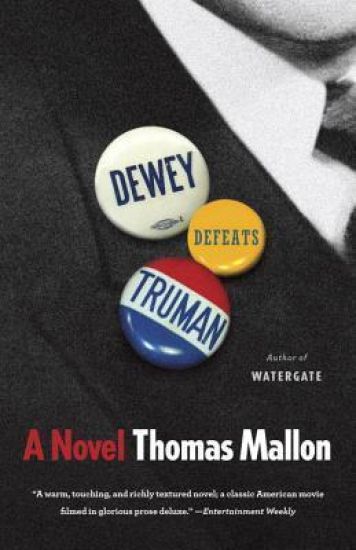
Dewey Defeats Truman

Dewey Defeats Truman

Thomas Mallon

Vintage Books
2013
pokkari
A masterful retelling of a legend and famous headline of modern American history Harry Truman s upset victory over Thomas E. Dewey in the 1948 presidential election. Set in Dewey s hometown of Owosso, Michigan, this is the captivating story of a local love triangle that mirrors the national election contest. As the voters must decide between the candidates, so must Anne Macmurray choose between two suitors: an ardent United Auto Workers organizer and his polar opposite, a wealthy young Republican lawyer who s running for the state senate. Weaving a tapestry of small-town secrets, the people of Owosso ready themselves for the fame that is bound to shower down upon them after Dewey s sure thing victory. But as the novel and history move toward election night, we watch the townspeople, along with Anne and her suitors, have their fates rearranged in a climax filled with suspense, chagrin and unexpected joy."
Dewey Defeats Truman: The 1948 Election and the Battle for America's Soul
From the New York Times best-selling author of The Accidental President comes the thrilling story of the 1948 presidential election, one of the greatest election stories of all time, as Truman mounted a history-making comeback and staked a claim for a new course for America. On the eve of the 1948 election, America was a fractured country. Racism was rampant, foreign relations were fraught, and political parties were more divided than ever. Americans were certain that President Harry S. Truman's political career was over. "The ballots haven't been counted," noted political columnist Fred Othman, "but there seems to be no further need for holding up an affectionate farewell to Harry Truman." Truman's own staff did not believe he could win. Nor did his wife, Bess. The only man in the world confident that Truman would win was Mr. Truman himself. And win he did. The year 1948 was a fight for the soul of a nation. In Dewey Defeats Truman, A. J. Baime sheds light on one of the most action-packed six months in American history, as Truman both triumphs and oversees watershed events--the passing of the Marshall plan, the acknowledgement of Israel as a new state, the careful attention to the origins of the Cold War, and the first desegregation of the military. Not only did Truman win the election, he succeeded in guiding his country forward at a critical time with high stakes and haunting parallels to the modern day.
Dewey

Dewey

J.E. Tiles

Routledge
1990
nidottu
First Published in 1990. The purpose of this series is to provide a contemporary assessment and history of the entire course of philosophical thought. Each book constitutes a detailed, critical introduction to the work of a philosopher of major influence and significance. Someone relatively new to philosophy might expect from the series title to have here a book about the disputes in which John Dewey engaged with other philosophers. ‘Arguments’ in the present context, however, refers to a general way of articulating thoughts, that is by offering some as reasons for holding others. The author states that Dewey offers a picture of what contemporary philosophy would be like if, transformed as it has been under the influence of modern science, it had at the same time carried with it more of the legacy of the post-Kantian (or ‘Hegelian’) philosophy of the nineteenth century. This book is an attempt to specify some of the most important features of that picture and how they bear on the way philosophy conducts argument.
Dewey-Arg Philosophers

Dewey-Arg Philosophers

J.E. Tiles

Routledge
1999
sidottu
First Published in 1999. The purpose of this series is to provide a contemporary assessment and history of the entire course of philosophical thought. Each book constitutes a detailed, critical introduction to the work of a philosopher of major influence and significance. Someone relatively new to philosophy might expect from the series title to have here a book about the disputes in which John Dewey engaged with other philosophers. ‘Arguments’ in the present context, however, refers to a general way of articulating thoughts, that is by offering some as reasons for holding others.
Dewey-Arg Philosophers

Dewey-Arg Philosophers

J.E. Tiles

Routledge
2014
nidottu
First Published in 1999. The purpose of this series is to provide a contemporary assessment and history of the entire course of philosophical thought. Each book constitutes a detailed, critical introduction to the work of a philosopher of major influence and significance. Someone relatively new to philosophy might expect from the series title to have here a book about the disputes in which John Dewey engaged with other philosophers. ‘Arguments’ in the present context, however, refers to a general way of articulating thoughts, that is by offering some as reasons for holding others.
Dewey, Pragmatism and Economic Methodology
This book brings together, for the first time, philosophers of pragmatism and economists interested in methodological questions. The main theoretical thrust of Dewey is to unite inquiry with behavior and this book's contributions assess this insight in the light of developments in modern American philosophy, social and legal theories, and the theoretical orientation of economics. This unique book contains impressive contributions from a range of different perspectives and its unique nature will make it required reading for academics involved with philosophy and economics.
Dewey, Pragmatism and Economic Methodology
This book brings together, for the first time, philosophers of pragmatism and economists interested in methodological questions. The main theoretical thrust of Dewey is to unite inquiry with behavior and this book's contributions assess this insight in the light of developments in modern American philosophy, social and legal theories, and the theoretical orientation of economics. This unique book contains impressive contributions from a range of different perspectives and its unique nature will make it required reading for academics involved with philosophy and economics.
Dewey

Dewey

Steven Fesmire

Routledge
2014
sidottu
John Dewey (1859 - 1952) was the dominant voice in American philosophy through the World Wars, the Great Depression, and the nascent years of the Cold War. With a professional career spanning three generations and a profile that no public intellectual has operated on in the U.S. since, Dewey's biographer Robert Westbrook accurately describes him as "the most important philosopher in modern American history."In this superb and engaging introduction, Steven Fesmire begins with a chapter on Dewey’s life and works, before discussing and assessing Dewey's key ideas across the major disciplines in philosophy; including metaphysics, epistemology, aesthetics, ethics, educational philosophy, social-political philosophy, and religious philosophy.This is an invaluable introduction and guide to this deeply influential philosopher and his legacy, and essential reading for anyone coming to Dewey's work for the first time.
Dewey

Dewey

Steven Fesmire

Routledge
2014
nidottu
John Dewey (1859 - 1952) was the dominant voice in American philosophy through the World Wars, the Great Depression, and the nascent years of the Cold War. With a professional career spanning three generations and a profile that no public intellectual has operated on in the U.S. since, Dewey's biographer Robert Westbrook accurately describes him as "the most important philosopher in modern American history."In this superb and engaging introduction, Steven Fesmire begins with a chapter on Dewey’s life and works, before discussing and assessing Dewey's key ideas across the major disciplines in philosophy; including metaphysics, epistemology, aesthetics, ethics, educational philosophy, social-political philosophy, and religious philosophy.This is an invaluable introduction and guide to this deeply influential philosopher and his legacy, and essential reading for anyone coming to Dewey's work for the first time.
Dewey: The Small-Town Library Cat Who Touched the World

Dewey: The Small-Town Library Cat Who Touched the World

Vicki Myron; Bret Witter

Grand Central Publishing
2008
sidottu
Experience the uplifting, "unforgettable" New York Times bestseller about an abandoned kitten named Dewey, whose life in a library won over a farming town and the world -- with over 2 million copies sold (Booklist) Dewey's story starts in the worst possible way. On the coldest night of the year in Spencer, Iowa, at only a few weeks old--a critical age for kittens--he was stuffed into the return book slot of the Spencer Public Library. He was found the next morning by library director Vicki Myron, a single mother who had survived the loss of her family farm, a breast cancer scare, and an alcoholic husband. Dewey won her heart, and the hearts of the staff, by pulling himself up and hobbling on frostbitten feet to nudge each of them in a gesture of thanks and love. For the next nineteen years, he never stopped charming the people of Spencer with his enthusiasm, warmth, humility (for a cat), and, above all, his sixth sense about who needed him most. As his fame grew from town to town, then state to state and finally, amazingly, worldwide, Dewey became more than just a friend; he became a source of pride for an extraordinary Heartland farming community slowly working its way back from the greatest crisis in its long history.
Dewey (Large Print Edition)

Dewey (Large Print Edition)

Vicki Myron

Grand Central Publishing
2008
sidottu
Experience the uplifting, unforgettable New York Times bestseller about an abandoned kitten named Dewey, whose life in a library won over a farming town and the world -- with over 2 million copies sold (Booklist) Dewey's story starts in the worst possible way. On the coldest night of the year in Spencer, Iowa, at only a few weeks old--a critical age for kittens--he was stuffed into the return book slot of the Spencer Public Library. He was found the next morning by library director Vicki Myron, a single mother who had survived the loss of her family farm, a breast cancer scare, and an alcoholic husband. Dewey won her heart, and the hearts of the staff, by pulling himself up and hobbling on frostbitten feet to nudge each of them in a gesture of thanks and love. For the next nineteen years, he never stopped charming the people of Spencer with his enthusiasm, warmth, humility (for a cat), and, above all, his sixth sense about who needed him most. As his fame grew from town to town, then state to state and finally, amazingly, worldwide, Dewey became more than just a friend; he became a source of pride for an extraordinary Heartland farming community slowly working its way back from the greatest crisis in its long history.
Dewey's Nine Lives: The Legacy of the Small-Town Library Cat Who Inspired Millions
Vicki Myron follows up her #1 New York Times bestseller Dewey with stories of cats who inspire their owners and includes two brand-new Dewey stories Dewey's Nine Lives offers nine funny, inspiring, and heartwarming stories about cats--all told from the perspective of "Dewey's Mom," librarian Vicki Myron. Dewey: The Small-Town Library Cat Who Touched the World was a blockbuster bestseller and a publishing phenomenon. It has sold nearly a million copies, spawned three children's books, and will be the basis for an upcoming movie. No doubt about it, Dewey has created a community. Dewey touched readers everywhere, who realized that no matter how difficult their lives might seem, or how ordinary their talents, they can-and should-make a positive difference to those around them. Now, Dewey is back, with even more heartwarming moments and life lessons to share. The amazing felines in this book include Dewey, of course, whose further never-before-told adventures are shared, and several others who Vicki found out about when their owners reached out to her. Vicki learned, through extensive interviews and story sharing, what made these cats special, and how they fit into Dewey's community of perseverance and love. From a divorced mother in Alaska who saved a drowning kitten on Christmas Eve to a troubled Vietnam veteran whose heart was opened by his long relationship with a rescued cat, these Dewey-style stories will inspire readers to laugh, cry, care, and, most importantly, believe in the magic of animals to touch individual lives.
Dewey's Critical Pragmatism

Dewey's Critical Pragmatism

Alison Kadlec

Lexington Books
2007
sidottu
Dewey's Critical Pragmatism explores the critical potential of John Dewey's democratic vision. By reconstructing critical dimensions of Dewey's approach to epistemology, philosophy, pedagogy, and politics, Alison Kadlec develops a model of pragmatism that speaks to both radical and deliberative democratic theory. Critical pragmatism proceeds from the claim that the point of reflective inquiry is not to establish or justify principles of transcendental universality, but rather to improve our individual and shared capacity to tap into the critical potential of lived experience in a world characterized by change and flux. Dewey's Critical Pragmatism is geared toward recovering aspects of Dewey's work that have been persistently misunderstood or simply neglected. Kadlec posits that it is in the realm of contemporary deliberative democratic theory and practice that the greatest significance of critical pragmatism lies.
Dewey and European Education
Although John Dewey's ideas have been of central interest in Anglo-Saxon philosophy and history of education, it is only recently that similar interest has developed in continental Europe. Deweyan philosophy of education has had to pass through national filters, which meant that it was received in national contexts of reform. The `German Dewey' was differently construed to the French, Italian, or English Dewey. This seems to change after 1989 (and the fall of socialist education) when interest in Dewey increased. The new political and philosophical interest in Dewey has to do with the lost alternative `socialism', and thus with the opening of Eastern Europe and the new problems of education within a worldwide community. This volume stresses two points. The original interest of European education in Dewey will be presented in case studies, concerning different national contexts and thus different Dewey's. What can be called the renewal of interest will be argued from different sides. It is our intention to show that today's interest in Dewey is not the remake of the reception within the different camps of progressive education. This volume will be of interest to philosophers of education, historians of education, and people engaged in the philosophy, history and the reception of Dewey.
Dewey's Ethical Thought

Dewey's Ethical Thought

Welchman Jennifer

CORNELL UNIVERSITY PRESS
1995
sidottu
In the first book on the development ofJohn Dewey's ethical thought, Jennifer Welchman revises the prevalent interpretation of his ethics. Her clear and engaging account traces the history of Dewey's distinctive moral philosophy from its roots in idealism during the 1890s through the pragmatist approach of his 1922 work, Human Nature and Conduct. Central to the development of Dewey's ethics was his lifelong conviction that the realms of science and morals, facts and values were reconcilable. This conviction, Welchman demonstrates, drove Dewey to reject the orthodox ethics of his day in favor of radical alternatives—first absolute idealism and later pragmatism. She reveals how Dewey came to adopt and subsequently to modify idealist ethics of self-realization. Welchman then explores the transformations in Dewey's conception of science that exploded the fragile truce between fact and value that he had negotiated as an idealist. Finally, she examines how Dewey developed his own instrumentalist accounts of moral value, conduct, and character that culminated in his best-known work of ethics, Human Nature and Conduct.
Dewey on Democracy

Dewey on Democracy

William R. Caspary

Cornell University Press
2000
sidottu
Revived appreciation of John Dewey as an inspirational advocate of participatory democracy has been tempered by criticism that he lacks a concrete political program. William R. Caspary makes the case for Dewey as a more discerning and challenging political theorist than this. Caspary draws from Dewey's extensive writings a concrete politics of participatory democracy, solving classic dilemmas confronting both democratic theorists and citizen activists. He compares Dewey's views with the full range of approaches in contemporary democratic theory and explores the underpinnings of Dewey's political theory by offering a thorough and innovative account of his philosophy of science, social science, and ethics. In Dewey's democratic theory, conflict is an inescapable condition of politics, according to Caspary, and is also an essential stimulus for the advancement of individuals and societies. Recognizing the centrality of conflict, Caspary claims, Dewey makes conflict resolution an overarching concept in his theory of democracy. Caspary argues that conflict resolution is central to Dewey's philosophy of ethics and of science. Caspary—a scholar with many years of experience as a social movement activist, ombudsperson, and mediator—traces this conflict resolution orientation throughout Dewey's writings. Caspary brings Dewey's abstract theories down to earth with examples from present-day social and political experiments, including progressive educational experiments, common-ground dialogues on abortion, the South African program for truth and reconciliation, and worker self-management cooperatives. These cases illustrate Dewey's linking of political action, social experimentation, and public discourse. They pin down specific meanings for Dewey's sometimes vague political maxims, and suggest workable programs. Throughout Caspary demonstrates the courage and vision of Dewey's unwavering commitment to participatory democracy.