Kirjojen hintavertailu. Mukana 11 244 527 kirjaa ja 12 kauppaa.

Kirjahaku

Etsi kirjoja tekijän nimen, kirjan nimen tai ISBN:n perusteella.

1000 tulosta hakusanalla Dide

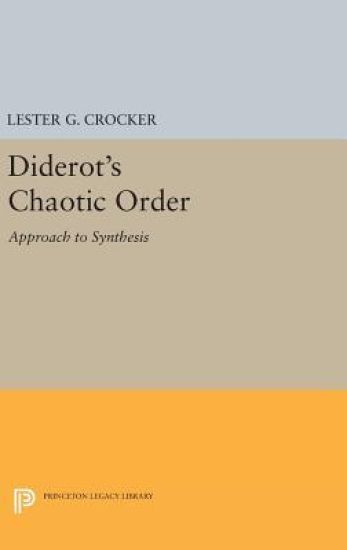
Diderot's Chaotic Order

Diderot's Chaotic Order

Lester G. Crocker

Princeton University Press
2016
sidottu
Because of its fragmentary, evolving, exploratory, and dialectical character, Diderot's thought has continuously resisted overall synthesis. In the ideas of "order" and "disorder," ideas important in all of eighteenth-century thought, Lester G. Crocker finds the key to an outline of a structure that leads to a genuine synthesis of Diderot's writings on philosophy, morality, politics, and aesthetics. The tensions in Diderot's thought, Professor Crocker shows, reflect his understanding of reality itself--paradoxically, an anarchic order, a dynamic universe governed by laws but always changing in a chaotic way. The book examines Diderot's approach to aesthetics as a human ordering response to the world, and his approach to morals and politics as practical ways of dealing with the problems of order and disorder in the context of life in society. In light of the concepts of order and disorder, the inextricable associations of all of these realms of thought in Diderot's work become clear, and a unity is perceived. Since the problem of order and disorder was fundamental to an age faced with the dissolution of the Christian view of cosmic order, this novel approach to Diderot's work suggests new ways of understanding the Enlightenment as a whole. Originally published in 1974. The Princeton Legacy Library uses the latest print-on-demand technology to again make available previously out-of-print books from the distinguished backlist of Princeton University Press. These editions preserve the original texts of these important books while presenting them in durable paperback and hardcover editions. The goal of the Princeton Legacy Library is to vastly increase access to the rich scholarly heritage found in the thousands of books published by Princeton University Press since its founding in 1905.
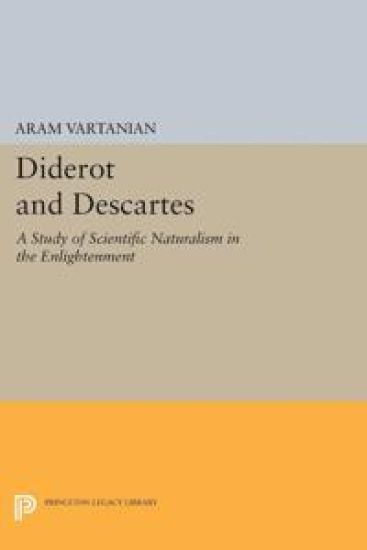
Diderot and Descartes

Diderot and Descartes

Aram Vartanian

Princeton University Press
2016
sidottu
A study of scientific naturalism in the Enlightenment. In tracing the materialism of Diderot, La Mettrie, Buffon, and D'Holbach to its sources, it offers a fresh appraisal of the total influence of Descartes on the Enlightenment. Originally published in 1953. The Princeton Legacy Library uses the latest print-on-demand technology to again make available previously out-of-print books from the distinguished backlist of Princeton University Press. These editions preserve the original texts of these important books while presenting them in durable paperback and hardcover editions. The goal of the Princeton Legacy Library is to vastly increase access to the rich scholarly heritage found in the thousands of books published by Princeton University Press since its founding in 1905.
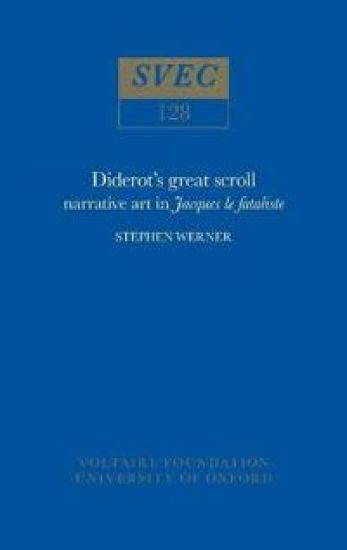
Diderot's Great Scroll

Diderot's Great Scroll

Stephen Werner

Voltaire Foundation
1975
nidottu
The Oxford University Studies in the Enlightenment series, previously known as SVEC (Studies on Voltaire and the Eighteenth Century), has published over 500 peer-reviewed scholarly volumes since 1955 as part of the Voltaire Foundation at the University of Oxford. International in focus, Oxford University Studies in the Enlightenment volumes cover wide-ranging aspects of the eighteenth century and the Enlightenment, from gender studies to political theory, and from economics to visual arts and music, and are published in English or French.
Diderot's 'Essai Sur Sénèque'

Diderot's 'Essai Sur Sénèque'

W.T. Conroy

Voltaire Foundation
1975
nidottu
The Oxford University Studies in the Enlightenment series, previously known as SVEC (Studies on Voltaire and the Eighteenth Century), has published over 500 peer-reviewed scholarly volumes since 1955 as part of the Voltaire Foundation at the University of Oxford. International in focus, Oxford University Studies in the Enlightenment volumes cover wide-ranging aspects of the eighteenth century and the Enlightenment, from gender studies to political theory, and from economics to visual arts and music, and are published in English or French.
Diderot and the Time-Space Continuum

Diderot and the Time-Space Continuum

Merle L. Perkins

Voltaire Foundation
1982
sidottu
The Oxford University Studies in the Enlightenment series, previously known as SVEC (Studies on Voltaire and the Eighteenth Century), has published over 500 peer-reviewed scholarly volumes since 1955 as part of the Voltaire Foundation at the University of Oxford. International in focus, Oxford University Studies in the Enlightenment volumes cover wide-ranging aspects of the eighteenth century and the Enlightenment, from gender studies to political theory, and from economics to visual arts and music, and are published in English or French.
Diderot, Philosopher of Energy

Diderot, Philosopher of Energy

B.Lynne Dixon

Voltaire Foundation
1988
sidottu
The title of this work may seem to beg an important question, since it rests on the assumption that Diderot has a ‘concept of physical energy’. Indeed the aim of the study is, in part, to assemble evidence in support of the acte de foi implicit in its title. I am using ‘physical energy’ in a loose sense, as a convenient term to denote ‘what matter can do’ as distinct from ‘what matter is made of’. Hence it may be taken as broadly synonymous with ‘power’ or ‘force’, encompassing both active and potential forms, and thus corresponding to a combination of the fourth and fifth senses identified by the Oxford English Dictionary:4. Power actively and efficiently displayed or exerted. 5. Power not necessarily manifested in action; ability or capacity to produce an effect.Modern subatomic physics, of course, recognises no such distinction between ‘being’ and ‘doing’; at a fundamental level, matter-as-substance and matter-as-energy are interchangeable (and, as I shall argue towards the end of the study, Diderot himself comes close to a similar position). Nevertheless, the division is both justifiable and useful within the context of eighteenth-century philosophies of nature. For, as many scholars have pointed out, the trend towards nature as an integrated, active phenomenon, in place of the cartesian view of passive étendue only incidentally endowed with motion, was crucial to the development of scientific thought in the mid-eighteenth century. Debate and development on such issues as Newtonian attraction, inertia, electricity and magnetism, chemical reactions, not only contributed directly to the advancement of physics and chemistry, but also (like cartesian mechanism) impinged upon the perennial biological questions, themselves being investigated from a new and exciting angle. As a philosopher rather than a practising scientist, Diderot was ideally placed to draw freely and creatively on all these areas, and his speculations on what we might call ‘the nature of nature’ are highly characteristic of the new approach. He comes increasingly to discuss and define natural phenomena (organic and inorganic alike) from the point of view of nature’s powers – in the spirit of Renaissance naturalism, but from the perspective of up-to-date scientific findings. It is in this sense that I refer to a ‘concept of physical energy’. Given the organic quality of Diderot’s thought, it is not surprising to find the idea of energy recurring in other areas of his works. If man is composed of matter – active matter – than all human activity, be it moral, political, aesthetic, becomes capable of interpretation in terms of energy. I share Chouillet’s conviction that this is a crucial aspect of Diderot’s overall philosophy, which deserves to be more widely recognised and more fully understood.
Diderot and European Culture

Diderot and European Culture

Voltaire Foundation
2006
nidottu
The shift in the interpretation of eighteenth-century European culture over the last century provokes the questions: what meaning can be ascribed to that notion at the beginning of the twenty-first century? and how should we see Diderot’s response to it?This collection of essays re-examines Diderot’s uniquely rich relationship with the intellectual life of European nations, and his crucial role in focusing, connecting and spreading its many strands. While sharing certain Eurocentric prejudices, he held a more liberated view of a common humanity and the universal nature of human aspirations. These essays explore his interest in those hybrid, borderline zones, where systems, hierarchies, and national or disciplinary boundaries come under productive stress. What emerges is the irreducibility of his writing, which resists incorporation into any officially sanctioned canon. The Diderot being created by today’s scholars is truly protean, not so much French, or even European, as global, a cultural icon for the modern age.
Diderot

Diderot

Kurt Ballstadt

Voltaire Foundation
2008
nidottu
One of the most eclectic and enigmatic of the philosophes, Denis Diderot left an intellectual legacy that has the capacity to stimulate, perplex and even confound. Particularly challenging are his writings on the natural sciences, an area largely neglected by scholars over the past fifty years.In Diderot: natural philosopher Kurt Ballstadt examines the entirety of Diderot’s scientific works from the Lettre sur les aveugles to the Eléments de physiologie, investigating his fascination with mathematics, experimental physics, chemistry, natural history and medicine, and drawing out the crucial points of contact between these disciplines. Diderot is shown to have a well-constructed philosophy of science and an integrated, sophisticated vision of how the world functions. We are led away from the image of a radical Diderot, champion of disorder, to an analysis of a more systematic thinker whose underlying search for structure characterized both his attitude to the world around him, and the way he wrote about it.Situating these writings on natural philosophy in the intellectual landscape of the Enlightenment, this book will engage Diderot scholars and historians of eighteenth-century science alike.
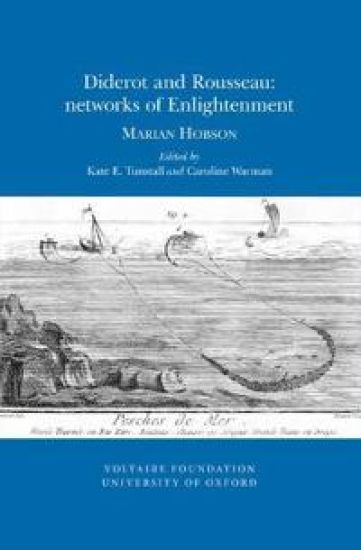
Diderot and Rousseau: Networks of Enlightenment
Marian Hobson’s work has made a seminal contribution to our understanding of the European Enlightenment, and of Diderot and Rousseau in particular. This book presents her most important articles in a single volume, translated into English for the first time.Hobson’s distinctive approach is to take a given text or problématique and position it within its intellectual, historical and polemical context. From close analysis of the underlying conceptual structures of literary texts, she offers a unique insight into the vibrant networks of people and ideas at work throughout Europe, and across disciplinary boundaries as diverse as literature and mathematics, medicine and music.In their translations of Hobson’s essays, Kate Tunstall and Caroline Warman present the primary sources in both the original eighteenth-century French and modern English, making the detail of these debates accessible to everyone, from the specialist to the student, whatever their academic discipline or interest.
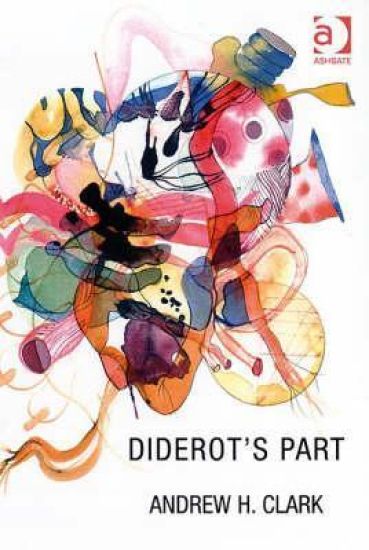
Diderot's Part

Diderot's Part

Andrew H. Clark

Ashgate Publishing Limited
2008
sidottu
Drawing upon the rich heterogeneity of Denis Diderot's texts-whether scientific, aesthetic, philosophic or literary-Andrew Clark locates and examines an important epistemological shift both in Diderot's oeuvre and in the eighteenth century more generally. In Western Europe during the 1750s, the human body was reconceptualized as physiologists began to emphasize the connections, communication, and relationships among relatively autonomous somatic parts and an animated whole. This new conceptualization was part of a larger philosophical and epistemological shift in the relationship of part to whole, as discovered in that of bee to swarm; organ to body; word to phrase; dissonant chord to harmonic progression; article to encyclopedia; and individual citizen to body politic. Starting from Diderot's concept of the body as elaborated from the physiological research and speculation of contemporaries such as Haller and Bordeu, the author investigates how the logic of an unstable relationship of part to whole animates much of Diderot's writing in genres ranging from art criticism to theatre to philosophy of science. In particular, Clark examines the musical figure of dissonance, a figure used by Diderot himself, as a useful theoretical model to give insight into these complex relations. This study brings a fresh approach to the classic question of whether Diderot's work represents a consistent point of view or a series of ruptures and changes of position.
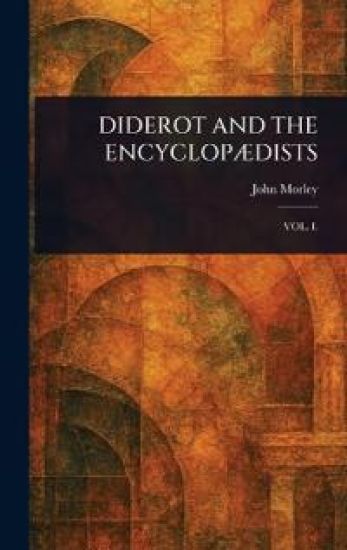
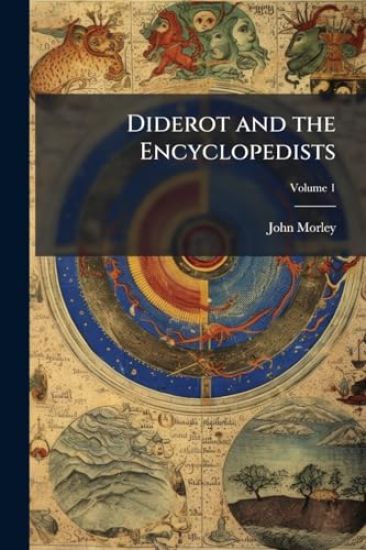
Diderot and the EncyclopÆdists

Diderot and the EncyclopÆdists

John Morley

Anson Street Press
2025
pokkari
Explore the intellectual ferment of 18th-century France with John Morley's "Diderot and the Encyclopaedists," Volume 1 of 2. This historical biography delves into the lives and ideas of Denis Diderot and the circle of philosophers who contributed to the groundbreaking "Encyclop die." A key figure of the French Enlightenment, Diderot spearheaded this ambitious project to compile all human knowledge, challenging traditional authority and advocating for reason and progress. Morley's work illuminates the philosophical debates and social context surrounding the creation of the "Encyclop die," offering insights into the minds of these influential thinkers. Discover the historical backdrop of the Enlightenment and the impact of these encyclopedists on European thought. This meticulously prepared print edition offers a fascinating exploration of a pivotal moment in intellectual history. A valuable resource for anyone interested in philosophy, French history, and the enduring legacy of the Enlightenment.This work has been selected by scholars as being culturally important, and is part of the knowledge base of civilization as we know it.This work is in the public domain in the United States of America, and possibly other nations. Within the United States, you may freely copy and distribute this work, as no entity (individual or corporate) has a copyright on the body of the work.Scholars believe, and we concur, that this work is important enough to be preserved, reproduced, and made generally available to the public. We appreciate your support of the preservation process, and thank you for being an important part of keeping this knowledge alive and relevant.
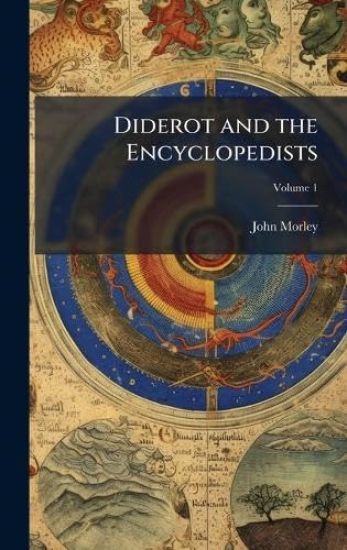
Diderot and the EncyclopÆdists

Diderot and the EncyclopÆdists

John Morley

Anson Street Press
2025
sidottu
Explore the intellectual ferment of 18th-century France with John Morley's "Diderot and the Encyclopaedists," Volume 1 of 2. This historical biography delves into the lives and ideas of Denis Diderot and the circle of philosophers who contributed to the groundbreaking "Encyclop die." A key figure of the French Enlightenment, Diderot spearheaded this ambitious project to compile all human knowledge, challenging traditional authority and advocating for reason and progress. Morley's work illuminates the philosophical debates and social context surrounding the creation of the "Encyclop die," offering insights into the minds of these influential thinkers. Discover the historical backdrop of the Enlightenment and the impact of these encyclopedists on European thought. This meticulously prepared print edition offers a fascinating exploration of a pivotal moment in intellectual history. A valuable resource for anyone interested in philosophy, French history, and the enduring legacy of the Enlightenment.This work has been selected by scholars as being culturally important, and is part of the knowledge base of civilization as we know it.This work is in the public domain in the United States of America, and possibly other nations. Within the United States, you may freely copy and distribute this work, as no entity (individual or corporate) has a copyright on the body of the work.Scholars believe, and we concur, that this work is important enough to be preserved, reproduced, and made generally available to the public. We appreciate your support of the preservation process, and thank you for being an important part of keeping this knowledge alive and relevant.