Kirjojen hintavertailu. Mukana 12 375 201 kirjaa ja 12 kauppaa.

Kirjahaku

Etsi kirjoja tekijän nimen, kirjan nimen tai ISBN:n perusteella.

674 tulosta hakusanalla Dio Cassius

Roman History, Volume IX
A sweeping chronicle from Aeneas to Alexander Severus.Dio Cassius (Cassius Dio), circa AD 150–235, was born at Nicaea in Bithynia in Asia Minor. On the death of his father (Roman governor of Cilicia) he went in 180 to Rome, entered the Senate, and under the emperor Commodus was an advocate. He held high offices, becoming a close friend of several emperors; he was made governor of Pergamum and Smyrna; consul in 220; proconsul of Africa; governor of Dalmatia and then of Pannonia; and consul again in 229. Of the eighty books of Dio's great work Roman History, covering the era from the legendary landing of Aeneas in Italy to the reign of Alexander Severus (AD 222–235), we possess Books 36–60 (36 and 55–60 have gaps), which cover the years 68 BC–AD 47. The missing portions are partly supplied, for the earlier gaps by Zonaras, who relies closely on Dio, and for some later gaps (Book 35 onwards) by John Xiphilinus (of the eleventh century). There are also many excerpts. The facilities for research afforded by Dio's official duties and his own industry make him a very vital source for Roman history of the last years of the republic and the first four emperors. The Loeb Classical Library edition of Dio Cassius is in nine volumes.
Römische Geschichte

Römische Geschichte

Dio Cassius

Hansebooks
2017
pokkari
R mische Geschichte - Vierter Band ist ein unver nderter, hochwertiger Nachdruck der Originalausgabe aus dem Jahr 1787. Hansebooks ist Herausgeber von Literatur zu unterschiedlichen Themengebieten wie Forschung und Wissenschaft, Reisen und Expeditionen, Kochen und Ern hrung, Medizin und weiteren Genres. Der Schwerpunkt des Verlages liegt auf dem Erhalt historischer Literatur. Viele Werke historischer Schriftsteller und Wissenschaftler sind heute nur noch als Antiquit ten erh ltlich. Hansebooks verlegt diese B cher neu und tr gt damit zum Erhalt selten gewordener Literatur und historischem Wissen auch f r die Zukunft bei.
Catilina

Catilina

Sallustius; Cicero; Asconius; Diodorus Siculus; Plutarchos; Appianus; Dio Cassius; Alexander Andrée

Bokförlaget Augusti
2022
sidottu
Catilinas sammansvärjning 63 f. vt. blev en händelse som inte bara banade väg för Ciceros karriär utan också på ett brutalt sätt förebådade både Caesar och den romerska republikens fall. De dramatiska händelserna föranledde Sallustius själv anhängare av Julius Caesar att skriva en bok på ämnet och de fick Cicero att tillägna ett antal berömda tal till den process han själv drev gentemot Catilina. Som alltid i Rom fick makt­spelet ett blodigt slut. Catlina och den armé han samlat för att störta republiken höggs ner till sista man vid Pistoria av republikens styrkor i januari 62 f. vt. I efterspelet gjorde Catlinias samtida, personer som Pompejus och Julius Caesar, allt för att fjärma sig från ­Catilina. Men det fanns anklagelser också gentemot Caesars beröringspunkter med kuppmakaren. I boken Catilina ges efterlängtade nyöversättningar av samtliga antika källor, både från latin och grekiska, till de händelser som utspelade sig kring Lucius Sergius Catilina. Översättning, förord och noter är författade av Alexander Andrée, universitetslektor i latin vid Lunds universitet.
Cassius Dio: Roman History

Cassius Dio: Roman History

C. T. Mallan

Oxford University Press
2020
sidottu
This volume provides a new translation of Books 57 and 58 of Cassius Dio's Roman History and the 'fragments' of these books preserved in later Byzantine epitomes, as well as the first English language commentary to examine them in their entirety. Dio's Roman History covers almost 1,000 years from the founding of Rome up to the early third century AD, with Books 57 and 58 focusing on the reign of the emperor Tiberius (AD 14-37): his account of this period is one of the most important to have survived from antiquity, not least as it preserves a historiographical tradition in some ways distinct from that of Tacitus and Suetonius. These books also reveal something of his authorial preoccupations and present a glimpse into the mind of the historian, and especially into his understanding of the mechanics of imperial government. The focus of the commentary is both historical and historiographical, in so far as it aims to illuminate not only issues arising from Dio's account of the Tiberian principate, but also to reveal the unity of his work and literary programme: a series of appendices complement the analysis by providing discussion of some of the key historical problems surrounding Dio and the reign of Tiberius. The translation (the first since the Loeb Classical Library edition of E. Cary) aims for both clarity and accuracy, and particular care has been taken to separate the various textual traditions that have been used to reconstruct the lost portions of Dio's text. An accompanying general introduction offers an accessible overview of Cassius Dio's approach to history based on the latest research in the field, and will be of particular use to graduate and undergraduate students coming to the text for the first time.
Cassius Dio

Cassius Dio

Jesper Majbom Madsen

Bloomsbury Academic
2019
sidottu
This volume offers an introduction to the life and work of the 3rd-century-AD Greco-Roman senator and historian Cassius Dio, whose work, although imperfectly preserved in 80 books, is of fundamental importance to our understanding of Roman history. It is said that Dio is not one of the best ancient historians and his Roman history, due to its sheer size, is often imprecise and superficial in its analysis. It has also been assumed that there was no political agenda behind the work, and that Dio’s principal value to us is as a reliable copyist, who mediated the works of other, and better sources. This introduction to his life and work offers a different picture. Here, Dio is presented through his Greek cultural lens as a politician with a clear vision for how Roman politics and government should be organized. Carefully selected examples will be the starting points for fresh critical analysis of Dio’s work and its legacy, both in antiquity and through to the Enlightenment. The book assumes no familiarity with Cassius Dio, his writing or context. All text will be translated and suggested further reading will point readers towards avenues for more detailed study.
Cassius Dio und die Römische Republik

Cassius Dio und die Römische Republik

Benedikt Simons

De Gruyter
2009
sidottu
Die Romaika Cassius Dios dienten bisher eher als Steinbruch zu Rekonstruktion verlorener Quellen und der Ereignisgeschichte. Diese Arbeit verknüpft die traditionelle "Quellenforschung" der Romaika des severischen Senators mit der Suche nach seiner Sicht der Römischen Republik, indem sie, angeleitet durch die Rezeptionsforschung und Cassius Dio selbst, die Kriterien seiner Quellenverarbeitung untersuchte: Ausgehend von Cassius Dios eigenen Schwerpunkten und denen der Forschung wurden seine Kommentare zu wichtigen Magistraturen betrachtet, seine "Analyse" der "Ständekämpfe", seine Einschätzung der Epochenjahre 218, 189 und 146 v. Chr. und seine Charakterisierungen Hannibals, der Africani und des Viriathus: Cassius Dio fügte in eine fortlaufende Erzählung, die er auch von den Annalisten Licinius Macer und Valerius Antias und der Monographie des Coelius Antipater bezog, Analysen, Urteile und Exempla insbesondere von Ulpian und Poseidonios ein. Das Ziel seiner Quellenverarbeitung bestand darin, im Sinne des Poseidonios das stoisch geprägte Ideal einer harmonischen Gemeinschaft, in der jeder (Führer) zum Wohle aller diente. Mit diesem Ideal hoffte Cassius Dio, seinen Zeitgenossen einen Weg aus der von ihm wahrgenommenen Krise des Reiches weisen zu können.
Cassius Dio's Speeches and the Collapse of the Roman Republic: The Roman History, Books 3-56
In Cassius Dio's Speeches and the Collapse of the Roman Republic, Christopher Burden-Strevens provides a radical reinterpretation of the importance of public speech in one of our most significant historical sources for the bloody and dramatic transition from Republic to Principate. Cassius Dio's Roman History, composed in eighty books early in the 3rd century CE, has only recently come to be appreciated as a sophisticated work of history-writing. In this book, Burden-Strevens demonstrates the central role played by speeches in Dio's original analysis of the decline of the Republic and the success of the emperor Augustus' regime, including a detailed study of their possible sources, themes, methods of composition, and their distinctiveness within the traditions of Roman historiography.
Cassius Dio and the Late Roman Republic
Cassius Dio's Roman History is an essential, yet still undervalued, source for modern historians of the late Roman Republic. The papers in this volume show how his account can be used to gain new perspectives on such topics as the memory of the conspirator Catiline, debates over leadership in Rome, and the nature of alliance formation in civil war. Contributors also establish Dio as fully in command of his narrative, shaping it to suit his own interests as a senator, a political theorist, and, above all, a historian. Sophisticated use of chronology, manipulation of annalistic form, and engagement with Thucydides are just some of the ways Dio engages with the rich tradition of Greco-Roman historiography to advance his own interpretations.
Cassius Dio

Cassius Dio

Jesper Majbom Madsen

Bloomsbury Academic
2019
nidottu
This volume offers an introduction to the life and work of the 3rd-century-AD Greco-Roman senator and historian Cassius Dio, whose work, although imperfectly preserved in 80 books, is of fundamental importance to our understanding of Roman history. It is said that Dio is not one of the best ancient historians and his Roman history, due to its sheer size, is often imprecise and superficial in its analysis. It has also been assumed that there was no political agenda behind the work, and that Dio’s principal value to us is as a reliable copyist, who mediated the works of other, and better sources. This introduction to his life and work offers a different picture. Here, Dio is presented through his Greek cultural lens as a politician with a clear vision for how Roman politics and government should be organized. Carefully selected examples will be the starting points for fresh critical analysis of Dio’s work and its legacy, both in antiquity and through to the Enlightenment. The book assumes no familiarity with Cassius Dio, his writing or context. All text will be translated and suggested further reading will point readers towards avenues for more detailed study.
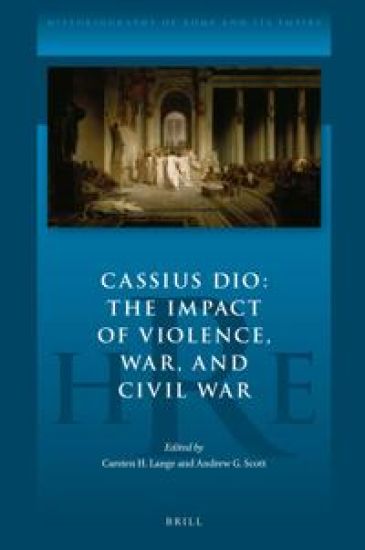
Cassius Dio: The Impact of Violence, War, and Civil War
Cassius Dio: The Impact of Violence, War, and Civil War is part of a renewed interest in the Roman historian Cassius Dio. This volume focuses on Dio’s approaches to foreign war and stasis as well as civil war. The impact of war on Rome as well as on the history of Rome has long be recognised by scholars, and adding to that, recent years have seen an increasing interest in the impact of civil war on Roman society. Dio’s views on violence, war, and civil war are an inter-related part of his overall project, which sought to understand Roman history on its own historical and historiographical terms and within a long-range view of the Roman past that investigated the realities of power.
Cassius Dio

Cassius Dio

VDM Publishing House
2010
nidottu
Observera att förlaget som ger ut denna produkt baserar innehållet i sina produkter på fria källor som Wikipedia. Boken är med stor sannolikhet endast ett utdrag ur dessa informationskällor, alltså inte en vanlig bok i den bemärkelsen.
Emperors and Political Culture in Cassius Dio's Roman History
The Roman History of Cassius Dio provides one of the most important continuous narratives of the early Roman empire, spanning the inception of the Principate under Augustus to the turbulent years of the Severan Dynasty. It has been a major influence on how scholars have thought about Roman imperial history, from the Byzantine period down to the present day, as well as being a work of considerable literary sophistication and merit. This book, the product of an international collaborative project, brings together thirteen chapters written by scholars based in Europe, North America, and Australia. They offer new approaches to Dio's representation of Roman emperors, their courtiers, and key political constituencies such as the army and the people, as well as the literary techniques he uses to illuminate his narrative, from speeches to wonder narratives.
Emperors and Political Culture in Cassius Dio's Roman History
The Roman History of Cassius Dio provides one of the most important continuous narratives of the early Roman empire, spanning the inception of the Principate under Augustus to the turbulent years of the Severan Dynasty. It has been a major influence on how scholars have thought about Roman imperial history, from the Byzantine period down to the present day, as well as being a work of considerable literary sophistication and merit. This book, the product of an international collaborative project, brings together thirteen chapters written by scholars based in Europe, North America, and Australia. They offer new approaches to Dio's representation of Roman emperors, their courtiers, and key political constituencies such as the army and the people, as well as the literary techniques he uses to illuminate his narrative, from speeches to wonder narratives.