This best-selling guide will help you get to grips with the larger themes and issues behind historical study, while also showing you how to formulate your own ideas in a clear, analytical style. Fully updated throughout, further advice on using web-based sources and avoiding plagiarism will equip you with the tools you need to succeed on your course.
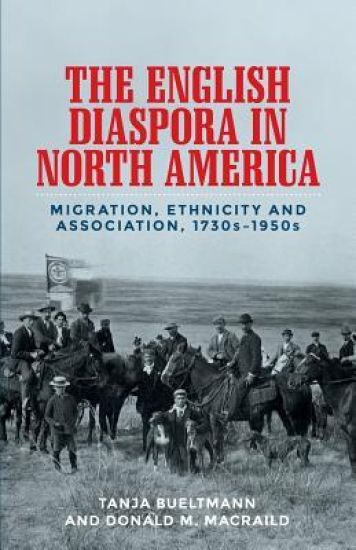
Ethnic associations were once vibrant features of societies, such as the United States and Canada, which attracted large numbers of immigrants. While the transplanted cultural lives of the Irish, Scots and continental Europeans have received much attention, the English are far less widely explored. It is assumed the English were not an ethnic community, that they lacked the alienating experiences associated with immigration and thus possessed few elements of diasporas. This deeply researched new book questions this assumption. It shows that English associations once were widespread, taking hold in colonial America, spreading to Canada and then encompassing all of the empire. Celebrating saints days, expressing pride in the monarch and national heroes, providing charity to the national poor, and forging mutual aid societies mutual, were all features of English life overseas. In fact, the English simply resembled other immigrant groups too much to be dismissed as the unproblematic, invisible immigrants.
Ethnic associations were once vibrant features of societies, such as the United States and Canada, which attracted large numbers of immigrants. While the transplanted cultural lives of the Irish, Scots and continental Europeans have received much attention, the English are far less widely explored. It is assumed the English were not an ethnic community, that they lacked the alienating experiences associated with immigration and thus possessed few elements of diasporas. This deeply researched new book questions this assumption. It shows that English associations once were widespread, taking hold in colonial America, spreading to Canada and then encompassing all of the empire. Celebrating saints days, expressing pride in the monarch and national heroes, providing charity to the national poor, and forging mutual aid societies mutual, were all features of English life overseas.
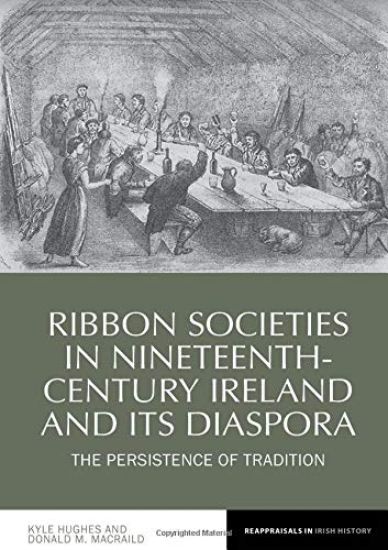
This is the first full-length study of Irish Ribbonism, tracing the development of the movement from its origins in the Defender movement of the 1790s to the latter part of the century when the remnants of the Ribbon tradition found solace in a new movement: the quasi-constitutional affinities of the Ancient Order of Hibernians. Placing Ribbonism firmly within Ireland’s long tradition of secret societies, this book shows that, due to its diversity and adaptability, it stood apart from other similar bodies and showed remarkable longevity not matched by its contemporaries. The book describes the wider context of Catholic struggles for improved standing, explores traditions and networks for association, and it describes external impressions. Drawing on rich archives in the form of state surveillance records, `show trial’ proceedings and press reportage, the book shows that Ribbonism was a sophisticated and durable underground network drawing together various strands of the rural and urban Catholic populace in Ireland and Britain. Ribbon Societies in Nineteenth-Century Ireland and Britain is a fascinating study that demonstrates Ribbonism operated more widely than previous studies have revealed.
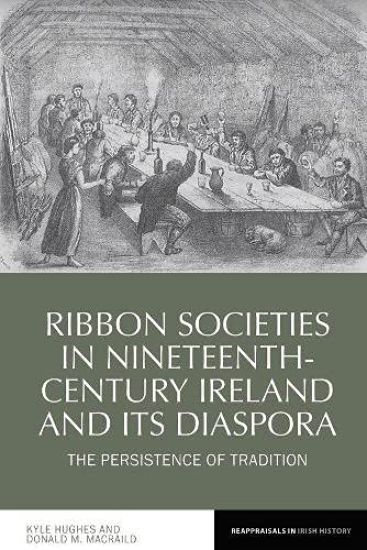
This is the first full-length study of Irish Ribbonism. It traces the development of Ribbonism from its origins in the Defender movement of the 1790s until the latter part of the century when the remnants of the Ribbon tradition found solace in the quasi-constitutional affinities of the Ancient Order of Hibernians. Placing Ribbonism firmly within Ireland’s long tradition of collective action and protest, this book shows that, owing to its diversity and adaptability, it shared similarities, but also stood apart from, the many rural redresser groups of the period and showed remarkable longevity not matched by its contemporaries. The book describes the wider context of Catholic struggles for improved standing, explores traditions and networks for association, and it describes external impressions. Drawing on rich archives in the form of state surveillance records, ‘show trial’ proceedings and press reportage, the book shows that Ribbonism was a sophisticated and durable underground network drawing together various strands of the rural and urban Catholic populace in Ireland and Britain. Ribbon Societies in Nineteenth-Century Ireland and Its Diaspora is a fascinating study that demonstrates Ribbonism operated more widely than previous studies have revealed.
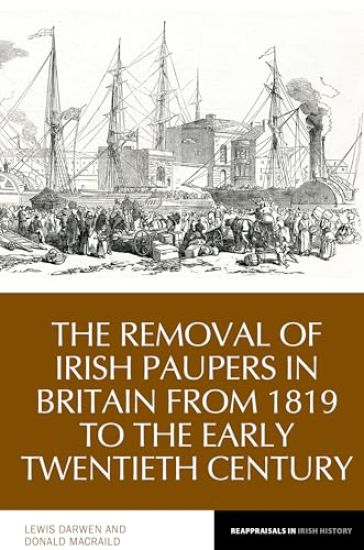
During the nineteenth century, local officials sought to deal with their Irish pauper ‘problem’ by removing these poor migrants back to Ireland under the laws of settlement and removal. Over the course of the century, hundreds of thousands of Irish paupers were forcibly repatriated in this way. Even though the settlement rights of Irish immigrants gradually improved over time, removals were still taking place into the twentieth century. The system was widely recognised as being cruel and unfair, especially in Ireland where the removal of Irish paupers from Britain garnered considerable political and press attention. Much was made of the illegality of some removals, and of harsh removals involving widowed women, children and the elderly. This book, which is the first sustained study of repatriation from Britain, demonstrates a persistent theme: the marginal nature of Irish life on the larger island. Drawing on extensive research from newspaper sources and parliamentary papers, it presents an original and richly detailed perspective on Irish immigration, poverty and pauperism in nineteenth-century Britain.
This book offers a new interpretation of the Employment Act of 1946. It argues that in addition to Keynesian economics, the idea of a living wage was also part of the background leading up to the Employment Act. The Act mandated that the president prepare an Economic Report on the state of the economy and how to improve it, and the idea of a living wage was an essential issue in those Economic Reports for over two decades. The author argues that macroeconomic policy in the USA consisted of a dual approach of using a living wage to increase consumption with higher wages, and fiscal policy to create jobs and higher levels of consumption, therefore forming a hybrid system of redistributive economics. An important read for scholars of economic history, this book explores Roosevelt’s role in the debates over the Employment Act in the 1940s, and underlines how Truman’s Fair Deal, Kennedy’s New Frontier and Johnson’s Great Society all had the ultimate goal of a living wage, despite their variations of its definition and name.
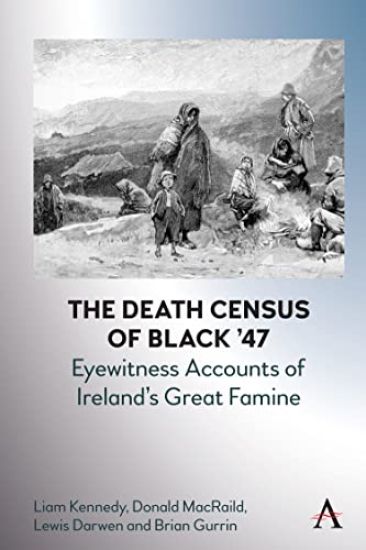
The Great Irish Famine claimed the lives of one million people, mainly from the lower classes. More than a million others fled the stricken land between 1845 and 1851. In recent decades, its history has become the focus of considerable scholarly and popular attention, but much remains to be retrieved and reconstructed, particularly at the level of the rural poor. This book fills that gap. It is based on a large volume of reports on social conditions in the Irish localities, emanating from within those localities, that has never been used systematically by historians. It bears the compelling title of the ‘Death Census’. Most historians are simply unaware of its existence. The outstanding feature of the Death Census is that it was authored by local clergymen who lived among the people they served and were intimately involved with their lives. This book brings the Death Census together in composite form for the first time and provides a detailed examination of its contents. The result is new understanding of the Great Famine as it was experienced on the ground.
As America's most infamous former Secretary of Defense lies poised to unleash his wistful recollections and rewriting of the war on terror, authors Eric Martin and Stephen Elliott humbly submit their take to the historical record: Donald. What would happen if Donald Rumsfeld, former defense secretary and architect of the war on terror, was abducted at night from his Maryland home, held without charges in his own prison system, denied a trial, and kept in a place where no one could find him, beyond the reach of the law? Donald is a high-wire allegory that answers this question, in equal parts breakneck thriller and gradual descent into madness. But it is also a novel rooted in the harrowing stories of real people caught in America's military campaigns. And while there are those who would try to convince us that war is full of uncertainty--of knowns and unknowns--Donald reminds us that there remain things we know to be wrong.
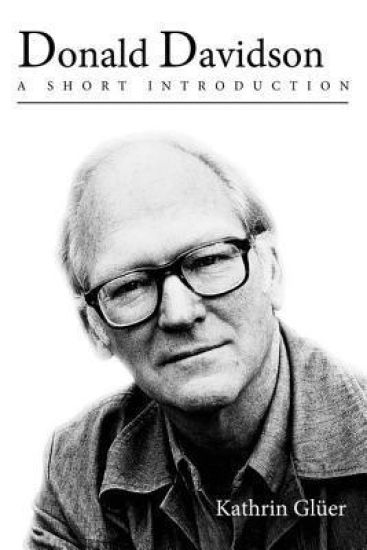
Donald Davidson was one of the 20th Century's deepest analytic thinkers. He developed a systematic picture of the human mind and its relation to the world, an original and sustained vision that exerted a shaping influence well beyond analytic philosophy of mind and language. At its center is an idea of minded creatures as essentially rational animals: Rational animals can be interpreted, their behavior can be understood, and the contents of their thoughts are, in principle, open to others. The combination of a rigorous analytic stance with aspects of humanism so distinctive of Davidsonian thought finds its maybe most characteristic expression when this central idea is brought to bear on the relation of the mental to the physical: Davidson defended the irreducibility of its rational nature while acknowledging that the mental is ultimately determined by the physical. Davidson made contributions of lasting importance to a wide range of topics -- from general theory of meaning and content over formal semantics, the theories of truth, explanation, and action, to metaphysics and epistemology. His writings almost entirely consist of short, elegant, and often witty papers. These dense and thematically tightly interwoven essays present a profound challenge to the reader. This book provides a concise, systematic introduction to all the main elements of Davidson's philosophy. It places the theory of meaning and content at the very center of his thought. By using interpretation, and the interpreter, as key ideas it clearly brings out the underlying structure and unified nature of Davidson's work. Kathrin Glüer carefully outlines his principal claims and arguments, and discusses them in some detail. The book thus makes Davidson's thought accessible in its genuine depth, and acquaints the reader with the main lines of discussion surrounding it.
Donald Davidson was one of the 20th Century's deepest analytic thinkers. He developed a systematic picture of the human mind and its relation to the world, an original and sustained vision that exerted a shaping influence well beyond analytic philosophy of mind and language. At its center is an idea of minded creatures as essentially rational animals: Rational animals can be interpreted, their behavior can be understood, and the contents of their thoughts are, in principle, open to others. The combination of a rigorous analytic stance with aspects of humanism so distinctive of Davidsonian thought finds its maybe most characteristic expression when this central idea is brought to bear on the relation of the mental to the physical: Davidson defended the irreducibility of its rational nature while acknowledging that the mental is ultimately determined by the physical. Davidson made contributions of lasting importance to a wide range of topics -- from general theory of meaning and content over formal semantics, the theories of truth, explanation, and action, to metaphysics and epistemology. His writings almost entirely consist of short, elegant, and often witty papers. These dense and thematically tightly interwoven essays present a profound challenge to the reader. This book provides a concise, systematic introduction to all the main elements of Davidson's philosophy. It places the theory of meaning and content at the very center of his thought. By using interpretation, and the interpreter, as key ideas it clearly brings out the underlying structure and unified nature of Davidson's work. Kathrin Gl¨ uer carefully outlines his principal claims and arguments, and discusses them in some detail. The book thus makes Davidson's thought accessible in its genuine depth, and acquaints the reader with the main lines of discussion surrounding it.
Donald Davidson (1917-2003) was one of the most important philosophers of the late twentieth century. His work on language and the theory of meaning has been particularly influential.Two of the world's leading authorities on Davidson's philosophy, Ernest Lepore and Kirk Ludwig, provide a systematic exposition of his work in this field and of his contributions to philosophy of mind, metaphysics, and epistemology which spring from it. Their second aim is to assess Davidson's program critically, to mark its successes, but also to identify where its ccomplishments fall short of its ambitions, and, since it is an on-going research program, to assess its prospects for the future, and to contribute to the expansion of that program. Criticizing and extending Davidson's thought, as well as providing an introduction to it, Lepore and Ludwig address a broad academic audience. Their work will be of fundamental importance for those who are coming to Davidson's work for the first time; while some philosophical sophistication and training is presupposed, it is accessible both to advanced undergraduates and to graduate students. It will also be welcomed by professional philosophers, linguists, and anyone wishing to assess and understand Davidson's remarkable intellectual legacy.
Ernest Lepore and Kirk Ludwig examine the foundations and applications of Davidson's influential program of truth-theoretic semantics for natural languages. The program uses an axiomatic truth theory for a language, which meets certain constraints, to serve the goals of a compositional meaning theory. Lepore and Ludwig explain and clarify the motivations for the approach, and then consider how to apply the framework to a range of important natural language constructions, including quantifiers, proper names, indexicals, simple and complex demonstratives, quotation, adjectives and adverbs, the simple and perfect tenses, temporal adverbials and temporal quantifiers, tense in sentential complement clauses, attitude and indirect discourse reports, and the problem of interrogative and imperative sentences. They not only discuss Davidson's own contributions to these subjects but consider criticisms, developments, and alternatives as well. They conclude with a discussion of logical form in natural language in light of the approach, the role of the concept of truth in the program, and Davidson's view of it. Anyone working on meaning will find this book invaluable.