This paper is written in the belief that people are important and that equipment is to serve the needs of the people and therefore should be designed to meet their specific needs and environment. This is particularly important in the case of a developing country when a professional engineer accepts the responsibility to formulate policies evaluate equipment imple ment projects and train national people. 1. Government, geography and climate Papua New Guinea, an independent and self governing state since 1975, is located directly North of Australia above the North Eastern State of Queensland. The country extends from 141° east longitude, at the border with Indonesia (Irian Jaya) to 160° east longitude and between latitudes 1° and 12° south (see figure 1). Papua New Guinea is a parliamentary democracy, with a single legis lature known as the National Parliament (1). The State is divided into 19 provinces plus the National Capital District (Port Moresby) with de centralized Government established in each province. Before independence the country comprised the Australian territory of Papua in the southern regions and the United Nations Trust Territory of New Guinea in the North (1). Land area is 462,840 square kilometres This inclUdes the mainland, the three large islands of New Britain, ~ew Ireland and fiougainville plus 600 small islands and archipelagos. Approximate direct distances from the capital city of Port Moresby to some of the other centres are : Vanimo 990 km, Rabaul SOO km, Arawa 990 km and Lorengau S25 km.
Availability of E-Tag Information to Commission Staff (US Federal Energy Regulatory Commission Regulation) (FERC) (2018 Edition) The Law Library presents the complete text of the Availability of E-Tag Information to Commission Staff (US Federal Energy Regulatory Commission Regulation) (FERC) (2018 Edition). Updated as of May 29, 2018 In this Final Rule, the Federal Energy Regulatory Commission (the Commission) is amending its regulations, pursuant to sections 222 and 307(a) of the Federal Power Act (FPA), to grant Commission access, on a non-public and ongoing basis, to the complete electronic tags (e-Tags) used to schedule the transmission of electric power interchange transactions in wholesale markets. This Final Rule will require e-Tag Authors (through their Agent Service) and Balancing Authorities (through their Authority Service) to take appropriate steps to ensure Commission access to the e-Tags covered by this Final Rule by designating the Commission as an addressee on the e-Tags. After the Commission is designated as an addressee, the Commission will access the e-Tags by contracting with a commercial vendor. The commercial vendor will provide data management services and receive e-Tags addressed to the Commission. The information made available under this Final Rule will bolster the Commission's market surveillance and analysis efforts by helping the Commission to detect and prevent market manipulation and anti-competitive behavior. This information will also help the Commission monitor the efficiency of markets and better inform Commission policies and decision-making, thereby helping to ensure just and reasonable rates. In addition, this Final Rule will require that e-Tag information be made available to regional transmission organizations and independent system operators and their Market Monitoring Units, upon request to e-Tag Authors and Authority Services, subject to appropriate confidentiality restrictions. This book contains: - The complete text of the Availability of E-Tag Information to Commission Staff (US Federal Energy Regulatory Commission Regulation) (FERC) (2018 Edition) - A table of contents with the page number of each section
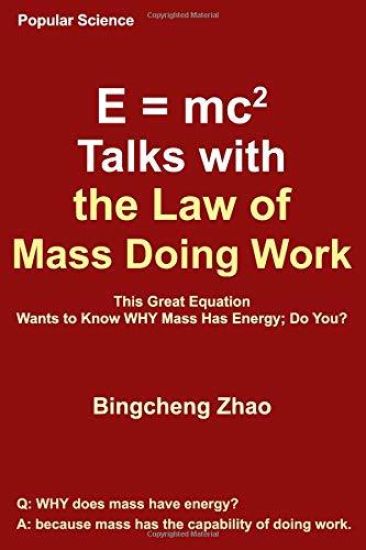
"Hi, dear E = mc 2, what are you doing? It seems that you are deeply meditating on something," a physicist saluted and chatted with the famous and great equation. "I have been pondering over the fundamental question, why does mass have energy? In fact, this thorny question has been constantly baffling me for quite a long time. Moreover, I have been asked this question many, many times over the entire last century," this great equation replied candidly and specifically. "Have you ever heard of the law of mass doing work?" the physicist suggested. "I haven't yet; what's this law about?" this great equation replied honestly and asked curiously. "It's a newly discovered and verified physical law. This law answers the question of why mass has energy by revealing and showing that mass has the capability of doing work," the physicist replied concisely. "Oh, mass has the capability of doing work Really?" this great equation became obviously astonished. "Yes, really, because this law also shows that the mc 2 in you is equal to the maximum capability of m doing work," the physicist answered calmly and assuredly. "And so, I want to know the law of mass doing work. And I'm going to talk with this law," this great equation reacted excitedly and eagerly.
Per millenni il pensiero cinese consapevole che gli umani, per essere individui armoniosi, devono essere in armonia (e "riverenza"), con il cielo ed il cosmo. Ci segue dal principio che ogni intervento umano deve rispettare i diversi flussi energetici che reggono insieme l'Universo. QUESTO LIBRO TRATTA DI ENERGIE. Esso descrive cosa sono e come interagiscono con noi. L'Essenza chiamata Energia compone tutte le cose visibili, cos come quelle Energie invisibili che influenzano il nostro corpo e psiche. Esso aiuta a vedere che c' una sola radice, un'unica fonte da cui tutto emana e si materializza. Tuttavia, ENERGIA VISION non un trattato ma un manuale pratico, che contiene molte semplici tecniche per l'uso della nostra energia interna ed esterna. Il libro tratta anche delle energie della nostra vita, aiutando il lettore a vedere, capire e lasciare andare i blocchi mentali e fisici che limitano il potenziale personale.
Can the human body truly heal itself? Can we actually reverse the process of disease? If so, what modality do we choose to find our way back to health? The answers to these questions are found in C.U.R.E. Cultivating Unlimited Rejuvenating Energy is your step by step guide to understanding how the body works, why we get sick and how we heal through deep detoxification and cellular rejuvenation. For author Rosanne Calabrese AP, C.U.R.E. is paramount not only to her as a practitioner but also as a patient. As a practitioner of Traditional Chinese Medicine (TCM), Rosanne has helped thousands of people feel better and improve their state of health. As a patient she battled relentlessly to reverse two "incurable" autoimmune diseases, something numerous doctors told her was impossible. Through her personal process of C.U.R.E. Rosanne gained a much deeper understanding of the human body, why disease occurs and subsequently, how to reverse it. This understanding does not apply to only autoimmune diseases but to virtually all disease processes in modern life. In the United States, the standard of care for dealing with practically any health issue is to medicate, operate or radiate in an effort to "control" the symptoms of disease. But controlling or suppressing symptoms is not C.U.R.E. It is, instead, an illusion. A temporary reprieve if you will. A way to gather statistics so as to manipulate them, creating the impression that help is just a pill, procedure or process away. As the public wakes up to this deception they seek a different choice. That alternate choice to heal the human body is not a recent discovery. It is a culmination of what natural healers have used and nature has provided for eons. Rosanne Calabrese AP has taken the teachings of natural healers along with her knowledge of TCM and her own experience of reversing disease in her body and put it in simple, common sense language.
Energy Conservation Standards for Certain Consumer Products and Commercial and Industrial Equipment (US Department of Energy Regulation) (DOE) (2018 Edition) The Law Library presents the complete text of the Energy Conservation Standards for Certain Consumer Products and Commercial and Industrial Equipment (US Department of Energy Regulation) (DOE) (2018 Edition). Updated as of May 29, 2018 The Department of Energy (DOE) is publishing this technical amendment to place the energy conservation standards and test procedures, and related definitions, prescribed in the Energy Independence and Security Act of 2007 (EISA 2007) for certain consumer products and commercial and industrial equipment in the Code of Federal Regulations. This book contains: - The complete text of the Energy Conservation Standards for Certain Consumer Products and Commercial and Industrial Equipment (US Department of Energy Regulation) (DOE) (2018 Edition) - A table of contents with the page number of each section
This volume comprises the select peer reviewed proceedings of the International Conference on Recent Evolutions in Energy, Drives and e-Vehicles (REED-EV 2022). It aims to provide a comprehensive and broad-spectrum picture of the state-of-the-art research and development in the area of power and energy systems, grid integration, convertor topology, electrification for transport industries, battery storage and energy management systems, system protection, filters and harmonics, among others. This volume will provide a valuable resource for those in academia and industry.
This volume comprises the select peer reviewed proceedings of the International Conference on Recent Evolutions in Energy, Drives and e-Vehicles (REED-EV 2022). It aims to provide a comprehensive and broad-spectrum picture of the state-of-the-art research and development in the area of power and energy systems, grid integration, convertor topology, electrification for transport industries, battery storage and energy management systems, system protection, filters and harmonics, among others. This volume will provide a valuable resource for those in academia and industry.
Sharing my life lessons when you change your energy and mindset it allows you to release your limiting beliefs. When you are in alignment energetically you can begin to BE - DO - HAVE all that you desire in life when it comes to your health and wellness. Easy tips and techniques to potentially add 10 - 15 years to your life. Do not let the EMT's take you away before your time
In order to attract our inner most desires, we must learn to change the stories of our lives. These stories - which are often a result of messages that were planted within our subconscious minds when we were very young, have become ingrained within us - creating fear, worry and anxiety - which often act as obstacles in our lives.L.O.V.E: Live a Life Of Vibrant Energy is a compilation of reflections, theories and practical applications that help people to understand their ingrained programming and ultimately equip them with the power to re-program their thoughts, words, actions and change the way in which they approach their world at large. If you want to be free of your limiting beliefs and begin to live the life you've imagined, open this book and delve into the wisdom and secrets of your own subconscious mind and become no longer a slave to your thoughts, but their master Thereby, attracting more love, prosperity and success to your everyday life.
2009-01-09 Energy Conservation Program for Commercial and Industrial Equipment - Energy Conservation Standards for Commercial Ice-Cream Freezers (US Energy Efficiency and Renewable Energy Office Regulation) (EERE) (2018 Edition) The Law Library presents the complete text of the 2009-01-09 Energy Conservation Program for Commercial and Industrial Equipment - Energy Conservation Standards for Commercial Ice-Cream Freezers (US Energy Efficiency and Renewable Energy Office Regulation) (EERE) (2018 Edition). Updated as of May 29, 2018 The Department of Energy (DOE) is adopting new energy conservation standards for commercial ice-cream freezers; self-contained commercial refrigerators, commercial freezers, and commercial refrigerator-freezers without doors; and remote condensing commercial refrigerators, commercial freezers, and commercial refrigerator-freezers. DOE has determined that energy conservation standards for these types of equipment would result in significant conservation of energy, and are technologically feasible and economically justified. This book contains: - The complete text of the 2009-01-09 Energy Conservation Program for Commercial and Industrial Equipment - Energy Conservation Standards for Commercial Ice-Cream Freezers (US Energy Efficiency and Renewable Energy Office Regulation) (EERE) (2018 Edition) - A table of contents with the page number of each section
2009-08-31 Energy Conservation Program - Energy Conservation Standards for Refrigerated Bottled or Canned Beverage Vending Machines - Final rule (US Energy Efficiency and Renewable Energy Office Regulation) (EERE) (2018 Edition) The Law Library presents the complete text of the 2009-08-31 Energy Conservation Program - Energy Conservation Standards for Refrigerated Bottled or Canned Beverage Vending Machines - Final rule (US Energy Efficiency and Renewable Energy Office Regulation) (EERE) (2018 Edition). Updated as of May 29, 2018 The U.S. Department of Energy (DOE) is adopting new energy conservation standards for refrigerated bottled or canned beverage vending machines. DOE has determined that energy conservation standards for these types of equipment would result in significant conservation of energy, and are technologically feasible and economically justified. This book contains: - The complete text of the 2009-08-31 Energy Conservation Program - Energy Conservation Standards for Refrigerated Bottled or Canned Beverage Vending Machines - Final rule (US Energy Efficiency and Renewable Energy Office Regulation) (EERE) (2018 Edition) - A table of contents with the page number of each section
2011-11-18 Energy Conservation Program - Energy Conservation Standards for Direct Heating Equipment - Final Rule (US Energy Efficiency and Renewable Energy Office Regulation) (EERE) (2018 Edition) The Law Library presents the complete text of the 2011-11-18 Energy Conservation Program - Energy Conservation Standards for Direct Heating Equipment - Final Rule (US Energy Efficiency and Renewable Energy Office Regulation) (EERE) (2018 Edition). Updated as of May 29, 2018 The Energy Policy and Conservation Act of 1975 (EPCA), as amended, prescribes energy conservation standards for various consumer products and certain commercial and industrial equipment, including residential direct heating equipment. In this final rule, the U.S. Department of Energy (DOE) is amending its definitions pertaining to direct heating equipment. Specifically, through this final rule, DOE is amending the definition of "vented hearth heater," a type of direct heating equipment, to clarify the scope of the current exclusion for those vented hearth heaters that are primarily decorative hearth products. The amendment to the existing exclusion shifts the focus from a maximum input capacity limitation (i.e., 9,000 Btu/h) to a number of other factors, including the absence of a standing pilot light or other continuously-burning ignition source. DOE has concluded that these amendments would result in increased energy savings overall, as well as for the types of units under the exclusion. This book contains: - The complete text of the 2011-11-18 Energy Conservation Program - Energy Conservation Standards for Direct Heating Equipment - Final Rule (US Energy Efficiency and Renewable Energy Office Regulation) (EERE) (2018 Edition) - A table of contents with the page number of each section
2016-01-08 Energy Conservation Program - Energy Conservation Standards for Refrigerated Bottled or Canned Beverage Vending Machines - Final Rule (US Energy Efficiency and Renewable Energy Office Regulation) (EERE) (2018 Edition) The Law Library presents the complete text of the 2016-01-08 Energy Conservation Program - Energy Conservation Standards for Refrigerated Bottled or Canned Beverage Vending Machines - Final Rule (US Energy Efficiency and Renewable Energy Office Regulation) (EERE) (2018 Edition). Updated as of May 29, 2018 The Energy Policy and Conservation Act of 1975 (EPCA), as amended, prescribes energy conservation standards for various consumer products and certain commercial and industrial equipment, including refrigerated bottled or canned beverage vending machines (beverage vending machines or BVM). EPCA also requires the U.S. Department of Energy (DOE) to periodically determine whether more-stringent standards would be technologically feasible and economically justified, and would save a significant amount of energy. In this final rule, DOE is amending the energy conservation standards for Class A and Class B beverage vending machines. DOE is also amending the definition for Class A equipment to more unambiguously differentiate Class A and Class B beverage vending machines. In addition, DOE is amending the definition of combination vending machine, is defining two new classes of combination vending machines, Combination A and Combination B, and is promulgating standards for those new classes. Finally, DOE is adopting new provisions that DOE will use to verify the appropriate equipment class and refrigerated volume during enforcement testing. This book contains: - The complete text of the 2016-01-08 Energy Conservation Program - Energy Conservation Standards for Refrigerated Bottled or Canned Beverage Vending Machines - Final Rule (US Energy Efficiency and Renewable Energy Office Regulation) (EERE) (2018 Edition) - A table of contents with the page number of each section
2017-01-04 Energy Conservation Program - Test Procedures for Compressors - Final rule (US Energy Efficiency and Renewable Energy Office Regulation) (EERE) (2018 Edition) The Law Library presents the complete text of the 2017-01-04 Energy Conservation Program - Test Procedures for Compressors - Final rule (US Energy Efficiency and Renewable Energy Office Regulation) (EERE) (2018 Edition). Updated as of May 29, 2018 On May 5, 2016, the U.S. Department of Energy (DOE) published a notice of proposed rulemaking (NOPR) to establish new test procedures for certain varieties of compressors. That proposed rulemaking serves as the basis for the final rule. This final rule establishes definitions, materials incorporated by reference, sampling plans, representations requirements, enforcement provisions, and test procedures for certain varieties of compressors. Specifically, this final rule establishes full-load package isentropic efficiency as the applicable energy metric for certain fixed-speed compressors and part-load package isentropic efficiency as the applicable energy metric for certain variable-speed compressors. Finally, this final rule incorporates by reference certain sections of the ISO Standard 1217:2009(E), (ISO 1217:2009(E)), "Displacement compressors-Acceptance tests," as amended through Amendment 1:2016, as the basis for a test method for determining compressor efficiency. ISO 1217:2009(E) includes a test method for measuring compressor inlet and discharge pressures, actual volume flow rate, electrical input power, package isentropic efficiency, and other compressor performance metrics. This final rule also adopts certain modifications and additions to ISO 1217:2009(E) to increase the specificity of certain testing methods established in ISO 1217:2009(E) and improve the repeatability of tested and measured values. This book contains: - The complete text of the 2017-01-04 Energy Conservation Program - Test Procedures for Compressors - Final rule (US Energy Efficiency and Renewable Energy Office Regulation) (EERE) (2018 Edition) - A table of contents with the page number of each section