Title: Brent Knoll. A night thought in verse]. By Juvenis i.e. J. W. Stephenson?]Publisher: British Library, Historical Print EditionsThe British Library is the national library of the United Kingdom. It is one of the world's largest research libraries holding over 150 million items in all known languages and formats: books, journals, newspapers, sound recordings, patents, maps, stamps, prints and much more. Its collections include around 14 million books, along with substantial additional collections of manuscripts and historical items dating back as far as 300 BC.The POETRY & DRAMA collection includes books from the British Library digitised by Microsoft. The books reflect the complex and changing role of literature in society, ranging from Bardic poetry to Victorian verse. Containing many classic works from important dramatists and poets, this collection has something for every lover of the stage and verse. ++++The below data was compiled from various identification fields in the bibliographic record of this title. This data is provided as an additional tool in helping to insure edition identification: ++++ British Library Anonymous; Stephenson, J W.; 1837. 20 p.; 8 . 11649.cc.27.(4.)
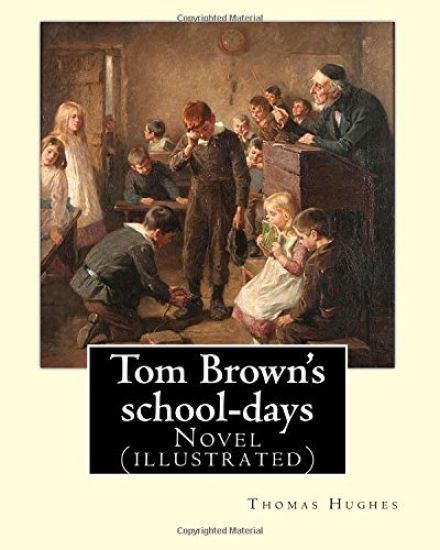
The story is set in the 1830s at Rugby School, a public school for boys. Hughes attended Rugby School from 1834 to 1842. The novel was originally published as being "by an Old Boy of Rugby", and much of it is based on the author's experiences. Tom Brown is largely based on the author's brother George Hughes. George Arthur, another of the book's main characters, is generally believed to be based on Arthur Penrhyn Stanley. The fictional Tom's life also resembles the author's, in that the culminating event of his school career was a cricket match. 3] The novel also features Dr Thomas Arnold (1795-1842), who was the actual headmaster of Rugby School from 1828 to 1841. Tom Brown's School Days has been the source for several film and television adaptations. It also influenced the genre of British school novels, which began in the nineteenth century, and led to fictional depictions of schools such as Billy Bunter's Greyfriars School, Mr Chips' Brookfield, St. Trinian's, and Harry Potter's Hogwarts. A sequel, Tom Brown at Oxford, was published in 1861.Tom Brown is energetic, stubborn, kind-hearted and athletic, rather than intellectual. He follows his feelings and the unwritten rules of the boys. The early chapters of the novel deal with his childhood at his home in the Vale of White Horse. Much of the scene setting in the first chapter is deeply revealing of Victorian England's attitudes towards society and class, and contains a comparison of so-called Saxon and Norman influences on England. This part of the book, when young Tom wanders the valleys freely on his pony, serves as a contrast with the hellish experiences in his first years at school. His first school year is at a local school. His second year starts at a private school, but due to an epidemic of fever in the area, all the school's boys are sent home, and Tom is transferred mid-term to Rugby School. On his arrival, the eleven-year-old Tom Brown is looked after by a more experienced classmate, Harry "Scud" East. Tom's nemesis at Rugby is the bully Flashman. The intensity of the bullying increases, and, after refusing to hand over a sweepstake ticket for the favourite in a horse race, Tom is deliberately burned in front of a fire. Tom and East defeat Flashman with the help of Diggs, a kind, comical, older boy. In their triumph they become unruly........ Edmund Joseph Sullivan (1869-1933), usually known as E. J. Sullivan, was a British book illustrator who worked in a style which merged the British tradition of illustration from the 1860s with aspects of Art Nouveau. Louis John Rhead (November 6, 1857 - July 29, 1926) was an English-born American artist, illustrator, author and angler who was born in Etruria, Staffordshire, England. He emigrated to the United States at the age of twenty-four. William Dean Howells ( March 1, 1837 - May 11, 1920) was an American realist novelist, literary critic, and playwright, nicknamed "The Dean of American Letters". He was particularly known for his tenure as editor of The Atlantic Monthly, as well as for his own prolific writings, including the Christmas story "Christmas Every Day" and the novels The Rise of Silas Lapham and A Traveler from Altruria.... Thomas Hughes QC (20 October 1822 - 22 March 1896) was an English lawyer, judge, politician and author. He is most famous for his novel Tom Brown's School Days (1857), a semi-autobiographical work set at Rugby School, which Hughes had attended. It had a lesser-known sequel, Tom Brown at Oxford (1861). Hughes had numerous other interests, in particular as a Member of Parliament, in the British co-operative movement, and in a settlement in Tennessee reflecting his values.....
Since the mid-1820s, a series of lectures has been delivered each year over the Christmas period in the world-famous Faraday Lecture Theatre at The Royal Institution of Great Britain by prominent scientists, addressed specifically to an audience of children. Initially made accessible in book form, the lectures have been nationally televised throughout the UK and distributed worldwide since the 1960s, making them accessible to an even larger audience. The importance of these lectures in promoting science to a broad audience is perhaps best gauged by the fact that an image of one of Faraday's lectures appeared on the Bank of England £20 note in the 1990s.This anthology brings together, for the first time, a carefully chosen selection of 11 lectures from the 1860s to the 1990s. The selection includes lectures by Michael Faraday, arguably the most important and influential 19th-century physicist, and Lawrence Bragg, the youngest ever winner of the Nobel Prize. Through this work, readers will come to grips with the changing nature of popular science lectures over the past 140 years.
Since the mid-1820s, a series of lectures has been delivered each year over the Christmas period in the world-famous Faraday Lecture Theatre at The Royal Institution of Great Britain by prominent scientists, addressed specifically to an audience of children. Initially made accessible in book form, the lectures have been nationally televised throughout the UK and distributed worldwide since the 1960s, making them accessible to an even larger audience. The importance of these lectures in promoting science to a broad audience is perhaps best gauged by the fact that an image of one of Faraday's lectures appeared on the Bank of England £20 note in the 1990s.This anthology brings together, for the first time, a carefully chosen selection of 11 lectures from the 1860s to the 1990s. The selection includes lectures by Michael Faraday, arguably the most important and influential 19th-century physicist, and Lawrence Bragg, the youngest ever winner of the Nobel Prize. Through this work, readers will come to grips with the changing nature of popular science lectures over the past 140 years.

![Brent Knoll. a Night Thought [in Verse]. by Juvenis [i.E. J. W. Stephenson?]](/covers/9781241543655.jpg)




![A Letter On Frequent Communion [tr. By H. Lear] Ed. By W.j.e. Bennett](/covers/9781024672534.jpg)
![A Letter On Frequent Communion [tr. By H. Lear] Ed. By W.j.e. Bennett](/covers/9781024676471.jpg)
![The Battle of the Bards [Peter Pindar, Pseud., i.e. J. Wolcot and W. Gifford]. an Heroic Poem, in Two Cantos. the Author Mauritius Moonshine, F.R.S., Ox. Cant. Dubl. Et Edin. Soc. A. B. C. and D., Etc., Etc.](/covers/9781241042332.jpg)

![Der Krieg gegen Dänemark im Jahre 1864. Bearbeitet von G. Gr. W. [i.e. F. J. G. von Waldersee, Count.] ... Mit Beilagen, Karten und Plänen. Zweite aufs neue durchgesehene Auflage.](/covers/9781241776879.jpg)