Kirjojen hintavertailu. Mukana 12 390 323 kirjaa ja 12 kauppaa.

Kirjahaku

Etsi kirjoja tekijän nimen, kirjan nimen tai ISBN:n perusteella.

1000 tulosta hakusanalla Edward Alexander

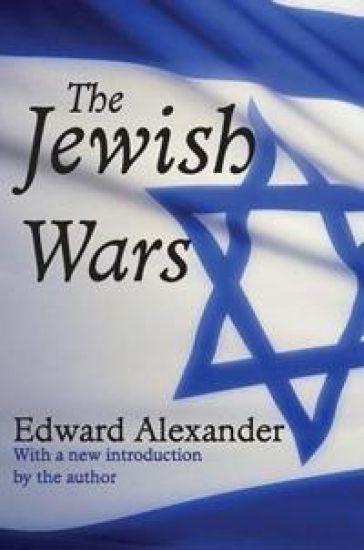
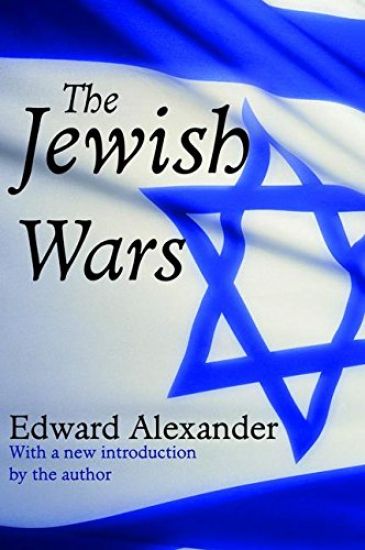
The Jewish Wars

The Jewish Wars

Edward Alexander

Routledge
2017
sidottu
Edward Alexander launches a counterattack in the war of ideas over Zionism, very much a warrior using words and ideas as his weapons. This book begins with a dissection of the first (1987) Intifada and deals with people and events through 1994, when Israel, having embraced the PLO, began their withdrawal from the disputed territories. Alexander shows how the Intifada proved to be a potent propaganda tool for its organizers. The spectacle of young Palestinians facing Israeli soldiers won for Arabs precisely the victory they had sought: it moved liberal, especially Jewish liberal, sympathy decisively to the side of the Palestinians.Alexander criticizes prominent figures in politics, journalism, education, and literature who express hatred of Jews, Judaism, and Israel. He gives special attention to major combatants in the Jewish wars such as the late Edward Said, Desmond Tutu, Patrick Buchanan, Alexander Cockburn, Michael Lerner, Noam Chomsky, and still more to certain personality types: the timorous Jew cloaking his timidity in the robes of the biblical prophet; the treacherous Jew presenting betrayal of his own people as ethical idealism; the Israelophobe parading as a dispassionate "critic of Israeli policies," the journalist exploiting the full public address and public relations systems provided by his profession.The recurring themes in Alexander's essays are the relations between American and Israeli Jews and the incorporation of anti-Zionism into liberalism, multiculturalism, and literary criticism. He analyzes the politically motivated distortion and exploitation of the Holocaust, the strategies of moral and political discrimination used against Israel, the self-deceptions by which prominent American and Israeli Jews evade the implications of such discrimination, and the growing impunity with which antisemitic tropes can be employed at both ends of the political spectrum. The author's new introduction traces these developments into the twenty-first century.
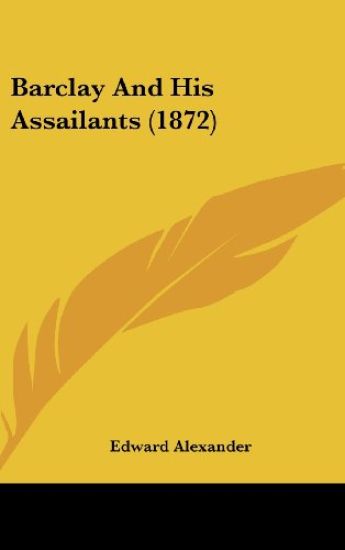
Lionel Trilling and Irving Howe

Lionel Trilling and Irving Howe

Edward Alexander

AldineTransaction
2009
sidottu
This pioneering effort links history and personality by pairing intellectual friends, most notably Lionel Trilling and Irving Howe, but also Thomas Carlyle and John Stuart Mill, D. H. Lawrence and Bertrand Russell, George Eliot and Emanuel Deutsch, Theodore Roethke and Robert Heilman. Chronologically the essays range from the early 1830s, when Carlyle and Mill discovered each other, to 1975, when Lionel Trilling died.The essay that gives this volume its title is also the most ambitious. Alexander examines Trilling and Howe in relation to one another and to Jewish quandaries, Henry James, politics and fiction, antisemitic writers, literary radicals, 1960s insurrectionists, the state of Israel, the nature of friendship itself.The chapter on the friendships (and ex-friendships) of Carlyle and Mill, Lawrence and Russell, views their stories against the background of the modern conflict between reason and feeling, positivism and imagination. Though some relationships began in adversity, they developed into friendships. This happened with Roethke and Heilman, and with Eliot and Deutsch. As a young woman, Eliot disparaged Jews as candidates for "extermination," but her friendship with the Talmudic scholar Deutsch changed her into one of the major Judeophiles of the Victorian period. The quartet of Carlyle and Mill, Lawrence and Russell shows how quickly-formed literary friendships, especially those based on hunger for disciples, can dissolve into ex-friendships. This volume offers new perspectives on leading literary figures and their relationship, and shows how friendship influences art.
The Jewish Wars

The Jewish Wars

Edward Alexander

AldineTransaction
2010
nidottu
Edward Alexander launches a counterattack in the war of ideas over Zionism, very much a warrior using words and ideas as his weapons. This book begins with a dissection of the first (1987) Intifada and deals with people and events through 1994, when Israel, having embraced the PLO, began their withdrawal from the disputed territories. Alexander shows how the Intifada proved to be a potent propaganda tool for its organizers. The spectacle of young Palestinians facing Israeli soldiers won for Arabs precisely the victory they had sought: it moved liberal, especially Jewish liberal, sympathy decisively to the side of the Palestinians.Alexander criticizes prominent figures in politics, journalism, education, and literature who express hatred of Jews, Judaism, and Israel. He gives special attention to major combatants in the Jewish wars such as the late Edward Said, Desmond Tutu, Patrick Buchanan, Alexander Cockburn, Michael Lerner, Noam Chomsky, and still more to certain personality types: the timorous Jew cloaking his timidity in the robes of the biblical prophet; the treacherous Jew presenting betrayal of his own people as ethical idealism; the Israelophobe parading as a dispassionate "critic of Israeli policies," the journalist exploiting the full public address and public relations systems provided by his profession.The recurring themes in Alexander's essays are the relations between American and Israeli Jews and the incorporation of anti-Zionism into liberalism, multiculturalism, and literary criticism. He analyzes the politically motivated distortion and exploitation of the Holocaust, the strategies of moral and political discrimination used against Israel, the self-deceptions by which prominent American and Israeli Jews evade the implications of such discrimination, and the growing impunity with which antisemitic tropes can be employed at both ends of the political spectrum. The author's new introduction traces these developments into the twenty-first century.
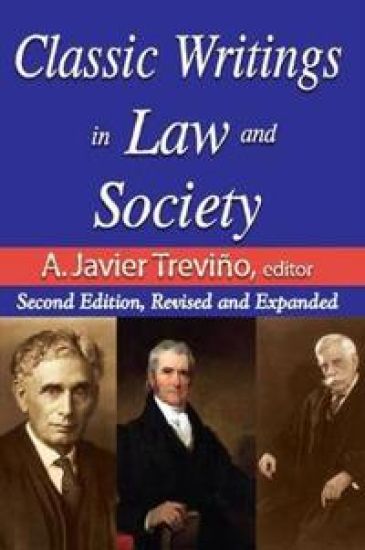
Classic Writings in Law and Society

Classic Writings in Law and Society

Edward Alexander

AldineTransaction
2010
nidottu
This volume consists of outstanding essays by contemporary scholars and specialists on classic writings in law and society. This second edition expands the previous volume by adding additional statements. Included are commentaries on Edward A. Ross's Social Control: A Survey of the Foundations of Order, Karl N. Llewellyn's Jurisprudence: Realism in Theory and Practice, Jerome Frank's Law and the Modern Mind, Leon Petrazycki's Law and Morality, and Karl Renner's The Institutions of Private Law and their Social Functions.The goal of Classic Writings in Law and Society is to acquaint a new generation of students with classic writings by diverse social and legal scholars—ranging from Henry Sumner Maine, Oliver Wendell Holmes, Jr., and Hans Kelsen to Eugen Ehrlich, Nicholas S. Timasheff, and Richard Quinney. This work continues to demonstrate their contemporary theoretical relevance. Accordingly, each chapter speaks of the scholars' work in general, how the particular book under consideration fits into that corpus, and how the book is assessed in a present day context. These essays have a clear relation to the "classic" tradition in sociolegal thought.Reading the classics is useful in gaining a better understanding and appreciation of the essential foundation for a post-classic approach in law and social inquiry—an approach that can be found in such orientations as critical legal studies, chaos theory in law, and legal semiotics. Classic Writings in Law and Society includes commentaries that consider early writings that set the standard for the social scientific approach in examining issues of law and punishment, social control, joint stock companies, business firms and nation-states in the study of law and society.
The Holocaust and the War of Ideas

The Holocaust and the War of Ideas

Edward Alexander

Transaction Publishers
1994
sidottu
The Holocaust and the War of Ideas begins with an analysis of ancient and modern anti-Semitism as the primary cause of the destruction of European Jewry. Alexander proceeds to interpret representative works from the three main bodies of Holocaust literature—Yiddish, American, Hebrew—in relation to the war of ideas that surrounds the historical catastrophe that is their subject.The chapter on Yiddish writers explores religious ideas and the claim that Yiddish, having become the language of martyrdom, has replaced Hebrew as the Jews' sacred tongue. The discussion of American writers centers on the attempts to Americanize Anne Frank, and criticizes the "personalization" of the Holocaust by literary latecomers to the subject who knew little of the Jewish past other than the Holocaust. Alexander treats sympathetically writers like Kovner and Appelfeld who integrated the European tragedy into the Israeli imagination, but charges that some Israeli dramatists have perpetrated travesties of the Holocaust that resemble anti-Semitic polemics.The second half of the book enters the seething cauldron of controversy in which the Holocaust is now engulfed. The chapter on Italian Jewry evaluates accusations of Vatican indifference and Primo Levi's allegations about German national character; the chapter "Crime and Punishment" reevaluates the writings of Arendt, Wiesenthal, and Weiss on the nature of Nazi war crimes, arguing that attempts to exculpate killers on the grounds that they were compelled to obey orders lack historical foundation.Alexander concludes the book with a survey of recent controversies: denial of the Holocaust; appropriation and relativization of it; the scandals of Bitburg and the Auschwitz Convent. He imputes the pervasive deformations of the Holocaust to the fact that the war of ideas over the Holocaust has become part of the larger war forced upon the Jews by the foes of Zionism as an ideology and Israel as a nation.
Christianity and Morals

Christianity and Morals

Edward Alexander Westermarck

Routledge
2013
sidottu
A thorough examination of many aspects of morality through the lens of Christianity, this book, originally published in 1939, is philosophical in its approach to assessing religion. It compares moral traditions of many world religions and describes their changes over time as well. Written accessibly, this is a fascinating outlay of moral theology.
The Story of a Cannoneer Under Stonewall Jackson

The Story of a Cannoneer Under Stonewall Jackson

Edward Alexander Moore

Anson Street Press
2025
sidottu
Experience the American Civil War through the eyes of a common soldier in "The Story of a Cannoneer Under Stonewall Jackson." This historical account offers a compelling glimpse into the Confederate Army and the strategies employed during the conflict. Edward A. Moore vividly recounts his experiences as an artilleryman serving under the legendary Stonewall Jackson, providing valuable insights into the day-to-day realities of military life in Virginia. Dive into the campaigns and battles that defined this pivotal period in American history, gaining a deeper understanding of the challenges faced by soldiers on both sides. This enduring narrative illuminates a crucial chapter in military history, offering a unique perspective on the Civil War. A timeless story of courage, resilience, and the human spirit amidst the turmoil of war.This work has been selected by scholars as being culturally important, and is part of the knowledge base of civilization as we know it.This work is in the public domain in the United States of America, and possibly other nations. Within the United States, you may freely copy and distribute this work, as no entity (individual or corporate) has a copyright on the body of the work.Scholars believe, and we concur, that this work is important enough to be preserved, reproduced, and made generally available to the public. We appreciate your support of the preservation process, and thank you for being an important part of keeping this knowledge alive and relevant.
On Rome and the Gods

On Rome and the Gods

Edward Alexander; Emperor Julian; Julian The Apostate

Invictus Publishing
2022
pokkari
Flavius Claudius Julianus, better known to history as "Julian the Apostate", was the last Pagan Emperor to ever rule Rome. Despite his formally Christian upbringing, the nephew of Constantine the Great was irrepressibly drawn from a young age to the gods of old. With Christianity coming to predominate among the Roman elite, and Pagan religions throughout the Empire struggling to endure in the face of restrictive laws and violent coercion, Julian sought to protect, unify, and revitalise the ailing Greco-Roman faith during his tragically brief rule.All fourteen of Julian's extant works and an extensive collection of letters are reproduced here with an improved translation by Edward Alexander, as well as an extensive original biography of the fourth century Emperor.As a keen student of philosophy, Julian wrote prodigiously on a wide range of subjects including Neo-Platonism, Greco-Roman theology, just rulership, mythology, and the religious struggle between Christianity and traditional polytheism. The full list of Julian's writings as featured in this edition: The Deeds of Emperor Constantius; Panegyric in Honour of Eusebia; Panegyric in Honour of Constantius; To the Uneducated Cynics; To the Cynic Heraclius; Consolation on the Departure of Salutius; Letter to the Philosopher Themistius; Letter to the Senate and People of Athens; Fragment of a Letter to a Priest; Miscellaneous Letters; Epigrams and Fragments; Against the Galilaeans; Hymn to Lord Helios; Hymn to the Mother of the Gods; Misopogon; The Caesars
On Rome and the Gods

On Rome and the Gods

Edward Alexander; Emperor Julian; Julian The Apostate

Invictus Publishing
2022
sidottu
Flavius Claudius Julianus, better known to history as "Julian the Apostate", was the last Pagan Emperor to ever rule Rome. Despite his formally Christian upbringing, the nephew of Constantine the Great was irrepressibly drawn from a young age to the gods of old. With Christianity coming to predominate among the Roman elite, and Pagan religions throughout the Empire struggling to endure in the face of restrictive laws and violent coercion, Julian sought to protect, unify, and revitalise the ailing Greco-Roman faith during his tragically brief rule.All fourteen of Julian's extant works and an extensive collection of letters are reproduced here with an improved translation by Edward Alexander, as well as an extensive original biography of the fourth century Emperor.As a keen student of philosophy, Julian wrote prodigiously on a wide range of subjects including Neo-Platonism, Greco-Roman theology, just rulership, mythology, and the religious struggle between Christianity and traditional polytheism. The full list of Julian's writings as featured in this edition: The Deeds of Emperor Constantius; Panegyric in Honour of Eusebia; Panegyric in Honour of Constantius; To the Uneducated Cynics; To the Cynic Heraclius; Consolation on the Departure of Salutius; Letter to the Philosopher Themistius; Letter to the Senate and People of Athens; Fragment of a Letter to a Priest; Miscellaneous Letters; Epigrams and Fragments; Against the Galilaeans; Hymn to Lord Helios; Hymn to the Mother of the Gods; Misopogon; The Caesars