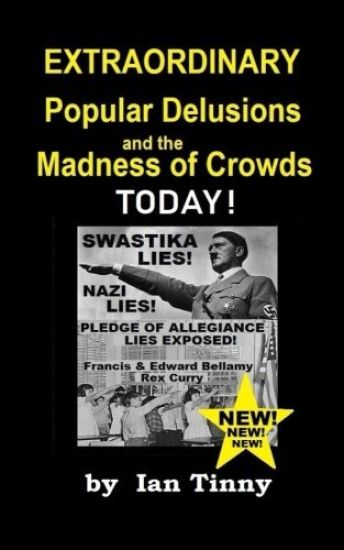
Delusions are exposed to reveal the following: The Nazi salute was performed by public officials in the USA from 1892 through 1942. What happened to old photographs and films of the American Nazi salute performed by federal, state, county, and local officials? Those photos and films are rare because people don't want to know the truth about the government's past. Public officials in the USA who preceded the German socialist (Hitler) and the Italian socialist (Mussolini) were sources for the stiff-armed salute (and robotic chanting) in those countries and other foreign countries. Explore how the "ancient Roman salute" myth originated from the city of Rome in the state of New York (not Italy), Francis Bellamy's hometown. Learn about Mussolini's strange gift to the city of Rome, NY: a statue of two human male infants suckling on a female wolf. That statue remains on display in Rome, NY. See how Boy Scouts and Girl Scouts helped spread the Nazi salute and the swastika to Germany and elsewhere. Discover how Stalin was forced to involuntarily join the allies during WWII. Learn how the word "fascist" is related to the word "faggot." Discover how the military salute was the origin of the Nazi salute. Read why the Pledge of Allegiance would not be performed by anyone today (other than kooks) if the truth were taught in school. Find out who you are, what you are, and how you got to be that way. Also learn who you should blame: your teacher (and the government's schools). Debunk myths about Adolf Hitler, Joseph Stalin, Vladimir Lenin, Mao Zedong, Francis Bellamy (and his cousin Edward Bellamy), Fascism, Unionism, Socialism, genocide, swastikas, the Pledge of Allegiance to the flag, the cliche' "under God," Christianity, modern crusades, ancient Rome, military socialism, Sovietology, crony socialism, and the military-socialism complex. "Extraordinary Popular Delusions and the Madness of Crowds Today" is long awaited. There is an inferior book from 1841 by author Charles Mackay that is outdated. Mackay's book contains noting on the 20th century, nor the 21st century, nor the last half of the 19th century. This book provides the latest information. The author Ian Tinny brings the newest delusions and madness that are here for you today So, let your freak flag fly The Pointer Institute proudly presents another news-breaking volume from Ian Tinny and the Dead Writers Club (DWC). Much of the madness is illuminated from the work of the historian Dr. Rex Curry. Tinny is a philologist and a forensic fraud analyst. Tinny's work led to the arrest, trial, conviction, and imprisonment of America's Dumbest Criminals (and the foreclosure of their homes, along with victim restitution liens, and criminal forfeiture judgments, in amounts totaling millions of dollars). Tinny collaborates with the legendary Dead Writer's Club ("DWC" -an author's group) and assists the Pointer Institute for Media Studies to provide remedial education to journalists about history, economics, and government.
This work has been selected by scholars as being culturally important, and is part of the knowledge base of civilization as we know it. This work was reproduced from the original artifact, and remains as true to the original work as possible. Therefore, you will see the original copyright references, library stamps (as most of these works have been housed in our most important libraries around the world), and other notations in the work. This work is in the public domain in the United States of America, and possibly other nations. Within the United States, you may freely copy and distribute this work, as no entity (individual or corporate) has a copyright on the body of the work. As a reproduction of a historical artifact, this work may contain missing or blurred pages, poor pictures, errant marks, etc. Scholars believe, and we concur, that this work is important enough to be preserved, reproduced, and made generally available to the public. We appreciate your support of the preservation process, and thank you for being an important part of keeping this knowledge alive and relevant.
The Origins of Culture Vol. II - Sir Edward Burnett Tylor ist ein unver nderter, hochwertiger Nachdruck der Originalausgabe aus dem Jahr 1871. Hansebooks ist Herausgeber von Literatur zu unterschiedlichen Themengebieten wie Forschung und Wissenschaft, Reisen und Expeditionen, Kochen und Ern hrung, Medizin und weiteren Genres. Der Schwerpunkt des Verlages liegt auf dem Erhalt historischer Literatur. Viele Werke historischer Schriftsteller und Wissenschaftler sind heute nur noch als Antiquit ten erh ltlich. Hansebooks verlegt diese B cher neu und tr gt damit zum Erhalt selten gewordener Literatur und historischem Wissen auch f r die Zukunft bei.
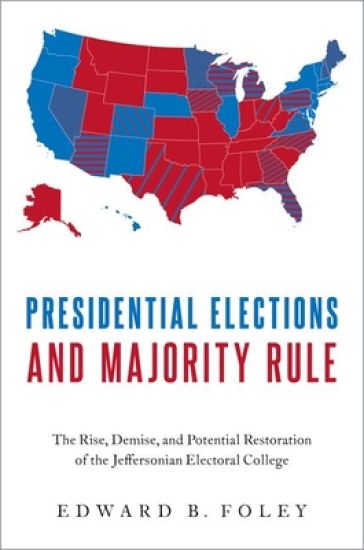
The Electoral College that governs America has been with us since 1804, when Thomas Jefferson's supporters redesigned it for his re-election. The Jeffersonians were motivated by the principle of majority rule. Gone were the days when a president would be elected by acclamation, as George Washington had been. Instead, given the emergence of intense two-party competition, the Jeffersonians wanted to make sure that the Electoral College awarded the presidency to the candidate of the majority, rather than minority, party. They also envisioned that a candidate would win by amassing a majority of Electoral College votes secured from states where the candidate's party was in the majority. For most of American history, this system has worked as intended, producing presidents who won Electoral College victories derived from state-based majorities. In the last quarter-century, however, there have been three significant aberrations from the Jeffersonian design: 1992, 2000, and 2016. In each of these years, the Electoral College victory depended on states where the winner received only a minority of votes. In this authoritative history of the American Electoral College system, Edward Foley analyzes the consequences of the unparalleled departure from the Jeffersonians' original intent and delineates what we can do about it. He explains how states, by simply changing their Electoral College procedures, could restore the original Jeffersonian commitment to majority rule. There are various ways to do this, all of which comply with the Constitution. If only a few states had done so before 2016, the outcome might have been different. Doing so before future elections can prevent another victory that, contrary to the original Jeffersonian intent, a majority of voters did not want.
This is a book about the formation, development, and success or failure of new high technology companies, focusing on those that grew under the auspices of entrepreneurs from MIT in Boston at the end of World War Two. Edward Roberts has conducted extensive empirical research on these firms for the past 25 years and has written widely on the subject. He is one of the acknowledged academic experts on entrepreneurship. This book is the culmination of his work and synthesizes his findings.
A timely look into and argument for the Jeffersonian Electoral College. The Electoral College that governs America has been with us since 1804, when Thomas Jefferson's supporters redesigned it for his re-election. The Jeffersonians were motivated by the principle of majority rule. Gone were the days when a president would be elected by acclamation, as George Washington had been. Instead, given the emergence of intense two-party competition, the Jeffersonians wanted to make sure that the Electoral College awarded the presidency to the candidate of the majority, rather than minority, party. They also envisioned that a candidate would win by amassing a majority of Electoral College votes secured from states where the candidate's party was in the majority. For most of American history, this system has worked as intended, producing presidents who won Electoral College victories derived from state-based majorities. In the last quarter-century, however, there have been three significant aberrations from the Jeffersonian design: 1992, 2000, and 2016. In each of these years, the Electoral College victory depended on states where the winner received only a minority of votes. In this authoritative history of the American Electoral College system, Edward Foley analyzes the consequences of the unparalleled departure from the Jeffersonians' original intent-and delineates what we can do about it. He explains how states, by simply changing their Electoral College procedures, could restore the original Jeffersonian commitment to majority rule. There are various ways to do this, all of which comply with the Constitution. If only a few states had done so before 2016, the outcome might have been different. Doing so before future elections can prevent another victory that, contrary to the original Jeffersonian intent, a majority of voters did not want.
The 2000 presidential race resulted in the highest-profile ballot battle in over a century. But it is far from the only American election determined by a handful of votes and marred by claims of fraud. Since the founding of the nation, violence frequently erupted as the votes were being counted, and more than a few elections produced manifestly unfair results. Despite America's claim to be the world's greatest democracy, its adherence to the basic tenets of democratic elections-the ability to count ballots accurately and fairly even when the stakes are high-has always been shaky. A rigged gubernatorial election in New York in 1792 nearly ended in calls for another revolution, and an 1899 gubernatorial race even resulted in an assassination. Though acts of violence have decreased in frequency over the past century, fairness and accuracy in ballot counting nonetheless remains a basic problem in American political life. In Ballot Battles, Edward Foley presents a sweeping history of election controversies in the United States, tracing how their evolution generated legal precedents that ultimately transformed how we determine who wins and who loses. While weaving a narrative spanning over two centuries, Foley repeatedly returns to an originating event: because the Founding Fathers despised parties and never envisioned the emergence of a party system, they wrote a constitution that did not provide clear solutions for high-stakes and highly-contested elections in which two parties could pool resources against one another. Moreover, in the American political system that actually developed, politicians are beholden to the parties which they represent - and elected officials have typically had an outsized say in determining the outcomes of extremely close elections that involve recounts. This underlying structural problem, more than anything else, explains why intense ballot battles that leave one side feeling aggrieved will continue to occur for the foreseeable future. American democracy has improved dramatically over the last two centuries. But the same cannot be said for the ways in which we determine who wins the very close races. From the founding until today, there has been little progress toward fixing the problem. Indeed, supporters of John Jay in 1792 and opponents of Lyndon Johnson in the 1948 Texas Senate race would find it easy to commiserate with Al Gore after the 2000 election. Ballot Battles is not only the first full chronicle of contested elections in the US. It also provides a powerful explanation of why the American election system has been-and remains-so ineffective at deciding the tightest races in a way that all sides will agree is fair.
Originally published in 1994, The Economics of the Tropical Timber Trade provides a detailed analysis of the economic linkages between the trade and forest degradation. Based on a report prepared for the ITTO, it looks current and future market conditions at the time of publication, and assesses the impacts on current and future market conditions, and assesses the impacts on tropical forests of both the international timber trade and domestic demand. The authors examine the causes of deforestation and compare the environmental impacts of the timber trade with other factors, such as the conversion of the forests to agriculture. Finally, they assess the national and international trade policy options, and discuss the potential role of interventions in the international timber trade in promoting efficient and sustainable use of forest resources. The book will be of interest to those concerned with forest management and policy, trade and environment, and with the economics of conversation and resource use.
Originally published in 1994, The Economics of the Tropical Timber Trade provides a detailed analysis of the economic linkages between the trade and forest degradation. Based on a report prepared for the ITTO, it looks current and future market conditions at the time of publication, and assesses the impacts on current and future market conditions, and assesses the impacts on tropical forests of both the international timber trade and domestic demand. The authors examine the causes of deforestation and compare the environmental impacts of the timber trade with other factors, such as the conversion of the forests to agriculture. Finally, they assess the national and international trade policy options, and discuss the potential role of interventions in the international timber trade in promoting efficient and sustainable use of forest resources. The book will be of interest to those concerned with forest management and policy, trade and environment, and with the economics of conversation and resource use.
The Journey Ahead At the heart of transcendental number theory lies an intriguing paradox: While essen tially all numbers are transcendental, establishing the transcendence of a particular number is a monumental task. Thus transcendental numbers are an enigmatic species of number: We know they are all around us and yet it requires enormous effort to catch one. More often than not, they slip through our fingers and dissappear back into the dense jungle of numbers. Here we will venture to tame a few of these incredible creatures. In the pages ahead we offer an approach to transcendence that not only includes the intricate analysis but also the beautiful ideas behind the technical details. The phrase "classical transcendental number theory" in the title of this book refers to the most widely known results that were obtained in the nineteenth and early twentieth centuries. The reason for this focus is threefold. Firstly, this body of work requires only the mathematical techniques and tools familiar to advanced undergraduate mathematics students, and thus this area can be appreciated by a wide range of readers. Secondly, the ideas behind modem transcendence results are almost always an elaboration of the classical arguments we will explore here. And finally, and perhaps more importantly, this early work yields the transcendence of such admired and well-known numbers as e, rr, and even 2v'2.