This is a book about the formation, development, and success or failure of new high technology companies, focusing on those that grew under the auspices of entrepreneurs from MIT in Boston at the end of World War Two. Edward Roberts has conducted extensive empirical research on these firms for the past 25 years and has written widely on the subject. He is one of the acknowledged academic experts on entrepreneurship. This book is the culmination of his work and synthesizes his findings.
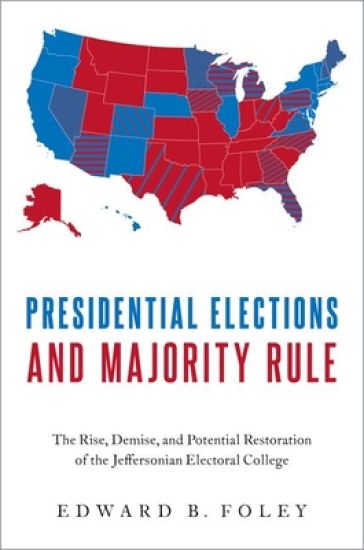
A timely look into and argument for the Jeffersonian Electoral College. The Electoral College that governs America has been with us since 1804, when Thomas Jefferson's supporters redesigned it for his re-election. The Jeffersonians were motivated by the principle of majority rule. Gone were the days when a president would be elected by acclamation, as George Washington had been. Instead, given the emergence of intense two-party competition, the Jeffersonians wanted to make sure that the Electoral College awarded the presidency to the candidate of the majority, rather than minority, party. They also envisioned that a candidate would win by amassing a majority of Electoral College votes secured from states where the candidate's party was in the majority. For most of American history, this system has worked as intended, producing presidents who won Electoral College victories derived from state-based majorities. In the last quarter-century, however, there have been three significant aberrations from the Jeffersonian design: 1992, 2000, and 2016. In each of these years, the Electoral College victory depended on states where the winner received only a minority of votes. In this authoritative history of the American Electoral College system, Edward Foley analyzes the consequences of the unparalleled departure from the Jeffersonians' original intent-and delineates what we can do about it. He explains how states, by simply changing their Electoral College procedures, could restore the original Jeffersonian commitment to majority rule. There are various ways to do this, all of which comply with the Constitution. If only a few states had done so before 2016, the outcome might have been different. Doing so before future elections can prevent another victory that, contrary to the original Jeffersonian intent, a majority of voters did not want.
The 2000 presidential race resulted in the highest-profile ballot battle in over a century. But it is far from the only American election determined by a handful of votes and marred by claims of fraud. Since the founding of the nation, violence frequently erupted as the votes were being counted, and more than a few elections produced manifestly unfair results. Despite America's claim to be the world's greatest democracy, its adherence to the basic tenets of democratic elections-the ability to count ballots accurately and fairly even when the stakes are high-has always been shaky. A rigged gubernatorial election in New York in 1792 nearly ended in calls for another revolution, and an 1899 gubernatorial race even resulted in an assassination. Though acts of violence have decreased in frequency over the past century, fairness and accuracy in ballot counting nonetheless remains a basic problem in American political life. In Ballot Battles, Edward Foley presents a sweeping history of election controversies in the United States, tracing how their evolution generated legal precedents that ultimately transformed how we determine who wins and who loses. While weaving a narrative spanning over two centuries, Foley repeatedly returns to an originating event: because the Founding Fathers despised parties and never envisioned the emergence of a party system, they wrote a constitution that did not provide clear solutions for high-stakes and highly-contested elections in which two parties could pool resources against one another. Moreover, in the American political system that actually developed, politicians are beholden to the parties which they represent - and elected officials have typically had an outsized say in determining the outcomes of extremely close elections that involve recounts. This underlying structural problem, more than anything else, explains why intense ballot battles that leave one side feeling aggrieved will continue to occur for the foreseeable future. American democracy has improved dramatically over the last two centuries. But the same cannot be said for the ways in which we determine who wins the very close races. From the founding until today, there has been little progress toward fixing the problem. Indeed, supporters of John Jay in 1792 and opponents of Lyndon Johnson in the 1948 Texas Senate race would find it easy to commiserate with Al Gore after the 2000 election. Ballot Battles is not only the first full chronicle of contested elections in the US. It also provides a powerful explanation of why the American election system has been-and remains-so ineffective at deciding the tightest races in a way that all sides will agree is fair.
Originally published in 1994, The Economics of the Tropical Timber Trade provides a detailed analysis of the economic linkages between the trade and forest degradation. Based on a report prepared for the ITTO, it looks current and future market conditions at the time of publication, and assesses the impacts on current and future market conditions, and assesses the impacts on tropical forests of both the international timber trade and domestic demand. The authors examine the causes of deforestation and compare the environmental impacts of the timber trade with other factors, such as the conversion of the forests to agriculture. Finally, they assess the national and international trade policy options, and discuss the potential role of interventions in the international timber trade in promoting efficient and sustainable use of forest resources. The book will be of interest to those concerned with forest management and policy, trade and environment, and with the economics of conversation and resource use.
Originally published in 1994, The Economics of the Tropical Timber Trade provides a detailed analysis of the economic linkages between the trade and forest degradation. Based on a report prepared for the ITTO, it looks current and future market conditions at the time of publication, and assesses the impacts on current and future market conditions, and assesses the impacts on tropical forests of both the international timber trade and domestic demand. The authors examine the causes of deforestation and compare the environmental impacts of the timber trade with other factors, such as the conversion of the forests to agriculture. Finally, they assess the national and international trade policy options, and discuss the potential role of interventions in the international timber trade in promoting efficient and sustainable use of forest resources. The book will be of interest to those concerned with forest management and policy, trade and environment, and with the economics of conversation and resource use.
Since the publication of the first edition of Integrated Product and Process Design and Development: The Product Realization Process more than a decade ago, the product realization process has undergone a number of significant changes. Reflecting these advances, this second edition presents a thorough treatment of the modern tools used in the integrated product realization process and places the product realization process in its new context.See what’s new in the Second Edition: Bio-inspired concept generation and TRIZComputing manufacturing cost, costs of ownership, and life-cycle costs of products Engineered plastics, ceramics, composites, and smart materialsRole of innovationNew manufacturing methods: in-mold assembly and layered manufacturing This book discusses how to translate customer needs into product requirements and specifications. It then provides methods to determine a product’s total costs, including cost of ownership, and covers how to generate and evaluate product concepts. The authors examine methods for turning product concepts into actual products by considering development steps such as materials and manufacturing processes selection, assembly methods, environmental aspects, reliability, and aesthetics, to name a few. They also introduce the design of experiments and the six sigma philosophy as means of attaining quality.To be globally viable, corporations need to produce innovative, visually appealing, quality products within shorter development times. Filled with checklists, guidelines, strategies, and examples, this book provides proven methods for creating competitively priced quality products.
Advanced Engineering Mathematics with Mathematica® presents advanced analytical solution methods that are used to solve boundary-value problems in engineering and integrates these methods with Mathematica® procedures. It emphasizes the Sturm–Liouville system and the generation and application of orthogonal functions, which are used by the separation of variables method to solve partial differential equations. It introduces the relevant aspects of complex variables, matrices and determinants, Fourier series and transforms, solution techniques for ordinary differential equations, the Laplace transform, and procedures to make ordinary and partial differential equations used in engineering non-dimensional. To show the diverse applications of the material, numerous and widely varied solved boundary value problems are presented.
The Journey Ahead At the heart of transcendental number theory lies an intriguing paradox: While essen tially all numbers are transcendental, establishing the transcendence of a particular number is a monumental task. Thus transcendental numbers are an enigmatic species of number: We know they are all around us and yet it requires enormous effort to catch one. More often than not, they slip through our fingers and dissappear back into the dense jungle of numbers. Here we will venture to tame a few of these incredible creatures. In the pages ahead we offer an approach to transcendence that not only includes the intricate analysis but also the beautiful ideas behind the technical details. The phrase "classical transcendental number theory" in the title of this book refers to the most widely known results that were obtained in the nineteenth and early twentieth centuries. The reason for this focus is threefold. Firstly, this body of work requires only the mathematical techniques and tools familiar to advanced undergraduate mathematics students, and thus this area can be appreciated by a wide range of readers. Secondly, the ideas behind modem transcendence results are almost always an elaboration of the classical arguments we will explore here. And finally, and perhaps more importantly, this early work yields the transcendence of such admired and well-known numbers as e, rr, and even 2v'2.
An irreverent and accessible explanation of challenging puzzles within the world of mathematics considers such topics as the link between a pineapple's spirals and the famous Fibonacci numbers, the shape of the universe as reflected by a twisted strip of paper, and the parallels between the Lincoln and Kennedy assassinations. Reprint.
This is Volume I of thirteen in a collection on Persia. Originally published in 1880, this is a translation of The Gulistan or Rose-Garden of Shekh Muslihu'D-Din Sadi Shiraz. The Gulistan of Sadi has attained a popularity in the East which, perhaps, has never been reached by any European work in this Western world. Written in the first half of the thirteen century, in Sadi's code of morals, mercy and charity are not restricted to true believers.
Global warming is an increasing problem, tropical forests are being wiped out and major upper watersheds are being degraded. Using insights provided by environmentalism, ecology and thermo-dynamics, this book – first published in 1989 – outlines an economic approach to the use of natural resources and particularly to the problem of environmental degradation. Edward Barbier reviews and critiques the long past of environmental and resource economics and then goes on to elaborate an economics which allows us to develop alternative strategies for dealing with the problems faced. With examples drawn from Latin America and Indonesia, he not only develops a major theoretical advance but shows how it can be applied. Barbier’s work is an important and relevant contribution to the discussion surrounding the economics of environmental sustainability.
Global warming is an increasing problem, tropical forests are being wiped out and major upper watersheds are being degraded. Using insights provided by environmentalism, ecology and thermo-dynamics, this book – first published in 1989 – outlines an economic approach to the use of natural resources and particularly to the problem of environmental degradation. Edward Barbier reviews and critiques the long past of environmental and resource economics and then goes on to elaborate an economics which allows us to develop alternative strategies for dealing with the problems faced. With examples drawn from Latin America and Indonesia, he not only develops a major theoretical advance but shows how it can be applied. Barbier’s work is an important and relevant contribution to the discussion surrounding the economics of environmental sustainability.
Ivory is big business, and in some parts of Africa elephants have been hunted almost to extinction in the quest for it. The losses to African economies have been catastrophic. Now there is an international ban on the trade and conservation is. the principal goal. This should be a matter for rejoicing, but nothing is quite so simple. The authors of this book have looked at the overall statistics, including those for countries where the elephant population is stable. They have considered the multiplicity of economic and social functions fulfilled by ensuring that elephant herds survive, tourism, a variety of ecological purpose. and, finally, as a source of ivory. They show how the careful management of elephants as a resource can best serve African interests. This book is at the cutting edge of economic thinking and provides a model for the consideration of the difficult relationship between people and wildlife. Originally published in 19990
This is Volume I of thirteen in a collection on Persia. Originally published in 1880, this is a translation of The Gulistan or Rose-Garden of Shekh Muslihu'D-Din Sadi Shiraz. The Gulistan of Sadi has attained a popularity in the East which, perhaps, has never been reached by any European work in this Western world. Written in the first half of the thirteen century, in Sadi's code of morals, mercy and charity are not restricted to true believers.
Mathematicians do not know in advance if their assertions are true, so they need to verify assertions with rigorous proofs or produce counterexamples, then attempt to salvage the assertions by transforming them into theorems. Extending the Frontiers of Mathematics: Inquiries into proof and argumentation invites students to experience this progression of mathematical discovery. Burger's informal, humorous writing style and intriguing puzzles engage students throughout the learning process. The innovative text offers a discovery-based approach that is ideally suited for use in a proofs course, a discrete math course, or any bridge course to more abstract mathematics.
The effective and fun-filled way to teach spelling to elementary students The Spelling Teacher's Lesson-a-Day gives teachers 180 engaging and ready-to-use lessons-one for each day of the school year-that boost spelling skills in students grades 3-6. These lessons may be used as "sponge" or "hook" activities (five-minute lessons to start off each school day) or teachers may simply pick and choose activities from within the book for the occasional spelling lesson. Fry teaches spelling patterns by contrasting homophones (like-sounding words) to help students recognize these spelling patterns in more complex words. He also boosts students' spelling skills by demystifying contractions, abbreviations, capitalization, silent letters, suffixes and prefixes, and more. Offers an easy-to-use method for teaching spelling that has been proven to be effectiveIncludes 180 ready-to-use, reproducible lessons-one for each day of the school yearA new volume in the new series 5-Minute FUNdamentals This book is designed to be used by classroom teachers, homeschoolers, tutors, and parents.
Meeting the short run challenges of reviving the worldwide economy need not mean sacrificing long run economic and environmental sustainability. A Global Green New Deal (GGND) is an economic policy strategy for ensuring a more economically and environmentally sustainable world economic recovery. Reviving growth and creating jobs should be essential objectives. But policies should also aim to reduce carbon dependency, protect ecosystems and water resources, and alleviate poverty. Otherwise, economic recovery today will do little to avoid future economic and environmental crises. Part One argues why a GGND strategy is essential to the sustainability of the global economy. Part Two provides an overview of the key national policies whilst Part Three focuses on the global actions necessary to allow national policies to work. Part Four summarizes the main recommendations for national and international action, and discusses the wider implications for restructuring the world economy towards 'greener' development.
Throughout much of history, a critical driving force behind global economic development has been the response of society to the scarcity of key natural resources. Increasing scarcity raises the cost of exploiting existing natural resources and creates incentives in all economies to innovate and conserve more of these resources. However, economies have also responded to increasing scarcity by obtaining and developing more of these resources. Since the agricultural transition over 12,000 years ago, this exploitation of new 'frontiers' has often proved to be a pivotal human response to natural resource scarcity. This book provides a fascinating account of the contribution that natural resource exploitation has made to economic development in key eras of world history. This not only fills an important gap in the literature on economic history but also shows how we can draw lessons from these past epochs for attaining sustainable economic development in the world today.
Natural Resources and Economic Development, first published in 2005, explores a key paradox: why is natural resource exploitation not yielding greater benefits to the poor economies of Africa, Asia and Latin America? Part I examines this paradox both through a historical review of resource use and development and through examining current theories which explain the under-performance of today's resource-abundant economies, and proposes a frontier expansion hypothesis as an alternative explanation. Part II develops models to analyse the key economic factors underlying land expansion and water use in developing countries. Part III explores further the 'dualism within dualism' structure of resource dependency, rural poverty and resource degradation within developing countries, and through illustrative country case-studies, proposes policy and institutional reforms necessary for successful resource-based development.