Kirjojen hintavertailu. Mukana 11 699 587 kirjaa ja 12 kauppaa.

Kirjahaku

Etsi kirjoja tekijän nimen, kirjan nimen tai ISBN:n perusteella.

1000 tulosta hakusanalla Edward Hopper; Lyons Deborah

Edward Hopper: The Eternal Instant

Edward Hopper: The Eternal Instant

Sabrina Toni

Createspace Independent Publishing Platform
2018
nidottu
In the years of the Great Depression and the New Deal in America, the master realist painter Edward Hopper (1882 - 1967) looked at everyday life in America with disenchantment and melancholy, yet searching for the existence of a meaning in it. This artist is open to the possibility of the infinite, and he looks for its signs, not in a transcendent dimension, but in the reality that surrounds him. It is a reality that doesn't consist so much of skyscrapers and Broadway lights but rather of the limited horizon of small town America. Realism, or being faithful to the real, for Hopper does not simply mean imitating what is in front of him. Rather, realism is evident, above all, in his fidelity to what his dialectic, and at times dramatic relationship with reality stirs up in him: "My aim in painting has always been to make the most exact transcription possible of my most intimate impression of nature." When representing reality Hopper concentrates his attention particularly on light. "Maybe I am not very human - all I wanted to do was to paint the sunlight on the side of a house." Here is where he recognizes the possibility of a new, deeper look at things. His painting stops the passing of time: a house, a lighthouse, a shop, or a figure, all caught in a state of fixed suspension, and immersed in this decided, dense, almost metaphysical light. This is his newness: the possibility of the infinite entering a still, everyday, reality. Hopper himself said he loved the idea of the "delicious hour" expressed by Verlaine. In other words, the moment in which life seems to stop and suddenly the infinite is revealed in it. It is on the threshold of this newness, seen through the reality of a window or shop-front, that his figures seem to stop, astonished, as if frozen in the instant of the sigh preceding the recognition of this infinite. By focusing attention on the artist's main works, this book illustrates Hopper's poetic theory by pointing out its connections with philosophy (Emerson) and poetry (Verlaine, Goethe, Frost). In addition, there will be references to the America of the Great Depression, with parallels and examples drawn from the areas of photography and cinema of that period.
Edward Hopper: Nighthawks (Foiled Journal)
Part of a series of exciting and luxurious Flame Tree Notebooks. Combining high-quality production with magnificent fine art, the covers are printed on foil in five colours, embossed then foil stamped. And they’re powerfully practical: a pocket at the back for receipts and scraps, two bookmarks and a solid magnetic side flap. These are perfect for personal use and make a dazzling gift.
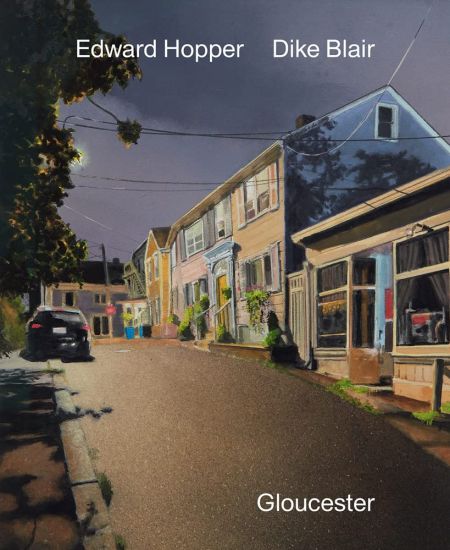
Edward Hopper & Dike Blair: Gloucester
Portraits of the picturesque Massachusetts city, painted a century apart In the late 19th and early 20th centuries, the coastal city of Gloucester, Massachusetts, long a major hub for America’s fishing industry, became a celebrated summer resort for prominent American painters and writers including Winslow Homer, Childe Hassam, Cecilia Beaux and T.S. Eliot. As a young man visiting Gloucester, Edward Hopper (1882–1967) turned away from the allure of its ragged coast line and instead created atmospheric watercolors of homes, lighthouses and street scenes in Gloucester. In this volume, art historian Robert Hobbs revisits these works from the 1920s, which he positions alongside the work of New York–based painter Dike Blair (born 1952), who, a century later, has created a new body of work centered on the small fishing city.
Edward Hopper (German edition)

Edward Hopper (German edition)

Ulf Küster

Hatje Cantz
2020
nidottu
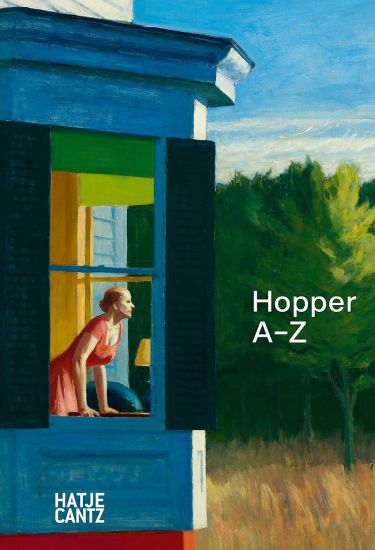
That incomparable melancholy in Edward Hopper’s pictures occasionally leads us to look at the details of his life. Where exactly did this master of loneliness live and work? What were his most important influences while he was working on his great paintings of America? In this wonderful, simply structured, A-to-Z book, Ulf Küster pursues these themes, which say a great deal about the painter and his interests, and yet he never loses sight of the artist and the necessary distance to his inimitable pictures. Thus, Küster strolls through the ABCs of Hopper’s life and work, from the “American landscape,” “Buick” “Goethe,” and “shadow and sunlight” to the key word, “time.” On the way he opens up many new doors or insights, enriching the views of Hopper’s paintings and make it possible to interpret them in new ways. An entertaining and informative book.
Edward Hopper: A to Z

Edward Hopper: A to Z

Ulf Küster

Hatje Cantz
2020
sidottu
That incomparable melancholy in Edward Hopper’s pictures occasionally leads us to look at the details of his life. Where exactly did this master of loneliness live and work? What were his most important influences while he was working on his great paintings of America? In this wonderful, simply structured, A-to-Z book, Ulf Küster pursues these themes, which say a great deal about the painter and his interests, and yet he never loses sight of the artist and the necessary distance to his inimitable pictures. Thus, Küster strolls through the ABCs of Hopper’s life and work, from the “American landscape,” “Buick” “Goethe,” and “shadow and sunlight” to the key word, “time.” On the way he opens up many new doors or insights, enriching the views of Hopper’s paintings and make it possible to interpret them in new ways. An entertaining and informative book.
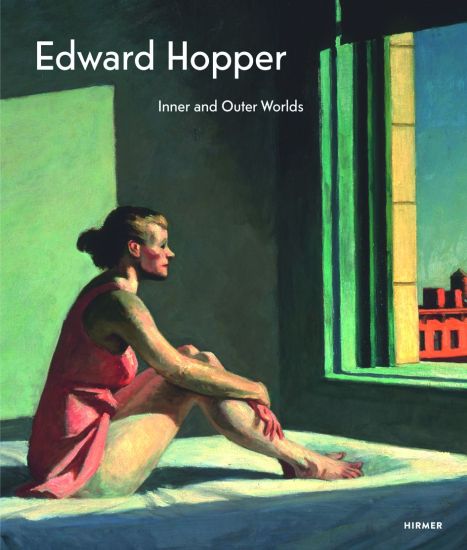
Edward Hopper: Inner and Outer Worlds
Edward Hopper is one of the bestknown American artists of the 20th century. His works are regarded as the epitome of a representation of American life. This catalogue casts a fresh look at Hopper’s oeuvre and analyses it in a dialogue with works by the old masters. This is a completely new approach, because to date works by Hopper and the old masters have never been shown together. Central to this catalogue are the points which the works of Edward Hopper (1882–1967) have in common with those of Johannes Vermeer (1632–1675). It is not only a question here of the very noticeable compositional similarities – the works of both artists frequently show interiors with figures absorbed by their activities – but also of the possibilities of interpretation which can be derived for the work of the American master.
Hopper Drawings

Hopper Drawings

Edward Hopper

Dover Publications Inc.
2003
nidottu
Edward Hopper holds an important place in twentieth-century American art. In his scenes of urban and rural life -- canvases that reveal his rare, highly focused technical accomplishment and his deep psychological penetration -- he created indelible images that often convey the loneliness of persons within their environment. Highly individual, instantly recognizable, his works are among the most esteemed in collections of American art.The Whitney Museum of American Art is the biggest repository of works by Edward Hopper. In its collection are a large number of Hopper drawings, powerful works that teach us not only about Hopper's technique and vision but also about the art of drawing itself. This book presents 44 major Hopper drawings, executed in crayon, charcoal, pencil, and other primarily monochromatic media, most of them reproduced directly from originals in the museum's collection. Some of these compelling works are studies for paintings. Many reveal familiar Hopper territory: Manhattan streets, a lighthouse on the Atlantic seacoast, the rural Northeast, and more.This inexpensive edition offers a wonderful opportunity for artists and art lovers to study the unique range and evocative power of Hopper's draftsmanship. Those mastering and refining their drawing skills will discover in these pages a rich source of inspiration and instruction.