Kirjojen hintavertailu. Mukana 12 390 323 kirjaa ja 12 kauppaa.

Kirjahaku

Etsi kirjoja tekijän nimen, kirjan nimen tai ISBN:n perusteella.

1000 tulosta hakusanalla Edward Lear

Edward Lear and the Pussycat

Edward Lear and the Pussycat

Alex Johnson

British Library Publishing
2019
nidottu
Behind every great writer there is a beloved pet, providing inspiration in life and in death, and companionship in what is often a lonely working existence. They also offer practical services, such as personal protection, although they may sometimes eat first drafts, or bite visitors. This book salutes all of the cats and dogs, ravens and budgerigars, monkeys and guinea pigs, wombats, turtles, and two laughing jackasses, who enriched the lives of their masters and mistresses, sat on their keyboards, slept in their beds, and occasionally provided the creative spark for their stories and poems. Gathered here are the tales of Beatrix Potter's rabbit, Benjamin Bouncer; Lord Byron's bear; the six cats of T S Eliot; Camus' cat, Cigarette; Arthur C Clarke's dog, Sputnik; and George Orwell's goat, Muriel. Enid Blyton's fox terrier, Bobs, `wrote' her columns in Teacher's World magazine, while John Steinbeck's poodle accompanied him on his 1960 US road trip, their exploits published as Travels with Charley. Agatha Christie dedicated her 1937 novel Dumb Witness to her favourite dog, Peter - the ultimate tribute.
Edward Lear as Victorian Modernist

Edward Lear as Victorian Modernist

Thomas Dilworth

TAYLOR FRANCIS LTD
2026
sidottu
Edward Lear as Victorian Modernist offers a bold new reading of Lear’s limericks as foundational works of literary modernism. Far from being mere nonsense for children, Lear’s picture-limericks—each a fusion of image and verse—operate as bi-modal metaphors that generate meaning through juxtaposition rather than narrative continuity. This interpretive mode, rooted in fragmentation and allusive density, aligns closely with modernist aesthetics. Drawing on Lear’s letters and unpublished diaries, this study reveals how the irritants, opinions, and idiosyncrasies of his inner life inform these deceptively playful compositions. Through close literary and visual analysis, the book uncovers a layered taxonomy of human types and social commentary, encompassing themes of individuality, society, sexuality, and more. Many of the limericks, often grotesque and unexpectedly beautiful, emerge as sophisticated works of art. The volume also explores Lear’s influence on the evolution of the limerick, particularly its later eroticization. By grounding interpretation in both biography and cultural context, this monograph repositions Lear not as an outlier but as a key figure in the genealogy of modernist expression.
Edward Lear and the Critics

Edward Lear and the Critics

Ann C. Colley

Camden House Inc
1994
sidottu
Critical response to Lear's literary, journalistic, musical and artistic output. This book is a history of how critics from the nineteenth century on have regarded Lear's extensive work. The survey includes not only what has been written in Great Britain and North America; it is also includes that which has come out of Spain, Italy, Germany, France, Greece, India and the Ukraine. In addition to offering a chronological sense of the various responses to Lear's work, the book identifies patterns of thought that run through the numerous critical reactions.
Edward Learns Guitar

Edward Learns Guitar

Cindy Walker

Createspace Independent Publishing Platform
2014
nidottu
Edward just got his very first guitar Join him in learning how to play as he gets ready for a performance. Edward will learn the names of each string on a guitar, what a strum is, and more Then the book turns into a visual guide, featuring pictures from an actual guitar. Let's play some music
Inventing Edward Lear

Inventing Edward Lear

Sara Lodge

Harvard University Press
2018
sidottu
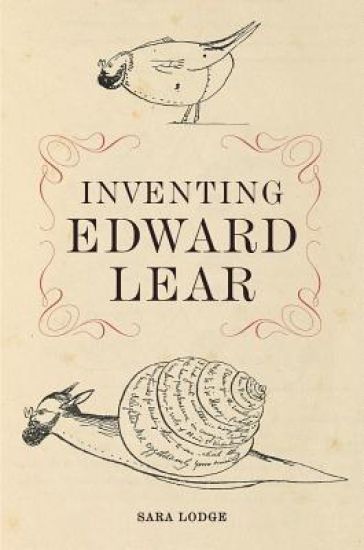
“Inventing Edward Lear is an exceptional, valuable, original study, presenting new materials on aspects of Lear’s life and work.”—Jenny Uglow, author of Mr. Lear and The Lunar MenEdward Lear wrote some of the best-loved poems in English, including “The Owl and the Pussycat,” but the father of nonsense was far more than a poet. He was a naturalist, a brilliant landscape painter, an experimental travel writer, and an accomplished composer. Sara Lodge presents the fullest account yet of Lear’s passionate engagement in the intellectual, social, and cultural life of his times.Lear had a difficult start in life. He was epileptic, asthmatic, and depressive, but even as a child a consummate performer who projected himself into others’ affections. He became, by John James Audubon’s estimate, one of the greatest ornithological artists of the age. Queen Victoria—an admirer—chose him to be her painting teacher. He popularized the limerick, set Tennyson’s verse to music, and opened fresh doors for children and adults to share fantasies of magical escape. Lodge draws on diaries, letters, and new archival sources to paint a vivid picture of Lear that explores his musical influences, his religious nonconformity, his relationship with the Pre-Raphaelite movement, and the connections between his scientific and artistic work. He invented himself as a character: awkward but funny, absurdly sympathetic. In Lodge’s hands, Lear emerges as a dynamic and irreverent polymath whose conversation continues to draw us in.Inventing Edward Lear is an original and moving account of one of the most intriguing and creative of all Victorians.
Rhythms of Feeling in Edward Lear, T. S. Eliot, and Stevie Smith
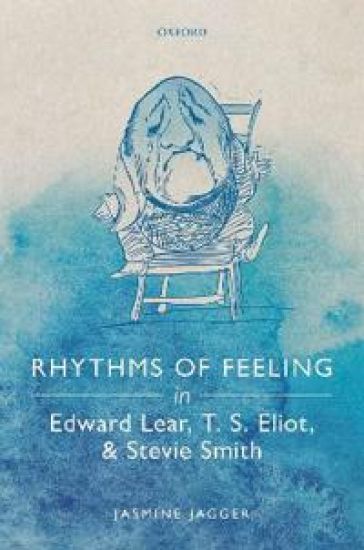
Rich with unpublished material and detailed insight, Rhythms of Feeling offers a new reading of three of the most celebrated poets: Edward Lear, T.S. Eliot, and Stevie Smith. Tracing exciting lines of interplay, affinity, and influence between these writers for the first time, the book shifts the terms of critical debate on Lear, Eliot, and Smith and subtly reorients the traditional account of the genealogies of Modernism. Going beyond a biographically-framed close reading or a more general analysis framed by affect theory, the volume traces these poets' 'affective rhythms' (fits, tears, nerves) to consider the way that poetics, the mental and physical process of writing and reading, and the ebbs and flows of their emotional weather might be in dialogue. Attentive, acute, and often forensic, the book broadens its reach to contemporary writers and medical accounts of creativity and cognition. Alongside deep critical study, this volume seeks to bring emotional intelligence to criticism, finding ways of speaking lucidly and humanely about emotional and physical states that defy lucidity and stretch our sense of the human.
The Natural History of Edward Lear, New Edition

The Natural History of Edward Lear, New Edition

Robert McCracken Peck; David Attenborough

Princeton University Press
2021
nidottu
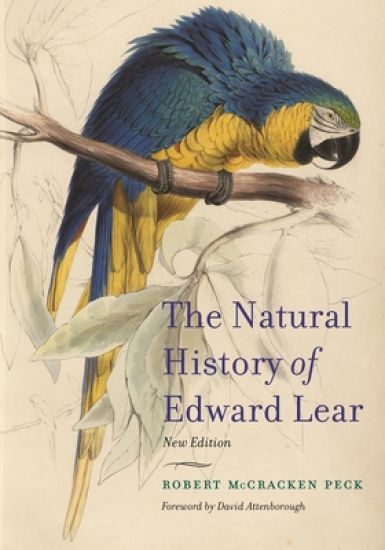
A beautifully illustrated exploration of Edward Lear's little-known career as a natural-history artist—now in a new expanded paperback editionEdward Lear (1812–1888) is best known today for his witty limericks and endearing nonsense verse. But the celebrated author of "The Owl and the Pussy-Cat" also created some of the most stunning paintings of birds and mammals during an age when many species were just being discovered and brought to private menageries and zoos throughout Europe. The Natural History of Edward Lear brings together more than 200 of Lear's strikingly beautiful illustrations of animals, plants, and landscapes. Robert McCracken Peck sheds light on Lear's astounding creativity, productivity, and success as an artist. He discusses Lear's humor, extensive travels, and important place in the history of science, and shows how Lear influenced other artists from Beatrix Potter and Maurice Sendak to James Prosek and Walton Ford.With a foreword by David Attenborough, a new chapter discussing Lear's interest in pets, and never-before-published illustrations by Lear, this new edition offers invaluable perspectives on a beloved writer who was also one of the greatest natural-history artists of all time.
Poems and Limericks of Edward Lear
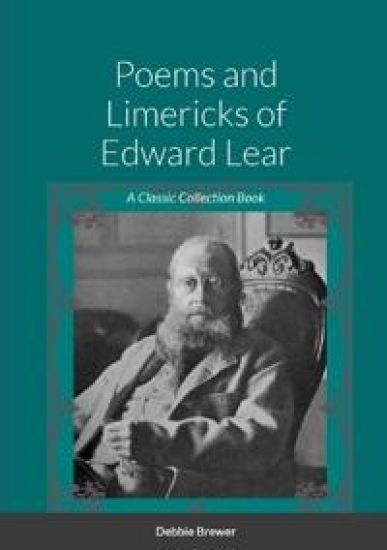
Edward Lear (1812-1888) was born in Holloway, London, and was the 20th of 21 children. His father was a stockbroker. He was raised by his sister, Ann, who was 21 years older than him and who continued to be a mother influence until her death, when Lear was 50. From childhood, Edward Lear suffered from multiple health conditions, including epilepsy, asthma and depression, and then later in life he became partially sighted. Lear had many talents. As well as his poetry, he was a respected artist and also a musician and composer. He became an ornithological draughtsman (bird artist) for the Zoological Society, and then later for the Earl of Derby. Edward was well travelled, visiting such places as Greece, Egypt, Sri Lanka and India but eventually settled in San Remo, Italy in 1870, where he stayed as his health declined until his death in 1888 from heart disease. Lear was known mostly for his literary nonsense in poetry and also his limericks, a poetic form that he popularised. His poems are a joy to read, ranging from childlike nursery fantasy (such as The Owl and the Pussy-Cat), to humorous observation and sheer nonsense. His ability to manipulate language is poetic genius and extremely satisfying to read.
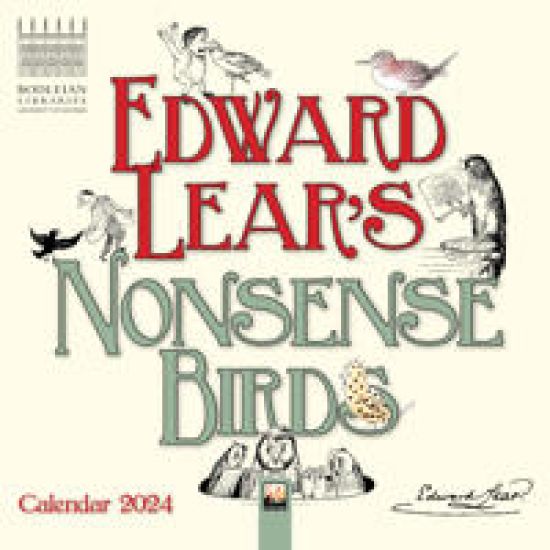
Bodleian Libraries: Edward Lear's Nonsense Birds Mini Wall Calendar 2024 (Art Calendar)
Edward Lear was a British artist, illustrator, author and poet, renowned for his literary nonsense. This calendar celebrates his wonderful illustrations with 12 nonsense birds, such as 'The Runcible Bird' and 'The Stripy Bird', from the collections at the Bodleian Libraries. Informative text accompanies each month and the date pad features previous and next month's views. Printed on FSC-certified paper, with plastic-free packaging.
The Nonsense Limericks of Edward Lear

The Nonsense Limericks of Edward Lear

Birchall Publishing

Createspace Independent Publishing Platform
2018
pokkari
Edward Lear was the nineteenth century poet and artist most associated with the poetry form known as limericks. 60 pages5" x 8" trim sizeIncludes Edward Lear's hand drawn illustrationsIncludes short bio of Edward LearAges 8 and upCheck out the Look Inside feature above to view a sampling of Edward Lear's classic limericks for kids
Letters of Edward Lear, author of "The book of nonsense," to Chichester Fortescue, Lord Carlingford, and Frances, Countess Waldegrave
This book has been considered by academicians and scholars of great significance and value to literature. This forms a part of the knowledge base for future generations. So that the book is never forgotten we have represented this book in a print format as the same form as it was originally first published. Hence any marks or annotations seen are left intentionally to preserve its true nature.
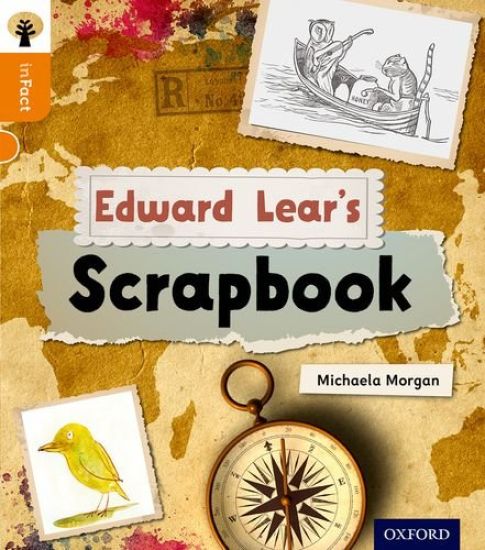
Oxford Reading Tree inFact: Level 6: Edward Lear's Scrapbook
Edward Lear's Scrapbook is a biography of the poet and artist Edward Lear. The book includes some of his original poems and pictures. Oxford Reading Tree inFact is a non-fiction series that aims to engage children in reading for pleasure as powerfully as fiction does. The variety of topics means there are books to interest every child in this compelling series. The series is written by top children's authors and subject experts. The books are carefully levelled, making it easy to match every child to the right book.